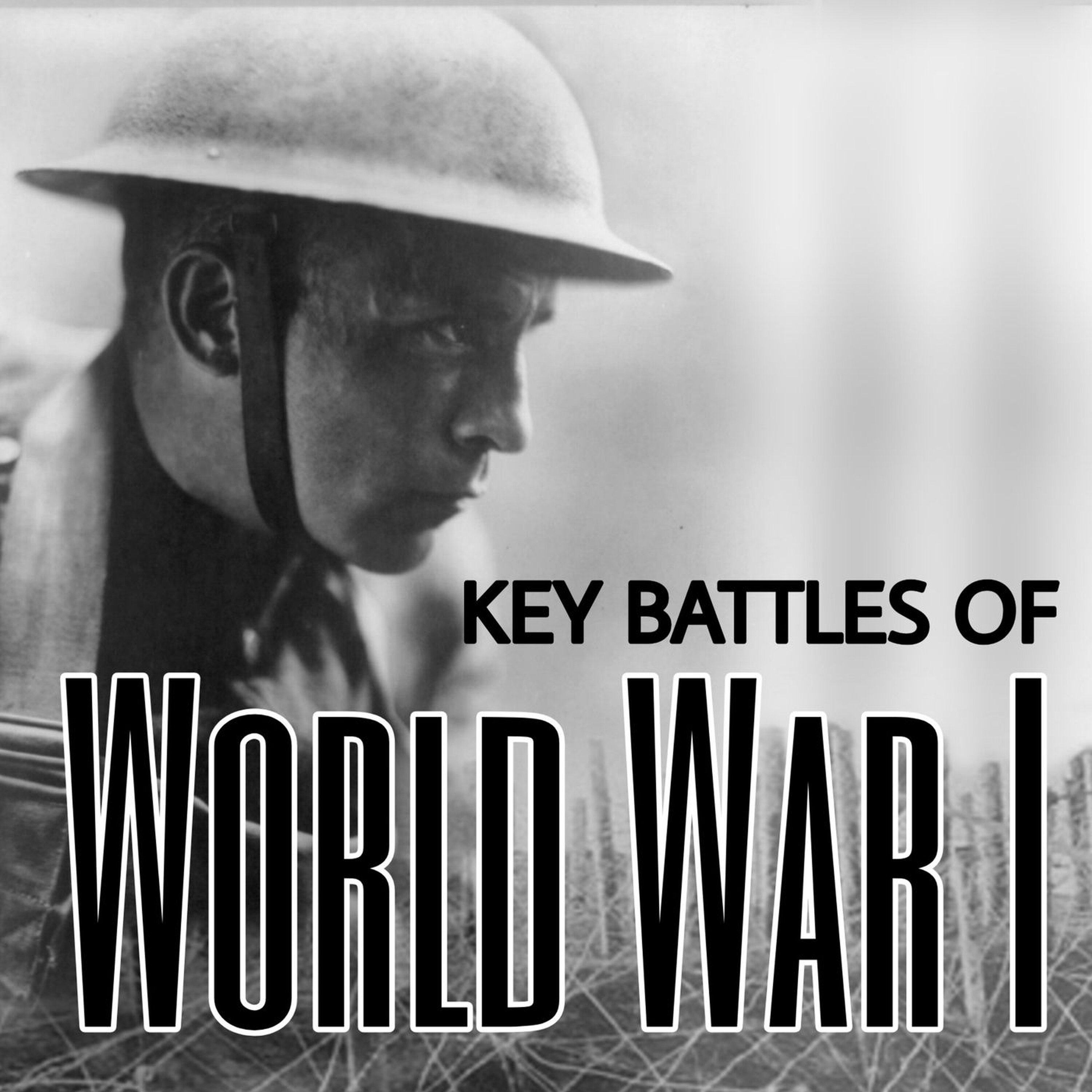
Key Battles of World War One
Key Battles of World War One
World War One is the watershed moment in modern history. The Western World before it was one of aristocrats, empires, colonies, and optimism for a future of unending progress. After four years of hellish trench warfare, shell fire, 10 million combat deaths, and another 10 million civilian deaths, the world that emerged in 1918 was irrevocably changed. Nation-states came out of the rubble, along with a push for universal rights. New technologies emerged, such as tanks and fighter planes. But something was lost permanently in the Great War: a sense of optimism in mankind. In this series, history...
No dejes de visitar la web del podcast y apoyar a su creador: www.spreaker.com
Autor
Key Battles of World War One
Categoría
Web del podcast
Último episodio
24 de sep. de 2023
¿Dónde escuchar?
Podcasts en la app Replaio Radio Muy prontoLos podcasts llegarán muy pronto a la app. Instálala ahora y sé el primero en descubrir una forma totalmente nueva de vivir los podcasts
 Instálala gratis
Android casi 10 M de descargas · valoración de 4,8
iOS muy pronto
Instálala gratis
Android casi 10 M de descargas · valoración de 4,8
iOS muy pronto
Episodios
Key Battles Of World War 1_Special Announcment - Sources Used for WW1 Series 24.09.2023 3:19
See omnystudio.com/listener for privacy information.
Introducing James Early's New Podcast "Key Battles of American History" 26.02.2021 21:24
Did you enjoy this series? Then you'll love James Early's new show "Key Battles of American History." Check it out on the podcast player of your choice or go to keybattlesofamericanhistory.com. Listen here to a snippet of his episode where he and a guest discuss the World War One movie "All Quiet on the Western Front." See omnystudio.com/listener for privacy information.
24: The Eternal Legacy of the First World War 31.12.2020 56:02
World War One was the most consequential social event in centuries. 10 million soldiers died, creating 3 million widows and 10 million orphans. Many Europeans felt disillusionment and even anger about the war. They questioned earlier notions of honor, duty, and bravery. Europe lost its economic centrality. New York replaced London as the financial capital of the world., and the US and the USSR eme...
23: The Sad Afterlives of WW1's Leaders: The Humbling (and Exiling) of Generals, Emperors, and Sultans 30.12.2020 51:45
From 1914-1918, the leaders of World War One were generals who commanded millions of men, emperors who inherited dynasties with centuries of accumulated wealth, and Sultans who claimed a direct line of connection to the Prophet Muhammed. After the war, many of them lost all their money and power and were forced into lonely exile. British Chief of Staff Henry Wilson left the army after the war and...
22: The 1919 Paris Peace Conference Laid The First Bricks of the Road to World War Two 29.12.2020 45:03
The Paris Peace Conference opened on January 18, 1919. Its task was the writing of five separate peace treaties with the defeated separate powers: Germany, Turkey, Bulgaria, Austria, and Hungary (now separate nations). The defeated Central Powers were not allowed to participate in the negotiations. The terms would be dictated to them. Russia was also not allowed to come. The world had been remade....
21: WW1 Ends with Armistice -- The Moment of Silence That Sounded Like the Voice of God 28.12.2020 51:25
After Germany's' failed spring offensive, realized the only way to win was to push into France before the United States fully deployed its resources. The French and British were barely hanging on in 1918. By 1918, French reserves of military-aged recruits were literally a state secret; there were so few of them still alive. The British, barely maintaining 62 divisions on the Western Front, planned...
20: The 1918 Battle of Meggido Shattered the Ottoman Empire and Created the Modern Middle East 27.12.2020 38:59
The Battle of Megiddo was the climactic battle of the Sinai and Palestine campaign of the First World War, with Germans and Ottomans on one side, and British and French forces on the other (with Arab nationalists led by T.E. Lawrence). The actions immediately after it were a disaster for the Ottomans. They now had permanently lost control over their Middle Eastern possessions. Historian Edward Eri...
19: The Empire Strikes Back -- Germany's Final Push to Win WW1 in Spring 1918 26.12.2020 43:36
Many thought that Germany was capable of winning World War One until the very end. Unlike World War 2, in which the Allies believed that victory was inevitable as early as 1943, this was not the case with the Great War. It is also easy to assume that German defeat was inevitable at the hands of an Allied coalition richer in manpower, weapons and money. Yet Germany nearly captured Paris in 1914, cr...
18: Tank Warfare--How Military Tech Took a Quantum Leap at the Battle of Cambrai (1917) 25.12.2020 21:47
The British developed the tank in response to the trench warfare of World War I. In 1914, a British army colonel named Ernest Swinton and William Hankey, secretary of the Committee for Imperial Defense, championed the idea of an armored vehicle with conveyor-belt-like tracks over its wheels that could break through enemy lines and traverse difficult territory. The men appealed to British navy mini...
17: The Yanks Are Coming -- America Enters World War One 24.12.2020 50:52
Most Americans are indifferent about the nation's involvement in World War One (under half say the U.S. had a responsibility to fight in the war; one-in-five say it didn't). Many figure it entered the conflict too late to claim much credit, or intervention was discreditable. Some say the U.S. had no compelling national interest to enter the Great War; worse, U.S. intervention allowed Britain and F...
16: The Slog of War -- the Passchendaele Campaign of 1917 23.12.2020 37:21
The best way to describe the Third Ypres (Passchendaele) Campaign of 1917. It’s ‘slog.’ When you think about a drudging act that seems to accomplish nothing, this battle is it. Mud. Mud to your waist. Everything sinks down several feet into mud. Tanks, Cars, guns, horses, everything stuck in mud. Images of a battlefield landscape with pockmarked holes and mist rising from the plains with shattered...
15: The Russian Revolutions of 1917-1923--A Bigger Threat Than the Kaiser? 22.12.2020 43:14
We’ve looked at many battles in this series, but we’ve only tangentially touched on how this war fundamentally altered European society. The Great War is the watershed between the pre-modern and early modern era. As an example, all we have to do is look at Russia. Before World War One, it was an autocracy, very conservative, very religious, and only a few decades away from serfdom, which the rest...
14: Why WW1 Was the Graveyard of Empires (Russian, Ottoman, Austro-Hungarian) 21.12.2020 45:13
World War One shattered the empires of Russia, the Ottomans, and the Austro-Hungarians, which had all existed in one form or another for centuries. That's because it broke the fragile alliances that kept these Empires alive. In this episode, we explore the Southern Fronts of World War One in 1916-1917. Starting with Italy, since Italy’s entry into the war, Italy and Austria had fought several batt...
13: The Battle of the Somme Caused 1 Million Casualties But Was a Turning Point for WW1 20.12.2020 46:09
The 1916 Battle of the Somme caused a total of 1 million casualties on all sides. the total is over a million casualties. The Allies had gained very little ground. At the end of the battle, they had gained only 7 miles and were still about 3 miles short of their goal from the first day of the war. The Somme, along with Verdun and the Brusilov Offensive, were among the bloodiest in world history up...
12: The Flying Aces of World War One 19.12.2020 41:31
Since the first successful flight of an airplane, people had imagined and dreamed of airplanes being used for combat. H. G. Wells's 1908 book (The War in the Air was an example. When World War One broke out, there were only about 1000 planes on all sides. Planes were very basic. Cockpits were open, instruments were rudimentary, and there were no navigational aids. Pilots had to use maps, which wer...
11: The Brusilov Offensive: Russia's Mortal Blow to Austria-Hungary 18.12.2020 29:36
See omnystudio.com/listener for privacy information.
10: WW1 At Sea: The Battle of Jutland (1916) 17.12.2020 54:34
Although overlooked today, the war at sea was a crucial part of World War I overall. The German use of the Unrestricted Submarine Warfare (in which non-military ships could be blown up by submarines without the latter surfacing, making it impossible for innocent men, women, and children to abandon ship) against commerce not only threatened the Allied war effort, but also drew the United States int...
9: Verdun - The 299-Day Battle That Killed 300K Soldiers And Still Scars The Earth With Unexploded Shells 16.12.2020 48:11
The Battle of Verdun--fought from February 21-December 18 1916 in the Western Front of France--was horrifying and hellish even by the standards of World War One. Over a 299-day-period, there were 1 million total casualties. The French were bled white, but so were the Germans. Of these, 300,000 were killed, which is about 1 death for every minute of the battle. The French most likely lost slightly...
8: How 1915 Became World War One's Year of Poison Gas, Genocide, and Millions of Refugees 15.12.2020 43:23
In 1915, the Central Powers and Allies dug in their heels and tried desperately to break the stalemate of the war, still hoping for a short conflict on the scale of a few months. Poison gas was used for the first time. Germans experimented with flamethrowers and armored shields, while the French began using hand grenades. In April, Germans began the Second Battle of Ypres and used 168 tons of chl...
7: The Battle of Gallipoli (1915) How Ataturk and the Ottomans Hurled the Allies (Including Winston Churchill) Into the Sea 14.12.2020 45:40
The Allies desperately wanted to take control of the Dardanelles (the straights connecting Constantinople with the Mediterranean). They were crucial to Russia and would make it possible for Russia to (in effect) have a warm-water port. The only problem is the Ottomans had controlled the Dardanelles for five centuries and were backed by Germany and the rest of the Central Powers. The Allies wanted...
6: World War 1 Trenches Were A Labyrinth of Rats, Disease, Decaying Flesh, and the Omnipresent Threat of Death 13.12.2020 48:05
See omnystudio.com/listener for privacy information.
5: The Average WW1 Soldier Was a 110-Pound Villager Who Suffered Disease, Hunger, and PTSD 12.12.2020 49:05
See omnystudio.com/listener for privacy information.
4: Germany's Plans For Total French Defeat in 1914 Failed at the Battle of the Marne 11.12.2020 59:32
The beginning of World War One was marked the breakdown of the western powers’ war plans. Leaders on both sides experienced surprises, shocks, and the failure of plans. The first few months saw shocking violence on a scale never experienced before, at least not in Western Europe. During the first few months of the war, an average of 15,000 lives were lost each day. (five times as much as the worst...
3: Germany So Completely Annihilated Russia At the WW1 Battle of Tannenberg That A Russian General Committed Suicide 10.12.2020 50:18
The Battle of Tannenberg was the first major battle of World War One, fought between Germany and Russia, who surprised everyone with its fast mobilization. This muddled the plans of Germany, which sought to quickly fight a two-front war against France and Russia, knock France out of the war, then focus its resources on Russia. The plan didn't work, but Germany issued a crushing blow against Russia...
2: Europe's Pre-WW1 Alliances Were a Doomsday Machine That Pulled the Entire Continent Into War 09.12.2020 48:31
An impossibly complex web of alliances that maintained a fragile peace in Europe (and surprisingly held it together since the end of the Napoleonic Wars in 1815) always threatened to unravel. The 1914 assassination of Archduke Franz Ferdinand, the heir to the Austrian throne, by Serbian nationalists, made Austria declare war on Serbia. A doomsday machine kicked into gear: Russia mobilized against...
Podcasts similares






Escucha el podcast Key Battles of World War One en Replaio
Radio y podcasts en una sola app - gratis y sin registro. Instálala hoy y no te pierdas el estreno
Replaio no es editor de podcasts; los nombres de los programas, las portadas y el audio pertenecen a sus autores y se distribuyen a través de canales RSS públicos