Kimberly Hollins
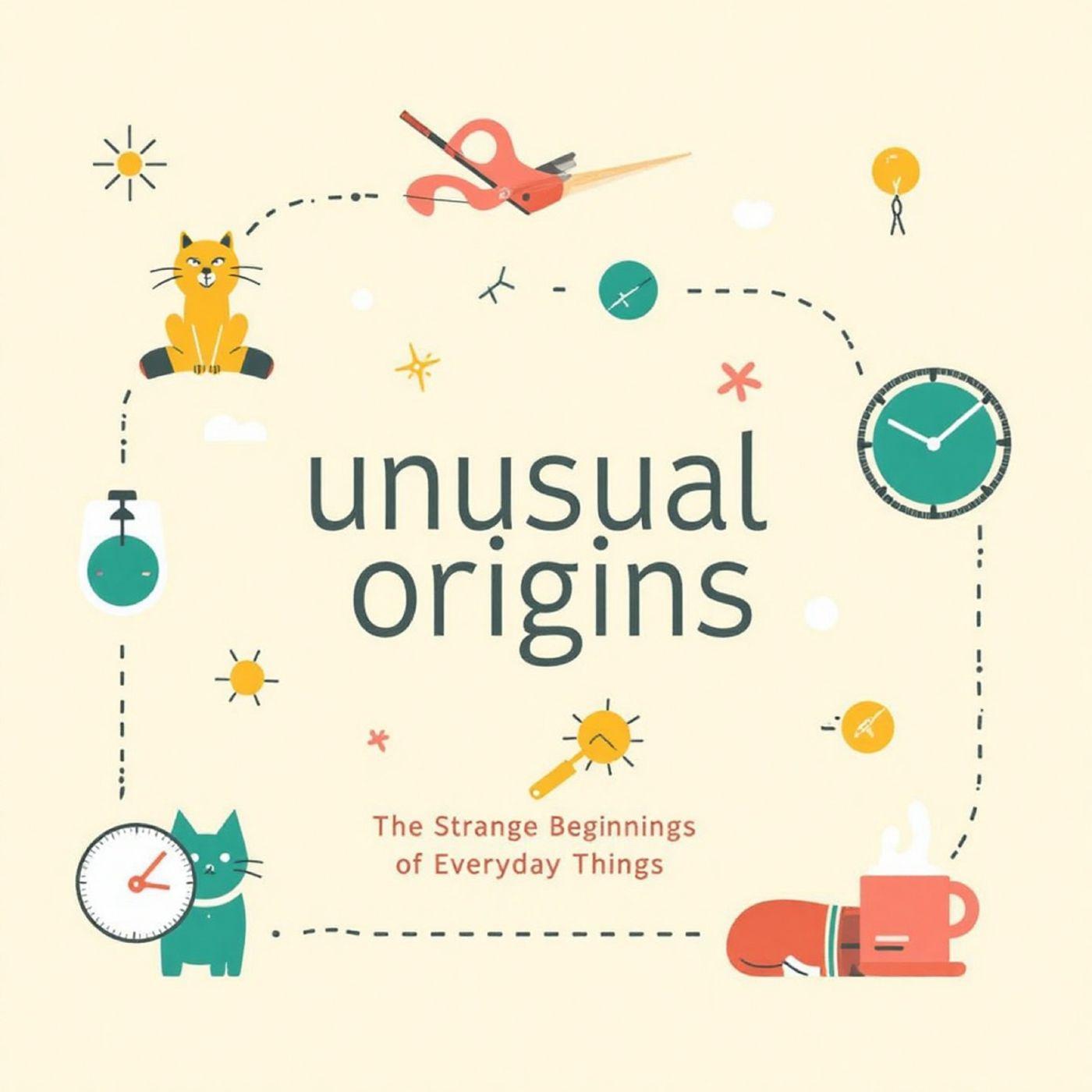
Unusual Origins – The Strange Beginnings
Have you ever wondered why things are the way they are? Why do scissors have two loops? Why does a cat say “meow” instead of “woof”? Why do we shake hands to greet people, or why are pencils yellow? Unusual Origins takes you on a journey through the odd, surprising, and often hilarious backstories behind the objects, words, habits, and ideas we take for granted. Each short episode—light, curious, and easy to listen to—dives into one everyday item or concept, uncovering its strange evolution through culture, history, and human creativity. You’ll never look at ordinary things the same way again....
Be sure to visit the podcast's website and support the creator: podcast.show
Where to listen?
Podcasts in the app Replaio Radio Coming soonPodcasts are coming to the app soon. Install now and be the first to see a whole new take on podcasts
 Install for free
Android almost 10M downloads · 4.8 rating
iOS soon
Install for free
Android almost 10M downloads · 4.8 rating
iOS soon
Episodes
Why We Make Wishes on Stars 22.10.2026 8:18
This episode explores why people began making wishes on shooting stars. In ancient cultures, unusual events in the sky were often seen as signs from gods or supernatural forces. Because a shooting star appeared suddenly and disappeared quickly, it could feel like a rare moment when the heavens were paying attention. Over time, stars became symbols of hope, guidance, and possibility. Folklore added...
Why We Blow Out Candles 15.10.2026 8:41
This episode explores how blowing out birthday candles developed from older traditions surrounding fire, prayer, wishes, and the symbolic meaning of light. Ancient cultures often treated flames as powerful symbols, while later European birthday customs helped connect candles specifically with age and personal celebration. The tradition became especially recognizable through children’s birthday cel...
Why We Celebrate Birthdays 08.10.2026 8:57
This episode explores how birthdays evolved from ancient calendar traditions, religious ceremonies, and celebrations once reserved mainly for rulers, gods, or people of status. As record keeping improved, ordinary people became more able to track the exact date of birth and recognize its yearly return. Over time, traditions such as cakes, candles, wishes, gifts, cards, and songs helped turn aging...
Why Plastic Wrap Sticks to Things 01.10.2026 8:35
This episode explains why plastic wrap clings to bowls, plates, food, and even itself without using ordinary glue. Its extreme thinness and flexibility allow it to press closely against smooth surfaces, where weak molecular attractions known as van der Waals forces can act across a large contact area. Static electricity can also contribute, especially when the film is pulled from the roll and fric...
Why Paper Cuts Hurt So Much 24.09.2026 8:23
This episode explains why such a tiny injury can cause surprisingly intense pain. Paper cuts usually occur on highly sensitive areas like the fingertips, where many nerve endings sit close to the skin’s surface. Because the cut is shallow, those nerves are irritated rather than destroyed, allowing them to keep sending strong pain signals. Paper also has a rough microscopic edge made from compresse...
Why Lids Screw Clockwise 17.09.2026 8:19
This episode explains why most lids tighten clockwise and loosen counterclockwise. The direction comes from the long history of screw threads, where right-hand threads gradually became the standard because they were familiar, practical, and easy to standardize across tools and machinery. As screw-top bottles and jars became common, manufacturers adopted the same convention. Turning a lid clockwise...
Why Umbrellas Are Round 10.09.2026 9:23
This episode explains that umbrellas are round because their structure spreads outward from a single central shaft. Equal-length ribs arranged around that center naturally create a circular or polygonal canopy, making the umbrella balanced, simple to build, and easy to fold. The rounded shape also provides even protection from rain coming from different directions, allows water to drain efficientl...
Why Zippers Interlock 03.09.2026 9:26
This episode explains how zippers use carefully shaped teeth and a slider to create a fast, secure closure. The teeth do not simply press together; their shapes fit into one another, while the slider guides each pair into alignment and locks them sequentially. The modern zipper evolved from nineteenth-century mechanical fasteners and was greatly improved by Gideon Sundback in the early twentieth c...
Why Mirrors Reverse Left and Right 26.08.2026 12:44
This episode reveals that mirrors do not actually reverse left and right. Instead, they reverse the direction perpendicular to their surface—what we experience as front and back. The illusion happens because our brains compare the reflection to another person who has turned around to face us, mentally creating a left-right swap. The episode explains how reflected writing, selfies, and asymmetric f...
Why Bottles Narrow at the Neck 20.08.2026 12:58
This episode explains why bottles usually have a wide body and a narrow neck. The wide lower section provides storage capacity, while the smaller opening improves control by reducing spills, guiding the flow, and making liquids easier to pour or drink. A narrow neck also makes bottles easier to seal with corks, caps, plugs, or valves. It can reduce evaporation, limit contamination, provide a conve...
Why Doors Open Inward or Outward 13.08.2026 12:31
This episode explores why doors swing in different directions and how that choice is shaped by safety, architecture, climate, privacy, and security. In many homes, exterior doors open inward because they keep hinges protected, avoid pushing into visitors, and remain usable when snow piles up outside. Public buildings often use outward-opening exit doors because crowds can push through them more sa...
Why Keyboards Aren’t Alphabetical – The Story of QWERTY 06.08.2026 12:55
This episode explores why modern keyboards use the seemingly random QWERTY arrangement instead of alphabetical order. The layout developed during the nineteenth century alongside early mechanical typewriters, whose metal typebars could collide or jam when certain letters were pressed rapidly. QWERTY was gradually shaped through experimentation, mechanical limitations, and feedback from early users...
Why Pencils Are Hexagonal 29.07.2026 11:08
This episode explains that pencils became hexagonal because six sides offer a practical balance between comfort, stability, and manufacturing efficiency. Unlike round pencils, hexagonal pencils are less likely to roll off desks, while their corners are still gentle enough to hold comfortably for long periods. The shape also suits traditional pencil production. Wooden pencils are cut from flat slat...
Why Loading Icons Spin 22.07.2026 9:07
This episode explains that loading icons spin because digital processes are invisible and users need reassurance that a machine is still working. A rotating symbol confirms that a command has been received, reduces uncertainty, and prevents people from repeatedly pressing the same button. Circular motion is especially effective because it has no clear beginning or end, allowing the animation to co...
Why Emojis Became Yellow Faces 15.07.2026 11:59
This episode explains that yellow became the default color of emoji faces because it is bright, highly visible, playful, and clearly symbolic rather than realistic. Early digital communication lacked facial expressions and tone, so emoticons and later emojis were created to restore emotional meaning to text. The yellow face was strongly influenced by the classic twentieth-century smiley symbol. It...
Why Maps Put North at the Top 09.07.2026 9:48
This episode explains that placing north at the top of maps is not a natural rule but a historical convention. In the ancient world, maps were oriented in many different ways. Some civilizations placed east at the top because of the rising sun and religious beliefs, while others, including traditional Chinese and some Islamic mapmakers, often placed south at the top to reflect their own cultural a...
Why Checkmarks Mean Correct 02.07.2026 9:25
This episode explores how the checkmark became one of the world's most recognizable symbols for correctness and completion. Originally, it was likely used by scribes, editors, and accountants as a quick handwritten mark to indicate that something had been reviewed, verified, or approved. Over time, the symbol evolved from meaning “checked” to meaning “correct.” As schools expanded, teachers adopte...
Why Arrows Mean Direction Everywhere 25.06.2026 9:48
This episode explains why the arrow has become one of the world's most universal symbols for direction. Originally, arrows were practical tools for hunting, and their pointed shape naturally indicated the direction of movement. Over thousands of years, the human brain learned to associate a pointed tip with motion and destination, making the arrow an intuitive visual guide. As societies grew and t...
Why Books Open the Way They Do 19.06.2026 8:11
This episode explores why books open in a specific direction and how that design evolved from ancient writing traditions. Before books existed, information was stored on scrolls. As texts became longer, scrolls became inconvenient, leading to the development of the codex—the ancestor of the modern book, made of pages bound along one edge. The direction a book opens is closely connected to the dire...
Why Paper Is Rectangular 12.06.2026 8:39
This episode explores why paper is almost always rectangular. The shape originated from practical needs in early writing materials such as papyrus, parchment, and later paper, where straight edges made materials easier to produce, cut, and use efficiently. Rectangles maximize usable space while minimizing waste, making them ideal for large-scale production. The rectangular shape also works well wi...
Why Text Is Left to Right 04.06.2026 7:15
This episode explores why many modern languages, including English, are written from left to right. In the ancient world, writing directions were far less standardized. Some scripts were written left to right, others right to left, vertically, or even in alternating directions from one line to the next. The direction of writing was often influenced by practical factors such as writing tools, surfa...
Why Power Symbols Look Like a Broken Circle 29.05.2026 7:48
This episode explains that the modern power symbol originated from the binary numbers used in electrical engineering. In binary notation, 1 represents an active or “on” state, while 0 represents an inactive or “off” state. Early electronic devices often labeled switches with these symbols directly. As technology evolved, designers needed a single icon that could represent both turning a device on...
Why Play Buttons Are Triangles 21.05.2026 7:19
This episode explains that the play button became a triangle because the shape naturally suggests forward movement and direction. In early media devices like tape players and film projectors, designers needed simple symbols that could communicate actions across languages. A right-pointing triangle visually matched the idea of media moving forward through time. The triangle was also effective becau...
Why Silence Feels Loud at Night 15.05.2026 7:51
This episode explains that nighttime silence feels intense because the brain becomes more sensitive to sound in darkness and quiet environments. During the day, background noise and visual activity constantly compete for attention, causing the brain to filter out many small sounds. At night, when external noise decreases and vision becomes less reliable, the brain shifts more attention toward hear...
Why We Say ‘Hmm’ When Thinking 08.05.2026 6:15
This episode explains that the sound “hmm” is not just a habit, but a natural bridge between thinking and speaking. When the brain needs time to process a question, it uses this simple sound to fill silence, signaling that attention is active and an answer is forming. “Hm” is easy to produce and does not interrupt thinking, allowing the brain to continue searching for ideas while maintaining commu...
Similar podcasts





Listen to the Unusual Origins – The Strange Beginnings podcast in Replaio
Radio and podcasts in one app - free, with no sign-up. Install today and do not miss the launch
Replaio is not a podcast publisher; show names, artwork and audio belong to their authors and are distributed through public RSS feeds.