I & A Publishing
Talks by Zen Roshi, Lola McDowell Lee
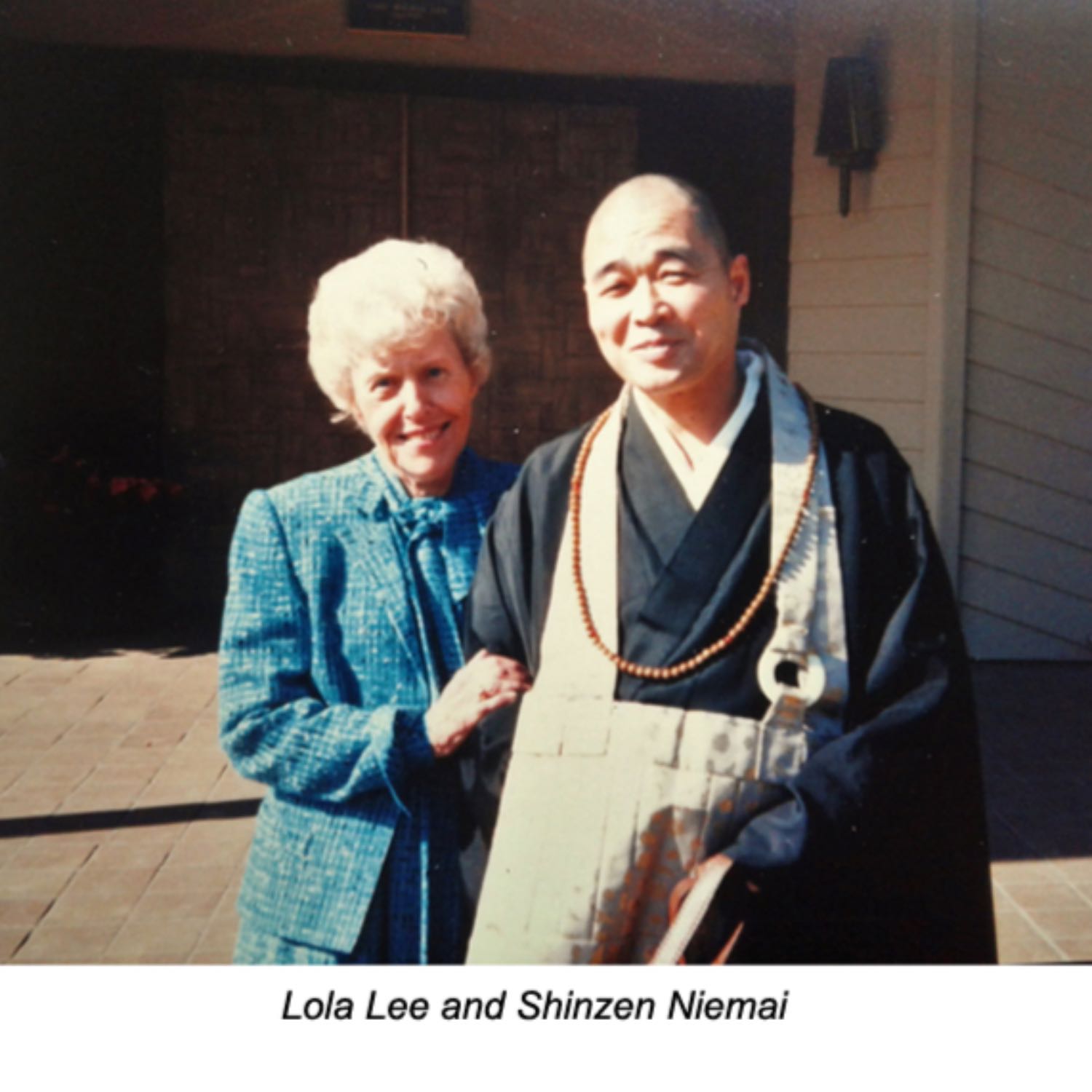
This is a series of newly digitized talks by spiritual teacher, Lola McDowell Lee, spanning two decades—from the early Seventies through the Nineties. Lola was a Zen Roshi whose Rinzai lineage included Doctor Henry Platov and renowned Zen master, Shigetsu Sasaki. Lola was a religious scholar as well as an ordained Christian minister. While the talks are focused mainly on Zen and Buddhism, Lola drew on many spiritual traditions—including those of Jesus, Plato, Lao-Tzu, the Hindu Vedas, Meister Eckhart and Gurdjieff. If you find Lola’s talks valuable, more will be posted in days to come. RSSVERI...
Where to listen?
Podcasts in the app Replaio Radio Coming soonPodcasts are coming to the app soon. Install now and be the first to see a whole new take on podcasts
 Install for free
Android 5M+ downloads · 4.8 rating
iOS soon
Install for free
Android 5M+ downloads · 4.8 rating
iOS soon
Episodes
How do you answer: “Does God exist?” Sep 20, 1987 24.08.2025 59:35
Zen Roshi, Lola McDowell Lee, (who is also an ordained Christian minister) explores issues that are common to both Christian and Eastern thought to illustrate the difference between theology/philosophy and religious practice. She explains that it is easier to join a religious group and hang around it than it is to truly struggle with oneself. There are many who participate in religions just so the...
A detailed introductory talk about the Bauls — a religious sect of India—and the mystery of consciousness. Sep 13, 1987 10.08.2025 59:31
Note: Unfortunately these talks about the Bauls were posted out of order. But the sound quality is much better on this one, which is also the most detailed in its explanation of who the Bauls were. And this talk develops into a wonderful, rich discussion of consciousness. Lola says that not many people have heard of the Bauls because they had no organization or dogma or scripture. They were freewh...
The Bauls religious sect of India. And Prakrit and Parusha. Oct 18, 1987 04.08.2025 41:44
Note: this talk has some sound issues, but I found it valuable enough to include the bulk of it anyway. It’s about 8 minutes shorter because the cassette player apparently started warbling and slowing down badly at the end—during the discussion of Prakrit and Parusha . There is another talk on this subject available here if you are interested. It’s a fascinating doctrine. Zen Roshi, Lola McDowell...
Zen and the meaning of Easter. Apr 19, 1987 28.07.2025 1:00:00
Zen Roshi, Lola McDowell Lee, gives a talk themed on Easter. (While Lola was primarily a Zen teacher, she was also an ordained Christian minister). Lola reads from the Gospels exploring the meaning of Jesus asking, “Why have you forsaken me?” Symbols of Easter include a baby chick, pecking its way out of an egg to become that which he was destined to be. That is also a good metaphor for the human...
Guilt and rejection of life does not make you more enlightened. Lola May , 1987 23.07.2025 1:00:00
Zen Roshi, Lola McDowell Lee, explores the meaning of Verse 15 of the Isha Upanishad: "The face of Truth is covered with a brilliant golden lid; that do thou remove, O Fosterer, for the law of the Truth, for sight." Lola discusses the prevalence of guilt in Puritanical America. How some of us feel guilt our entire lives, and how many, sometimes because of religious traditions, feel they shouldn’t...
What we can learn from Indian religious traditions. May 10, 1987 07.07.2025 59:20
Zen Roshi, Lola McDowell Lee, gives a detailed discussion of the philosophical and historical backgrounds of religious traditions as they developed in India—Vedas, Brahmanism and Hinduism. Lola explains the meaning of many of the Hindu terms and explores the Isha Upanishad. Shakti, the Great Mother or feminine energy of the universe. We all have in us a power. That is shake. Hindu Tantra versus Bu...
How to meditate. And why. Nov 29, 1987 28.06.2025 53:02
(Note: original recording audio is not ideal, but Lola's message is great) Zen Roshi, Lola McDowell Lee, gives an ind-depth explanation of the practice of sitting, as this talk is during a sesshin at the temple. Who is the Buddha? What is birth and death? Zazen is learning about life by dying to one’s self. Be quietly alert, dropping the ego and identifications. Our mistake is taking the phenomena...
The unconscious is the gateway to reality. July 18, 1981 20.06.2025 1:01:01
Zen Roshi, Lola McDowell Lee, discusses the meaning of the Zen saying, “Joy in the morning. Sleep at night. What else?” When we “do not know,” then we don’t concern ourselves with obsessions about outcomes. That is the meaning of “no mind.” Start by discovering what “no mind” is not. Is there a gradual acquisition of “no mind?” Is there an enduring entity called self? Is there a self to improve? D...
Why “What is the purpose of life?” is the wrong question. June 28, 1981 02.06.2025 56:00
Zen Roshi, Lola McDowell Lee, discusses Chapter 10 from the Tao Te Ching (Paul Carus translation) "What can be done? "Who by unending discipline of the senses embraces unity cannot be disintegrated. By concentrating his vitality and inducing tenderness he can become like a little child. By purifying, by cleansing and profound intuition he can be free from faults. "Who loves the people when adminis...
The role of patience in Zen practice. July 5, 1981 28.05.2025 53:02
Zen Roshi, Lola McDowell Lee, explores the notion of patience in practice. And time. For nearly twenty years, Hon, a layman, studied under Master Egon. Several of the students went out to the edge of the district and Hon looked up at the falling snow and said, “Snowflakes as nice as these do not fall elsewhere.” We are all in such a hurry. But time is a state of mind—full of anxiety about the futu...
Further exploration of the Mystica Theoligica. Dec 11, 1988 18.05.2025 53:53
Zen Roshi, Lola McDowell Lee, further explores the Mystica Theoligica . NOTE: LOLA HAS A BAD COLD TODAY AND A PERSISTENT COUGH. If that bothers you, please skip. But the content of the talk is worth the discomfort, in my opinion. Religious life is like a sculpture… best to take away from life that which is not Him rather than ascribe characteristics to Him. Most of our thoughts and emotions are un...
The meaning of the the Mystica Theoligica. Dec 4, 1988 10.05.2025 1:00:19
Zen Roshi, Lola McDowell Lee, explores the meaning of the opening of the Mystica Theoligica . “Thou Trinity beyond Being, direct us to the heights of mystical revelation, sublime beyond all thought and light, wherein the simple, absolute and immutable mysteries of Divine Truth are hidden in the translucent darkness of that silence which revealeth in secret. For this darkness, though of deepest obs...
Watch how you make your choices. Otherwise, how can you ever change? Nov 6, 1988 05.05.2025 57:06
Zen Roshi, Lola McDowell Lee, recounts the tale of the Persian teacher who asked a disciple to place a bag of gold in the middle of a bridge. He is to find a poor man to cross the bridge. The man successfully crossed the bridge where there is a bag of gold which he desperately needs. But he missed the gold. He had been too afraid to open his eyes and never saw it. Our problem is we think know our...
How often do we think that we—as individuals—are going to be enlightened? Oct 30, 1988 28.04.2025 48:01
Zen Roshi, Lola McDowell Lee, shares the tale of a student who asked his teacher why, after he had fasted and prayed for 30 years that he had still not found God. The teacher’s response: “You could sit for 100 years and it wouldn’t do any good. Selfishness is your barrier.” Lola recounts a long letter to a Roshi where the practitioner listed all his thoughts about spirituality and the universe. Th...
Meditate for one hour daily, and truly concentrate, and you can merge with the Ku. July 31, 1988 21.04.2025 1:00:08
Zen Roshi, Lola McDowell Lee, continues her examination of Lao Tsu’s Tao Te Ching, now in Chapter 17. "The great rulers - the people do not notice their existence; The lesser ones - they attach to and praise them; The still lesser ones - they fear them; The still lesser ones - they despise them; For where faith is lacking, It cannot be met by faith. Now how much importance must be attached to word...
The One-finger Zen of 9th Century Chinese Master Gutei. Jul 10, 1988 13.04.2025 56:15
Zen Roshi, Lola McDowell Lee, goes into considerable detail early and late in the talk about meditation to help prepare students for a sesshin. Lola talks about how the subject and object become one. One sitting. Master Gutei and his One-finger Zen. Lola discusses various teachings involving the monastery’s Tenzo, or cook. And why this is a very advanced position within the system. She recounts th...
To meditate no action is required—simply a shift in consciousness. Exploring the Tao Te Ching, Chapter 16. Jul 3, 1988 06.04.2025 52:13
Zen Roshi, Lola McDowell Lee, continues a discussion of Lao Tsu’s Tao Te Ching. Today, Chapter 16 (Suzuki translation) By attaining the height of abstraction we gain fulness of rest. All the ten thousand things arise And I see them return. Now they bloom in bloom But each one homeward returneth to its root. Returning to the root means rest. It signifies the return according to destiny. Return acco...
How do we cross an icy stream? Exploring the Tao Te Ching, Chapter 15. May 28, 1988 02.04.2025 1:00:30
Zen Roshi, Lola McDowell Lee, continues her exploration of the Tao Te Ching. Today, Chapter 15: The ancient masters were subtle, mysterious, profound, responsive. The depth of their knowledge is unfathomable. Because it is unfathomable, All we can do is describe their appearance. Watchful, like men crossing a winter stream. Alert, like men aware of danger. Courteous, like visiting guests. Yielding...
A detailed exploration of Chapter 14 of Lao Tzu’s Tao Te Ching, “Praising The Mysterious.” May 8, 1988 28.03.2025 54:31
Zen Roshi, Lola McDowell Lee, provides a detailed exploration of Chapter 14 of Lao Tzu’s Tao Te Ching, “Praising The Mysterious.” In it Lao Tzu calls Reason the form of the formless. Reason’s clue. But if we can’t touch it or see it, how are we to understand it? Don’t to endow it with qualities. Don’t describe it. It may appear bright, but it is simply reflecting our brightness. But that is only w...
Lao Tzu on two fundamental types of meditation. May 1, 1988 23.03.2025 51:42
Zen Roshi, Lola McDowell Lee, gives a detailed explanation of Lao Tzu’s notion that there are two basic types of meditation one should practice. One of emptiness only, and one of concentration. Sitting with pure, empty mind: The first he described as meditating without desire. Chuang-Tzu called it “just sitting and forgetting” meditation. During this practice, we empty the mind of all impediments...
More Bible parables that can help you practice Zen. Dec 12, 1984 14.03.2025 57:58
Zen Roshi, Lola McDowell Lee, who is also an ordained Christian minister, continues her exploration of Christian parables and how they might apply for Zen practitioners. Jesus spoke, in the book of Luke 5:36-39: “And no man putteth new wine into old bottles; else the new wine will burst the bottles, and be spilled, and the bottles shall perish. But new wine must be put into new bottles; and both a...
Bible parables that can help you practice Zen. Dec 9, 1984 02.03.2025 1:02:27
Zen Roshi, Lola McDowell Lee, who is also an ordained Christian minister, discusses parables from the Bible and how they can help Zen practitioners. Understanding Jesus’ parables is like puzzling with Zen koans. We reach a point with the puzzles and allows them, like a diamond cutter, to work on us. And eventually, in a new state, we begin to understand. We are free. Yet we have no freedom. It’s a...
Zen is not a belief system. Zen disturbs the dreaming mind. Nov 12, 1984 25.02.2025 51:05
Zen Roshi, Lola McDowell Lee, explains that enlightenment is not a goal. “A goal is like the horizon. You can never reach it.” The immediate is the ultimate. You have to be aware and wake up to this moment. This moment is eternity. Human beings do a lot of unconscious abstracting. Lola explains. The teacher asks, “Do I have a staff or do I not have a staff?” The monk tries to answer in different w...
When you learn to accept that you are alone, truly alone, it builds a great strength. Nov 5 1984 21.02.2025 51:02
Zen Roshi, Lola McDowell Lee, explains that when you sit properly in meditation, your world is gone. You are alone. Absolutely alone. And when you learn to accept this alone , it builds a great strength. Find that alone—and accept it. She asks: you know all about your history, your friends, your work… but do you know you? Without that light within you—that forgotten light—there would be no you. It...
Who are you really? Your name is not you. Your photo is not you. Who are you? Oct 28, 1984 10.02.2025 49:49
Zen Roshi, Lola McDowell Lee, asks how someone like Hitler could come to power. He was loud, and brash, and gave a secure feeling of strength to those who were insecure. Lola recounts the tale of the Turkish teacher who travels to foreign lands and gathers quite a following. Until some Turks happen onto him and hear the nonsense he speaks. This, she says, is often how we talk to ourselves. We can...
Similar podcasts







Listen to the Talks by Zen Roshi, Lola McDowell Lee podcast in Replaio
Radio and podcasts in one app - free, with no sign-up. Install today and do not miss the launch
Replaio is not a podcast publisher; show names, artwork and audio belong to their authors and are distributed through public RSS feeds.