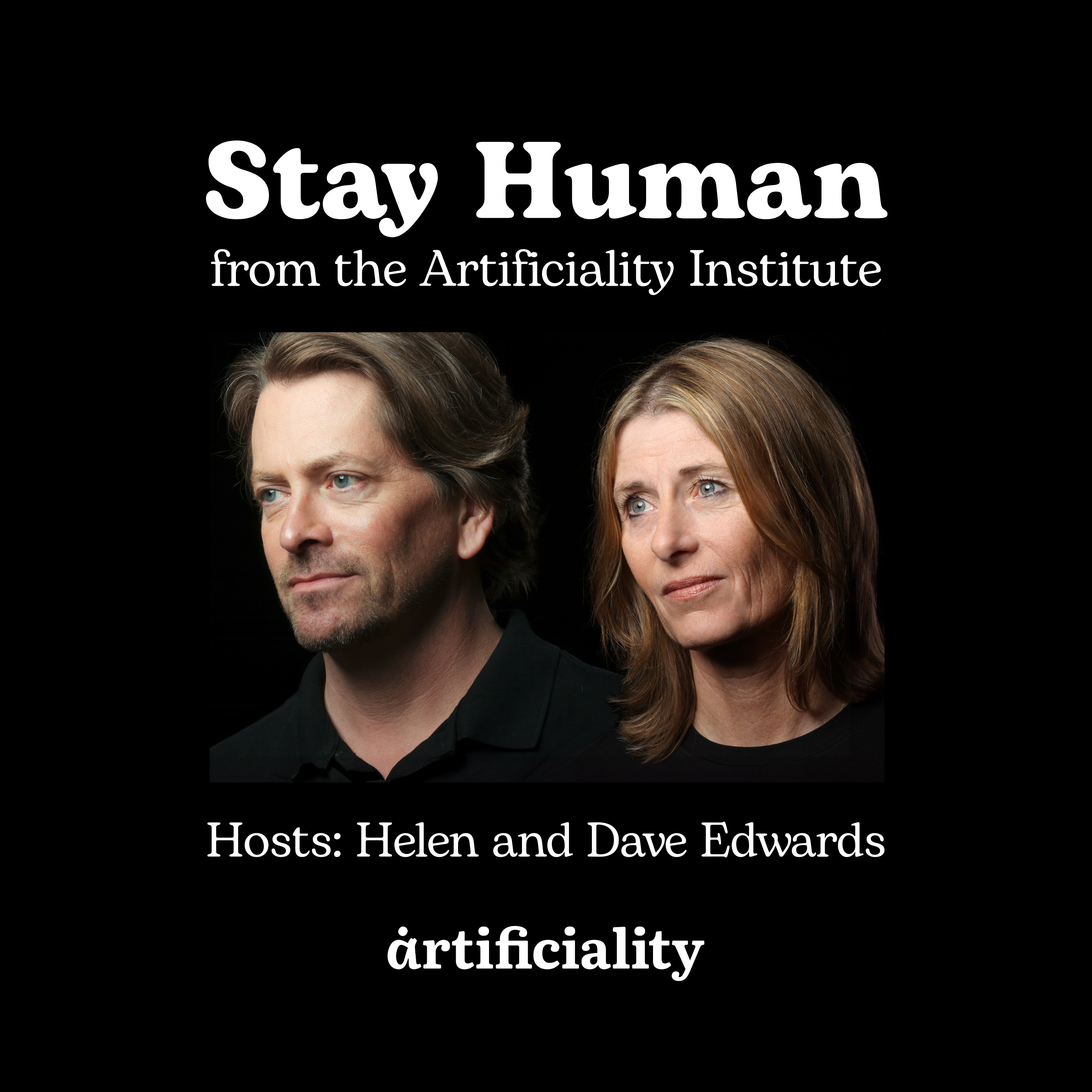
Helen and Dave Edwards
Stay Human, from the Artificiality Institute
Exploring how AI changes the way we think, who we become, and what it means to be human. We explore how AI changes the way we think, who we become, and what it means to be human. We believe AI shouldn't just be safe or efficient—it should be worth it. Through story-based research, education, and community, we help people choose the relationship they want with machines—so they remain the authors of their own minds.
Author
Helen and Dave Edwards
Category
Podcast website
Latest episode
Apr 19, 2026
Where to listen?
Podcasts in the app Replaio Radio Coming soonPodcasts are coming to the app soon. Install now and be the first to see a whole new take on podcasts
 Install for free
Android 5M+ downloads · 4.8 rating
iOS soon
Install for free
Android 5M+ downloads · 4.8 rating
iOS soon
Episodes
Generative AI: ChatGPT, DALL-E, Stable Diffusion, and the rest 12.02.2023 29:43
Everyone’s talking about it so we will too. Generative AI is taking the world by storm. But is it a good storm or a scary storm? How should individuals think about what’s possible? What about companies? Our take: generative AI is hugely powerful but will always have flaws and potholes. As probabilistic systems, it will always produce errors—how will you plan for that? As systems that are trained o...
Kees Dorst: Frame Innovation 29.01.2023 1:02:50
What can we learn from the practice of design? What might we learn if we had an insight into top designers’ minds? How might we apply the best practices of designers beyond the field of design itself? Most of our listeners are likely familiar with design thinking—what other practices should we learn about and understand? To answer these questions, we talked with Kees Dorst about his books, Frame I...
No-duhs and some surprises 02.12.2022 26:37
The latest Big Ideas report from MIT Sloan and BCG makes for an interesting read but contains flaws, obvious conclusions, and raises more questions than it answers. We discuss this report and make some suggestions about how to think about AI based on the survey’s conclusions: * trust matters (no-duh). The data suggests if people trust AI they will use it twice as much. * ability to override the AI...
Elon's error calculation at Twitter 18.11.2022 27:29
Twitter as we knew is gone. Elon has fired half the full time employees and 80 percent of the contractors. It’s a brutal way to trim excess fat, reset the culture, and establish a loyal band. But is it a good decision? How could it go wrong? Elon is incredibly successful at running engineering companies. But if you look at his failures—the fixes he hasn’t been able to affect—they are all in the zo...
Marina Nitze and Nick Sinai: Hack Your Bureaucracy 30.10.2022 56:50
We all likely want to improve the organizations we work in. We might want to improve the employee experience, improve the customer experience, or be more efficient and effective. But we all likely have had the experience of feeling like our organizations are too difficult, too entrenched, and too complex to change. Any organization—large or small, public or private—can feel like a faceless bureauc...
Tom Davenport and Steve Miller: Working with AI 16.10.2022 52:38
How will AI change our jobs? Will it replace humans and eliminate jobs? Will it help humans get things done? Will it create new opportunities for new jobs? People often speculate on these topics, doing their best to predict the somewhat unpredictable. To help us get a better understanding of the current state of humans and AI working together, we talked with Tom Davenport and Steve Miller about th...
Helen Edwards and Dave Edwards: Make Better Decisions 02.10.2022 37:04
We humans make a lot of decisions. Apparently, 35,000 of them every day! So how do we improve our decisions? Is there a process to follow? Who are the experts to learn from? Do big data and AI make decisions easier or harder? Is there any way to get better at making decisions in this complex, modern world we live in? To dig into these questions we talked with…ourselves! We recently published our f...
Kat Cizek and William Uricchio: Co-Creation 18.09.2022 55:43
We all do things with other people. We design things, we write things, we create things. Despite the fact that co-creation is all around us it can be easy to miss because creation gets assigned to individuals all too often. We’re quick to assume that one person should get credit thereby erasing the contributions of others. The two of us have a distinct interest in co-creation because we co-create...
Gerd Gigerenzer: Staying Smart 04.09.2022 1:01:40
How should we respond and react to artificial intelligence and its impact on the world and each other? How should we handle the risk and uncertainty risk caused by the permeation of AI throughout our lives? To tackle these questions, we talked with Gerd Gigerenzer about his recent book, How to Stay Smart in a Smart World . We talk with Gerd about the impacts of big data on making decisions, the in...
Eric Pliner: Difficult Decisions 14.08.2022 59:20
We all want decision-making to be easier. We want simple tools and frameworks that provide a process for no-regrets decisions. But it just isn’t that easy. Despite how much we understand about the science of decision-making, the act of making decisions is frequently quite difficult. And the quantity of data we can now access to support decision-making doesn’t make decisions easier, it actually mak...
Tom Hale: Oura Ring and the New Data of Health 31.07.2022 57:08
We’d all like to be healthier—to sleep longer, have lower stress, and have more energy. But is it possible for an AI to help us accomplish this? And how would that experience feel? What data would we need to provide? How would the AI encourage the behavior changes required? Would it feel like a friend or a bully? Would it work at all? To answer some of these questions, we talked with Tom Hale, the...
Frank Rose: Storytelling in a Data-Driven World 17.07.2022 59:17
We all love stories—they are one of the most important ways that humans communicate. Stories create heroes to root for and villains to revile. Stories create realities and help us align our values and objectives with others. But how do stories change in a world that is awash with data and is overwhelmed by large tech companies that try to motivate—or manipulate–us with stories using data that we d...
Ben Shneiderman: Human-Centered AI 03.07.2022 1:03:52
Many of our listeners will be familiar with human-centered design and human-computer interaction. These fields of research and practice have driven technology product design and development for decades. Today, however, these fields are changing to adapt to the increasing use of artificial intelligence, leading to an emerging field called human-centered AI. Prior to the widespread use of AI, techno...
Julio Mario Ottino: The Nexus 05.06.2022 59:41
“How can we augment our thinking spaces to increase creative solutions? How can we make those solutions real by mastering complexity?” Julio Mario Ottino and Bruce Mau ask and answer these questions in their ambitious and visually stunning work, The Nexus. In their book, Ottino and Mau take on a big subject—how to augment your thinking by integrating art, technology, and science. It is a thought-p...
Mark Nitzberg: Human-Compatible AI 15.05.2022 54:11
We hear a lot about harm from AI and how the big platforms are focused on using AI and user data to enhance their profits. What about developing AI for good for the rest of us? What would it take to design AI systems that are beneficial to humans? In this episode, we talk with Mark Nitzberg who is Executive Director of CHAI or the UC Berkeley Center for Human-Compatible AI and head of strategic ou...
Barbara Tversky: Spatial Cognition 30.04.2022 1:07:01
Have you ever wondered why you can recognize and remember things but can’t describe them in words? That is one of the questions that started Barbara Tversky’s contrarian research and academic career, leading to her theory that spatial thinking is the foundation of abstract thought. While most people were focused on language as central to human thinking, Barbara recognized that our relationship wit...
Megan Brown: Data Literacy 24.04.2022 59:38
All major companies are working to increase the value of data science. Setting a goal may be easy but implementation often raises challenging questions. How should companies think about the role of data scientists, the challenge of increasing diversity in data science and increasing data literacy and data-driven decision-making? In this episode, we talk with Megan Brown, the Director of Data Scien...
Peter Sterling: Decision Evolution 20.02.2022 1:13:41
This week we talk with Peter Sterling, the author of What is Health . Peter has had a long career in medicine and neuroscience. He has recently published in Jama Psychiatry, with Michael Platt, on Why Deaths of Despair Are Increasing in the US and Not Other Industrial Nations with many Insights From Neuroscience and Anthropology. While that might not sound like AI, we do wonder what the role of te...
Stephen Fleming: Metacognition 12.12.2021 1:01:40
It’s human to know oneself. We are able to self-monitor, understand our cognition, and recognize gaps in our knowledge. This is called metacognition—we think about how we think. We can think of it as self-awareness or the ability to understand the state of our knowledge. In this episode, we talk with Stephen Fleming, Professor of Cognitive Neuroscience at University College London. Steve has recen...
Jevin West: Making Sense of Data 23.07.2021 51:57
Have you ever wondered what it means to be data literate in a world of big data and AI? Now that so many decisions rely on information that is only readable by machine and our statistical intuitions, which were bad before, are now practically useless, what is data literacy in the age of AI and how important is it? We talked with Jevin West, assistant professor in the Information School at the Univ...
Michael Bungay Stanier: Staying Curious 13.07.2021 43:25
Have you wondered what makes people different from machines? Well one thing is curiosity—curiosity is something that drives humans but as yet not machines. And one person that knows humans and curiosity is Michael Bungay Stanier , coach extraordinaire and well-known author of the best selling books The Coaching Habit and The Advice Trap. We first met Michael at the House of Beautiful Business , a...
Mollie Pettit: Visualizing Data 07.07.2021 41:01
Making decisions with data requires some form of communication with data. But how do we communicate with numbers and characters and binary bits? The best way today is through data visualization. Visualizing data has come a long way since the early days of hand-drawn charts and graphs. Starting with the desktop publishing revolution of the 1980s through to the current world of data viz tools in the...
Josh Lovejoy: Designing AI 29.06.2021 1:27:39
Have you ever wondered about what it takes to design AI that doesn’t do more harm than good? We speak with Josh Lovejoy who is perhaps the most experienced out there in the field of human-centered AI design. At the time of our recording, Josh was Head of Design for Microsoft’s Ethics & Society team. Since our recording, Josh has taken a role as a UX Manager in Google’s Privacy & Data Prote...
Kate O'Neill: Humanizing Tech 21.06.2021 43:52
Have you ever wondered what it means to be a humanist in the age of technology? How can we put human values into a machine? How can we even know what those human values are? We asked Kate O’Neill, founder of KO Insights and author of the Tech Humanist, this question and found that there’s a lot to work with when it comes to understanding humans and what they might want their machines to do. About...
Tania Lombrozo: Intuition and data 15.06.2021 49:20
Have you ever wondered why we humans love to use our intuition even when we are surrounded by data and we also know that even simple algorithms can be more accurate than human judgment? We put that exact question to Tania Lombrozo , Arthur W. Marks ’19 Professor of Psychology and director of the Concepts & Cognition Lab at Princeton University, and it turns out that the answer is surprisingly...
Similar podcasts







Listen to the Stay Human, from the Artificiality Institute podcast in Replaio
Radio and podcasts in one app - free, with no sign-up. Install today and do not miss the launch
Replaio is not a podcast publisher; show names, artwork and audio belong to their authors and are distributed through public RSS feeds.