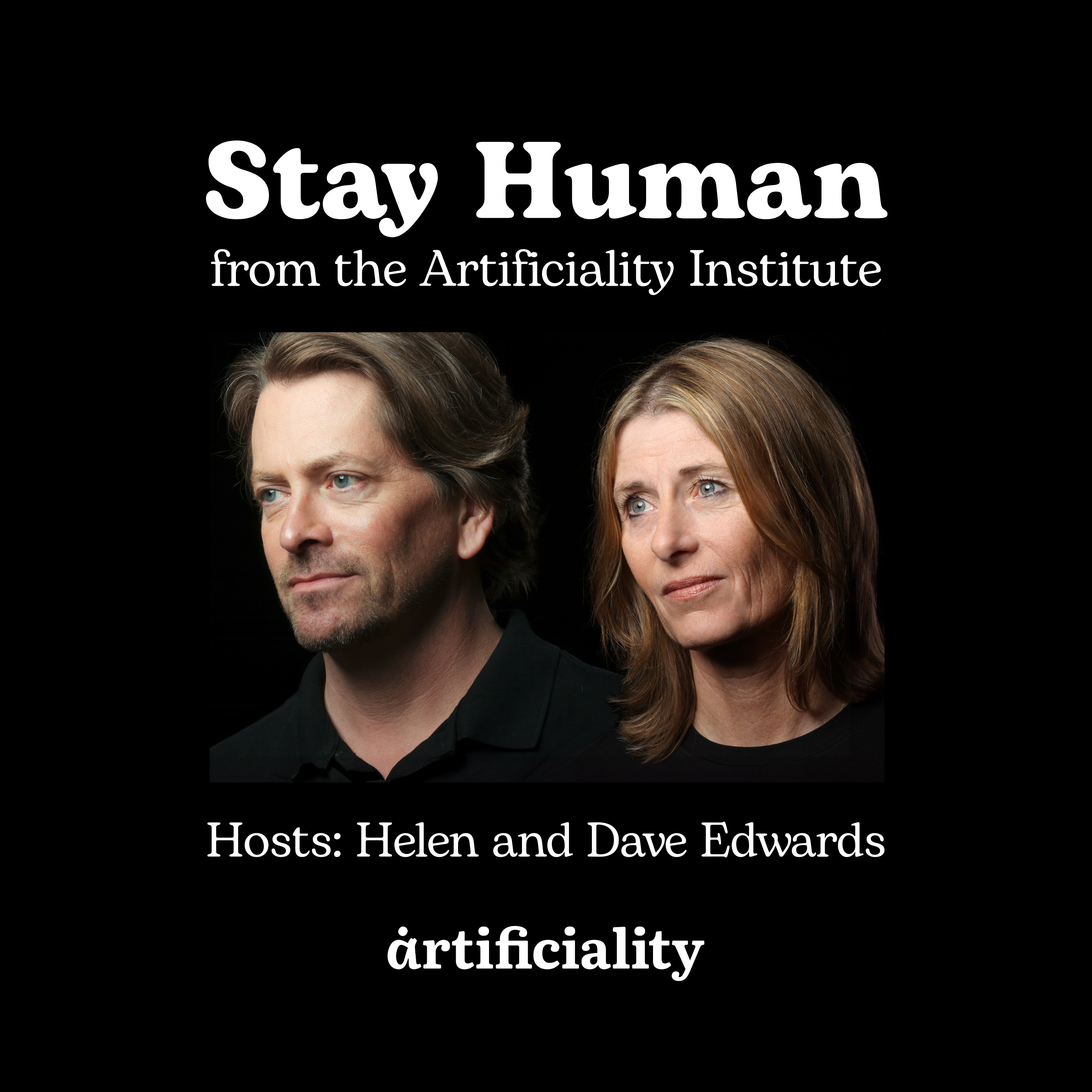
Helen and Dave Edwards
Stay Human, from the Artificiality Institute
Exploring how AI changes the way we think, who we become, and what it means to be human. We explore how AI changes the way we think, who we become, and what it means to be human. We believe AI shouldn't just be safe or efficient—it should be worth it. Through story-based research, education, and community, we help people choose the relationship they want with machines—so they remain the authors of their own minds.
Author
Helen and Dave Edwards
Category
Podcast website
Latest episode
Apr 19, 2026
Where to listen?
Podcasts in the app Replaio Radio Coming soonPodcasts are coming to the app soon. Install now and be the first to see a whole new take on podcasts
 Install for free
Android 5M+ downloads · 4.8 rating
iOS soon
Install for free
Android 5M+ downloads · 4.8 rating
iOS soon
Episodes
Chris Summerfield: These Strange New Minds 19.04.2026 1:00:31
In this conversation, we explore machine intelligence and human understanding with Christopher Summerfield, Professor of Cognitive Neuroscience at Oxford and author of "These Strange New Minds: How AI Learned to Talk and What It Means." Chris offers a "third way" of thinking about AI—neither irrational exuberance nor dismissive skepticism, but a view grounded in cognitive scien...
Nina Beguš: Artificial Humanities 28.03.2026 55:07
In this conversation, we explore the cultural foundations of artificial intelligence with Nina Beguš, Assistant Professor at UC Berkeley and author of "Artificial Humanities: A Fictional Perspective on Language in AI." Nina makes a compelling case for an entirely new field—one that brings humanistic insights into the very creation of technology rather than treating humanities as critical...
Blaise Agüera y Arcas: What Is Intelligence? 27.02.2026 44:05
In this conversation, we explore the nature of intelligence and life itself with Blaise Agüera y Arcas, VP and Fellow at Google and head of the Paradigms of Intelligence Lab. Blaise discusses his ambitious new book "What Is Intelligence?"—a work that bridges evolutionary biology, complexity science, artificial life, and AI to argue that intelligence fundamentally arises from computation,...
Steven Sloman: The Cost of Conviction 15.02.2026 52:46
In this conversation, we explore the psychology of conviction with Steve Sloman, Professor of Cognitive, Linguistic, and Psychological Sciences at Brown University and advisor to the Artificiality Institute. Returning to the podcast for a third time, Steve discusses his new book "The Cost of Conviction," which examines a fundamental tension in how humans make decisions—between carefully...
Ellie Pavlick: The AI Paradigm Shift 05.02.2026 55:49
In this conversation, we explore the foundations of artificial intelligence with Ellie Pavlick, Assistant Professor of Computer Science at Brown University, a Research Scientist at Google Deepmind, and Director of ARIA, an NSF-funded institute examining AI's role in mental health support. Ellie's trajectory—from undergraduate degrees in economics and saxophone performance to pioneering res...
Helen & Dave Edwards: Becoming Synthetic 09.12.2025 25:04
We enjoyed giving a virtual keynote for the Autonomous Summit on December 4, 2025, titled Becoming Synthetic: What AI Is Doing To Us, Not Just For Us. We talked about our research on how to maintain human agency & cognitive sovereignty, the philosophical question of what it means to be human, and our new(ish) approach to create better AI tools called unDesign. unDesign is not the absence of de...
Tess Posner: AI, Creativity, and Education 09.11.2025 51:15
In this conversation recorded on the 1,000th day since ChatGPT's launch, we explore education, creativity, and transformation with Tess Posner, founding CEO of AI4ALL. For nearly a decade—long before the current AI surge—Tess has led efforts to broaden access to AI education, starting from a 2016 summer camp at Stanford that demonstrated how exposure to hands-on AI projects could inspire high...
Eric Schwitzgebel: The Weirdness of the World 17.10.2025 50:16
In this conversation, we explore the philosophical art of embracing uncertainty with Eric Schwitzgebel, Professor of Philosophy at UC Riverside and author of "The Weirdness of the World." Eric's work celebrates what he calls "the philosophy of opening"—not rushing to close off possibilities, but instead revealing how many more viable alternatives exist than we typically rec...
John Pasmore: Inclusive AI 11.10.2025 34:31
In this conversation, we explore the challenges of building more inclusive AI systems with John Pasmore, founder and CEO of Latimer AI and advisor to the Artificiality Institute. Latimer represents a fundamentally different approach to large language models—one built from the ground up to address the systematic gaps in how AI systems represent Black and Brown cultures, histories, and perspectives...
De Kai: Raising AI 21.09.2025 54:57
In this conversation, we explore how humans can better navigate the AI era with De Kai, pioneering researcher who built the web's first machine translation systems and whose work spawned Google Translate. Drawing on four decades of AI research experience, De Kai offers a different framework for understanding our relationship with artificial intelligence—moving beyond outdated metaphors toward...
Adam Cutler: AI, Design, and the Human Future 06.09.2025 43:27
In this conversation, we sit down with Adam Cutler, Distinguished Designer at IBM and pioneer in human-centered AI design, to explore how generative AI is reshaping creativity, reliance, and human experience. Adam reflects on the parallels between today’s AI moment and past technology shifts—from the rise of Web 2.0 to the early days of the internet—and why we may be living through a “mini singula...
Christine Rosen: The Extinction of Experience 21.08.2025 55:26
In this conversation, we explore the shifts in human experience with Christine Rosen, senior fellow at the American Enterprise Institute and author of "The Extinction of Experience: Being Human in a Disembodied World." As a member of the "hybrid generation" of Gen X, Christine (like us) brings the perspective of having lived through the transition from an analog to a digital wo...
Beth Rudden: AI, Trust, and Bast AI 16.08.2025 36:34
Join Beth Rudden at the Artificiality Summit in Bend, Oregon—October 23-25, 2025—to imagine a meaningful life with synthetic intelligence for me, we and us. Learn more here: www.artificialityinstitute.org/summit In this thought-provoking conversation, we explore the intersection of archaeological thinking and artificial intelligence with Beth Rudden, former IBM Distinguished Engineer and CEO of Ba...
Steve Sloman: Information to Bits at the Artificiality Summit 2024 03.08.2025 34:59
At the Artificiality Summit in October 2024, Steve Sloman , professor at Brown University and author of The Knowledge Illusion and The Cost of Conviction , catalyzed a conversation about how we perceive knowledge in ourselves, others, and now in machines. What happens when our collective knowledge includes a community of machines? Steve challenged us to think about the dynamics of knowledge and un...
Jamer Hunt on the Power of Scale 27.07.2025 42:02
At the Artificiality Summit 2024, Jamer Hunt, professor at the Parsons School of Design and author of Not to Scale, catalyzed our opening discussion on the concept of scale. This session explored how different scales—whether individual, organizational, community, societal, or even temporal—shape our perspectives and influence the design of AI systems. By examining the impact of scale on context an...
Avriel Epps: Teaching Kids About AI Bias 12.07.2025 50:51
In this conversation, we explore AI bias, transformative justice, and the future of technology with Dr. Avriel Epps, computational social scientist, Civic Science Postdoctoral Fellow at Cornell University's CATLab, and co-founder of AI for Abolition. What makes this conversation unique is how it begins with Avriel's recently published children's book, A Kids Book About AI Bias (Penguin...
Benjamin Bratton: The Platypus and the Planetary 07.06.2025 1:04:29
In this wide-ranging conversation, we explore the implications of planetary-scale computation with Benjamin Bratton , Director of the Antikythera program at the Berggruen Institute and Professor at UC San Diego. Benjamin describes his interdisciplinary work as appearing like a "platypus" to others—an odd creature combining seemingly incompatible parts that somehow works as a coherent wh...
David Wolpert: The Thermodynamics of Meaning 05.04.2025 1:16:19
In this episode, we welcome David Wolpert , a Professor at the Santa Fe Institute renowned for his groundbreaking work across multiple disciplines—from physics and computer science to game theory and complexity. * Note: If you enjoy our podcast conversations, please join us for the Artificiality Summit on October 23-25 in Bend, Oregon for many more in person conversations like these! Learn more a...
Blaise Agüera y Arcas and Michael Levin: The Computational Foundations of Life and Intelligence 12.03.2025 1:10:14
In this remarkable conversation, Michael Levin (Tufts University) and Blaise Agüera y Arcas (Google) examine what happens when biology and computation collide at their foundations. Their recent papers—arriving simultaneously yet from distinct intellectual traditions—illuminate how simple rules generate complex behaviors that challenge our understanding of life, intelligence, and agency. Michael’s...
Maggie Jackson: Embracing Uncertainty 07.03.2025 1:00:08
In this episode, we welcome Maggie Jackson, whose latest book, Uncertain, has become essential reading for navigating today’s complex world. Known for her groundbreaking work on attention and distraction, Maggie now turns her focus to uncertainty—not as a problem to be solved, but as a skill to be cultivated. Note: Uncertain won an Artificiality Book Award in 2024—check out our review here: https:...
Greg Epstein: Tech Agnostic 06.03.2025 58:40
In this episode, we talk with Greg Epstein —humanist chaplain at Harvard and MIT, bestselling author, and a leading voice on the intersection of technology, ethics, and belief systems. Greg’s latest book, Tech Agnostic , offers a provocative argument: Silicon Valley isn’t just a powerful industry—it has become the dominant religion of our time. Note: Tech Agnostic won an Artificality Book Award in...
Chris Messina: Reimagining AI 28.02.2025 53:20
In this episode, we sit down with the ever-innovative Chris Messina—creator of the hashtag, top product hunter on Product Hunt, and trusted advisor to startups navigating product development and market strategy. Recording from Ciel Media’s new studio in Berkeley, we explore the evolving landscape of generative AI and the widening gap between its immense potential and real-world usability. Chris in...
D. Graham Burnett: Attention and much more... 27.02.2025 1:12:25
D. Graham Burnett will tell you his day job is as a professor of science history at Princeton University. He is also co-founder of the Strother School of Radical Attention and has been associated with the Friends of Attention since 2018. But none of those positions adequately describe Graham. His bio says that he “works at the intersection of historical inquiry and artistic practice.” He writes, h...
Michael Levin—The Future of Intelligence: Synthbiosis 05.02.2025 1:18:01
At the Artificiality Summit 2024, Michael Levin, distinguished professor of biology at Tufts University and associate at Harvard's Wyss Institute, gave a lecture about the emerging field of diverse intelligence and his frameworks for recognizing and communicating with the unconventional intelligence of cells, tissues, and biological robots. This work has led to new approaches to regenerative m...
Artificiality Keynote at the Imagining Summit 2024 28.01.2025 14:46
Our opening keynote from the Imagining Summit held in October 2024 in Bend, Oregon. Join us for the next Artificiality Summit on October 23-25, 2025! Read about the 2024 Summit here: https://www.artificiality.world/the-imagining-summit-we-imagined-and-hoped-and-we-cant-wait-for-next-year-2/ And join us for the 2025 Summit here: https://www.artificiality.world/summit/
Similar podcasts







Listen to the Stay Human, from the Artificiality Institute podcast in Replaio
Radio and podcasts in one app - free, with no sign-up. Install today and do not miss the launch
Replaio is not a podcast publisher; show names, artwork and audio belong to their authors and are distributed through public RSS feeds.