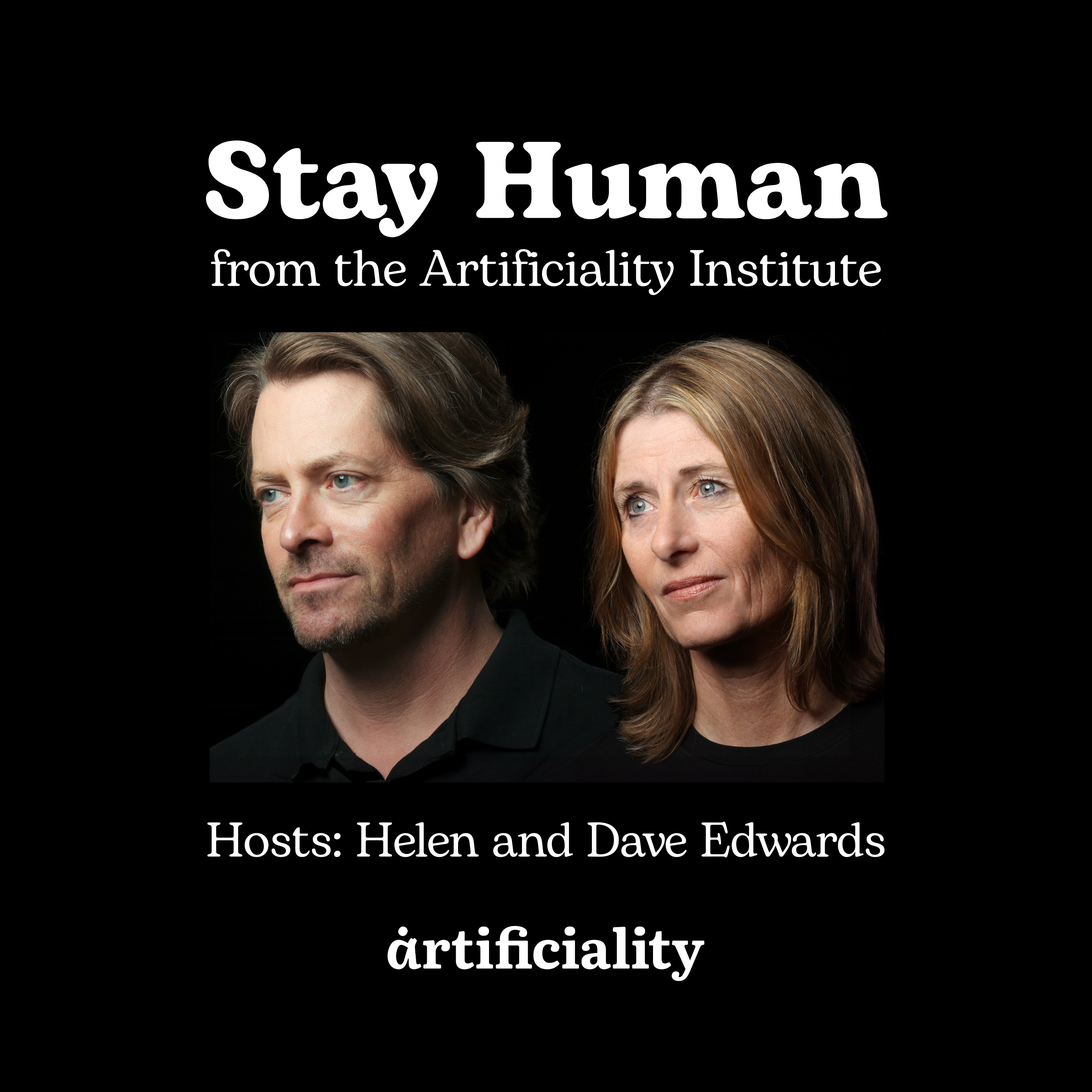
Helen and Dave Edwards
Stay Human, from the Artificiality Institute
Exploring how AI changes the way we think, who we become, and what it means to be human. We explore how AI changes the way we think, who we become, and what it means to be human. We believe AI shouldn't just be safe or efficient—it should be worth it. Through story-based research, education, and community, we help people choose the relationship they want with machines—so they remain the authors of their own minds.
Author
Helen and Dave Edwards
Category
Podcast website
Latest episode
Apr 19, 2026
Where to listen?
Podcasts in the app Replaio Radio Coming soonPodcasts are coming to the app soon. Install now and be the first to see a whole new take on podcasts
 Install for free
Android 5M+ downloads · 4.8 rating
iOS soon
Install for free
Android 5M+ downloads · 4.8 rating
iOS soon
Episodes
Steven Sloman: LLMs and Deliberative Reasoning 06.12.2023 1:01:06
If you’ve used a large language model, you’ve likely had one or more moments of amazement as the tool immediately responded with impressive content from its massive data cosmos training set. But you’ve likely also had moments of confusion or disillusionment as the tool responded with irrelevant or incorrect responses, displaying a lack of reasoning. A recent research paper from Meta caught our e...
Julia Rhodes Davis: Advancing Racial Equity 29.10.2023 47:39
In this episode, we speak with Julia Rhodes Davis, a Senior Advisor at Data & Society, about her recent report "Advancing Racial Equity Through Technology Policy" published by the AI Now Institute. This comprehensive report provides an in-depth examination of how the technology industry impacts racial inequity and concrete policy recommendations for reform. A critical insight from th...
Alicia Juarrero: Context Changes Everything 22.10.2023 1:04:50
Grounding her work in the problem of causation, Alicia Juarrero challenges previously held beliefs that only forceful impacts are causes. Constraints, she claims, bring about effects as well, and they enable the emergence of coherence. Alicia is the author of multiple books, most recently Context Changes Everything: How Constraints Create Coherence . Helen says in this interview that it feels like...
Jai Vipra: Computational Power and AI 15.10.2023 41:17
Jai Vipra is a research fellow at the AI Now Institute where she focuses on competition issues in frontier AI models. She recently published the report Computational Power and AI which focuses on compute as a core dependency in building large-scale AI. We found this report to be an important addition to the work covering the generative AI industry because compute is incredibly important but not ve...
Wendy Wong: We, the Data, and Human Rights 08.10.2023 58:40
Wendy Wong is a professor of political science and principal’s research chair at the University of British Columbia where she researches and teaches about the governance of emerging technologies, human rights, and civil society/non-state actors. In this interview, we talk with Wendy about her new book We, the Data: Human Rights in the Digital Age which is described as “a rallying call for extendin...
Chris Summerfield: Natural General Intelligence 01.10.2023 56:53
Chris Summerfield is a Professor of Cognitive Science at the University of Oxford. His work is concerned with understanding how humans learn and make decisions. He is interested in how humans acquire new concepts or patterns in data, and how they use this information to make decisions in novel settings. He's also a research scientist at Deepmind. Earlier this year, Chris released a book called...
Michael Bungay Stanier: How to Work with (Almost) Anyone 13.08.2023 58:02
Michael Bungay Stanier has an extraordinary talent for distilling the complexity of human relationships into easy to remember and follow frameworks—doing so with just the right amount of Australian humor and plenty of vulnerability. Despite his remarkable success with books like The Coaching Habit, The Advice Trap, and How to Begin , Michael never comes across as one of those gurus who thinks they...
Synthesis & Generative AI 05.08.2023 33:21
An exploration of how we might conceptualize the design of AGI within the context of human left and right brains. The tension between AI and human functioning highlights unique cooperation. AI uses language, abstraction, and analysis, while humans rely on experience, empathy, and metaphor. AI manipulates static elements well but struggles in a changing world. This leads to two distinct design appr...
Jonathan Coulton: Generative AI, songwriting, and creativity 29.07.2023 1:01:37
If you’ve read our show notes, you’ll know that our music was written and performed by Jonathan Coulton . I’ve known Jonathan for more than 30 years, dating back to when we sang together in college. But that’s a story for another day, or perhaps never. Jonathan spent his first decade post college as a software coder and then through a bit of happenstance and throwing care to the wind, he transitio...
Is it possible for AI to be meaningful? 22.07.2023 36:30
An exploration of the intersection of AI, meaning, and human relationships. In this episode, we dive deep into the role of AI in our lives and how it can influence our perception of meaning. We explore how AI, and specifically generative AI, is impacting our collective experiences and the ways we make authentic choices. We discuss the idea of intimacy with AI and the future trajectory of human-AI...
Existential risk of AI 14.07.2023 32:37
ChatGPT, Dall-e, Midjourney, Bard, and Bing are here. Many others are coming. At every dinner conversation, classroom lesson, and business meeting people are talking about AI. There are some big questions that now everyone is seeking answers for, not just the philosophers, ethicists, researchers, and venture folks. It’s noisy, complicated, technical and often agenda-driven. In this episode, we tac...
Values & Generative AI 09.07.2023 25:05
As Silicon Valley lunges towards creating AI that is considered superior to humans (at times called Artificial General Intelligence or Super-intelligent AI), it does so with the premise that it is possible to encode values in AI so that the AI won’t harm us. But values are individual, elusive, and ever-changing. They resist being mathematized. Join us as we discuss human values, how they form, how...
Culture & Generative AI 02.07.2023 32:29
Culture plays a vital role in connecting individuals and communities, enabling us to leverage our unique talents, share knowledge, and solve problems together. However, the rise of an intelligentsia of machine soothsayers highlights the need to consciously design new coherence strategies for the age of machines. Why? Because generative AI is a cultural technology that produces different outcomes d...
Mind for our Minds: Introduction 18.06.2023 26:28
This episode is the first in our summer series based on our thesis for designing AI to be a Mind for our Minds. We recently presented this idea for the first time at our favorite event of the year hosted by The House of Beautiful Business . We are grateful for our long-term relationship with the House and its founders, Tim Leberecht and Till Grusche, and head of curation and community, Monika Jian...
C. Thi Nguyen: Metrification 21.05.2023 1:07:38
AI is based on data. And data is frequently collected with the intent to be quantified, understood, and used across context. That’s why we have things like grade point averages that translate across subject matters and educational institutions. That’s why we perform cost-benefit analyses to normalize the forecasted value of projects—no matter the details. As we deploy more AI that is based on a me...
Harpreet Sareen: Cyborg Botany 14.05.2023 48:44
We are deeply interested in the intersection of the digital and material worlds, both living and not living. Most of our interviews are focused on the intersection of humans and machines—how does the digital world affect humans and how do humans affect the digital world. This interview, however, is about the intersection of plants and machines. Harpreet Sareen works at the intersection of digital...
Arvind Jain: Glean, Enterprise Search, and Generative AI 07.05.2023 48:03
Anyone working in a large organization has likely asked this question: Why is it that I can seemingly find anything on the internet but I can’t seem to find anything inside my organization? It is counter-intuitive that it’s easier to organize the vast quantity of information on the public internet than it is to organize the smaller amount of information inside a single organization. The reality is...
Lukas Egger: Generative AI, a view from SAP 30.04.2023 46:35
The world has been upended by the introduction of generative AI. We think this could be the largest advance in technology—ever. All of our clients are trying to figure out what to do, how to de-risk the introduction of these technologies, and how to design new, innovative solutions. To get a perspective on these changes created by AI, we talked with Lukas Egger who leads the Innovation Office &...
Katie Davis: Technology's Child 23.04.2023 52:32
Is technology good or bad for children? How should parents think about technology in their children’s lives? Are there different answers depending on the age of the child and their stage of development? What can we apply from what we know about children’s play and activity in the analog world to the digital world? How should product designers think about designing technology to be good for kids? H...
Andrew Blum: The Weather Machine 09.04.2023 52:58
Weather forecasting is fascinating. It involves making predictions in the complex, natural world, using a global infrastructure for people who have varying needs and desires. Some just want to know if we should carry an umbrella today. Others want to know how to prepare for a week-long trip. And then there are those who use the weather forecast to make decisions that can have significant, even cri...
Juan Noguera: Generative AI in Industrial Design 26.03.2023 39:26
We’ve heard a lot about how generative AI may negatively impact careers in design. But we wonder how might generative AI have a positive impact on designers? How might generative AI be used as a tool that helps designers rather than as a replacement for designers? How might we use generative AI in design education? How do design educators and their students feel about generative AI? How else might...
Don Norman: Design for a Better World 12.03.2023 1:03:51
What role does design have in solving the world’s biggest problems? What can designers add? Some would say that designers played a role in getting us into our current mess. Can they also get us out of it? How can we design solutions for problems in complex systems that are evolving, emerging, and changing? To answer these questions, we talked with Don Norman about his book, Design for a Better Wor...
Jamer Hunt: Not to Scale 05.03.2023 1:08:32
What are the cause and effect of my actions? How do I know the effect of the small acts in my life? How can I identify opportunities to have impact that is much larger than myself? How can we make problems that seem overwhelmingly complex feel more manageable and knowable? How might we use the scaling tools of designers to tackle some of the world’s largest and most complex problems? To answer the...
ChatGPT: Why does it matter, how special is it, and what might be ahead? 26.02.2023 34:46
Why does ChatGPT matter? * People always get excited about AI advances and this one is accessible in a way that others weren’t in the past. * People can use natural language to prompt a natural language response. * It’s seductive because it feels like synthesis. * And it can feel serendipitous. But… * We need to remember that ChatGPT and all other generative AI are tools and they can fail us. * Wh...
David Krakauer: Complexity 19.02.2023 1:34:34
We’re always looking for new ideas from science that we can use in our work. Over the past few years, we have been researching new ways to handle increasing complexity in the world and how to solve complex problems. Why do we seem to see emergent, adaptive, open, and networked problems more often? And why don’t they yield to traditional problem solving techniques? Our research has centered on comp...
Similar podcasts







Listen to the Stay Human, from the Artificiality Institute podcast in Replaio
Radio and podcasts in one app - free, with no sign-up. Install today and do not miss the launch
Replaio is not a podcast publisher; show names, artwork and audio belong to their authors and are distributed through public RSS feeds.