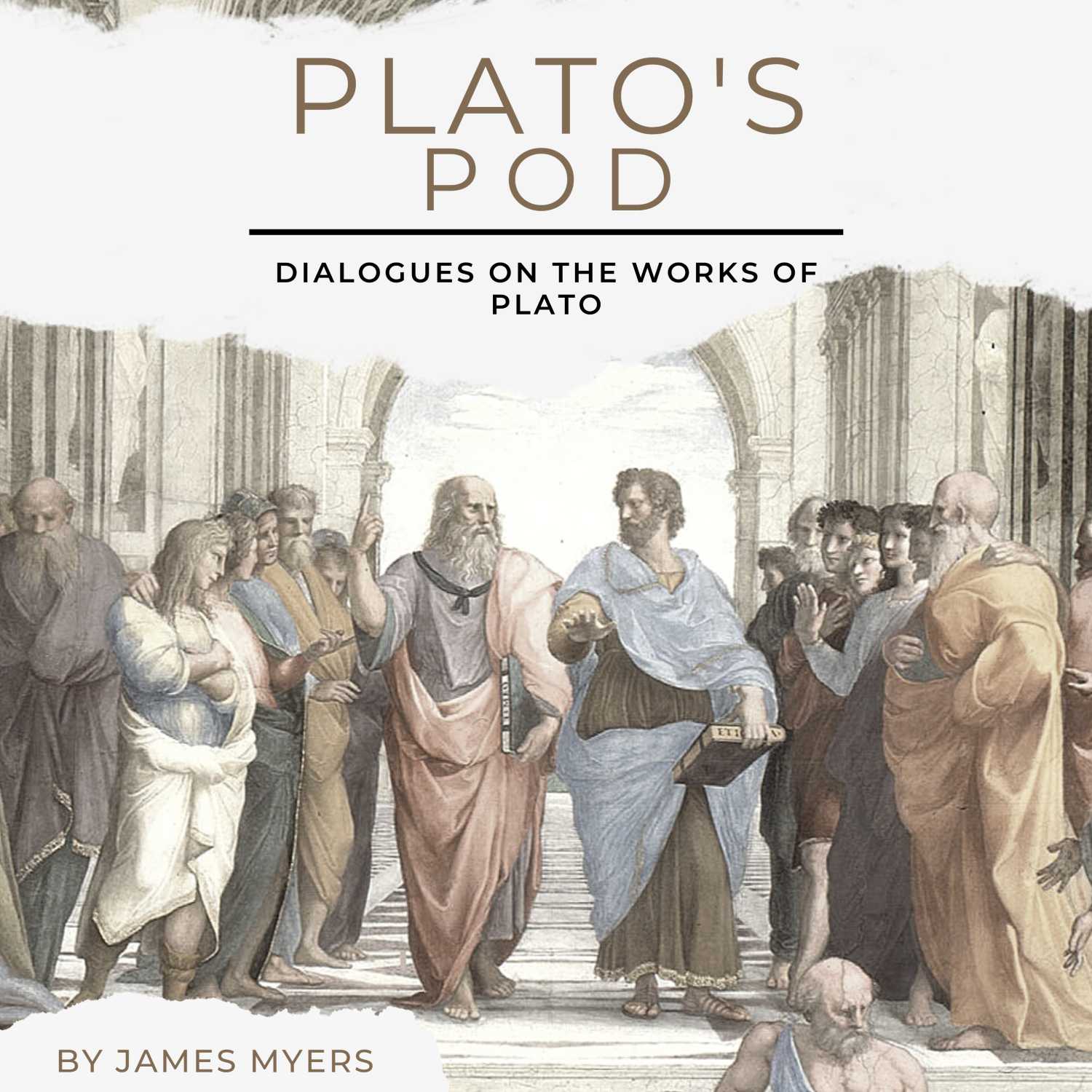
James Myers
Plato's Pod: Dialogues on the works of Plato
Welcome to Plato's Pod, a podcast of discussions on the dialogues of Plato, the philosopher and geometer who wrote nearly 2,400 years ago. Hosted by amateur philosopher James Myers, the first four seasons of the podcast featured group discussions and some incredible insights on many of Plato's works. Now in our fifth season, we continue to probe the philosophy of Plato's dialogues, with invited guests discussing selected topics and applying the timeless philosophical principles to contemporary issues and circumstances. We welcome your thoughts and suggestions for discussion topics, and please...
Be sure to visit the podcast's website and support the creator: rss.com
Where to listen?
Podcasts in the app Replaio Radio Coming soonPodcasts are coming to the app soon. Install now and be the first to see a whole new take on podcasts
 Install for free
Android almost 10M downloads · 4.8 rating
iOS soon
Install for free
Android almost 10M downloads · 4.8 rating
iOS soon
Episodes
Alfred North Whitehead, Part 2: The Mathematician Who Added Plato to Modern Science 13.04.2026 1:22:58
In their second episode featuring the works of modern Platonist Alfred North Whitehead (1861-1947), James Myers and Michael Fitzpatrick brought Plato into the 21st century through Whitehead’s perspectives as a mathematician and philosopher. The discussion relates Whitehead’s perspectives to many of Plato’s dialogues, including The Sophist , The Timaeus , The Republic , The Parmenides , and The Phi...
On Modern Platonist Alfred North Whitehead, Part 1: The Mathematician Philosopher 11.02.2026 1:20:04
In this episode, James Myers and Michael Fitzpatrick continue to discuss modern Platonists with an introduction to Alfred North Whitehead (1861-1947), a mathematician who ended up as a professor of philosophy at Harvard University even though he didn’t hold a degree in philosophy. Whitehead hadn’t formally trained as a philosopher but came to be highly regarded for his mathematically-informed proc...
Why Artificial Intelligence is Impossible 05.01.2026 41:49
Plato’s Pod host James Myers brings the logic of the characters in ten of Plato’s dialogues to bear on the question of “what is intelligence?” and concludes that “artificial intelligence” is impossible. Plato’s message, that intelligence is developed only in a soul on the basis of the soul’s understanding of motion, is especially empowering for the potential of intelligent humans when big tech com...
Justice in Plato’s Time and Our Time: Words that Shape Constitutions, Justice, and Governments 15.11.2025 27:30
Our choice and use of words has a profound effect on the operation of justice, and a particular legal dispute now before the United States Supreme Court hangs on the meaning of three words. In this episode, Plato’s Pod host James Myers explores what eight of Plato’s works have to say about the meaning of words, and the ways that words shape constitutions, justice, and governments in our time as th...
On Modern Platonist Alain Badiou:"Thinking the Event" to Distinguish the Real from Images on the Wall 22.09.2025 1:52:32
“Think the event” is central to the philosophy of Alain Badiou, a modern Platonist who has been writing and lecturing in philosophy for over five decades. Badiou said, “Philosophy is the seizure of thought of what breaks with the sleep of thought,” because real truth is found by looking for the exceptions and finding the important connections in time that we have overlooked. Badiou’s insight is th...
Plato’s Letters VI and VIII: Good Kings are Servants of the Laws and Justice 09.05.2025 1:30:45
We followed our discussion of Plato’s famous Letter VII by looking at his lesser-known Letters VI and VIII. Together, they form a powerful trilogy in which “Love your neighbour” emerges as an overarching theme, and a principle that Plato says applies above all to kings, whose rule must be tempered by a love for their subjects. Plato’s concept of kingship is very different from the history of misru...
Plato's Seventh Letter, Part 2: Can Virtue Be Taught? 07.04.2025 1:33:12
The second half of our discussion on Plato’s Seventh Letter begins with a reading of Plato’s famous statement that he never published any statement of his opinions. That’s both the beauty and, for some, the frustration of Plato to his readers. The reason, as Michael Fitzpatrick states in our dialogue, is that Plato didn’t want to give us the answer key: “The only way your soul benefits is if these...
Plato's Seventh Letter: On Tyrants Who are Blind to Philosophy 03.03.2025 1:17:02
In our first discussion on Plato's letters, we look at his best-known Seventh Letter. In the letter, Plato relates his experience with Dionysius, the tyrannical ruler of Syracuse, and the philosophically minded Dion was was persecuted by Dionysius. Plato's extraordinary recounting of his time teaching both Dionysius and Dion demonstrates his success with the latter, and failure with the former. Th...
Bringing Plato into the 21st Century: a Discussion on Political and Social Principles Spanning 2,400 Years 29.12.2024 1:41:58
What relevance do the principles and ideas of Plato's dialogues have for the modern, technologically-powered world of 8 billion people? In a wide-ranging discussion, James Myers and Michael Fitzpatrick address current social and political issues around the globe, relating them to the themes presented in a number of Plato's dialogues that include The Republic , The Laws , the Statesman , and the Me...
Plato's Laws - Book XII, Part 2: The Nocturnal Council Guarding Virtue 28.10.2024 2:01:24
Our final meeting on Plato’s longest dialogue, The Laws , concluded with readings from Book XII, where the Athenian expounds on the operation of a special Nocturnal Council that will act as the head and intellect for Crete’s new colony, Magnesia. On August 4, 2024, members of the Toronto, Calgary, and Chicago Philosophy Meetup groups considered many of the key themes of The Laws , in discussing ho...
Plato's Laws - Book XII, Part 1: Who Guards the Guardians? 27.09.2024 1:51:35
Book XII is the final chapter of Plato’s longest and last dialogue, The Laws, and addresses the challenge of how a community can thrive when its leaders act against the collective interest. Having set out a novel constitution that promotes the virtue of citizens and leaders in Crete’s new colony, Magnesia, the three characters in the dialogue turn their attention to protecting the colony from vice...
Plato's Laws - Book XI: Property and Punishment in Magnesia 02.09.2024 1:52:09
Book XI of Plato's last and longest dialogue represents a dramatic shift in tone from Book X, where we began our series on The Laws eleven episodes ago. On July 7, 2024, members of the Toronto, Calgary, and Chicago Philosophy Meetup groups convened to consider the thirty-three laws that the Athenian proposes to Clinias and Megillus for the regulation of trade and property in Crete's new colony, Ma...
Plato's Laws - Book IX: Legislating the Good for Unjust Acts Committed 05.08.2024 1:59:01
In our eleventh meeting on Plato's longest and final dialogue, we set aside Book VIII and moved from Book VII to read selections from Book IX. In Book IX, the Athenian, Clinias from Crete, and Megillus from Sparta address the practical questions of administering justice for those in Crete's new colony who might commit evil acts. On June 23, members of the Toronto, Calgary, and Chicago Philosophy M...
Plato’s Laws – Book VII: Teaching and Legislating for Harmony 23.07.2024 1:56:26
In our series on Plato’s longest and last dialogue, The Laws , on June 9, 2024 members of the Toronto, Calgary, and Chicago Philosophy Meetup groups turned to Book VII. There, the three characters – the Athenian, Clinias from Crete, and Megillus from Sparta – discuss the raising of children in Crete’s new colony, Magnesia. They begin by exploring the harmony of the colony’s laws with the customs a...
Plato's Laws - Book VI: Founding and Governing a Virtuous Society 04.07.2024 1:59:33
In Book VI of his last dialogue, The Laws , Plato has the Athenian, Clinias from Crete, and Megillus from Sparta discuss the governing structure for Crete’s new colony, to be called Magnesia. It’s a mixed system involving elements of democracy and monarchy, and one that places responsibility on every citizen to perform duty for the community and to choose the Guardians of the Laws through a rigoro...
Plato’s Laws – Book V: The Soul in Communal Harmony 18.06.2024 1:44:56
In Book V of Plato’s Laws , only the unnamed Athenian speaks while the other two characters, Clinias from Crete and Megillus from Sparta, listen to his presentation on the power of the soul, harmony in human behaviour, and the just division of property for Crete’s new colony to be called Magnesia. On May 12, 2024, Plato’s Pod held its eighth meeting on Plato’s longest and last dialogue, with membe...
Plato's Laws - Book IV: Leadership by Reason 26.05.2024 2:04:46
Book IV of Plato's longest dialogue, The Laws , places the spotlight on the qualities of virtuous leadership as the three characters - the unnamed Athenian, Clinias from Crete, and Megillus from Sparta - discuss the establishment of Crete's new colony. The skill of the leader, says the Athenian, must help guide the colony through the risks and rewards of chance and opportunity. These, he says, rei...
Plato’s Laws – Book III: Finding Unity and Reason in the Balance of Reason 12.05.2024 2:06:52
Our discussion on Book III of Plato’s longest dialogue, The Laws , began by considering the consequences of natural cataclysms that invariably befall humanity. Plato opens the book with the emergence of early human communities that begin with goodwill when people are few and resources are relatively abundant, and many fascinating observations emerged when members of the Toronto, Calgary, and Chica...
Plato's Laws - Book II: Learning the Pleasure of the Good and Beautiful 14.04.2024 2:12:21
Our coverage of Plato’s longest dialogue, The Laws , continues with a discussion on Book II, building on the connection of virtue and happiness that was emphasized in Book I. As the Athenian, Cretan, and Spartan proceed in considering the ideal framework for a constitution, the theme of harmony in the soul and in the community is central to Book II. How are children to be educated, to instill in t...
Plato's Laws - Book I, Part 2: Mastering Pain and Pleasure in a Virtuous Society 16.03.2024 1:53:22
If the constitution for Crete’s new colony, Magnesia, is to succeed in setting the conditions for virtue among its citizens, self control and courage will be required to conquer the pains but equally the pleasures that visit every human life. This is the conclusion of the Athenian, Clinias, and Megillus in the second part of Book I of Plato’s dialogue The Laws , which highlights the benefits of ha...
Plato's Laws - Book I, Part 1: A Constitution for Peace and Virtue 03.03.2024 1:57:58
Plato’s Pod began discussing Book I of Plato’s longest dialogue, the Laws , which advances the argument for the constitution of Crete’s new colony to cultivate the virtue of its citizens. It’s unlike the war-focussed constitution of Crete itself, represented in the discussion by the character Clinias, and the laws of Sparta whose spokesman is Megillus, but together with the unnamed Athenian they a...
Plato's Laws - Book X, Part 2: Reason as the Cause in the Middle of It All 16.02.2024 1:53:00
Plato's Pod continues its series on Plato's longest work, The Laws, picking up where we left off two weeks ago with the second part of Book X, near the end of the dialogue. In Book X, the three characters - an unnamed Athenian speaking with Clinias (from Crete) and Megillus (from Sparta) - set out the logic for reason as the primary cause of the universe, and reason's central function in the soul'...
Plato's Laws - Book X, Part 1: Universal Patterns 02.02.2024 2:03:17
On January 21, 2024, Plato's Pod began its extended series on Plato's longest and perhaps most enigmatic and impenetrable dialogue, The Laws, which is said to have been his final work. Members of the Toronto, Calgary, and Chicago Philosophy Meetup groups began by discussing Book X, near the end of the dialogue, which features Plato's cosmology. The immaterial soul, says the unnamed Athenian speaki...
Plato's Critias Revisited: The Tale of Atlantis and the Harmonics of Memory 18.12.2023 1:53:22
Plato brought the legend of Atlantis to the world in the Timaeus , and in the Critias provided many details of the fabulously wealthy and technologically advanced society that fell into disharmony and disappeared in a great earthquake 9,000 years earlier. As the character Critias relates the story, over time the Atlanteans gradually forgot their divine origin from the god Poseidon and began to pur...
Plato's Timaeus Revisited: Part IV - The Soul's Perceptions in the Universal Middle 03.12.2023 1:52:14
Plato’s Pod concluded its revisiting of Plato’s Timaeus, covering from 53(a) to 72(d) with a focus on sensory perception in relation to triangles and what have come to be known as the five Platonic solids because of this dialogue. It was 2,400 years ago, when Plato wrote Timaeus , that he revealed to the world knowledge of the only five regular solids in the universe. Why did Plato, who was a geom...
Similar podcasts







Listen to the Plato's Pod: Dialogues on the works of Plato podcast in Replaio
Radio and podcasts in one app - free, with no sign-up. Install today and do not miss the launch
Replaio is not a podcast publisher; show names, artwork and audio belong to their authors and are distributed through public RSS feeds.