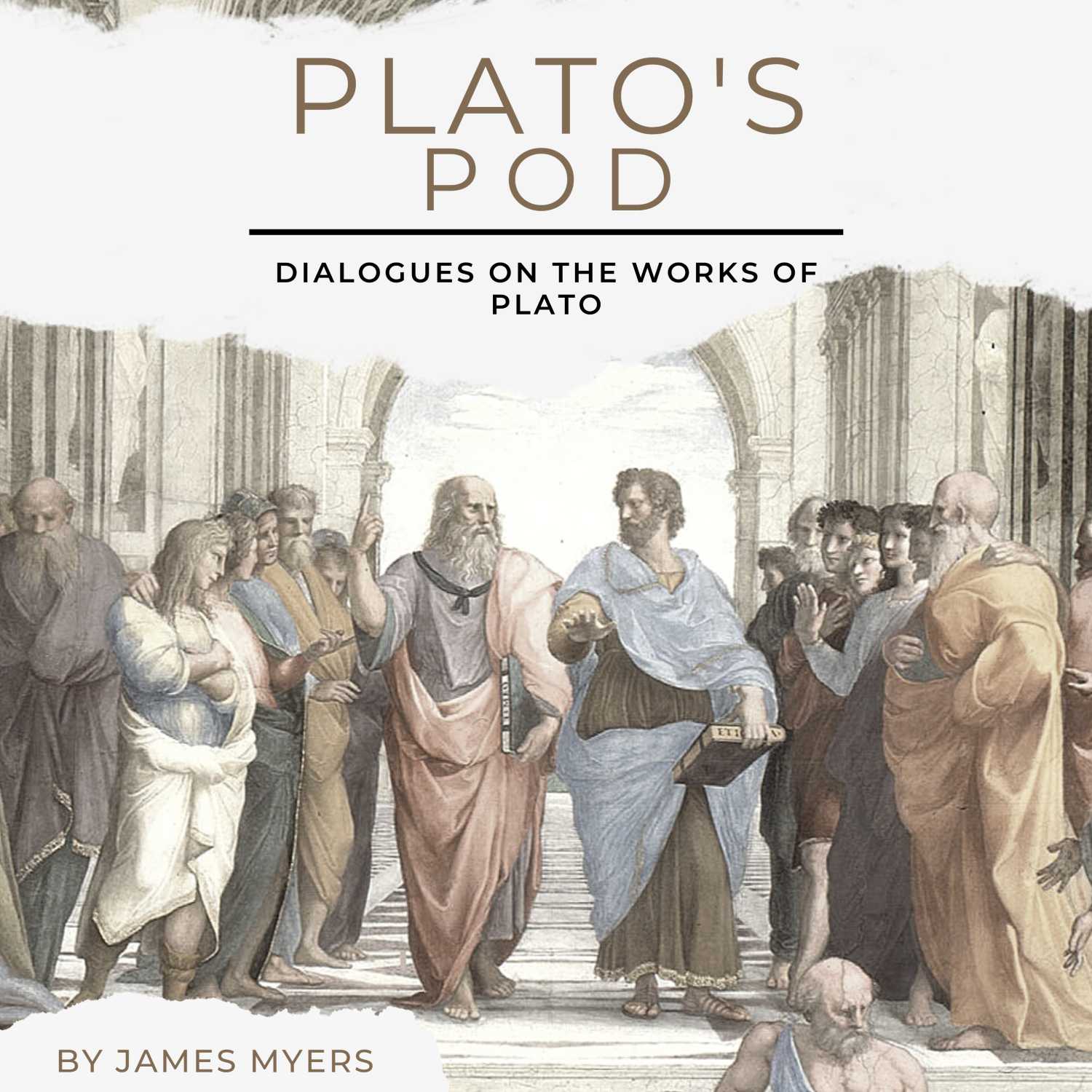
James Myers
Plato's Pod: Dialogues on the works of Plato
Welcome to Plato's Pod, a podcast of discussions on the dialogues of Plato, the philosopher and geometer who wrote nearly 2,400 years ago. Hosted by amateur philosopher James Myers, the first four seasons of the podcast featured group discussions and some incredible insights on many of Plato's works. Now in our fifth season, we continue to probe the philosophy of Plato's dialogues, with invited guests discussing selected topics and applying the timeless philosophical principles to contemporary issues and circumstances. We welcome your thoughts and suggestions for discussion topics, and please...
Be sure to visit the podcast's website and support the creator: rss.com
Where to listen?
Podcasts in the app Replaio Radio Coming soonPodcasts are coming to the app soon. Install now and be the first to see a whole new take on podcasts
 Install for free
Android almost 10M downloads · 4.8 rating
iOS soon
Install for free
Android almost 10M downloads · 4.8 rating
iOS soon
Episodes
Plato’s Timaeus Revisited, Part III: Perceiving Imitations of Being as they Become 17.11.2023 1:59:38
How does perception of shape relate to our understanding of time, when everything we see, touch, taste, smell, and hear is in a constant state of motion and change? The question occupied members of the Toronto, Calgary, and Chicago Philosophy Meetup groups on November 5, 2023 in reading the assertions of the astronomer Timaeus on the interplay of proportions and probabilities in a spherical univer...
Plato's Timaeus Revisited: Part II - A Universe Centered on the Soul 03.11.2023 1:50:20
Plato’s Pod continues its coverage of Plato’s Timaeus , from 30(d)-47(e) where the astronomer Timaeus explains the construction of the universe centered on the soul. On October 22, 2023, members of the Toronto, Calgary, and Chicago Philosophy Meetup groups discussed the soul’s vantage in the timeless realm of Being relative to motions in the universe’s physical realm of Becoming, and our capacity...
Plato's Timaeus Revisited: Part I – Cities in Motion for both Observer and Observed 15.10.2023 1:54:23
Why does Plato’s Timaeus , on the creation of the universe, begin with Socrates disavowing the imagined city of The Republic ? As Socrates and the astronomer Timaeus review their discussion of the previous day, which was the basis of Plato's epic on justice and political organization, Socrates declares that he can’t picture the idealized city in motion. It’s a question discussed by members of the...
What Would Socrates Say About ChatGPT? 25.09.2023 41:12
Plato’s Pod introduces its 4th season by demonstrating the relevance of ancient philosophy to modern technology with the question, “What Would Socrates Say About ChatGPT?” We take Socrates to the offices of OpenAI to meet the company’s CEO, Sam Altman, and imagine the questions that Socrates would have after the technology is explained to him. In the course of the imagined meeting, we bring a numb...
Plato's Crito: The Constitution of Souls 18.07.2023 2:00:38
What is our relationship with the laws of the society of which we are a part, and what should we do when the laws are misapplied by a misguided majority? For Socrates, in Plato’s Crito , the answer was clear: to endure the consequences, since he benefited from Athenian society and its constitution for seventy years. Wrongly convicted, and faced with his execution in two days, Socrates tells his fr...
Plato’s Ion: The Stories That Souls Trade 04.07.2023 1:51:28
“We are all Ions,” one participant observed, and maybe that’s truly the case if each one of us is a link in a storytelling chain. In Plato’s dialogue the Ion, Socrates reminds the title character, who is a proponent of the poet Homer, that since Homer represented an idea, Ion is representing Homer’s representation. With each successive representation, some of the original idea is altered to suit t...
Platio's Symposium, Part 3: Knowledge Versus Mastery, and Love's Light in The Cave 15.06.2023 1:48:05
In the opening of the last third of Plato’s Symposium , the very drunken Alcibiades erupts in a comic and dramatic demonstration of his love for Socrates. When members of the Toronto, Calgary, and Chicago Philosophy Meetup groups met on May 28, 2023, we noted that whereas the previous six speeches were about love in the abstract, Plato chose to end the dialogue with the practical. In our discussio...
Plato's Symposium, Part 2: Love and the Immortal Good 31.05.2023 1:52:11
Speeches on love, first by Aristophanes, then Agathon, followed by Socrates who relates the wisdom of Diotima, lead us to wonder whether love is, as Diotima says, the mortal human's search for the immortality of the universe. On May 14, 2023, members of the Toronto, Calgary, and Chicago Philosophy Meetup groups gathered to piece together the grains of truth from the first six speakers in the sympo...
Plato's Symposium, Part 1: Love's Poetry, Bearing Individual and Universal Truths 12.05.2023 1:46:24
In our first of three sessions on Plato's Symposium, the dialogue on love that occurs among a group of hungover Athenians, participants from the Toronto, Calgary, and Philosophy Meetup groups pointed to grains of truth in the poetry of love presented by three speakers at the symposium. On April 30, 2023 we met to read parts of the three speeches, each of which examines love from a different perspe...
Plato’s Hippias Minor: Truth, Lies, and Feedback Loops 05.05.2023 1:32:12
What is the truth? In our previous discussion, we heard the conclusion of Socrates that measurement is the greatest skill that we can exercise. The title character of Plato’s Lesser Hippias, or Hippias Minor, is unable to separate cause and effect in the motions of time, and the dialogue challenges not only Hippias but the reader to measure the difference that separates truth and lie – not just in...
Plato's Protagoras, Part 3: In Virtue of What Does Good Outweigh Bad? 09.04.2023 1:51:51
In concluding our 3-part series on Plato’s Protagoras, a consensus may have emerged that virtue is not a universal form – but if it has no consistent definition, what is virtue, and can it be taught? Members of the Toronto, Calgary, and Chicago Philosophy Meetup groups convened on March 26, 2023 to consider the teachability of virtue, which is the subject of Plato’s dialogue. If virtue is really a...
Plato's Protagoras, Part 2: Is Virtue One Thing or Many? 24.03.2023 1:52:55
Is there a first principle of virtue? If virtue is knowledge that can be taught, does the teacher need to know the limits of virtue as a single thing - or does virtue consist of a range of attributes, each with different limits that are somehow connected? These and more questions on the nature of virtue were the subject of discussion on March 12, 2023 among members of the Toronto, Calgary, and Chi...
Plato's Protagoras, Part 1: Can Virtue Be Taught? 10.03.2023 1:53:31
Plato’s dialogue Protagoras revolves around the question of whether virtue can be taught. If it can, then how do we define virtue? Is there a universal form for virtue, one thing alone that defines virtue regardless of our cultural, religious, or family circumstances? If virtue is not taught, how would anyone acquire the essential attributes that are needed to govern societies such as ours? Whethe...
Plato's Philebus, Part 3: The Philosopher's Arithmetic 23.02.2023 1:52:18
In our exercise of reason to judge the harmonious mixture of pleasure and knowledge in the good life, Socrates ranks first the skill of measurement. In the conclusion of Plato’s Philebus, we learn that measuring the combination of limits in becoming and the unlimitedness of being requires a special type of ability. On February 12, 2023, members of the Toronto, Calgary, and Chicago Philosophy Meetu...
Plato’s Philebus, Part 2: Does the Universe Have a Soul and Reason? 08.02.2023 1:39:38
Where does the human soul come from, if not the universe of which we are part? The question that Socrates poses relates to his assertion that everything comes to be from a cause, as he and Protarchus search for the causes of the soul’s pleasure in things that in time neither are, nor ever were, nor ever will, be. In the second of three meetings on Plato’s Philebus, members of the Toronto, Calgary,...
Dialogue on the Philebus, Part 1: The Universe of Memory, Knowledge, and Limits 25.01.2023 1:51:12
What is the good? Why do we each measure the good differently, and what calculation do we apply to know the more from the less? Can we really know the good unless we fall in love with the good? These and other questions echoed many of Plato’s other dialogues throughout the first of three discussions on the Philebus, when members of the Toronto, Calgary, and Chicago Philosophy Meetup groups met on...
Plato's Greater Hippias: The Measure of Intelligence 21.12.2022 1:46:44
Time, and our understanding of sequences of cause and effect in the order of time, emerged as themes in our discussion of Plato’s Greater Hippias. Members of the Toronto, Calgary, and Chicago Philosophy Meetup groups began their December 11, 2022 dialogue by considering the difference between intelligence – that the character Hippias claims to possess – and wisdom, which in Plato’s Cratylus Socrat...
Dialogue on the Cratylus, Part 3: Things Good, True, and Beautiful 08.12.2022 1:40:24
We concluded our 3-part series on Plato's Cratylus with another deeply insightful discussion that emerged as we joined thoughts on the nature of things - things being objects of thoughts. We explored the frontiers of thoughts and the motion of their limits, with a fascinating discussion on whether man is the measure of things, the question of what number is, and some thoughts on a logic in the geo...
Dialogue on The Cratylus, Part 2: Being, Becoming, and Limits 22.11.2022 1:42:59
How do we perceive a thing – defined as an “object of thought” – both with limits and without limits? Socrates begins the second part of Plato’s Cratylus by examining our perception of being without limit in the names that we apply to the gods. Then he proceeds to consider differences when limits are applied to things in the continually changing state of becoming in the present. On November 13, 20...
Dialogue on The Cratylus, Part 1: Distinguishing One Thing From Another 07.11.2022 1:34:03
The focus of Plato's dialogue the Cratylus is the origin and use of names applied to things, and our understanding of their meaning in complex ideas exchanged by language. On October 30, 2022 members of the Toronto, Calgary, and Chicago Philosophy Meetup groups began by examining the meaning of the word "thing" as an "object of thought", to establish the very broad and crucial scope of Plato's wor...
Plato's Cratylus and the Forms: Our Perception in Time 22.10.2022 35:53
In this introduction to Plato's Cratylus and season 3 of the podcast, James Myers reviews the highlights of the first two seasons and the relevance of Plato's Theory of Forms. What are the Forms? The question plays a central role in the origin and meaning of the words that we apply to things, which is the subject of the Cratylus and a matter of particular importance to today's technological world....
Modern Technology and Ancient Philosophy: Building the Bridge With Science 29.07.2022 1:37:25
James Myers and Lantern Jack, host of the Ancient Greece Declassified podcast, discuss the relevance of ancient philosophy to modern technology. We explore technological mindsets, communication and the meaning crisis, the linearity or circularity of time, and the importance of memory. As humanity's technological power increases, is there a fundamental role for ancient philosophy in answering the "...
Dialogue on The Parmenides, Session 2: If the One is Not, then Nothing Is 26.06.2022 1:37:25
Season two of group discussions on Plato’s Pod concluded on June 19, 2022, when members of the Toronto Philosophy, Calgary Philosophy, and Chicago Philosophy Meetup groups met to discuss the second half of Plato’s Parmenides and its conclusion that “if the one is not, nothing is.” In our minds, how do we distinguish one thing from another thing, and is it an absolute, universal truth that no thing...
Dialogue on The Parmenides, Session 1: The One and the Many 11.06.2022 1:51:19
In the first of two sessions on the Parmenides, members of the Toronto Philosophy, Calgary Philosophy, and Chicago Philosophy Meetup groups met on June 5, 2022 to discuss the first part of Plato’s most enigmatic dialogue. What, exactly, is “the One” as the revered philosopher Parmenides describes universal being, and is it different from “not many” which are the words that Xeno attributes to all o...
Dialogue on The Statesman, Session 3: Harmony in Time 28.05.2022 1:43:35
In the conclusion of Plato’s Statesman, the Visitor from Elea describes the role of time and the ruler who understands the consequences of time’s causes and effects (as both one and many) to maintain the harmony of the social fabric. But should such an ideal leader, whose role is to orchestrate but not participate in the administration of the state, be constrained by laws established in an earlier...
Similar podcasts








Listen to the Plato's Pod: Dialogues on the works of Plato podcast in Replaio
Radio and podcasts in one app - free, with no sign-up. Install today and do not miss the launch
Replaio is not a podcast publisher; show names, artwork and audio belong to their authors and are distributed through public RSS feeds.