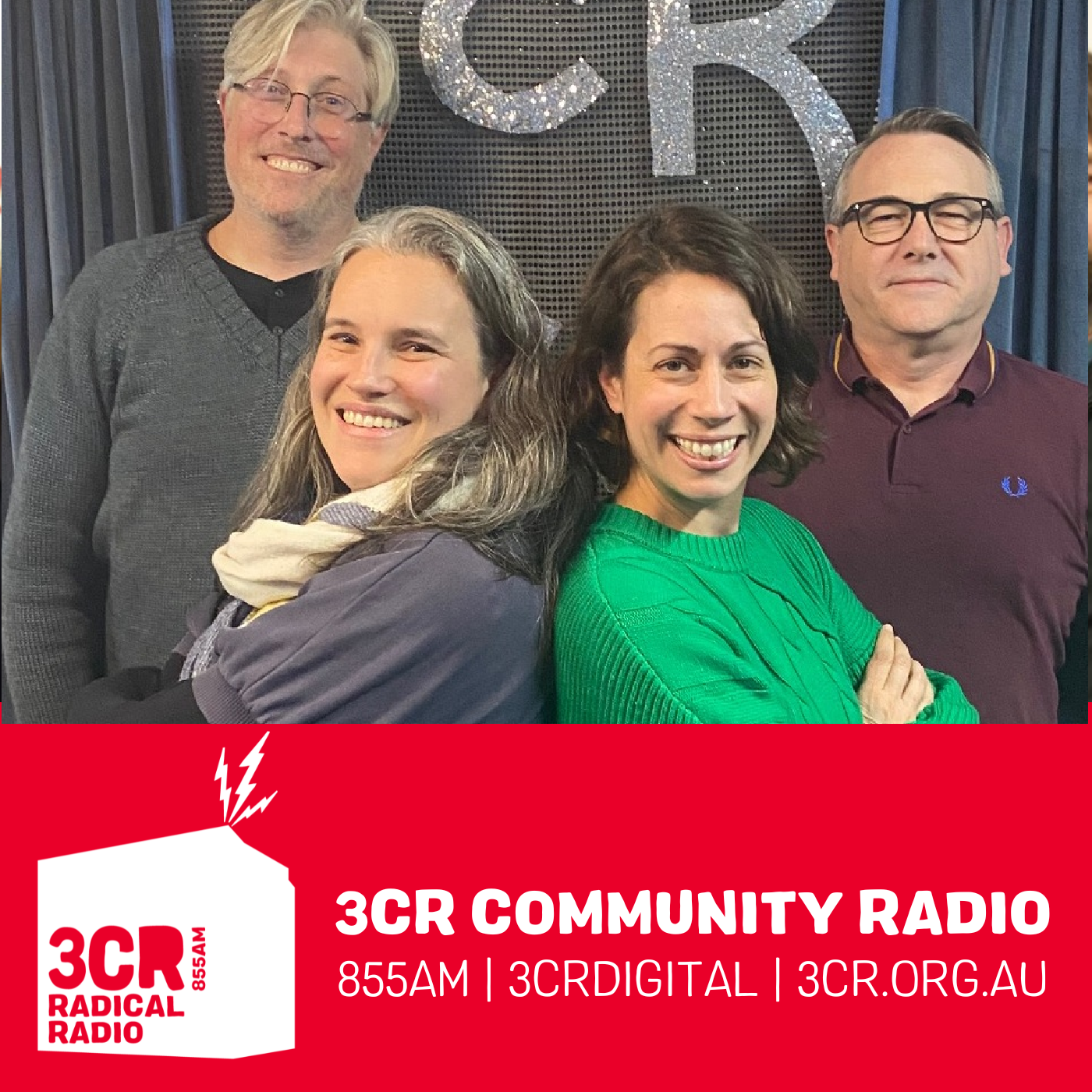
Chris Lassig, Stuart Burns, Claire Farrugia and Linden Ashcroft.
Lost in Science
Lost in Science is your weekly hit of mind-blowing science, strange facts, and big ideas. From cutting-edge discoveries to the science behind everyday life, our curious and passionate hosts make it fun, fast, and fascinating. If it’s weird, wonderful, or just worth knowing - we’re on it.
Be sure to visit the podcast's website and support the creator: www.3cr.org.au
Author
Chris Lassig, Stuart Burns, Claire Farrugia and Linden Ashcroft.
Category
Podcast website
Latest episode
Jul 8, 2026
Where to listen?
Podcasts in the app Replaio Radio Coming soonPodcasts are coming to the app soon. Install now and be the first to see a whole new take on podcasts
 Install for free
Android almost 10M downloads · 4.8 rating
iOS soon
Install for free
Android almost 10M downloads · 4.8 rating
iOS soon
Episodes
National Science Week 2022 10.08.2022
Stu and Claire give us a run down of events in Melbourne, in Victoria, around the country and online for National Science Week (13-21 August 2022), including the schools program based on the International Year of Glass. And Claire gives a taste of questions for Lost in Science's annual trivia night on Monday 15 August. Find out more about National Science Week at scienceweek.net.au
What is the mental health cost of unpaid domestic work and the Eureka Prizes 2022 07.08.2022
Chris talks to PhD candidate Jennifer Ervine about her review paper of the mental health cost of unpaid domestic labour which is largely borne by women, and Stu checks out the winners of the 2022 Eureka Prizes for science from the Australian Museum.
Covid origins and AI sentience 03.08.2022
This week on the show Stu talks us through the two new research papers on the origins of the spread of the covid-19 virus to humans from the wet market in Wuhan. Also on the show, do you think AI can become sentient? Chris looks into the spurious claims that the laMDA AI chat from google is actually a sentient being.
Interstellar telescope discoveries and life from freeze dried skin 27.07.2022
Chris talks about some of the discoveries the new JW space telescope has possibly discovered since booting up in the last few weeks, and Stu looks at a new technique for bringing dead skins back to life which may hold the key to genetic diversity in endangered animal populations.
Return of the reproducing condors and regenerating frogs 20.07.2022
This week we replay a couple of recent favourites: Claire reveals the surprising observation of parthenogenesis, aka 'virgin birth', in the endangered California condor (Gymnogyps californianus), and explains how this is possible, and why the chicks are male thanks to bird sex chromosomes being different from ours; and Stu tells us how it's possible to get frogs to regrow amputated limbs, raising...
Varroa threat to Australian Honey Bees 13.07.2022
Claire talks to Dr. Jay Iwasaki about the invasive pest of honey bees the Varroa mite which was discovered in hives around Newcastle in NSW for the first time.
SIDS breakthrough and International Year of Glass 06.07.2022
This week on the show Chris dives into the recent research about Sudden Infant Death Syndrome, or SIDS, bringing us closer to understanding a biological cause. Also on the show, did you know it's International Year of Glass? Stu talks about why this humble material is so important in our lives, and for science.
Recycling fabrics, and X and Y diversity 29.06.2022
Recycled cotton and polyester are often seen in clothing shops, but Claire tells us about the challenges to making it work, and how there are other ways to reduce waste; and Stu runs us through recent research showing much more common variations in human sex chromosomes beyond the XX and XY you might have learned at school (see more at https://doi.org/10.1016/j.gim.2022.05.011)
Plastic eating grubs and why twine is so strong 22.06.2022
This week on the show Stu speaks to researcher Chris Rinke about his fascinating research investigating how superworms, the larval stage of some beetles, can eat and digest polystyrene breaking it down into organic components. Also on the show Chris gets experimental again, this time showing how twisting threads creates enough friction to make incredibly strong twine and rope.
What is Monkeypox? And is the Hubble constant accurate? 15.06.2022
A new disease on the block is cause for concern, but how much should we be worried about the erroneously named Monkeypox virus? Claire finds out more on this week's show. And Chris explains what the Hubble constant is, and how it should be able to tell us how fast the universe is expanding, but it may reveal potential flaws in the way we think about physics. Photo by Brett Ritchie on Unsplash
First Nations knowledge on show, and mysteries between sleep and wakefulness 08.06.2022
Claire speaks to Barkandji woman, researcher, storyteller and writer Zena Cumpston about the new exhibition Emu Sky at the University of Melbourne, which shines a light on knowledge systems informed by careful observation and scientific methodologies and understanding that have been a fundamental part of the how Aboriginal peoples thrive and shaped this continent continuously for over 65 000 years...
Dolphin communication & overpopulation science 01.06.2022
This week on the show Chris talks with the animals - dolphins in particular, and the new research showing how they communicate with each other verbally and with their urine. Also this week Stu looks at the scientific evidence around human overpopulation
Dolphin communication & overpopulation science 01.06.2022
This week on the show Chris talks with the animals - dolphins in particular, and the new research showing how they communicate with each other verbally and with their urine. Also this week Stu looks at the scientific evidence around human overpopulation
Parasites in your eyes, and lost in migration 18.05.2022
Claire tells us about new research finding that scarring of the retina from toxoplasmosis, a parasitic infection that comes from cats, is surprisingly common; and Stu reveals the amazing feats of some migrating animals, and others that seem to get lost along the way.
Familiaris breeds - content? And life from space! Or at least the alphabet 04.05.2022
Do dog breeds have distinctive personalities based on their genetics? A study into Canis familiaris and their individual canine behaviour questions the assumption that not all dogs are equal. And Claire looks into some astounding discoveries around rocks found on earth that are older than the solar system, and what they might tell us about the origins of terrestrial biology.
Bad honey bees and bogus black holes 27.04.2022
Stu reveals how one of Australia's best-loved and tiniest livestock animals is actually an invasive species that displaces native pollinators; and Chris discusses black holes and how what was believed to be the closest one to Earth is probably a vampire star instead.
Moultin' spider crabs and over charged bosons 20.04.2022
Chris fills us in on the widely reported and misunderstood news about changes to physics as we know it, and Claire chats to Elodie Camprasse about the mass moulting of spider crabs in southern waters of Australia and how anyone can help better understand these creatures by joinging in a citizen science project to track their movements.
Menstruating mice and talking fungi 14.04.2022
This week on the show Claire chats to Dr Jarrod McKenna about the incredible Egypian Spiny mouse and why it is so useful as a model for human reproduction. Also on the show Stu digs into research just published that reportedly fungi can communicate with each other.
Research fraud and retractions part 2, and the magnificent Triceratops 06.04.2022
Chris continues his investigation into fraudulent, dodgy and mistaken science research, and Claire talks to Hazel Richards about the new exhibition at the Museum of Victoria featuring the world's most complete Triceratops fossil ever discovered.
Medical research questions and ozone layer issues 30.03.2022
This week on the show Chris speaks to Professor Ben Mol about his research investigating fraud and misconduct in medical research and his claim that up to 20% of medical research trials are false. Also on the show Stu looks at some new research just released about an old issue, the hole in the ozone layer, and how climate change and catastrophic bushfires effects it.
Animal bites and anaesthetised plants 23.03.2022
Claire tells us about research from Cairns about which animals are most likely to have people go to hospital due to their bites, and what the outcomes are; and Stu explains how anaesthetics that work on humans can also affect plants too.
Mosquito borne encephalitis and global mass extinction 16.03.2022
Claire talks about the recent outbreak of so-called Japanese encephalitis and how it spreads, while Chris takes a look at the greatest hits of global extinction events on earth.
International Women's Day Special 09.03.2022
This week on the show it's our annual International Women's Day special as we celebrate, advocate and work towards a more sustainable and equitable world for women. Claire is joined by climate scientist Dr Linden Ashcroft and neuroscientist and gender equity advocate Dr Emma Burrows.
Food allergy rates flattening, and dinosaurs flattened in spring 02.03.2022
This week, Stu explains how new advice about feeding children allergens earlier seems to be slowing the as-yet unexplained rise in rates of food allergies; and Chris bring us more news from a controversial site with fossils supposedly from the impact that (probably) finished off the dinosaurs, suggesting the asteroid struck in the northern hemisphere spring.
Similar podcasts







Listen to the Lost in Science podcast in Replaio
Radio and podcasts in one app - free, with no sign-up. Install today and do not miss the launch
Replaio is not a podcast publisher; show names, artwork and audio belong to their authors and are distributed through public RSS feeds.