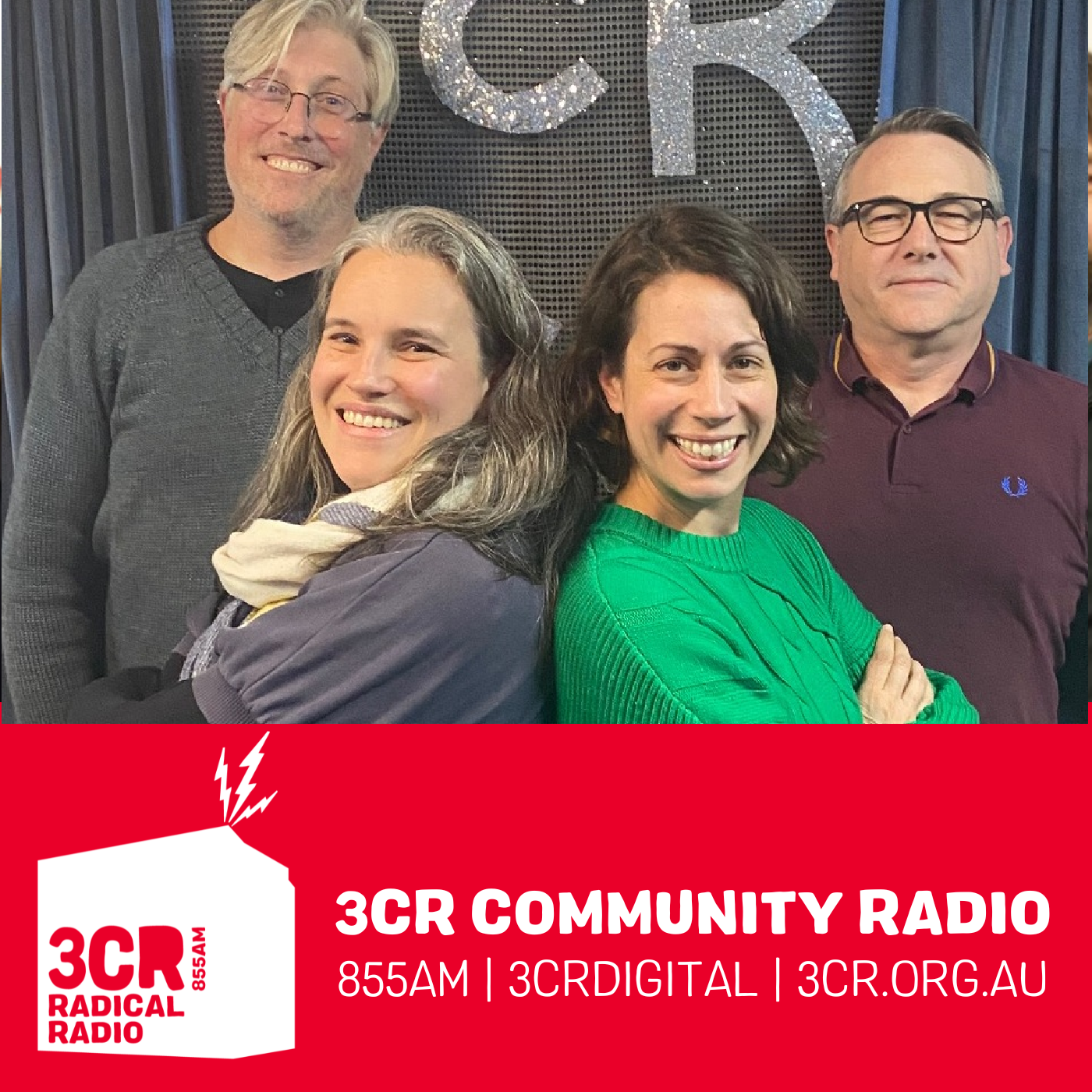
Chris Lassig, Stuart Burns, Claire Farrugia and Linden Ashcroft.
Lost in Science
Lost in Science is your weekly hit of mind-blowing science, strange facts, and big ideas. From cutting-edge discoveries to the science behind everyday life, our curious and passionate hosts make it fun, fast, and fascinating. If it’s weird, wonderful, or just worth knowing - we’re on it.
Be sure to visit the podcast's website and support the creator: www.3cr.org.au
Author
Chris Lassig, Stuart Burns, Claire Farrugia and Linden Ashcroft.
Category
Podcast website
Latest episode
Jul 8, 2026
Where to listen?
Podcasts in the app Replaio Radio Coming soonPodcasts are coming to the app soon. Install now and be the first to see a whole new take on podcasts
 Install for free
Android almost 10M downloads · 4.8 rating
iOS soon
Install for free
Android almost 10M downloads · 4.8 rating
iOS soon
Episodes
Journey to the centre of the earth and the end of homework as we know it. 08.02.2023
Chris takes a trip through the planet core to find out why news reports were telling that the core had stopped spinning, and Stu takes a look at the new technology of ChatGPT, what is it, what does it do, and is it the end of take home exams?
Helpless humans and disruptive discoveries 01.02.2023
Claire returns to Lost in Science this week, to tell us what she’s learnt about her new baby, and how the needs of altricial human infants compare to other precocial animals that are ready to get up and go straight after birth; and Chris examines a new study into how the proportion of disruptive or paradigm-shifting research has declined across fields, and what may be the reasons for that.
Summer Series: Claire talks to Barkandji woman Zena Cumpston about First knowledges of Australia 25.01.2023
A rerun of an interview from June 2022 with Barkandji woman Zena Cumpston, curator of Emu Sky, an exhibition which explores and illuminates Indigenous perspectives related to science, innovation, plant use, land management and agricultural practice. Her book was published in September 2022, co-authored with Michael Fletcher, Lesley Head and is called Plants Past Present and Future
Summer series: Catriona on immunology & ecology 18.01.2023
It’s another Summer Series episode of greatest hits, in which we hear from immunologist and science communicator Catriona Nguyen-Robertson about her recently completed PhD research and direct personal experience of how the immune system's T cells can also target fats and oils; and Catriona also tells us about studies into pharmacological waste or medicines in our waterways, including Prozac (fluox...
Summer Series: Claire talks mammals - protecting monotremes and rise of the warmbloods 11.01.2023
Summer series continues as we hear from Claire about close encounters of a monotreme kind, and how they are being saved in the wild. And also Claire looks into the detective story of figuring out how mammals became warm blooded animals and what it has to do with ears.
Summer series: Michael Mann on climate change 04.01.2023
This week on the Lost in Science Summer Series, we replay our interview with climate scientist Professor Michael Mann about how not to lose hope about climate change, and Chris gives an update on how the climate is looking coming into 2023.
Science stories of 2022: where are they now, and research we missed 28.12.2022
In our final episode for 2022, Stu gives a lightning overview of some of the many important science stories we didn’t have time to cover, and Chris runs back over the stories that have had updates since we last talked about them.
Chemistry of Christmas cooking 21.12.2022
It’s a festive food episode, as Chris digs into the science of Christmas pudding, particularly how it’s cooked so differently to regular cakes thanks to physics and chemistry; and Stu digs even deeper into one of the chemical reactions involved, the Maillard reaction that makes cooked food brown and tasty.
Did humans domesticate cats, or did they decide to keep us as pets? And where are all the Christmas Beetles? 14.12.2022
Catriona investigates the origins of cat people, or more specifically where and when did cats become domesticated. And also, whether they are truly domesticated at all. Chris looks at a favourite insect, the colourful and seasonal Australian Christmas beetle, which many people think is disappearing, but a national citizen science project aims to keep tabs on the flying baubles.
Climate change clarity and celebrating soil 07.12.2022
This week, Chris talks to climatologist Michael Mann, creator of the famous Hockey Stick Graph, about his research into rising temperatures, and what we can do to continue reducing emissions and not give in to doom; and with World Soil Day upon us, Stu gives us a run down on the basics of soil and the new CSIRO website https://ansis.net/Tickets to see Michael Mann in May and June 2023 are availabl...
Medicine waste and ice age asteroids 30.11.2022
This week, Catriona tells us about research into pharmacological waste or medicines in our waterways, including Prozac (fluoxetine) and oestrogen, and the effect they can have on other species; and Chris examines the Younger Dryas Impact Hypothesis, an asteroid or comet strike some believe to have caused additional cooling at the end of the last ice age, and the status of attempts to prove it by f...
The science of olive oil: Interview with Professor Paolo Inglese 23.11.2022
Stu talks to Professor Paolo Inglese, a world expert on olive oil on what has changed and what hasn't in the long history of olive oil.
Methane is from Mars, Phosphine is from Venus, and doing the rat dance 16.11.2022
Chris talks about the possibility of life on our immediate neighbour planets Mars and Venus based on observations of organic chemicals in their atmospheres, and Stu finds out whether rats really like the nightlife and got to boogie on the disco round...
Covid lab leak speculation & revolutionary click chemistry 09.11.2022
This week, Chris examines some recent reporting on the hypothesis that COVID-19 originated as a leak from a laboratory in Wuhan, China, and finds that it’s based less on science than it is on reading between the lines in questionable translations of online documents; and Stu explains the Nobel Prize in Chemistry 2022, which was awarded for the development of “click” and bioorthogonal chemistry.
Nobel prize for physics and reptilian viruses 02.11.2022
Chris walks us through the 2022 Nobel Prize for physics which unravels quantum entanglement, and Stu talks to Emma Harding about her research into amphibian and reptile viruses and what they can tell us about virus evolution.
Lost in Science Fiction! Space plants, hoverboards & wormholes 26.10.2022
It’s our annual Halloween episode where we get lost in science fiction! Catriona explains how the hoverboards and flying cars in Back to the Future II (1989) could become real; Stu explores the practicalities of moving ecosystems to space as seen in the 1972 movie Silent Running; and Chris goes down the path of wormholes as mentioned in 2022’s Thor: Love and Thunder.
Deflecting asteroids and growing Moon plants 19.10.2022
This week, Catriona tells all about the surprising success of NASA's DART mission, which tested a method of colliding a spacecraft with an asteroid to redirect it before it can threaten Earth; and Stu speaks to Tien Huynh from RMIT University about a plan to grow plants on the Moon as part of the project https://lunaria.one/
Peacock spiders and shark noses 12.10.2022
Two interviews from the archives, Claire talks to Joseph Schubert about Peacock spiders, and to Victoria Camilleri Asch about how sharks can smell in water
Once and future humans: The Nobel prize for physiology and how to get babies to sleep 05.10.2022
The Nobel prize for Physiology and Medicine for 2022 looks at the relationship between ancient homnids and modern humans, Chris talks abotu the research that won the prize. Stu looks at the relationship between the newest humans and their immediate ancestors, as science tackles exactly how to get babies to sleep.
Immune cells and nature walks 28.09.2022
This week, our special guest immunologist and science communicator Catriona Nguyen-Robertson tells us about her PhD research and direct personal experience of how the immune system's T cells can also target fats and oils; and Stu shares a new study using brain scans to find out why spending time in nature can reduce the stress of city life.
The 32nd First Annual Ig Nobel Prizes - The Winners! 21.09.2022
It's that time of year again when science recognises its most improbable research by awarding the 32nd First Annual Ig Nobel Prizes to ten research projects that "make you laugh, then make you think". Find out how researchers use ice cream to save the day (again) and why having your ducks in a row is scientifically a good thing.
T. rex evolution and reverse lasers 14.09.2022
This week, Stu shares new research that may explain why the most famous dinosaur, the T. rex, evolved such big heads, plus maybe why they had tiny arms as well; and Chris talks about reverse or anti lasers, which absorb light rather than emit it, and for that to make that sense he tries to explain how regular lasers work too.
Out-of-season coral spawning and mistaken alpha males 31.08.2022
This week, Claire talks to Dr Cathie Page from the Australian Institute of Marine Science about getting coral to spawn out of season in the laboratory; and Stu explains how the concept of alpha males does not in fact correspond to how wolf packs operate in the wild.
Space junk and world's biggest bacteria 24.08.2022
This week on the show Chris revisits the world of space junk, who is putting it up there, and where it comes down. And Stu informs us of a big discovery that is rocking the microbe world - a giant bacteria that you can see with the naked eye!
Hearing the rise of warm blood and more alleged academic misconduct. 17.08.2022
Claire talks about new research that links hearing with the evolution of warm blooded animals, and Chris fills us in on another possible case of academic misconduct linked to Alzheimers research.
Similar podcasts


Listen to the Lost in Science podcast in Replaio
Radio and podcasts in one app - free, with no sign-up. Install today and do not miss the launch
Replaio is not a podcast publisher; show names, artwork and audio belong to their authors and are distributed through public RSS feeds.