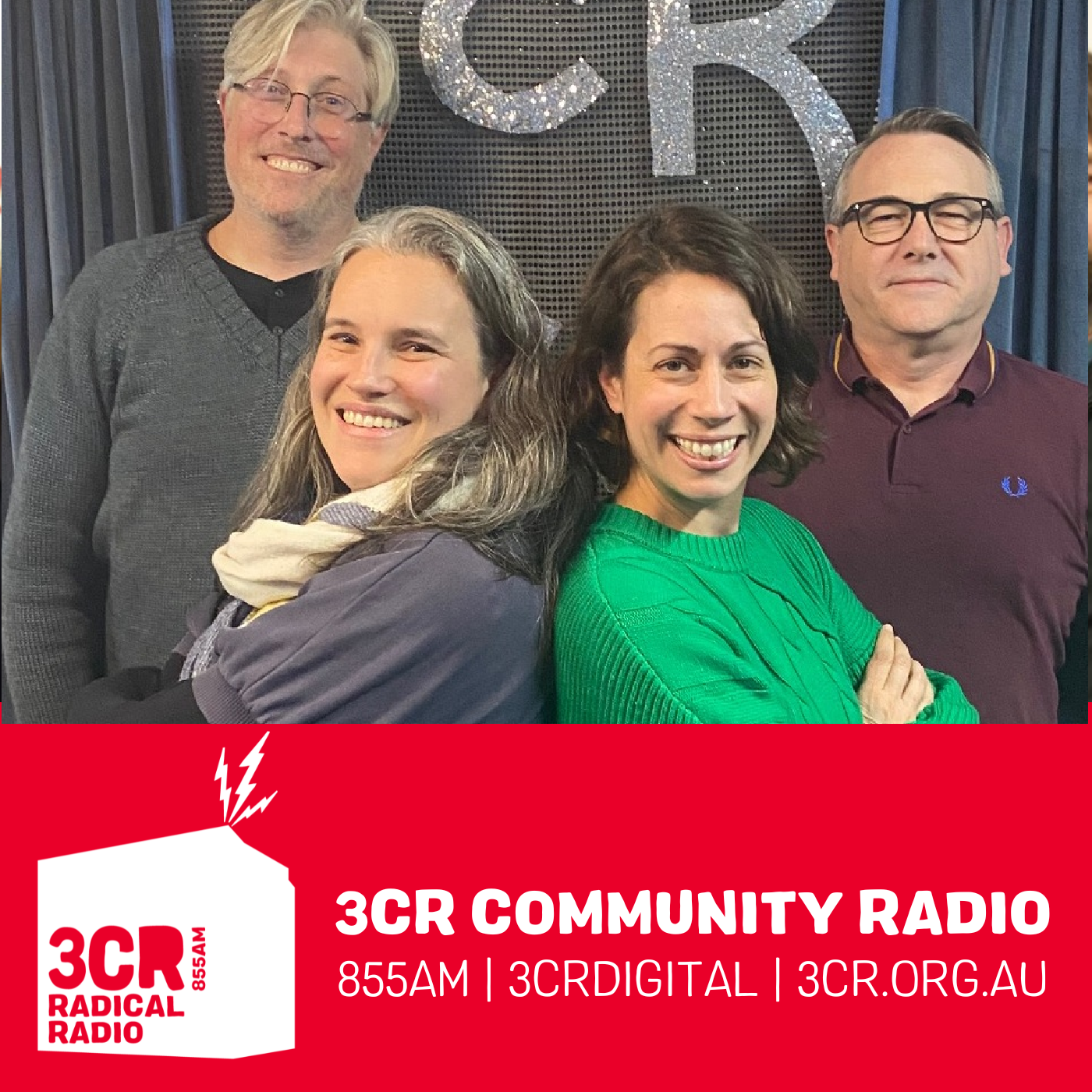
Chris Lassig, Stuart Burns, Claire Farrugia and Linden Ashcroft.
Lost in Science
Lost in Science is your weekly hit of mind-blowing science, strange facts, and big ideas. From cutting-edge discoveries to the science behind everyday life, our curious and passionate hosts make it fun, fast, and fascinating. If it’s weird, wonderful, or just worth knowing - we’re on it.
Author
Chris Lassig, Stuart Burns, Claire Farrugia and Linden Ashcroft.
Category
Podcast website
Latest episode
Jul 8, 2026
Where to listen?
Podcasts in the app Replaio Radio Coming soonPodcasts are coming to the app soon. Install now and be the first to see a whole new take on podcasts
 Install for free
Android 5M+ downloads · 4.8 rating
iOS soon
Install for free
Android 5M+ downloads · 4.8 rating
iOS soon
Episodes
Climate changing Coffee; IgNobel Prizes 2017; Fire affecting native animal habitat 27.09.2017
Claire looks into the future of Ethiopian coffee growing as climate change pushes coffee growers further up mountainsides for the best coffee. Chris runs through the winners of the 2017 IgNobel prizes for scientific research that makes you laugh, then makes you thinkStu talks to Cara Penton from Charles Darwin University who is researching the decline of indigenous mammal species in response to ch...
Training astronauts, microgravity physics and runaway inflammation 20.09.2017
This week, Chris looks at inflammation, which is the immune response that leads to cold symptoms and which is also the subject of much research because of its connection to other conditions. Also, Claire talks to physicist Gail Iles about training astronauts, flying in microgravity, making magnetic nanoparticles and designing cubesats.
Ancient algae blooms brought on animals, Eureka prize wrap up 13.09.2017
Associate Professor Jochen Brocks talks to Stu about the algae explosion that happened 650 million years ago, and offers answers as to how and when animals evolved. Also this week we take a look at Australian science's "night of nights" the Eureka Prizes, and the innovations of some of the winners.
A cure for hiccups and how the heck do magnets work? 06.09.2017
Stu looks at what causes hiccups and if there is a surefire cure, while Chris answers the question "Magnets, how the fudge do they work?"
Bone marrow donation and flesh-eating amphipods 30.08.2017
This week, Claire talks to bone marrow donor Ollie Barrand about what happens in a donation and how it saves lives. To find out more about joining the Australian Bone Marrow Donor Registry, go to www.abmdr.org.auAlso, Chris asks marine biologist Genefor Walker-Smith all about the flesh-eating amphipods that attacked a Melbourne teenager.
Women in museum collections, Ancestry DNA kits and undiscovered elements 23.08.2017
This week on the show Chris explains the science and reliability of ancestry DNA kits. Claire talks to Tilly Boleyn about how are women and their innovations and stories are represented in museum collections. Stu ponders whether there are any undiscovered elements out in the universe.
Cassini's last hurrah, determination of sex, and beyond the eye. 16.08.2017
Stu catches up with the Cassini probe's planned final days in orbit around Saturn, Claire looks at how sex is determined in animals, and Chris talks to Alan Duffy and Cara Santa Maria about their upcoming show in November, Beyond the Eye.
Kilogram changes, slug glue and eligibility for women's sport 09.08.2017
This week, Chris tells us about an impending redefinition of the kilogram, Claire reveals a glue made from sticky slug excretions, and Stu looks at the lack of good science associated with gender testing in sporting competitions.
Bees are alright, Pooping phosphorus and National Science Week 02.08.2017
This week on Lost in Science Stu looks at the buzz around bees and pesticides, specifically one group of pesticides, the neonicotinoids. Is it all gloom and doom as the internet would have us think? Manisha looks at the phosphorus cycle and how megafauna poop plays a bigger role than expected in keeping our soils high in this essential nutrient. And did you know National Science Week is just aroun...
More Bird Brains, You're the Voice, and Chronic Fatigue research 26.07.2017
Manisha looks into research that further shows we should be concerned about how intelligent ravens might be. Claire talks to Tilly Boleyn about current exhibits at the Powerhouse museum in Sydney. Chris looks into research around Chronic Fatigue Syndrome and finds that long standing advice is ignoring the cause of the illness.
Drummer cockatoos and proving Flat-Earthers wrong 19.07.2017
This week on the show Claire talks about the best drummers in the animal kingdom, Palm Cockatoos! New research published recently in Science Advances shos Palm Cockatoos to be the only animal to make a rhythmic beat using sticks as drumsticks and tree hollows for a drum. Also on the show Stu takes on the Flat-Earthers and shares experiments of the past, and ones you can do at home to prove the cur...
Planets Lost in Space, Snails and PTSD, Human origins earlier than previously known 12.07.2017
Chris goes on a journey in search of the lost planets of our own solar system. Manisha looks into a difference kind of space in an effort to understand how PTSD may be treated, and Stu talks to Dr. Renaud Johannes Boyau about new discoveries regarding the origin of the human species.
Wonders from the ocean abyss, and mental health of farmers 05.07.2017
This week Claire talks to Melanie Mackenzie from Museum Victoria about an expedition to the deep sea abyss and the collection of weird animals like zombie worms, sea cucumber herds, and faceless fish (currently on display at Melbourne Museum).Also this episode, Manisha talks about studies showing the mental health problems experienced by farmers and investigating some of the possible causes.
Dustology, Price equation, Galileo goes quantum 28.06.2017
Dust is a part of our lives, but how much do we know about it, and what it is made up of? Claire investigates this seemingly innocuous part of life. Also this week, Stu introduces us to geneticist George Price, whose equation is used by evolutionary genetics to predict how useful a genetic trait will be for a population. And Chris speaks to physicist Dr Magdalena Zych about her research designing...
Testing proof, Mega Brush Turkeys and Peanut allergy advice reversal 21.06.2017
Senator Malcolm Roberts has called for scientific proof of climate change, but he misunderstands the meaning of proof in science by doing so, and also misunderstands how scientific consensus is reached. The brush turkey seems to be coping well with a changed environment, and newly discovered fossils show its ancestors were also adaptable to changes in their environment. Why has medical advice on...
Quantum weirdness, hyperloop technology, and allergy cures 14.06.2017
This week, Chris looks at a weird way quantum physics could let you take a picture of something without looking at it, Claire chats to the Vichyper team who are working on supersonic vacuum tube transport, and Stu speaks to Dr Ray Steptoe about curing allergies.
This show is brought to you by "S"; Scinema, salt wars and simian senses 07.06.2017
This week on the show we speak to Lisa Bailey from Australia's Science Channel about SCINEMA the International Science Film Festival. Stu talks about new research looking at monkey brains, which shows how our brains react to see and recognise different faces. And Chris deep dives into the Cochrane Library to gatehr evidence for the Salt Wars. Not the actual Salt Wars, but looks at the evidence for...
Are some people immune to hangovers? Does salt really make us thirsty? Charlie Marshall on science music. 31.05.2017
Is it true that some people don't get hangovers? We look at some research into why that might be. Also, everybody knows that salt makes us thirsty, but new research suggests that may not actually be the case. And Chris talks to Musician Charlie Marshall about his new album of science related songs, and how science can give a deeper understanding of the universe.
Disappearing insects, social media psychology, and sushi sickness 24.05.2017
Could declining insect populations be the reason windscreens don't seem to be as bug-splattered as they used to be? Two recent publications in Science—an article in 2014 and another in 2017—suggest that's the case. This may also relate to the decline in House sparrow populations overseas—see work by the Royal Society for the Protection of Birds and the British Trust for Ornithology.(If you're inte...
Microwaves, destructive dogs and climate changing species distribution 17.05.2017
Dogs may be our best friends, but they are one of the more ecologically destructive species we don't talk about. Microwaves, how do they work? We find out how they warm up your food, and why it isn't a good idea to stick foil in them. And we speak to Professor Stewart Frusher from the University of Tasmania about how our already changing climate and warming waters are changing where we find specie...
Cycling for Health, What are Parabens? The Impact of roads 10.05.2017
How does a worker's daily commute impact their risk of cancer and heart disease? Researchers in Glasgow wanted to find out. Claire finds out from Dr. Oliver Jones what parabens are, and whether we waqnt them in our cosmetics or notManisha discusses the impact of roads on the natural environment.
A Pint of Science, a March for Science, and Boltzmann brains 03.05.2017
Claire speaks to Anna Sexton about the Pint of Science events happening in pubs around the country on the 15, 16 and 17 May 2017. Find out more at pintofscience.com.au. Also, Chris spots a mention of a bizarre but profound physics concept hidden in a blockbuster movie, and Manisha speaks to the people about why they chose to March for Science on 22 April.
Naked mole rats, artificial sweeteners & negative mass 26.04.2017
Claire gives the inside scoop on the Naked mole-rat. Although it is a mammal, the naked mole-rat lives in a social structure comparable to an ant, thermoregulates like a reptile, and now researchers have found it can survive in very low oxygen environment using a plant-like pathway. Also this week, Chris asks the question - what is negative mass? This comes after claims that scientists have create...
The science of Marathon running, Toxoplasmosis, and the psychology of rumours 19.04.2017
Stu Looks into the science of running a marathon, and whether there are any health risks with thsi increasingly popular race. Manisha finds out more about a common and sometimes deadly parasite Toxoplasma gondiiChris looks into a commonly quoted psychological study and finds it is often used in an ironically incorrect way by those using it as evidence.
FNQ's Thylacine, Siri's secrets and Manisha's bats 12.04.2017
In this episode, Chris speaks to James Cook University's Dr Sandra Abell, who is conducting a scientific search for a Thylacine, or Tasmanian Tiger, in Far North Queensland. Also, Claire explains how the smartphone assistant Siri can understand human and possibly cat speech, and Manisha tells us about her PhD research on how wildlife deals with urbanisation, or why did the bat cross the road.
Similar podcasts





Listen to the Lost in Science podcast in Replaio
Radio and podcasts in one app - free, with no sign-up. Install today and do not miss the launch
Replaio is not a podcast publisher; show names, artwork and audio belong to their authors and are distributed through public RSS feeds.