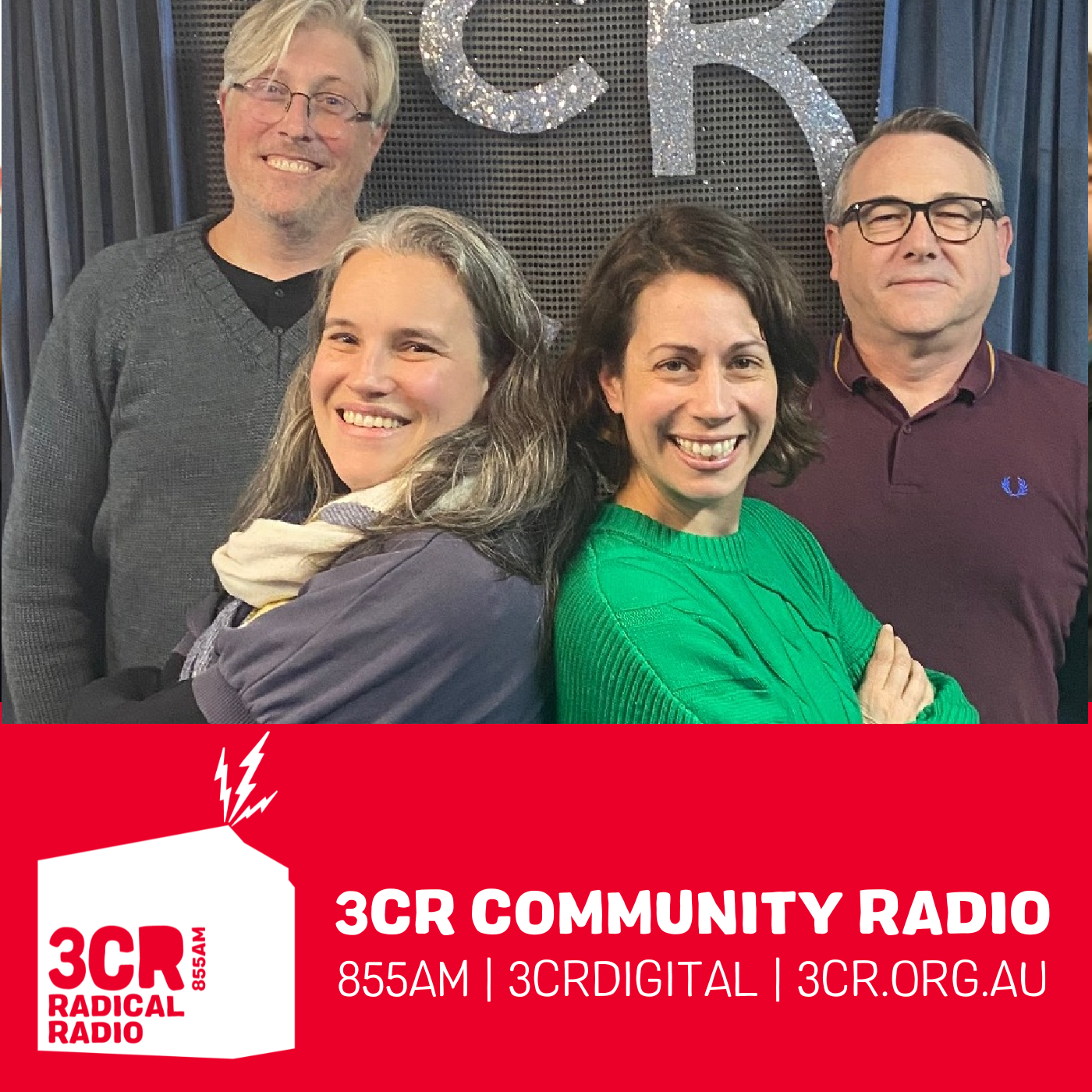
Chris Lassig, Stuart Burns, Claire Farrugia and Linden Ashcroft.
Lost in Science
Lost in Science is your weekly hit of mind-blowing science, strange facts, and big ideas. From cutting-edge discoveries to the science behind everyday life, our curious and passionate hosts make it fun, fast, and fascinating. If it’s weird, wonderful, or just worth knowing - we’re on it.
Be sure to visit the podcast's website and support the creator: www.3cr.org.au
Author
Chris Lassig, Stuart Burns, Claire Farrugia and Linden Ashcroft.
Category
Podcast website
Latest episode
Nov 4, 2026
Where to listen?
Podcasts in the app Replaio Radio Coming soonPodcasts are coming to the app soon. Install now and be the first to see a whole new take on podcasts
 Install for free
Android almost 10M downloads · 4.7+ rating
iOS soon
Episodes
CRISPR De-livers a cure and the galling prospect of lumpy plants 30.06.2021
Chris de-livers a story about a new CRISPR technique which may hold the key to gene therapies for adults with genetic conditions, and Stu has the gall to bring in a story about lumps and bumps on plants, (aka galls) and what causes them.
Spiders ballooning, and inevitable ageing 23.06.2021
Claire explains how sheets of gossamer webs blanketing Gippsland are due to spiders flying away from the floods; and Stu tells us about how research into lifespan equality in humans and other primates shows that longevity may not be able to be extended, or ageing avoided.
Where are all the time travelers? And how an old vaccine is finding new life in medical trials. 09.06.2021
Chris travels back in time to a 2013 paper about traveling back in time and discovers an issue with replication of results and publishing of science journal articles which he attempts to correct. Stu looks at an old vaccine that is offering new hope for auto immune treatment in a variety of conditions which started out as the solution to a major global killer.
Safer poisons for mouse plagues, and science for hippies 02.06.2021
Claire discusses the ongoing mouse plague and the ecological risk of some of the harmful rodenticides being considered with ornithologist Maggie Watson from Charles Sturt University, who also suggests some safer options. And Stu speaks to Tom Thumb about his book and blog "Science for Hippies", which reaches out to people who may be sceptical of science – read more at https://scienceforhippies.com...
Why babies get sick so often, and quadraphonic record players 26.05.2021
Everyone remembers record players, in fact they are making a massive comeback. But what about quadrophonic record players? This week on Lost in Science Stu takes a trip back in time to explain the science behind what used to be cutting edge technology, how does it work, and why it never took off. Also on the show Chris investigates the science to tackle a question on the mind of many young parents...
If the Y chromosome goes extinct, do humans? And how are humans like fish? 19.05.2021
This week on Lost in Science Chris looks into sex genes in mammals and finds out how some species can live with different arrangements of parental genes, and Claire dives deep into the behaviour of Zebra Fish to find out why they are one of the most studied species in the world, and how in many ways they are similar to humans.
Dinosaur discoveries and how to win an argument on the internet 12.05.2021
This week on the show Lost in Science's resident paleontologist Adele Pentland stops by to talk about a pterosaur bone fossil that was later discovered to be into something different, changing what we know about Australian dinosaurs. And Stu answers the very current question of whether it is worth trying to correct people when they say things that aren't true on the internet. Whether you want to d...
Predicting earthquakes and insect extinctions 05.05.2021
This week on Lost in Science Stu talks to Michael Braby about endangered butterflies and how they can represent whole ecosystems in need of protection and how you can help protect them by signing up here, and Chris talks about how both toads and phones can possibly protect people from earthquakes.
Malaria vaccine breakthrough and revisiting the NASA em drive 28.04.2021
News on a different vaccine this week as Stu talks about some of the most recent breakthroughs in the malaria vaccine, and how it is related to the COVID vaccine. Also on the show Chris updates us on what NASA's em drive, which was previously heralded as a potential innovation in space travel despite the fact it defied the laws of physics.
Brain implants, space junk and Elon Musk 21.04.2021
It's all a bit Elon Musk this week, as Claire examines reports of his Neuralink company using brain implants to enable a monkey to play the computer game Pong with its mind (watch the video at https://youtu.be/rsCul1sp4hQ); and Stu looks at the impact of the Starlink satellite network, and how it's contributing to concerns of increasing space junk in low Earth orbit.
Methane eating microbes and the Muon magnetic moments 14.04.2021
This week Claire speaks to Luke Jeffrey about his fascinating new research looking into trees that emit methane and the microbes in their bark that can eat the greenhouse! Also on the show Chris gives us the low down on what a muon is, and why it's measurements are making such huge physics news right now. Could this be big news that changes the way we understand particle physics?
Is the Astra Zeneca causing health problems? And the International Year of Fruits and vegetables 07.04.2021
This week Chris looks into the reports of blood clotting issues associated with one of the covid-19 vaccines to try and figure out if the large scale of the vaccine program is to blame for the appearance of the responses, and Stu has a quick look at the UN's International Year of Fruit and Vegetables and how science can play a role in getting people their apple a day, and convincing them to try th...
Citizen scientist spots peculiar peacock spider hider; and lunar-sea in the Suez Canal 31.03.2021
This week Claire talks to Melbourne Museum's own Spider-Man about a newly discovered peacock Spider that looks like a cartoon fish. Chris explains how the moon helped solve a problem with international global shipping caused by a no float boat.
Interstellar objects and clones that model human embryos 24.03.2021
This week on the show Stu explains the actual research behind the headlines claiming that "scientists have cloned a human embryo" and why it isn't exactly what it seems. And Chris takes us into space to reveal the mystery behind our strangest pancake comet-like interstellar visitor 'Oumuamua!
Warrior women of ancient times and the colonisation of Ascension 17.03.2021
Guess who's back? Back again! Chris is back, tell a friend... Yes Chris returns to the team this week with a story of ancient gender equality based on some interesting new finds which are prompting reinterpretation of gender roles in ancient societies. And Stu takes a trip to Ascension island in the mid Atlantic to look at an island-wide experiment that has been running for 160 years.
International Women's Day 2021; Paleontologist Mary Wade, and stories from a field ecologist 10.03.2021
This week on the show we celebrate International Women's Day in 2021 with all women talking all science. Our guests on the show include Adele Pentland, who tells us the story of one of Australia's greatest palaeontologists Mary Wade and her work which spanned the ages. Also on the show Claire speaks with Manisha Bhardwaj about her current research as a field ecologist in Sweden and what happens wh...
The connection between ideology and ability, is there a link? And cloning goes wild as old genes are brought back to life 03.03.2021
On the show this week, Stu looks into the psychology of ideology, do our abilities influence how we think, or does the way we think affect what we can do? And Claire investigates the world first wild animal clone from North America which opens up new possibilities for conservation efforts
Sunscreen and Vitamin D: is there a connection? And what is the Perseverance rover looking for on Mars 24.02.2021
On the show this week, Stu finds out if there's any evidence sunscreen is making people vitamin D deficient, and Claire talks to Brendan Burns about space, life on Mars and what Perseverance can do for us.
Parasitic blooms and booming animal populations 17.02.2021
This week Stu uses Valentine's Day as an excuse to research flowers, but not your average flower, the ones that bloom from parasitic plants! Also on the show Claire investigates what scientists understand about the booming population of insects and mice up and down the East coast at the moment, and what citizen science apps can be used to track these population explosions.
Can't see the wood? The return of Sputnik 10.02.2021
This week, Stu talks about a new development in making wood transparent which may revolutionise the way we look at the world (through windows), and Claire finds out how a new kind of Sputnik developed in Russia is helping fight covid-19
Victorian Biodiversity Conference, and toxicity detecting spinach 03.02.2021
Welcome back for the first new show of 2021! This week on the show Stu shares some of the science stories that were keeping him interested over the summer period including fascinating research that shows how scientists have engineered spinach that email us if toxic chemicals turn up in the soil. Also this week Claire speaks to Elodie Camprasse and Cassie Speakman about their research and the Victo...
Summer Series; Native grains and quantum fluids 27.01.2021
We will be back soon with all new shows, but in the meantime we are continuing our Summer Series where we look back on some interviews and stories from last year you may have missed. This week, Stu talks to Angela Pattison about her work in investigating indigenous grass species for potential as agricultural grain crops, and Chris talks to quantum physicist Kyla Adams about the quantum forces in o...
Summer series; how do sharks smell and what's up with anti-matter? 20.01.2021
Lost in Science summer series takes you back to an interview with shark biologist Victoria Camilieri-Asch about how well sharks cam smell, and that time when Chris asked what anti-matter really is.
Summer Series; 200 years of nursing and the return of the Zombie Pigs 13.01.2021
Another week of summer, another episode of our Summer Series. This week we have a listen to an interview from last year between Claire and Professor Marie Gerdtz about the 200th anniversary of the birth of Florence Nightingale, and the continued relevance of nursing in the 21st century. Then Stu digs up a story of the pigs that returned to life, or at least parts of them sort of did. Nurses vs Zom...
Summer series; La Niña weather and how to engineer yourself a face mask 06.01.2021
It's Lost in Science Summer Series where we revisit some of our favourite science stories of 2020. This week Stu talks about the La Niña weather pattern, what it is and how it affects Australian climate, and Claire speaks to Professor Sandra Kentish about how to engineer yourself a mask to protect against COVID-19.
Similar podcasts





Listen to the Lost in Science podcast in Replaio
Radio and podcasts in one app - free, with no sign-up. Install today and do not miss the launch
Replaio is not a podcast publisher; show names, artwork and audio belong to their authors and are distributed through public RSS feeds.