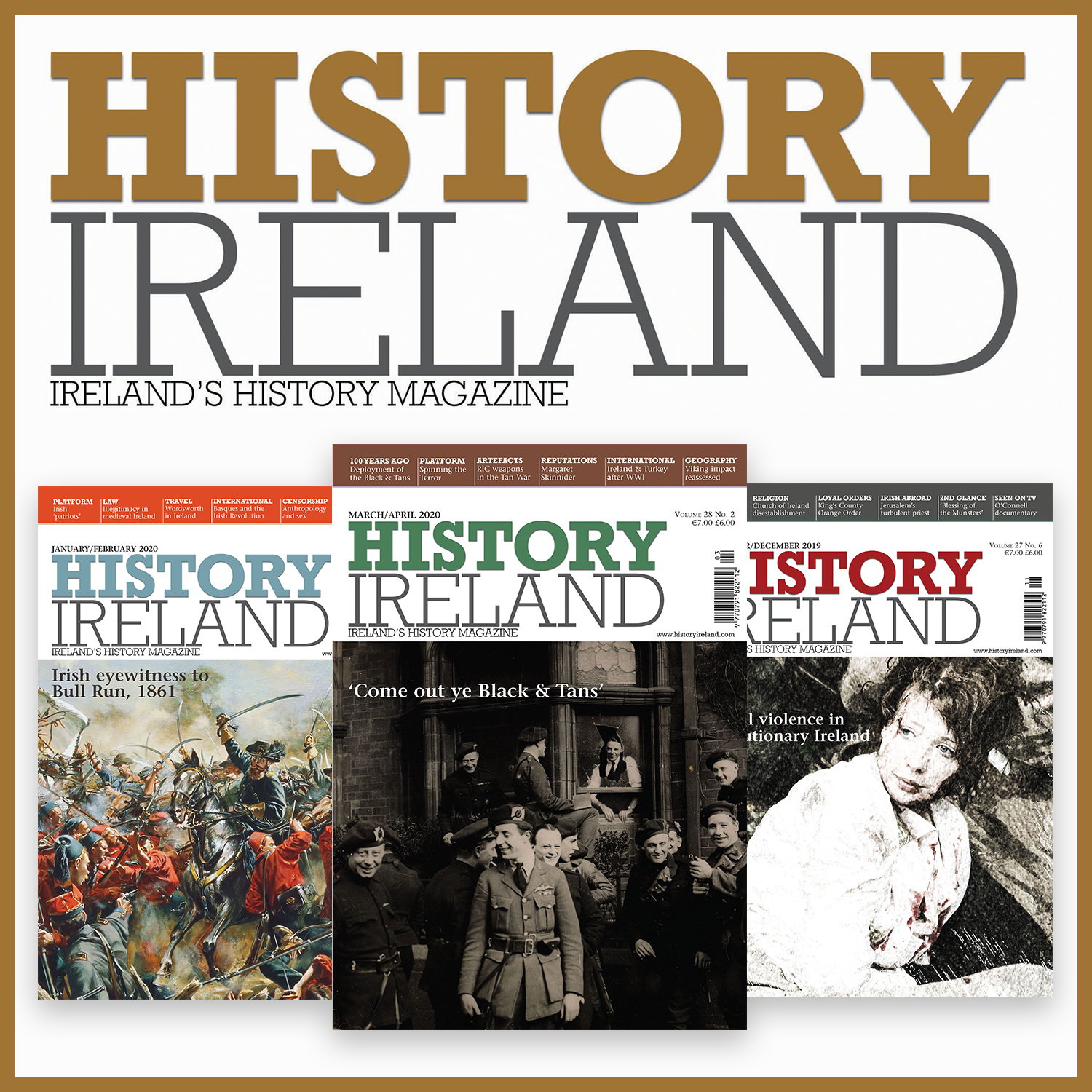
History Ireland
History Ireland
History Ireland magazine has now been in production for over 27 years. The History Ireland Podcast covers a wide variety of topics, from the earliest times to the present day, in an effort to give the listener a sense of the distant past but also to offer a contemporary edge.
Author
History Ireland
Category
Podcast website
Latest episode
Apr 17, 2026
Where to listen?
Podcasts in the app Replaio Radio Coming soonPodcasts are coming to the app soon. Install now and be the first to see a whole new take on podcasts
 Install for free
Android 5M+ downloads · 4.8 rating
iOS soon
Install for free
Android 5M+ downloads · 4.8 rating
iOS soon
Episodes
Dev and the Banner 1917–1926 17.12.2021 1:03:26
On 10 July 1917 Eamon de Valera won a by-election in East Clare, one of a series of victories for Sinn Féin in the run-up to their landslide victory in the general election of December 1918. He would continue to represent the county in the Dáil until his election to the presidency in 1959. What was his relationship with the ‘Banner County’ in the early tumultuous years of his career—War of Indepen...
Pandemics then and now—a reassessment of the 1918 flu in the light of Covid 14.12.2021 55:21
As we enter the third year of the Covid crisis, people the world over are now familiar with the concept and the reality of a ‘pandemic’. But how does it compare and with the previous pandemic—the ‘Spanish flu’ of 1918-19? What are the similarities? What are the differences? To address these and other questions join History Ireland editor, Tommy Graham , in discussion with Patricia Marsh , Ida Miln...
The Treaty—good deal or bad deal? 06.12.2021 1:01:06
Was the Treaty ‘Home Rule for slow learners’? Why was Eamon de Valera not part of the Irish delegation? Was the subsequent Civil War inevitable? Was it a good deal or a bad deal? To address these and other questions join History Ireland editor, Tommy Graham, in discussion with John Gibney, Brian Hanley, Mary McAuliffe, and David McCullagh. The Hedge School series of podcasts is produced by History...
Colmcille 1500—man, myth and memory 12.11.2021 1:01:14
Columba or Colmcille was born 1500 years ago in Gartan, Co. Donegal, and claimed descent from the legendary High King of Ireland, Niall of the Nine Hostages. He entered the church, became a missionary evangelist, and is credited with spreading Christianity to Scotland. In particular, he founded the abbey on Iona, which became the dominant religious and political institution in the region for centu...
Ireland and the ‘Greater War’ in Europe—compare and contrast 05.11.2021 1:10:12
While there were optimistic hopes that the First World War or ‘Great War’ would be ‘the war to end all wars’, post-1918 Europe, including Ireland, instead experienced a ‘Greater War’—a series of civil, border and ethnic conflicts—that lasted at least until 1923. How did Ireland fit into that paradigm? Was it typical or atypical of the period? Join History Ireland editor, Tommy Graham , in discussi...
‘Grand and Royal’—a history of Irish canals 29.10.2021 58:00
One of the unsung successes of the 1998 Good Friday Agreement was the establishment of the all-island body, Waterways Ireland, with responsibility for canals and waterways. But what drove the construction of the former in the first place? How important were they to the Irish economy at their height? How and why did they decline? And what are the prospects for their renaissance under the new dispen...
Crowd-funding the revolution—the underground administration 24.09.2021 1:11:16
Dáil Éireann sought not only to take back the political control lost in the 1800 Act of Union, but also the fiscal and monetary powers lost with the merger of the Irish and British exchequers in 1817. It also established a parallel legal system, the ‘Dáil Courts’, and, especially after the local elections of 1920, sought to control local government. To assess the success of these efforts join Hist...
Prisons and prisoners during the War of Independence 09.09.2021 1:12:39
On 9 September 1921 over fifty IRA prisoners staged a break-out—one of several during the War of Independence—from Rath internment camp in the Curragh, Co. Kildare. To mark its centenary, and to discuss the wider significance of prisons and prisoners in the revolutionary period, join History Ireland editor, Tommy Graham , in discussion with James Durney , Mary McAuliffe , William Murphy , and Liam...
Kenmare: History and survival—Fr John O’Sullivan and the Famine Poor 03.09.2021 27:49
Listen to author Colum Kenny in conversation with History Ireland editor, Tommy Graham, as he discusses the story of a remarkable man’s efforts to help starving people during the Irish Great Famine. He reveals their terrible experiences inside and outside one of the national ‘workhouses’ and throws new light on the relationship between class, religion and poverty in Ireland before independence. J...
Fingal in the revolutionary decade 27.08.2021 54:43
To what extent did the military tactics of Thomas Ashe's (5th) Fingal battalion of the Irish Volunteers in 1916 prefigure those of the IRA in the War of Independence, 1919-21? To what extent did the sack of Balbriggan in September 1920 provide the template for subsequent reprisals by Crown force? To discuss the role of Fingal (North County Dublin) in the revolutionary decade join History Ireland e...
The propaganda war in the revolutionary decade 13.08.2021 1:08:20
According to British Prime Minister David Lloyd George Irish nationalists were ‘natural propagandists’. How accurate was this description? How did they breach what Arthur Griffith called the ‘paper wall’ of British news coverage? How important was the new medium of film? And what was the role of women as both the disseminators and objects of propaganda? To address these and other questions tune in...
Faith and Fury: the evangelical campaign in Dingle and West Kerry 1825–45 06.08.2021 31:28
Author Bryan MacMahon in conversation with Tommy Graham (editor, History Ireland ) In West Kerry between 1825-45, the work of Protestant evangelicals was widely hailed as a model of a successful missionary campaign; however, it evoked a furious response from Catholic priests. The war of words between clergymen of both persuasions was fomented by rival local newspapers, reaching a climax in a notor...
Kilkenny in the Revolutionary Decade 23.07.2021 1:09:27
Kilkenny was described by Ernie O’Malley as ‘slack’ during the War of Independence. Was this really the case? Kilkenny has a notable revolutionary history—as crucible of the Tithe War (1830s), birthplace of one the founders of the IRB, James Stephens (1858), and a rebel turnout, albeit small (1916). Also, the attack and capture of Hugginstowm RIC barracks by the IRA in March 1920 was one of the e...
The Truce 11.07.2021 1:13:09
A century ago, at noon on 11 July 1921, a truce came into effect in the Anglo-Irish war between the IRA and Crown forces. Why did it happen then—and why had peace feelers in late 1920 failed? What motivated each side to sue for peace? What were their expectations? To address these and other questions tune in to History Ireland editor, Tommy Graham , in discussion with John Dorney , David McCullagh...
George V’s opening of the Northern Ireland parliament 22.06.2021 1:06:54
On 22 June 1921 King George V officially opened the Northern Ireland parliament, thus confirming the existence of Northern Ireland as set out in the 1920 Government of Ireland Act. Moreover, since the formation of the Ulster Special Constabulary in autumn 1920 it also had the means to defend itself. To discuss these and related matters tune in to History Ireland editor, Tommy Graham , in discussio...
Mayo in the Revolutionary Decade 11.06.2021 1:15:51
Despite a notable revolutionary pedigree—scene of a French invasion in support of the 1798 Rebellion and cradle of the Land League in 1879—Mayo was a ‘slow starter’ in the War of Independence, with major IRA engagements with Crown forces only starting in the spring of 1921. It was also the scene of major agrarian unrest. Listen to History Ireland editor, Tommy Graham , in discussion with James L...
The First Irish Cities: an eighteenth-century transformation 09.06.2021 44:35
Author David Dickson in conversation with Tommy Graham (editor, History Ireland ) The untold story of a group of Irish cities and their remarkable development before the age of industrialization. A backward corner of Europe in 1600, Ireland was transformed during the following centuries. This was most evident in the rise of its cities, notably Dublin and Cork. David Dickson explores ten urban ce...
The burning of the Custom House, 25 May 1921 25.05.2021 1:11:49
On 25 May 1921, Dublin’s Custom House, headquarters of the Local Government Board of Ireland, was occupied and then burnt in an operation involving over 100 IRA volunteers. It has long been regarded as a propaganda coup but a military disaster for the IRA. But are either of these assumptions correct? Did it disrupt British administration? Did it disable Dublin’s IRA subsequently? What does it tell...
Conceived in controversy—230 years of the Custom House 14.05.2021 1:14:05
Today James Gandon’s neoclassical masterpiece is one of the most recognizable and well-regarded buildings in Dublin. Its completion in 1791 marked yet another instalment in the movement of the axis of the Georgian city eastwards. Yet over the ten years of its construction it was regarded as a ‘white elephant’, built in what was then a swamp, with substantial cost overruns—even provoking the ire of...
Wexford in the Revolutionary Decade 23.04.2021 1:05:11
While not in the vanguard of armed activity during the War of Independence, Wexford has the distinction of being one of the few counties outside Dublin that saw action during the 1916 Rising. On the other hand it was also one of the few places where John Redmond’s (a native of the county) Irish Parliamentary Party maintained a substantial level of support throughout the revolutionary period. To in...
A History of Partition from the 1920 Government of Ireland Act to Brexit 09.04.2021 1:17:44
While the constitutional outcomes of the revolutionary period have evolved over time, one has remained constant over the past century—partition. While a previous Hedge School in December 2020 examined how that came about in 1920/21, this discussion will focus on its effects over the following century, up to and including the uncertainly caused by Brexit and growing calls for a border poll on Irish...
Crossbarry, Co. Cork—the biggest engagement of the War of Independence 19.03.2021 1:09:31
At Crossbarry, Co. Cork, on 19 March 1921 over 100 IRA volunteers, under the command of Tom Barry, were almost surrounded by a combined force of regular British Army and Auxiliaries of at least ten times that number. What happened? What were its consequences? And what does it tell us about the conduct of the War of Independence generally? Listen to History Ireland editor, Tommy Graham in discussio...
Clare in the revolutionary decade 12.03.2021 1:19:29
Despite its apparent geographical isolation, with the Atlantic Ocean to the west and north, and the River Shannon to the south and east, County Clare has been centre stage in Irish political life, from the election of Daniel O’Connell in 1828, to the equally ground-breaking election of Eamon de Valera in 1917, and was one of the most active counties in the War of Independence. Join History Irelan...
Limerick 6/7 March 1921 Curfew Murders 07.03.2021 1:11:30
On the night of the 6/7 March 1921, the Mayor of Limerick, George Clancy, his predecessor, Michael O’Callaghan, and IRA Volunteer Joseph O’Donoghue, were shot dead by an Auxiliary death squad lead by Maj. George Montagu Nathan. How did these killings fit into the wider story of Limerick during the revolutionary decade? Tune in to History Ireland editor, Tommy Graham , in conversation with Brian Ha...
Gaelic Ulster in the Middle Ages: history, culture and society 15.02.2021 50:11
Author Katharine Simms in conversation with Hiram Morgan (UCC) Gaelic Ulster was once a vigorous, confident society, whose members fought and feasted, sang and prayed. It maintained schools of poets, physicians, historians and lawyers, whose studies were conducted largely in their own Gaelic language, rather than in the dead Latin of medieval schools elsewhere in Europe. This monumental book exp...
Similar podcasts



Listen to the History Ireland podcast in Replaio
Radio and podcasts in one app - free, with no sign-up. Install today and do not miss the launch
Replaio is not a podcast publisher; show names, artwork and audio belong to their authors and are distributed through public RSS feeds.