History Ireland
History Ireland
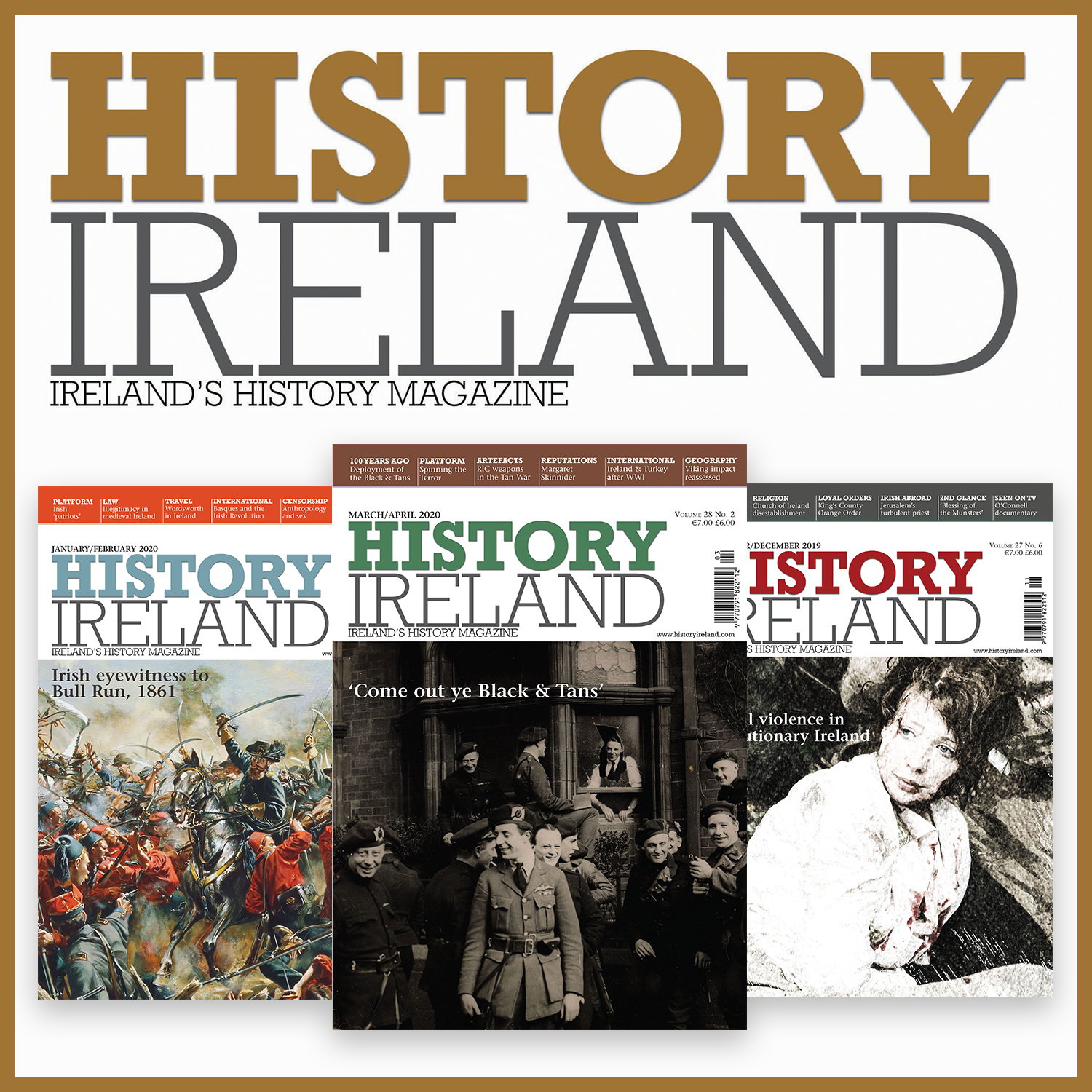
History Ireland magazine has now been in production for over 27 years. The History Ireland Podcast covers a wide variety of topics, from the earliest times to the present day, in an effort to give the listener a sense of the distant past but also to offer a contemporary edge.
Author
History Ireland
Category
Podcast website
Latest episode
Apr 17, 2026
Where to listen?
Podcasts in the app Replaio Radio Coming soonPodcasts are coming to the app soon. Install now and be the first to see a whole new take on podcasts
 Install for free
Android 5M+ downloads · 4.8 rating
iOS soon
Install for free
Android 5M+ downloads · 4.8 rating
iOS soon
Episodes
Katharine O’Shea centenary—what if she and Parnell never met? 05.02.2021 1:07:17
No other woman who never set foot on the island—with the possible exception of Queen Elizabeth I—has had a greater effect on the history of Ireland. But who was Katharine O’Shea (née Wood)? And what if she and Charles Stewart Parnell never met? Listen to History Ireland editor, Tommy Graham , discuss this contrafactual with Mary Kenny , Patrick Maume , Daniel Mulhall , and Margaret O’Callaghan . ...
‘Spies and informers beware!’—intelligence and counterintelligence in the War of Independence 20.01.2021 1:15:34
One of the most important—and controversial—aspects of the War of Independence was the ‘intelligence war’. Given the role of spies and informers in defeating previous insurrections, it is not surprising that Michael Collins, the IRA’s Director of Intelligence, was keen to insure that history did not repeat itself. How successful was he? To shed light on this ‘shadow war’ listen to History Irelan...
Kildare in the revolutionary decade 11.01.2021 1:12:20
While not in the vanguard of armed activity during the War of Independence, Kildare was central to the ‘revolutionary decade’ as whole, not only for its strategic importance and proximity to Dublin but in particular as the site of the largest British military establishment at the Curragh and elsewhere. It also has the dubious distinction of being the county worst affected by the flu pandemic of 19...
Wicklow in the revolutionary decade (part 2, South) 01.01.2021 1:07:41
While not in the vanguard of armed activity in the revolutionary decade, Wicklow was, nevertheless, active in other respects. Moreover, its unique characteristics—proximity to Dublin, pioneering development of tourism, and one of the highest Protestant populations outside Ulster—make it worthy of study. Join History Ireland editor, Tommy Graham in discussion with Sheila Clarke (Ashford), Brendan F...
Wicklow in the revolutionary decade (part 1, North) 07.12.2020 58:10
While not in the vanguard of armed activity in the revolutionary decade, Wicklow was, nevertheless, active in other respects. Moreover, its unique characteristics—proximity to Dublin, pioneering development of tourism, and one of the highest Protestant populations outside Ulster—make it worthy of study. Listen to History Ireland editor, Tommy Graham in discussion with Rosemary Raughter (Greystones...
The Government of Ireland Act 1920—100 years of partition 01.12.2020 1:07:29
Originally conceived as a ‘temporary’ amendment to the Third Home Rule Act, on the statute book since 1914, the 1920 Government of Ireland Act was presciently derided by the Freeman’s Journal as ‘the Dismemberment of Ireland Bill’—partition was the only element of it to endure. How did it come about and what were its effects over the following century? Listen to History Ireland editor, Tommy Gra...
History, Memory and Bloody Sunday 1920 18.11.2020 1:06:14
The events of Sunday 21 November 1920 are well named. Within fifteen hours on that fateful day, 32 people died: in the morning, eleven British intelligence officers killed by Michael Collins’s ‘squad’ (plus two Auxiliaries and two civilians); in the afternoon, fourteen civilians killed by British forces at Croke Park (including player Michael Hogan of Tipperary); and that evening, in murky circums...
Belfast and the North 1920-22 09.11.2020 56:49
As the War of Independence raged in southern Ireland a different type and more deadly form of conflict erupted in the northeast, and in Belfast in particular. Should this be considered part of the overall Irish revolution? Or a separate and distinct conflict with its roots in the sectarian geography of city? What was the long-term effect on community relations and on the formation of Northern Irel...
Bloody Sunday 1920—the Tipperary Connection 02.11.2020 1:11:23
Founded in Thurles in 1884, the GAA has had a long association with Tipperary, an association intensified by the events of Bloody Sunday, 21 November 1920, when Crown forces attacked a Dublin vs Tipperary football match at Croke Park. Three of the fourteen victims were from Tipperary, including, famously, the only player killed on the day, Michael Hogan. Listen to History Ireland editor, Tommy Gra...
Commemorating Bloody Sunday in the Junior Cycle history classroom 30.10.2020 1:00:31
In the early morning of Sunday 21 November 1920 units of Dublin’s IRA assassinated 11 suspected British intelligence agents; two Auxiliaries and two civilians were also killed. That afternoon Crown forces opened fire on the crowd at a Dublin vs Tipperary football match in Croke Park, killing 14 people. Later that evening senior IRA officers Peadar Clancy and Dick McKee, and civilian Conor Clune, w...
The West’s awake!–Revolution in Roscommon 1916-1921 27.10.2020 1:23:59
Roscommon was one of the first counties to reflect the ‘utter change’ of the post-1916 period, with the election of the first Sinn Féin-backed MP in February 1917; in less than two years that party would win a landslide victory in the general election of 1918. But that mandate for independence was ignored by the British, resulting in the War of Independence. How typical of that transformation was...
‘In Mountjoy Jail one Monday morning…’—the Irish Revolution in ballad and song 16.10.2020 1:16:22
Kevin Barry is one of the most popular, and certainly one of the most sung, of Irish ballads. But who was Kevin Barry? Why was he immortalized in song? And what has been the significance of the ballad tradition generally in the Irish Revolution and, indeed, of the Irish Revolution in the ballad tradition? Listen to History Ireland editor, Tommy Graham , in discussion with Liz Gillis , Eunan O’Halp...
'Eye of the storm?’—Dublin and the War of Independence 29.09.2020 1:26:28
Seat of Crown administration since the twelfth century, and still bearing the physical scars of the 1916 Rising, during the War of Independence Dublin was also GHQ of the IRA and the location of the underground Dáil administration. To find out how the conflict played out between the two sides join History Ireland editor, Tommy Graham , in discussion with Donal Fallon , John Gibney , Liz Gillis a...
'Better a state without public records than public records without a state’? 24.09.2020 1:12:46
'Better a state without public records than public records without a state’?— state formation, archives and commemoration So said Winston Churchill in reference to the Irish Free State on hearing news of the destruction of the Public Records Office in the Four Courts in June 1922 at the outbreak of the Civil War. But in many respects, this also applies to Northern Ireland whose Public Records Offi...
Nenagh and North Tipperary during the revolutionary decade 21.09.2020 1:23:02
Having considered the ‘global’ impact of the Irish revolution in the last podcast ( The Irish Republic abroad in 1920—Dev in America ), this Hedge School zooms in on the ‘local’—the market town of Nenagh and the surrounding North Tipperary area during the revolutionary decade—but also sets events in the wider national context. Listen to Tommy Graham , editor of History Ireland , in discussion wi...
The Irish Republic abroad in 1920—Dev in America 01.09.2020 1:16:24
While the War of Independence raged in Ireland, a parallel international diplomatic campaign for recognition and funding for the underground Irish Republic was being waged. Central to this was the tour of Éamon de Valera, ‘President of the Irish Republic’, to the United States from June 1919 to December 1920. To assess its success or otherwise listen to Tommy Graham , editor of History Ireland...
IRELAND, EMPIRE AND THE SEA 07.08.2020 1:12:54
The great voyages of discovery (Columbus, de Gama, etc.) shifted the centre of gravity of European maritime trade from the Mediterranean to the Atlantic. Over the same period the conquest of Ireland was completed. By the eighteenth century, Ireland, for centuries on the periphery of Europe, found itself at the centre of this newly formed ‘Atlantic world’ as part of the British Empire. Listen to...
Terence MacSwiney—martyrdom, civil resistance & the Irish Revolution 01.08.2020 1:07:18
This podcast is part of the History Ireland Hedge School programme supported by the Department of Culture, Heritage and the Gaeltacht under the Decade of Centenaries 2012–2023 initiative. Terence MacSwiney—martyrdom, civil resistance & the Irish Revolution On 25 October 1920, after 74 days on hunger strike, Terence MacSwiney, lord mayor of Cork, died in Brixton Prison. His death not only e...
Cork—Crucible of the War of Independence 06.07.2020 1:13:07
Why was it that Cork (county and city), which accounted for c. 10% of the country’s population, produced nearly 25% of those killed in the War of Independence? What role did its substantial ( c. 10%) non-Catholic (mainly loyalist) population play? Did individual IRA commanders like Tom Barry make a difference and what was the significance of the engagements he led at Kilmichael and Crossbarry? ...
Derry and the North-West, 1920–22—War of Independence or Communal Conflict? 30.06.2020 1:17:43
Historians have long contrasted the more nakedly sectarian conflict in Belfast ( c. 500 deaths in 1920–2) with the conduct of the War of Independence elsewhere. With disturbances costing twenty lives in June 1920, Derry seemed to be heading the same way but never reached the same level of intensity. Why not? What was the relationship between the city and its rural hinterland, including Donegal? Wh...
The Connaught Rangers Mutiny—1920, 1970 & 2020 28.06.2020 1:09:34
On 28 June 1920, five men from C Company of the 1st Battalion of the Connaught Rangers led a mutiny in Jalandhar, Punjab, in protest against martial law in Ireland. Following their surrender a few days later, 88 mutineers were court-martialled, of whom 77 were imprisoned; the leader, James Daly, was executed. The imprisoned mutineers were released in 1923; they returned to Ireland, and in 1936 wer...
Henry Grattan 200 years on—a misunderstood legacy? 06.06.2020 1:12:27
Born in Dublin’s Fishamble Street in 1746, but resident for most of his life in Tinnehinch, near Enniskerry, Co. Wicklow, Henry Grattan was the most noted, and certainly the most eloquent, of the eighteenth-century opposition ‘patriots’ in the Irish Parliament. To mark the bicentenary of his passing and to reassess his often misunderstood legacy, listen to History Ireland editor Tommy Graham in d...
Soviets, strikes and land seizures—class conflict & the Tan War 30.04.2020 1:05:45
This Podcast is part of the History Ireland Hedge School programme supported by the Department of Culture, Heritage and the Gaeltacht under the Decade of Centenaries 2012–2023 initiative. In the midst of the War of Independence a parallel class war raged, with strikes, land-seizures and even the establishment of soviets. What was its relationship to the national struggle? And why did it seem to...
Making sense of the general election 19.03.2020 54:49
The general election of 8 February 2020 marked a seismic shift in Irish politics. The Fianna Fáil/Fine Gael duopoly, which had dominated for nearly a century, was shattered by a resurgent Sinn Féin, creating a novel tripartite division. To make sense of it all, and in particular to address any historical precedents, History Ireland editor, Tommy Graham , spoke with Brian Hanley , author of Th...
Teaching Controversial Issues: History and Commemoration 09.03.2020 1:15:23
(organised by The History Teachers Association of Ireland (as part of the Dublin Branch Spring Seminar) in conjunction with the National Library of Ireland and History Ireland ) Recorded @ the National Library of Ireland on 7 March 2020 Tommy Graham: Editor of History Ireland was joined by Jim Herlihy, Historical and Reconciliation Police (Harp) Society; Dr Mary McAuliffe, Assistant Professor...
Similar podcasts


Listen to the History Ireland podcast in Replaio
Radio and podcasts in one app - free, with no sign-up. Install today and do not miss the launch
Replaio is not a podcast publisher; show names, artwork and audio belong to their authors and are distributed through public RSS feeds.