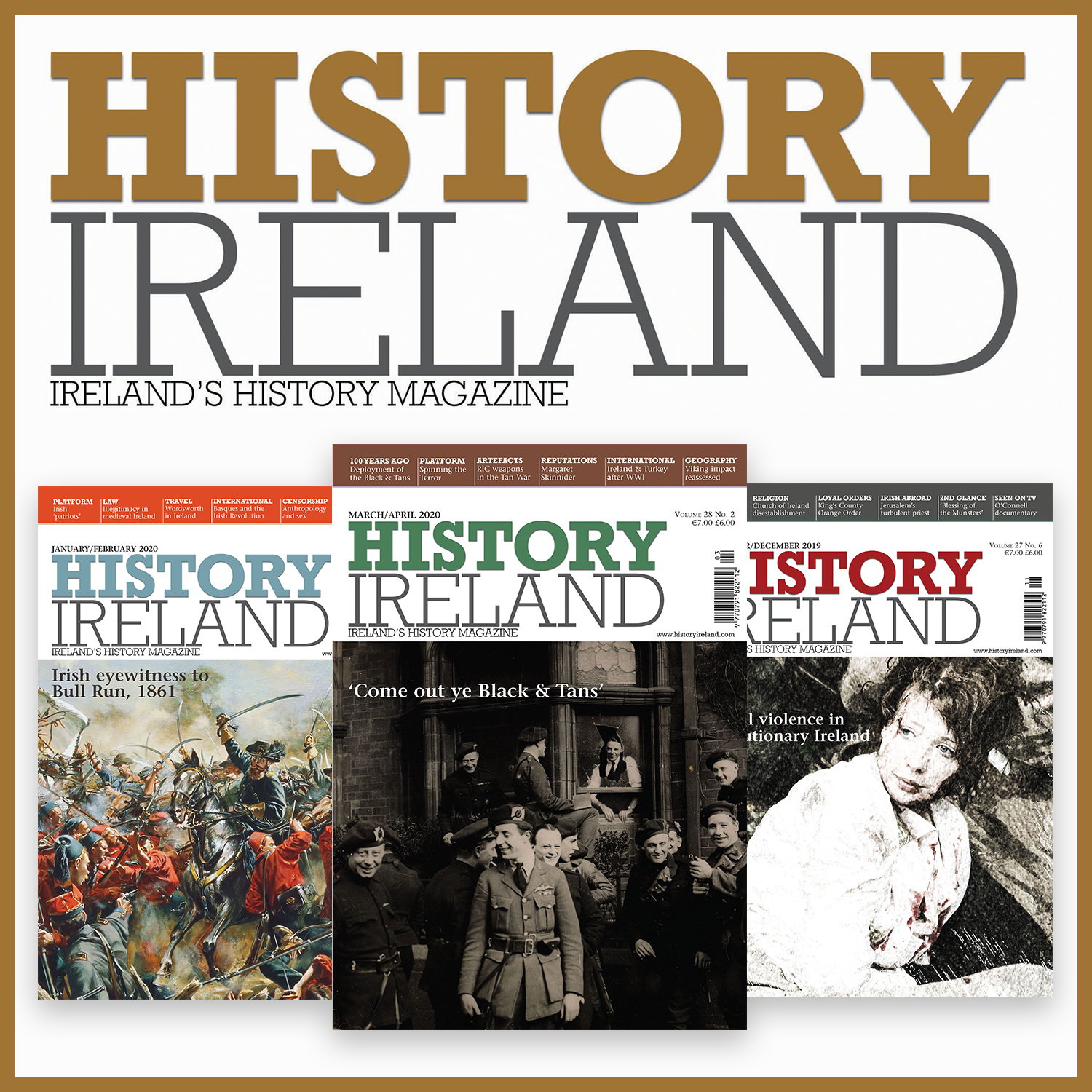
History Ireland
History Ireland
History Ireland magazine has now been in production for over 27 years. The History Ireland Podcast covers a wide variety of topics, from the earliest times to the present day, in an effort to give the listener a sense of the distant past but also to offer a contemporary edge.
Author
History Ireland
Category
Podcast website
Latest episode
Apr 17, 2026
Where to listen?
Podcasts in the app Replaio Radio Coming soonPodcasts are coming to the app soon. Install now and be the first to see a whole new take on podcasts
 Install for free
Android 5M+ downloads · 4.8 rating
iOS soon
Install for free
Android 5M+ downloads · 4.8 rating
iOS soon
Episodes
A century on—how do we view the Irish Civil War? 10.03.2023 1:21:19
History Ireland editor, Tommy Graham , and the Hedge School panel— John Dorney , Brian Hanley , Colum Kenny and Mary McAuliffe —field questions from Leaving Cert students in Coulson Theatre, Gonzaga College, Dublin (recorded on 2 March 2023). The Hedge School series of podcasts is produced by History Ireland and the Wordwell Group. For more information or to subscribe, visit historyireland.com Thi...
The Civil War in Kerry 03.03.2023 1:17:42
The violence and divisions caused by the Irish Civil War were more vicious, bitter and protracted in County Kerry than anywhere else in Ireland. Why? Join History Ireland editor Tommy Graham in discussion with John Dorney , Mary McAuliffe , Owen O’Shea and John Regan . The Hedge School series of podcasts is produced by History Ireland and the Wordwell Group. For more information or to subscribe, v...
Reflections on the Decade of Centenaries 03.02.2023 1:19:59
What is the relationship between commemoration and historical scholarship? How has this worked out in practice in the Decade of Centenaries? What were the opportunities taken? What were missed? Join History Ireland editor Tommy Graham in discussion with John Gibney , Brian Hanley , Heather Jones and Fearghal McGarry . The Hedge School series of podcasts is produced by History Ireland and the Wordw...
W.B. Yeats and the Irish Free State 09.12.2022 1:03:49
A century ago, in December 1922, at the height of the Civil War, poet W.B. Yeats was nominated to the Senate of the newly established Irish Free State. In January of that year he had participated in the cultural programme of the Irish Race Congress in Paris. In 1923 he was awarded the Nobel Prize for Literature, a major boost to the prestige of a nation after the trauma of civil war. He was to ser...
Marú in Iarthar Chorcaí (Murder in West Cork) 02.12.2022 54:58
Marú in Iarthar Chorcaí (Murder in West Cork) TG4, 9.30pm, Wednesday 7 December 2022 Over two nights in April 1922, thirteen Protestant men were shot dead in West Cork. According to Peter Hart’s 1998 book The IRA and its enemies , they were shot because they were Protestants—sectarian killings carried out by members of the IRA—and ‘the nationalist revolution had also been a sectarian one’. Hart’s...
Donegal in the Civil War 11.11.2022 1:10:46
While not in the vanguard of the War of Independence, Donegal became the scene of the last stand-up fight between the IRA (pro- and anti-Treaty) and British military (in the ‘Pettigo triangle’), with the latter using heavy artillery for the first time in Ireland since 1916. On the outbreak of the Civil War some of these IRA men, originally mobilised for the now-aborted ‘Northern offensive’, were c...
Irish Travellers and the State, 1922-2022—activism, advocacy and allyship 21.10.2022 1:18:06
How have Irish Travellers fared since the foundation of the state a century ago, and in particular since the 1963 Report of the Commission on Itinerancy? What are the challenges facing the current generation of Traveller activists? How can non-Travellers be effective allies? To address these and related questions, join History Ireland editor, Tommy Graham , in discussion with Martin Collins , Rose...
The Irish Civil War—a military analysis 14.10.2022 1:15:37
At the outbreak of the Irish Civil War in June 1922 the anti-Treaty IRA numbered some 15,000, holding key positions in Dublin and throughout the country, in particular behind a defensive line running from Limerick to Waterford (the so-called ‘Munster Republic’). Their pro-Treaty opponents in the newly-formed National Army numbered less than half that. Why then did the pro-Treaty side win? To addre...
What if Michael Collins had survived the Civil War? 16.09.2022 54:48
This Hege School was recorded at the Electric Picnic 2022 immediately after Paddy Cullivan's historical entertainment, 'The Murder of Michael Collins'. Details here www.paddycullivan.com . On 22 August 1922, Michael Collins was killed at Béal na Bláth, Co. Cork. But what if he had survived? Would he have become a military dictator? (Was he one already?) Would he have been more or less ruthless tha...
Unmanageable Revolutionaries—women in the ‘decade of centenaries’ 13.09.2022 1:00:30
It is nearly 40 years since Margaret Ward’s pioneering Unmanageable Revolutionaries: Women and Irish Nationalism, 1880-1980 (1983) first appeared. How has women’s history, and history written by women, fared in the meantime, particularly in this ‘decade of centenaries’? Join History Ireland editor, Tommy Graham, in discussion with Síobhra Aiken, Leeann Lane, Sarah-Anne Buckley and Margaret Ward. T...
Michael Collins—man and myth 22.08.2022 1:12:07
Born in West Cork in 1890, Michael Collins joined the Irish Republican Brotherhood (IRB) as a teenager while working as a clerk in London. He fought in the GPO in 1916, and rose to prominence by the War of Independence, combining the positions of Dáil minister for finance and IRA director of intelligence. How can his meteoric rise be explained? Why did he sign the Treaty? Did he intend to tear it...
Arthur Griffith, ‘father of us all’ 12.08.2022 1:20:18
So said Michael Collins, yet despite his central role in the development of the Irish nationalism from which the Irish State would emerge, Arthur Griffith has had to settle for a side-line role in the national historical memory. How fair or accurate are accusations of anti-Semitism, misogyny or ‘selling the pass’ at the Treaty negotiations? How stands his reputation today a century on from his unt...
The life and times of Harry Boland 05.08.2022 1:11:08
One of the most engaging figures of the revolutionary period, Harry Boland, along with his brother Gerry, joined the IRB in 1904 and participated in the 1916 Rising. He was centrally involved in the subsequent reorganization of Sinn Féin and the Volunteers and was uniquely close to the two dominant figures of the period, Eamon de Valera and Michael Collins. Having taken the anti-Treaty side, he wa...
The assassination of Sir Henry Wilson and the Irish Civil War 22.06.2022 1:13:31
On 22 June 1922 Field Marshall Sir Henry Wilson, former Chief of the Imperial General Staff, and Unionist MP for North Down, was assassinated outside his London home in Eaton Square. The anti-Treaty IRA were blamed and six days later, under pressure from the British, Michael Collins ordered the bombardment of the Four Courts, the opening salvos of the Irish Civil War. But who was Henry Wilson? Was...
The ‘Belleek/Pettigo triangle’, May/June 1922 03.06.2022 55:34
As part of the so-called ‘Northern Offensive’, on 27 May 1922, a combined force of pro-Treaty National Army and anti-Treaty IRA occupied the ‘Belleek/Pettigo triangle’, an enclave of Fermanagh/Northern Ireland only accessible over-land through Free State territory. Less than two weeks later they had been ejected by regular British Army troops; the ‘Northern Offensive’ was over. But how serious was...
Sister against sister—women, the Treaty split and the Civil War 20.05.2022 1:29:08
(Recorded @ Phizzfest [Phibsborough Community Arts Festival], Sun 15 May 2022, Glasnevin Cemetery Museum) Given their activism in the revolutionary period, now widely acknowledged by historians, why were Irish women and their organizations on the margins of deliberations on the Treaty? Why were Irish women under 30 denied the vote in the June 1922 general election? To what extent were they the vic...
Ulysses in history—history in Ulysses 06.05.2022 1:17:30
In this centenary year of its publication, the History Ireland Hedge School considers James Joyce’s Ulysses , set in Dublin on a single day, 16 June 1904. What was the history of the book? What is the history in the book? Join Tommy Graham in discussion with Sylvie Kleinman, Felix Larkin, Katherine McSharry and Dan Mulhall. The Hedge School series of podcasts is produced by History Ireland and th...
Burning the Big House—the story of the Irish country house in a time of war and revolution (Yale University Press) 29.04.2022 37:37
Over the course of the Irish War of Independence and Civil War, nearly 300 ‘Big Houses’ (those belonging to aristocrats with in excess of 2,000 acres), 20% of a total of c . 1,500, were burned to the ground. Why? Author Terence Dooley , Professor of History at Maynooth University and Director of the Centre for the Study of Historic Irish Houses and Estates, in conversation with History Ireland edi...
The internal politics of the IRA before the Civil War 08.04.2022 1:09:52
The Anglo-Irish Treaty sparked turmoil within the IRA. Some accepted it and joined the ranks of the Provisional Government’s new ‘National Army’; some remained neutral; the majority opposed it, but with the added twist that on the eve of the Civil War there were two anti-Treaty factions of the IRA, not one. Two Army Conventions, on 26 March and 18 June 1922, failed to resolve these differences. To...
Northern Ireland in 1922 24.03.2022 1:17:04
While an uneasy peace prevailed in the South following the Truce of July 1921, in Northern Ireland communal violence continued to rage, exemplified most notoriously on 24 March 1922 by the killings of a ‘respectable’ Catholic family, the McMahons, by an RIC ‘murder gang’. Was this a ‘one-off’ by a ‘rogue’ element or part of a wider policy of intimidation? And as the Treaty split drifted towards ci...
‘We English protest’—anti-colonial solidarity in the metropole 11.03.2022 55:43
So said the long white apron of suffragette and socialist Margaret Buckmaster at a protest in July 1921 organised by the Peace with Ireland Council (PIC). How significant were such anti-colonial solidarity movements in Britain in the revolutionary period? How effective were they? To address these and related questions, join History Ireland editor Tommy Graham in discussion with Darragh Gannon , An...
A Century of An Garda Síochána 25.02.2022 1:17:32
When the Civic Guard—later renamed An Garda Síochána—was founded in February 1922, the force it replaced, the Royal Irish Constabulary, was itself barely a century old. How much of the culture of the latter passed over to the former? What was the law-and-order situation in 1921/22? Why and how was it possible to set up an unarmed police force during a civil war? To address these and related questi...
Centenary of the Irish Race Congress, Paris, 21-28 January 1922 21.01.2022 54:02
Within weeks of the ratification of the Treaty by Dáil Éireann an ‘Irish Race Congress’ assembled in Paris representing Irish organizations from twenty-two countries. Inevitably the Treaty split overshadowed its proceedings. Did global Irish experiences moderate or radicalise expectations of Irish independence? What legacy did Irish sovereignty bequeath to the historical memory of the Irish diaspo...
‘Dublin Castle has fallen!’—the handover, 16 January 1922 16.01.2022 1:13:46
Under the terms of the Anglo-Irish Treaty, a Provisional Government, led by Michael Collins, was to oversee the transition of power until the Irish Free State formally came into being in December 1922. What was involved in the ‘handover’ that took place on 16 January 1922? Who was involved and what were their roles? To address these and related questions join Tommy Graham in discussion with John G...
Robert Barton—forgotten man of the Irish revolution? 31.12.2021 1:06:51
Of the five plenipotentiaries who signed the Anglo-Irish Treaty on 6 December 1921 most attention has been focused on the motivations and actions of Michael Collins and Arthur Griffith—and on ‘the plenipotentiary who wasn’t’, Eamon de Valera. But what about the other three—Eamon Duggan, George Gavan Duffy and Robert Barton, particularly the latter, the only one who later took an anti-Treaty positi...
Similar podcasts


Listen to the History Ireland podcast in Replaio
Radio and podcasts in one app - free, with no sign-up. Install today and do not miss the launch
Replaio is not a podcast publisher; show names, artwork and audio belong to their authors and are distributed through public RSS feeds.