Al Zambone
Historically Thinking
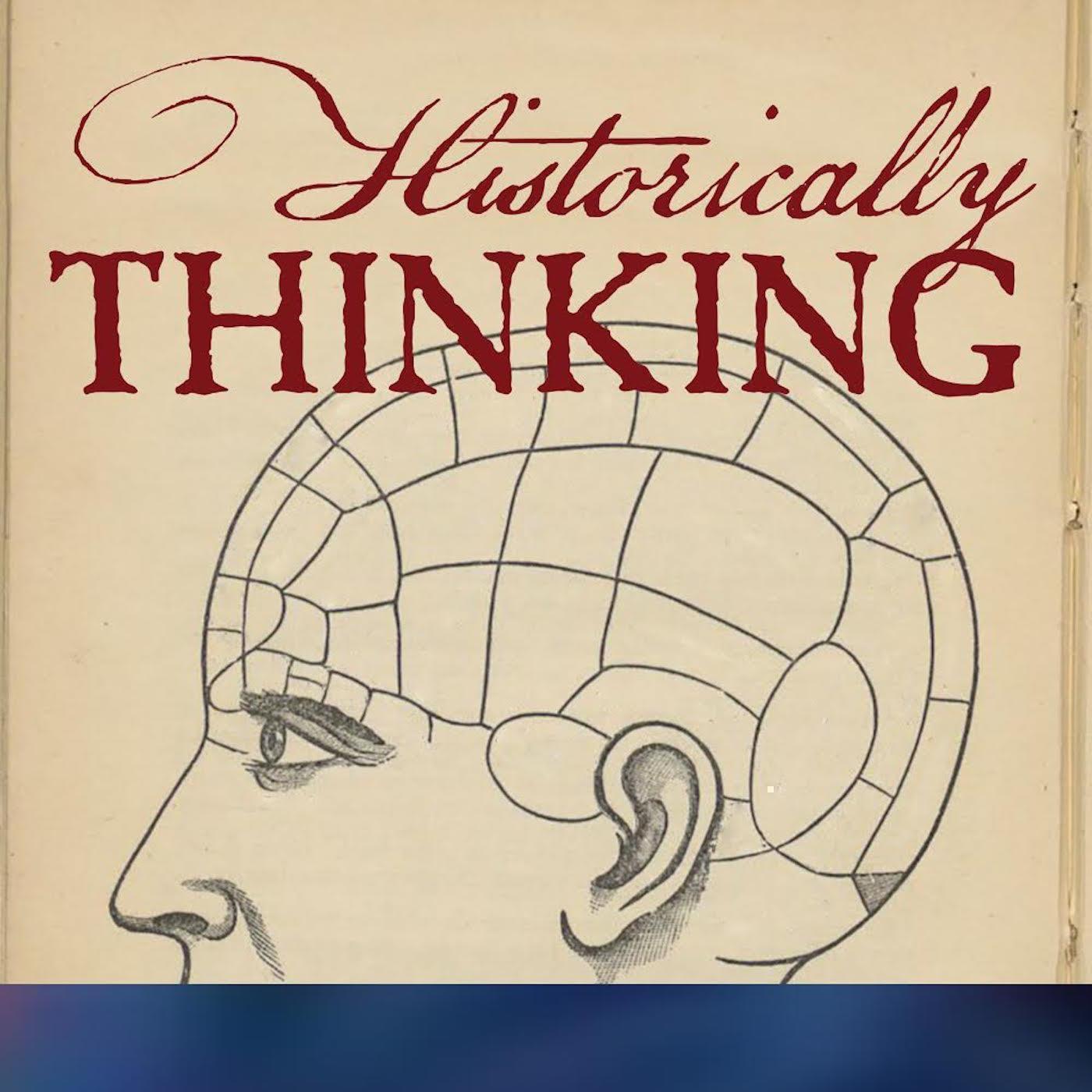
We believe that when people think historically, they are engaging in a disciplined way of thinking about the world and its past. We believe it gives thinkers a knack for recognizing nonsense; and that it cultivates not only intellectual curiosity and rigor, but also intellectual humility. Join Al Zambone, author of Daniel Morgan: A Revolutionary Life, as he talks with historians and other professionals who cultivate the craft of historical thinking.
Be sure to visit the podcast's website and support the creator: blubrry.com
Where to listen?
Podcasts in the app Replaio Radio Coming soonPodcasts are coming to the app soon. Install now and be the first to see a whole new take on podcasts
 Install for free
Android almost 10M downloads · 4.8 rating
iOS soon
Install for free
Android almost 10M downloads · 4.8 rating
iOS soon
Episodes
The Age of Hitler, and How We Shall Survive It 08.10.2025 27:39
In online debates, it’s almost inevitable that sooner or later someone invokes Hitler or the Nazis. That tendency, known as Godwin’s Law, has proven itself on social media thousands of times a day. But the persistence of this comparison points to something deeper than just the cheapening of argument. It reflects how much Hitler and the struggle against Nazism have become the ultimate reference poi...
1942: Peter Fritzsche on the year when war engulfed the world 01.10.2025 27:40
In this episode of Historically Thinking, host Al Zambone speaks with historian Peter Fritzsche about his book "1942: When World War II Engulfed the Globe." The conversation explores how 1942 marked the transformation of regional conflicts into a truly global war, examining the unprecedented scale and movement of the conflict, the suffering and displacement of millions, and the ideological forces...
Fuji: Andrew Bernstein on the human history of the ever-changing mountain 24.09.2025 28:36
Mount Fuji is at once instantly familiar and seemingly immutable, yet it always remains strange and changeable. Its postcard-perfect peak is known around the world as a wonder of nature and a symbol of Japan. But behind that outline lies a far more complicated history. Over the centuries, Fuji’s eruptions devastated farmland and terrified villagers. Revered as a sacred presence, its divine inhabit...
Cold War Analogies: Francis J. Gavin on how (and how not) to use the Cold War as a guide 17.09.2025 30:47
We reach for the Cold War as if it were a really good pocket tool: compact, familiar, ready to deal with any problem in today’s world. U.S.–China rivalry? “Cold War 2.0.” Russia and the West? “Cold War redux.” The appeal is obvious: the Cold War offers a story we already know how to tell—great-power tension, nuclear standoff, ideological blocs, and finally, a tidy ending. But as Francis J. Gavin a...
Prague: The Heart of Europe 10.09.2025 38:04
Introduction Each year millions of tourists visit the Czech capital, awed by its blend of architectural styles and dramatic landscape. St. Vitus’s Gothic cathedral towers above the Charles Bridge and the Vltava River, while winding alleys lead to elegant squares lined with Renaissance palaces, Baroque statues, and modern glass structures. Yet this beauty obscures centuries of conflict — ethnic, re...
Thinking Historically: Francis J. Gavin on What History Can Do for Policymakers...and the Rest of Us 03.09.2025 30:08
It might seem obvious that the study of history ought to improve the crafting of public policy. Surely if we understand the past, we should be able to make better decisions in the present—especially in the high-stakes worlds of statecraft and strategy. But that assumption raises deeper questions: How should history be used? What history should be used? How do we gain the kind of historical knowle...
Jews vs. Rome: Two Centuries (or More!) of Rebellion Against the World's Mightiest Empire, with Barry Strauss 27.08.2025 30:32
In 1960 Yigael Yadin, formerly chief of the Israeli general staff and by that year a prize winning archaeologist, visited the home of Israel’s president David Ben-Gurion, and said to him “Mr. President, I have the honor to tell you that we have discovered 15 dispatches written or dictated by the last president of ancient Israel over 1800 years ago.” Yadin was announcing the discovery of a collecti...
Amanda Roper, Public Historian 20.08.2025 30:46
Amanda Roper is a public historian who has spent her career working to preserve historic places and share traditionally underrepresented stories from America's past. She has been Director of the Lee-Fendall House Museum and Sr. Manager of Public Programs & Interpretation at Woodlawn & Pope-Leighey House , both in Alexandria, Virginia. In 2018, Amanda was recognized by the National Trust fo...
The Ramos Gin Fizz: A New Orleans Liquid History, with John Shelton Reed 13.08.2025 23:47
Join Al Zambone and guest John Shelton Reed (author of The Ramos Gin Fizz , for the LSU Press series on iconic New Orleans cocktails ) for a deep dive into the history, culture, and legend of the Ramos Gin Fizz—a cocktail that’s as much a symbol of New Orleans as it is a drink. From its 19th-century origins and the city’s cosmopolitan mix, to Prohibition, Huey Long, and the modern cocktail renaiss...
Thomas Jefferson and the Fight Against Slavery, with Cara Rogers Stevens 06.08.2025 34:08
In the past we’ve had entire conversations on Historically Thinking–indeed, many conversations, a whole series of conversations–on intellectual humility and historical thinking, often asking “how have you changed your mind?” Today’s guest makes me confront the fact that there is probably no person in the historical past about whom I have had a greater change of mind than Thomas Jefferson. This som...
Spellbound: Molly Worthen on Charisma, Four Centuries of American History, and the Search for Meaning 30.07.2025 33:54
Hello: Autumn, 1949. Fortune editor Bill Furth, flinty-eyed gatekeeper, scans a manuscript from 30-year-old whiz kid Daniel Bell. Spots the word “charisma.” Snorts. Blue pencil meets page. Word dies swiftly, without much appeal. Fast forward ten years: charisma is everywhere. Eggheads bandy it, pundits quote it, preachers peddle it. Bell—vindicated. Since the 1950s, Americans have grown used to t...
The Great Museum of the Sea: A Human History of Shipwrecks, with James Delgado 23.07.2025 31:25
Shipwrecks as events are probably humanity’s most common form of disaster”, writes my guest James Delgado “As such, shipwrecks–aside from epidemics, warfare on land, or great natural disasters—have been the cause of the greatest number of human deaths throughout history. Thanks to ships and other watercraft, humanity did not just walk across the globe from its ancestral home in Africa. We made us...
Phantom Fleet: U-Boats, Codebreakers, and the Daring Capture of U-505, with Alexander Rose 16.07.2025 36:02
There is a U-boat in the middle of Chicago. It’s attached to the Museum of Science and Industry in Hyde Park. Generations of Chicagolanders, and their cousins from far away, have walked through U-505, but they don’t always ask how in the world it got to Chicago. A crucial moment in the journey of U-505 to its permanent berth was on June 4, 1944. On that day for the first time in the history of the...
Light on Darkness: The Untold Story of the Liturgy of the Western Christian Church, with Cosima Clara Gillhammer 09.07.2025 29:55
The liturgy of the Christian church is often dismissed today as archaic, arcane—or dead. But as Cosima Clara Gillhammer shows in her new book Light on Darkness: The Untold Story of the Liturgy, these ritual forms were once the very heartbeat of Western culture and continue to shape not only our cultural memory but even contemporary cultural practice. In this episode, we explore how liturgical prac...
Londoner, Lawyer, Humanist, Husband, Statesman, Saint: The Life of Thomas More, with Joanne Paul 02.07.2025 33:54
His friend the great scholar Desiderius Erasmus referred to Thomas More as “a Man for all seasons.” But which season? Or which Thomas More? Is he an advocate of conscience? A heroic defender of the Catholic faith? A saintly martyr? A fanatical zealot unwilling to listen to cool reason? An amateur inquisitor who lit the night with burning Lutherans and their books, and enjoyed little more than comi...
The Accidental Tyrant: Kim Il-Sung’s Rise to Power, and How He Kept It, with Fyodor Tertitskiy 25.06.2025 31:07
In 1945, Kim Il-Sung was a minor figure with no political power in Korea. Within months, he was elevated by Soviet authorities to lead North Korea. Historian Fyodor Tertitskiy joins us to discuss The Accidental Tyrant, his new biography of Kim, and explains how this obscure guerrilla commander became one of the most durable dictators of the 20th century—and the founder of a regime that still rules...
Joseph Smith: The Rise and Fall of an American Prophet, with John G. Turner 18.06.2025 38:41
Joseph Smith was the founder of the Church of Jesus Christ of Latter Day Saints, known by those outside the church during his life and today as the Mormons. But Joseph Smith was many things besides: the child of a struggling family gradually moving westward in search of opportunity, a day laborer, visionary, seer; treasure hunter; translator; revelator; prophet; elder, banker, prisoner, wrestler,...
Revolution to Come: Dan Edelstein on Thinking About Revolution...and History 11.06.2025 31:19
In our conversation, Dan Edelstein traces the intellectual history of revolution as an idea—from its origins in classical antiquity to its dramatic transformation during the Enlightenment, to its seeming maturation in the 20th Century
Stephen Aron and Barry Strauss on History, Engaging a Wider Public, and Intellectual Humility 04.06.2025 1:03:05
This week’s episode features not one but two conversations—with Aron and Strauss—which, while it may sound like a jazz-age songwriting duo, is in fact a pairing of two distinguished historians: Stephen Aron and Barry Strauss. They join our ongoing series of interviews exploring historians’ early love of the past and the essential role of intellectual humility in historical thinking. First up is St...
Episode 406: Rogue Agent 05.05.2025 1:18:10
Robert Bruce Lockhart was at various times in his life a diplomat, a conspirator, an gatherer of intelligence, and a propagandist. He was always a maverick, a charmer, a bit of a cad with a touch of the bounder, and a devotee of the high life when he could afford it, and often when he could not. In his busy life he ran a Malaya rubber plantation; served as a diplomat in Czarist Russia; and was fi...
Episode 405: Free Creations 28.04.2025 1:02:56
Albert Einstein died in 1955, the most influential scientist of the 20th century. Yet even in the 21st-century his intellectual presence remains – seven of the noble prizes awarded since 2000 stemmed directly from the work which he did in 1905 and 1915. More even than Isaac Newton’s bewigged and apple-pelted image, Einstein’s pervades popular culture, from that photo with his tongue sticking out t...
Episode 404: Intellectual Humility, with Mikaberidze and Nelson 21.04.2025 58:38
This week I wanted to give you two conversations recorded some time ago, which are part of our recurring series on intellectual humility and historical thinking. The first guest is Alex Mikaberidze, a native of Georgia, the other one, not the one with peaches. He's Professor of History and Ruth Herring Noel Endowed Chair at Louisiana State University in Shreveport. Dr. Mika Reja specializes in 18t...
Episode 403: Visionary Histories 14.04.2025 1:09:09
My guest today is David Staley, associate professor in the Department of History at the Ohio State University, where he teaches courses in digital history and historical methods, and holds courtesy appointments in the Departments of Design where he is taught courses in design history and design futures, and the Department of Educational Studies where he has led the forum on the university. This is...
Episode 402: Broken Altars 31.03.2025 56:45
“For many educated Westerners,” writes today’s guest, “ the idea that religion promotes violence and secularism ameliorates the problem is a settled certainty, a doxa, an unstated premise of right thinking. By no means do I deny that religious energies…can be turned toward destructive ends, especially by unscrupulous politicians in times of crisis and uncertainty… Nonetheless, concentration on or...
Episode 401: Rot 23.03.2025 1:09:06
In 1845 a water mold named Phytophthora Infestans which afflicts potato and tomato plants began to spread across Europe, killing potatoes from Sweden to Spain. “The potato blight caused crisis everywhere it appeared in Europe,” writes my guest Padraic X. Scanlan; “in Ireland, it caused an apocalypse.” In 1845, a third of the United Kingdom’s population lived in Ireland; an 1841 census had counted...
Similar podcasts





Listen to the Historically Thinking podcast in Replaio
Radio and podcasts in one app - free, with no sign-up. Install today and do not miss the launch
Replaio is not a podcast publisher; show names, artwork and audio belong to their authors and are distributed through public RSS feeds.