Al Zambone
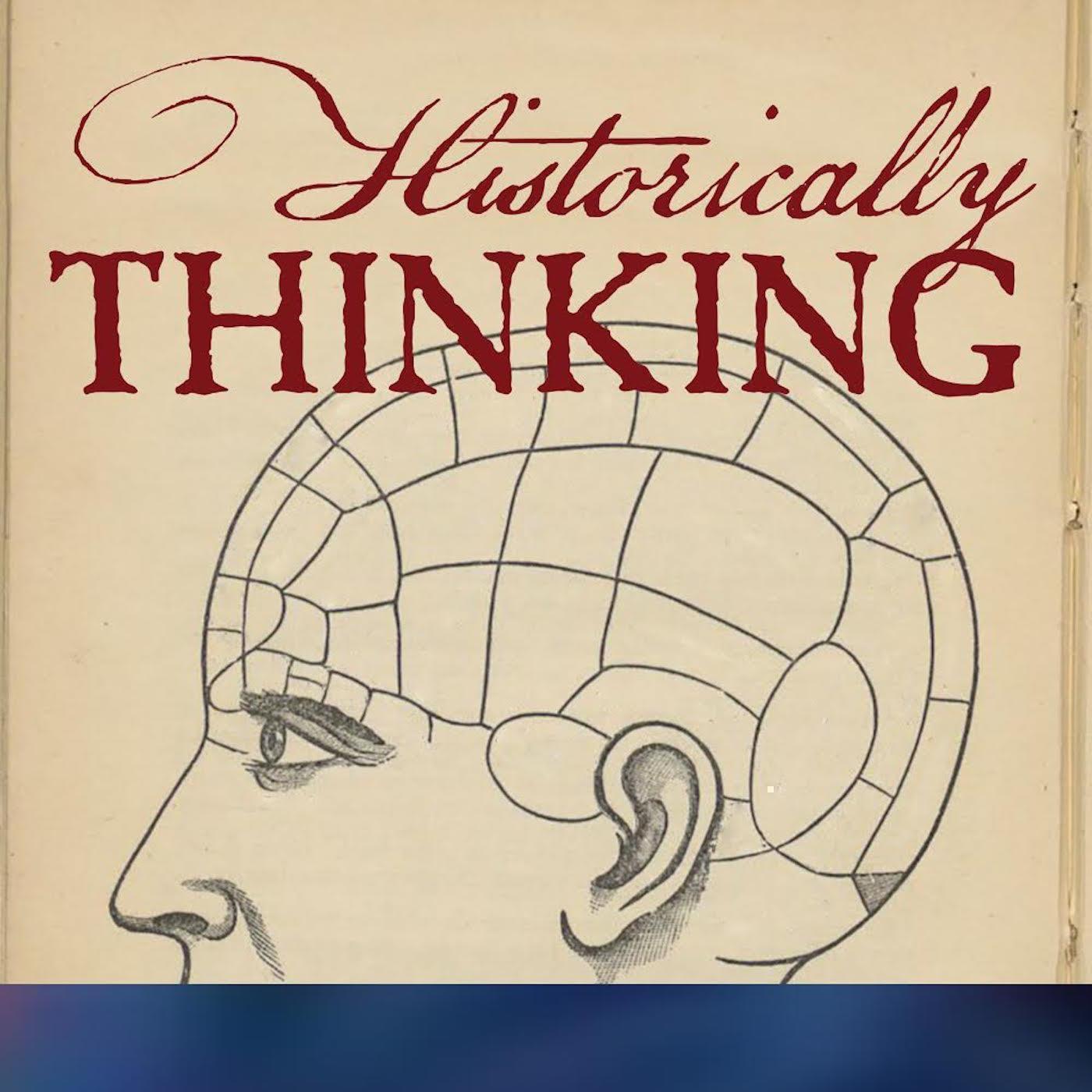
Historically Thinking
We believe that when people think historically, they are engaging in a disciplined way of thinking about the world and its past. We believe it gives thinkers a knack for recognizing nonsense; and that it cultivates not only intellectual curiosity and rigor, but also intellectual humility. Join Al Zambone, author of Daniel Morgan: A Revolutionary Life, as he talks with historians and other professionals who cultivate the craft of historical thinking.
Besuch unbedingt die Website des Podcasts und unterstütze die Macher: blubrry.com
Wo hören?
Podcasts in der App Replaio Radio Bald verfügbarPodcasts kommen bald in die App. Installiere sie jetzt und erlebe als Erster einen ganz neuen Blick auf Podcasts
 Kostenlos installieren
Android fast 10 Mio. Downloads · Bewertung 4,8
iOS bald
Kostenlos installieren
Android fast 10 Mio. Downloads · Bewertung 4,8
iOS bald
Folgen
The Great Horse Flu: Thomas Andrews on the “Great Epizootic of 1872”, and the Fate of Reconstruction America 07.10.2026 34:32
In September 1872, in the countryside north of Toronto, horses began to fall ill. Their noses ran, they coughed, and their breathing became “labored and severe.” In the worst cases, the sufferers could do nothing other than stand in their stalls “as if benumbed and paralyzed.” Eventually, an increasing number of them began to die. Within days of the illness being identified, it was spreading throu...
Librarian's War: Molly Guptill Manning on Ray Trautman and the Army of Readers 30.09.2026 29:59
On December 16, 1944, as American troops retreated or fled before advancing German soldiers on the first day of what is now known as the Battle of the Bulge, Lieutenant Colonel Ray Love Trautman found himself leading an ad hoc formation of stragglers and stranded soldiers. This might not seem strange—that’s a lieutenant colonel’s job, isn’t it? But while Ray Trautman had the rank of a lieutenant c...
Glorious Fate: Kevin Levin on the short life and complicated afterlife of Colonel Robert Gould Shaw of the 54th Massachusetts 23.09.2026 34:07
On July 18, 1863, the 54th Massachusetts—one of the first Black regiments in the Union Army, and the first raised in the North—led an assault on Fort Wagner, one of the fortifications defending Charleston, South Carolina. Their attack was preceded by an eight-hour bombardment that did little damage to the fort’s walls or defenders. Moving through heavy Confederate small-arms fire, with their comma...
Justice for Jehanne: Sara McDougall on a medieval survivor, a criminal investigation, and the limits of justice 16.09.2026 34:24
Content Warning: This episode contains frank discussions of rape, sexual assault, and physical violence and is not suitable for children. On a winter morning in 1472, an investigator arrived at a poor widow’s home in the St. Nicholas district of the city of Dijon. He was there to interview a tenant, a pregnant woman named Jehanne, an immigrant from the county of Lorraine. She had reportedly been a...
Pericles of Athens: Paul Cartledge on the statesman, demagogue, and eccentric 09.09.2026 34:19
Pericles of Athens was a complicated man, a man of twists and turns. Born into a lineage of Athenian aristocrats, he became a champion of democracy and indeed a masterful demagogue. A teenager by the end of the Persian Wars, he was one of the architects of an Athenian empire designed to ensure that Persia never again advanced westward. Possibly his earliest public act as an Athenian citizen was to...
Out of Chaos: Jon Wilson on how the Second World War led to the Nation-State 02.09.2026 26:54
At the beginning of the twentieth century many thinkers, activists, and politicians would have been astonished if you told them that at the end of that century the nation-state would be the prevalent form of government throughout the world. After all, the previous fifty years had seen a revival of empires, and by 1900 everyone was living in a world of empires. The nation-state was not an obvious n...
Ortiz's War: Nicholas Reynolds on the exploits of Peter J. Ortiz, a US Marine in occupied France 26.08.2026 33:31
Peter J. Ortiz was one of the most decorated United States Marines of the Second World War—and he served in the European Theater. In fact, his service was almost entirely within occupied France, where he worked for the Office of Strategic Services as the manager of a resistance network and later as the leader of a (sort of) Jedburgh Team. The stories of his exploits are legendary, though admitted...
Trojan War: Barry Strauss on the history behind the epic poetry 19.08.2026 27:05
Rage — Goddess, sing the rage of Peleus’ son Achilles, murderous, doomed, that cost the Achaeans countless losses, hurling down to the house of death so many sturdy souls, great fighters’ souls, but made their bodies carrion feasts for the dogs and birds, and the will of Zeus was moving toward its end. Begin, Muse, when the two first broke and clashed, Agamemnon lord of men and brilliant Achilles....
Punctuation Remakes the World: Florence Hazrat on the hidden history of the marks that shape how we read, think, and communicate 12.08.2026 30:57
Even that overlooked yet essential little pinprick at the end of this sentence has a history. For once upon a time, there were no stops or periods. And therefore there were no sentences, at least as we conceive them now. “Changes in punctuation,” writes my guest Florence Hazrat, “like changes in language, are normal, but they’re also important reflections of our values.” They are also, perhaps, in...
He Has the People: Jonathan Earle on the momentous Election of 1860 05.08.2026 1:04:11
YEAR of meteors! brooding year! I would bind in words retrospective some of your deeds and signs; I would sing your contest for the 19th Presidentiad;. I would sing how an old man, tall, with white hair, mounted the scaffold in Virginia; (I was at hand—silent I stood, with teeth shut close—I watch'd; I stood very near you, old man, when cool and indifferent, but trembling with age and yo...
Corn Syrup: Brian Leech does local history, regional history, labor history, technological history, environmental history, and food history 29.07.2026 26:08
In early 1965, three executives boarded a plane in Japan, bound for the United States. “Unbeknownst to the U.S. Customs, they were carrying corporate secrets. Each man had carefully placed two vials of an isomerase enzyme into their pockets before the flight.” With it, they would change the world. For after two arduous years of nearly aerobic chemical engineering, their corporation produced what i...
Louisiana Purchase: Alexander Mikaberidze on the grand bargain that made continental America 22.07.2026 33:35
Most Americans remember the Louisiana Purchase as a remarkably good bargain: fifteen million dollars for an enormous tract of land that doubled the size of the United States. But that familiar cliché hides a large story. It covers over a lot of things, and suggests a few more that just aren’t so. In his new book The Louisiana Purchase: The Grand Bargain and the Making of America , historian Alexan...
Offa the King: Rory Naismith writes the life of a great English king who has no biography 15.07.2026 27:44
Running for about 177 miles along the Welsh-English border is the remains of an earthwork, a fortification over a hundred miles longer than Hadrian’s Wall. Built sometime in the eighth century, it is known as Offa’s Dyke, one of the few surviving reminder of one of the most formidable kings in English history. “As a man,” writes my guest Roy Naismith, “Offa is effectively lost.” Winston Churchill...
When the Declaration of Independence Was News: Emily Sneff on how people first encountered independence 03.07.2026 32:25
"There was a time when the Declaration of Independence was news. Most books written about the Declaration have pursued questions about its precedence and authorship as well as its legacy. In 1776, when the Declaration was news, it was part of an ever-changing and circulating amalgam of accurate and inaccurate information, gossip, military intelligence, speculation, and opinion. At approximately on...
National Treasure: Michael Auslin on the Declaration of Independence's two simultaneous lives 01.07.2026 33:16
The Declaration of Independence has had two simultaneous lives. One is the life of its ideas, the life that scholars pay the most attention to: a life of fits and starts, surprisingly forgotten in the first years after the Revolution, then returning with a vengeance amid sectional conflict in the 1830s, during the Progressive Era, and again during the Civil Rights Movement. Its second life is as a...
The Democracy We Must Keep: David Stewart on seven founders, nine documents, and the ideas that shaped them 29.06.2026 27:53
American independence was not simply the writing of the Declaration of Independence, nor even the vote that approved it. It was the culmination of decades of argument, persuasion, and political innovation. The American founding emerged through a succession of speeches, petitions, resolutions, constitutions, and other documents in which Americans struggled to define liberty, self-government, and th...
Long Revolution: Nathan Perl-Rosenthal on a century of talking about revolution 27.06.2026 33:38
On July 4, 1777, in Boston, the Reverend William Gordon gave one of the first July 4th orations in American history—certainly the first to become a pamphlet. For over a century these orations were a feature of the national festival, “an essential annual occasion for debating the present and future of American politics.” In the first century of American independence over one hundred thousand such s...
World Crisis: Richard Bell on the American Revolution as a global event 24.06.2026 34:01
The often extremely quotable Hannah Arendt once wrote that “the French Revolution, which ended in disaster, has made world history, while the American Revolution, so triumphantly successful, has remained an event of little more than local importance.” My guest Richard Bell emphatically disagrees. In The American Revolution and the Fate of the World (Penguin, 2025), Bell argues that the Revolutio...
War Without Mercy: The American Revolution as an Existential War 17.06.2026 30:47
“This is a book about a cruel and ruthless war—a war without mercy—in which those caught up in it believed they had nothing to lose by fighting without regard for the rules of so-called ‘civilized warfare.’ It was the War for American Independence. At its grimmest level, this was a confrontation in which military restraint was more the exception than the rule, a struggle in which combatants believ...
Suitable: Chloe Chapin on the Sartorial Revolution and the Fashioning of Modern Men 10.06.2026 36:06
At his first inauguration, George Washington made a very carefully calibrated political statement: he wore a brown suit. It was tailored from a weave of superfine wool made in Hartford, Connecticut, and was so far from being the crude homespun which was for some an emblem of a proud American—or, for British cartoonists, of crude Brother Jonathan—that some newspapers criticized Washington for weari...
Contested Continent: Peter Mancall on the Struggle for North America, c. 1000–1680 03.06.2026 31:00
My guest Peter C. Mancall’s new book is Contested Continent: The Struggle for North America, c. 1000–1680 . It is, now, the first volume in the Oxford History of the United States, an ongoing multi-volume narrative series—a series whose story is worth an episode in and of itself. In Contested Continent, Mancall describes the foundation of that place which would eventually become the United Stat...
Stalin's Apostles: Antonia Senior on the Cambridge Five and their Service to the Soviet Empire 27.05.2026 30:43
In the 1930s, five young men at Cambridge University became members of the Communist Party. This is not too surprising, in retrospect; many others were doing so as well. But these five men were recruited by the intelligence services of the Soviet Union, and for seventeen years they betrayed the secrets of Britain and the United States. They are now often referred to as the Cambridge Five. They wer...
The First Ghetto: Alexander Lee on Venice and the Origins of Modern Antisemitism 20.05.2026 38:35
“It was a cold January afternoon when I first came to the ghetto. I got there much later than I’d hoped. I’d spent much of the day elsewhere and had just lost track of time. It was already beginning to get dark. The campo seemed deserted. Shutters were closed, and apart from the tinkling of water in the wells, there was hardly a sound. There were no streetlights, barely even the glimmer of a lamp....
Athens and Sparta: The Rivalry That Shaped Ancient Greece 13.05.2026 42:30
The story of classical Greece is often told, rightly or wrongly, as the story of the alliance, competition, and eventual war between Athens and Sparta. Even in antiquity, each city fascinated the other. Athenians imagined Spartans as disciplined, laconic conquerors; Spartans regarded Athens with a mixture of admiration, suspicion, and alarm. Yet despite their differences, both cities shared fundam...
1453: The Conquest and Tragedy of Constantinople 06.05.2026 28:37
On May 29, 1453, the city of Constantine—Constantinople—ceased to exist. For over a millennium it had stood as a center of Roman political power, Greek learning, and the Christian faith. Now its walls were breached, its emperor lay dead among the defenders, and its inhabitants were carried off into slavery. Yet, as my guest Anthony Kaldellis argues, the city’s final resistance tells a different st...
Ähnliche Podcasts





Höre den Podcast Historically Thinking in Replaio
Radio und Podcasts in einer App - kostenlos und ohne Anmeldung. Installiere sie noch heute und verpasse den Start nicht
Replaio ist kein Herausgeber von Podcasts; die Namen der Sendungen, Cover und Audioinhalte gehören ihren Autoren und werden über öffentliche RSS-Feeds verbreitet