Al Zambone
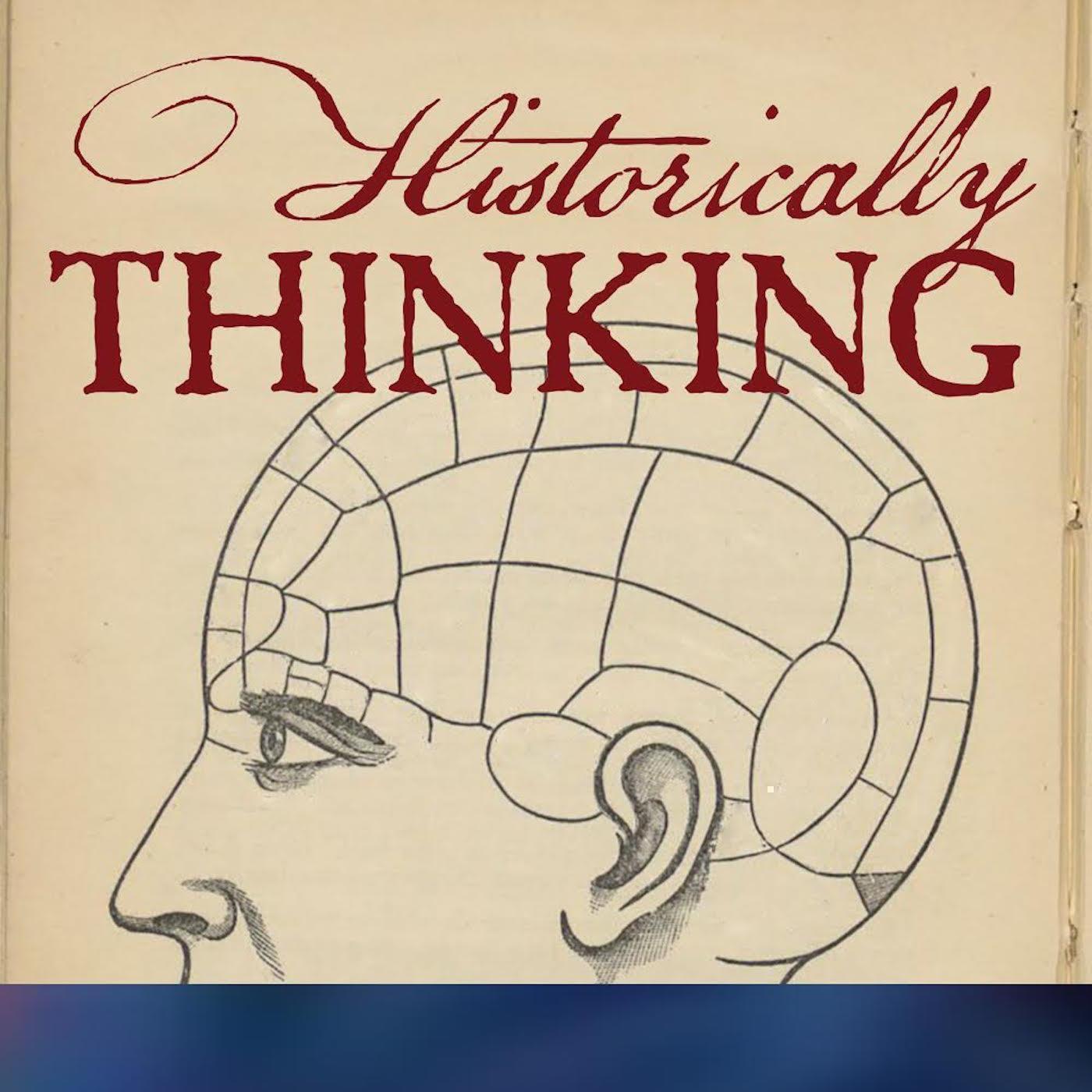
Historically Thinking
We believe that when people think historically, they are engaging in a disciplined way of thinking about the world and its past. We believe it gives thinkers a knack for recognizing nonsense; and that it cultivates not only intellectual curiosity and rigor, but also intellectual humility. Join Al Zambone, author of Daniel Morgan: A Revolutionary Life, as he talks with historians and other professionals who cultivate the craft of historical thinking.
Be sure to visit the podcast's website and support the creator: blubrry.com
Where to listen?
Podcasts in the app Replaio Radio Coming soonPodcasts are coming to the app soon. Install now and be the first to see a whole new take on podcasts
 Install for free
Android almost 10M downloads · 4.8 rating
iOS soon
Install for free
Android almost 10M downloads · 4.8 rating
iOS soon
Episodes
Nuclear Weapons: An International History 29.04.2026 28:37
For four years—from July 16, 1945, the date of the first atomic test, to August 29, 1949, when the Soviet Union detonated its first nuclear device—the history of nuclear weapons might appear to be an exclusively American story. But even that is misleading. From the earliest theorization of the chain reaction, nuclear development was international: a web of scientific collaboration, technological t...
Europe: A New History 22.04.2026 28:37
At the very beginning of his forthcoming book Europe: A New History, my guest Roderick Beaton asks a simple but disarming set of questions: Why a “new” history of Europe? Why might we need one? And what makes this history new? His answer is not merely about newly discovered facts, or even reinterpretations of old ones. It is about events. “To study history,” he writes, “is to look for patterns to...
Terrible Intimacy: Melvin Patrick Ely on Interracial Life in the Slaveholding South 15.04.2026 33:02
“In the generation just before the Civil War, something like one-quarter of America’s enslaved people lived on large plantations with fifty or more forced laborers—in essence, work camps, where contact with whites might be limited and mostly utilitarian. Another quarter lived on plantations where twenty to fifty persons were held in slavery. The typical owner of, say, thirty captive Black workers...
The Firearm Revolution: Catherine Fletcher on how the firearm changed society 09.04.2026 30:03
“Over the course of the sixteenth century,” writes my guest Catherine Fletcher, “the handgun made a transition from a novel and decisive military technology to become an everyday object, in use across society and carrying a new set of cultural associations that would persist through the coming centuries.” This was the firearm revolution. In this conversation, Fletcher explores how an evolving tech...
Syria: Daniel Neep on the Modern History of a Very Old Place 25.03.2026 36:28
The history of modern Syria is usually reduced to a story of autocracy, repression, and occasional revolt. And it is a short story, stretching back only to the fragmentation of the Ottoman Empire, or perhaps to the secret terms of the Sykes-Picot Agreement that divided the Near East between Britain and France. But my guest Daniel Neep has a different perspective. He believes that such narratives...
The Great Historian: Andrew Meyer on Sima Qian and the invention of history 19.03.2026 39:00
About a century before the birth of Jesus, during the reign of Emperor Wu of the Han Dynasty, a remarkable man began a nearly unprecedented intellectual endeavor. Sima Qian, like his father before him, was an official in the imperial court. Working on a plan left behind by his father, Sima Qian began writing a history of China for the two thousand years before his own time. The scope of his labors...
Introducing Historically Thinking Field Guides 11.03.2026 6:30
In this short episode, Al introduces a new feature of the Historically Thinking podcast: the Historically Thinking Field Guides. Drawing on nearly 450 past episodes, these guides gather conversations around major historical themes—beginning with a first guide devoted to the Second World War—so listeners can explore topics through curated sets of episodes, questions, and commentary. Al also explain...
Worse Than Hell: W. Fitzhugh Brundage on Prisoners of War and Prison Camps of the American Civil War 25.02.2026 44:06
During the American Civil War an estimated 194,000 Union soldiers and 214,000 Confederate soldiers became prisoners of war. No prior or subsequent American conflict has seen such numbers. During the Second World War, approximately 124,000 Americans were held captive, but the chance of being captured in that conflict was roughly one in one hundred; during the Civil War it was closer to one in five....
Civil War Religion: Timothy D. Grundmeier on Lutheranism, the Civil War Era, and American Culture 18.02.2026 32:22
Lutherans are a strange denomination in American religious history and culture. For Catholics they are certainly Protestants. For Protestants they are crypto-Catholics. While they have been around since the Swedes established their short-lived colony on the Delaware River, they have typically received as much attention in the American imagination as the short-lived Swedish colony on the Delaware R...
To Rule All Under Heaven: Andrew Seth Meyer on the Revolution of Classical China, and How It Changed Human History 11.02.2026 28:14
The two hundred and eighty years between the death of the philosopher Confucius and the reign of the first Emperor of China saw one of the most profound revolutions in human history. Not only did it end with the creation of an imperial rule that persisted through successive dynasties for 2,132 years, but it also saw the creation of “new traditions of thought and practice…great monuments of art, li...
Historically Thinking Roundtable: Historians, Historical Thinking, Civic Trust, and America at 250 04.02.2026 28:00
This is the first ever Historically Thinking Roundtable. Given that it's 2026, it’s appropriate that this roundtable focus on the 250th anniversary of the United States, and how historians can be involved in its commemoration. Difficulties in doing this can arise from at least two reasons. One is that historians, like most academics, represent a relatively small slice of the political pie. And in...
Caesar Augustus: Adrian Goldsworthy on the First Emperor of Rome 28.01.2026 42:31
He was at various times in his life known as Gaius Octavius Thurinus; Gaius Julius Caesar; and Caesar Augustus. He called himself Princeps, the first man in Rome; the Roman Senate would eventually call him pater patriae, the father of his country. Heir to his great-uncle Julius Caesar, this 19 year old was dropped into the tumult of Roman political violence, and emerged from it the sole and undisp...
The Great Shadow: Susan Wise Bauer on the History of How Sickness Shapes What We Do, Think, Believe, and Buy 21.01.2026 34:04
For a very long time humans have been getting sick. Sometimes we have gotten sick more easily than at other times. From time to time we get sick from things a human body has never before encountered. Sickness is always present with us. And while injury we can understand–like breaking a leg, or having a rock hit your head–sickness can be as mysterious to people in 2026 who trust the science as it w...
Inventing the Future: Bruno Carvalho on Cities, Planning, and the History of Urban Imagination 14.01.2026 28:35
On November 1, 1755, the city of Lisbon was devastated by a terrible earthquake, and a new era of urban planning began. The reconstruction of Lisbon was, more or less, the first time that modern planners had the opportunity to transform an urban landscape and bring it into line with their vision of what the future should look like. What shifting tectonic plates did to Lisbon would, in the future,...
Lady Frances Berkeley/Amy Stallings: Bacon’s Rebellion, Colonial Virginia, and First-person Historical Interpretation 23.12.2025 31:18
In this episode of Historically Thinking, we begin not with a historian’s voice, but with the voice of a seventeenth-century woman. Lady Frances Culpeper Berkeley—born in England, twice widowed, and married in 1670 to Sir William Berkeley, governor of Virginia—speaks from the midst of crisis. Jamestown has burned. Nathaniel Bacon’s rebellion has fractured the colony’s political order. Her husband...
The Party's Interests Come First: Joseph Torigian on the Life of Xi Zhongxun, Father of Xi Jinping 17.12.2025 29:42
According to Chinese Communist official Xi Zhongxun, his first revolutionary act was an attempt to poison one of his school’s administrators when he was 14. He was faithful to the revolution, and the Chinese Communist Party, until his death at age 88 in 2002. In between those ages was a remarkable life. He fought Nationalists and Japanese. He was a right-hand man to both Zhou Enlai in the 1950s, a...
Poinsettia Man: Lindsay Schakenbach Regele on Joel Roberts Poinsett, Adventures, Diplomacy, Espionage, Trade, Self-Dealing, South Carolina, and the Paradoxes of American Patriotism 10.12.2025 31:33
The red flowered plant that shows up everywhere at this time of year–I saw a forest of them in Wegman’s this morning– is called in Mexico the cuetlaxochitl, or the noche buena; but Americans know it by as the namesake of man who introduced it to the United States: poinsettia. Yet Joel Roberts Poinsett was a more interesting organism than that plant given his name. He was a South Carolinian who sp...
Plato's Letters: Ariel Helfer on the Political Challenges of the Philosophic Life 03.12.2025 34:27
The Greek philosopher Plato is famous for writing his teachings in the form of dialogues. But there are additionally a series of seven letters attributed to Plato. Over the centuries much ink has been spilt in arguments over their authenticity. My guest today argues that these letters are actually epistolary philosophical novel which are if nothing else a “ripping great yarn”. “In the pages of Pla...
Vector: Robyn Arianrohd on the Surprising Story of Space, Time, and Mathematical Transformation 26.11.2025 33:06
On October 16, 1843, William Rowan Hamilton was taking a walk with his wife Helen. He was on his way to preside over a meeting of the Royal Irish Academy. As Hamilton came to Broome Bridge, over the Royal Canal, the solution to a vexing problem finally emerged in front of him. He was so excited, and perhaps so afraid that he might forget, that he pulled out his penknife and carved the equation he...
Oral History: Douglas A. Boyd explains the basics of the oldest—and newest—historical method 19.11.2025 43:23
“Oral history is a field of study and a method of gathering, preserving, and interpreting the voices and memories of people, communities, and participants in past events.” That is the definition provided by no less an authority than the Oral History Association. And yet this brief, simple, and seemingly authoritative definition is accompanied by some ambiguity. On the one hand the Oral History As...
Love, War, and Diplomacy: Eric H. Cline on the Discovery of the Amarna Letters and the Bronze Age World They Revealed 12.11.2025 31:32
“Two years and a half years ago, when coming down the Nile in a dahabiah, I stopped at . . . Tel el-Amarna. In the course of my exploration, I noticed . . . the foundations of a large building, which had just been laid bare by the natives. . . . A few months afterwards the natives, still going on with their work of disinterment, discovered among the foundations a number of clay tablets covered wit...
War and Power: Phillips Payson O’Brien on Who Wins Wars and Why 05.11.2025 29:15
For at least two centuries, ideas of international relations and grand strategy have been premised on the notion of “great powers.” These were mighty states uniquely able to exert their influence through overwhelming military force. In the words of friend of the podcast Leopold von Ranke, a great power was one who could “maintain itself against all others, even when they are united”—but my guest,...
Bloody Crowns: Michael Livingston on Two Hundred Years of War, Power, and Transformation 29.10.2025 34:32
The young King was determined to strike. His throne and power had been taken from him; now he would seize them both back. Now his chosen men entered the castle where he was a virtual prisoner, under the watchful eyes of his mother and her lover. Joining them, he led their rush to the Queen Mother’s apartments. There they seized those who had prevented Edward III from truly ruling as King of Englan...
Wolfpack: Roger Moorhouse on the view from inside of Hitler's U-Boat war 22.10.2025 34:57
During the Second World War Germany’s submarines sank over three thousand Allied ships, that figure amounting to nearly three-quarters of Allied shipping losses in all theaters of the war. What would become a war within a war began in the very first days after September 1, 1939. This war–particularly the contest which has become known as the Battle of the Atlantic–has been the focus of numerous st...
Republic and Empire: Andrew O’Shaughnessy on the global causes and consequences of the American Revolution 15.10.2025 30:13
At the outbreak of the American Revolution, the British Empire stretched across nearly every corner of the globe. From India to the Caribbean, from Africa to Gibraltar to the Canadian provinces, Britain’s reach was vast. In 1776, the thirteen colonies that chose to rebel represented only half of the empire’s provinces. The other half—places like Quebec, Nova Scotia, Jamaica, and Bermuda—remained l...
Similar podcasts






Listen to the Historically Thinking podcast in Replaio
Radio and podcasts in one app - free, with no sign-up. Install today and do not miss the launch
Replaio is not a podcast publisher; show names, artwork and audio belong to their authors and are distributed through public RSS feeds.