Jason Edwards
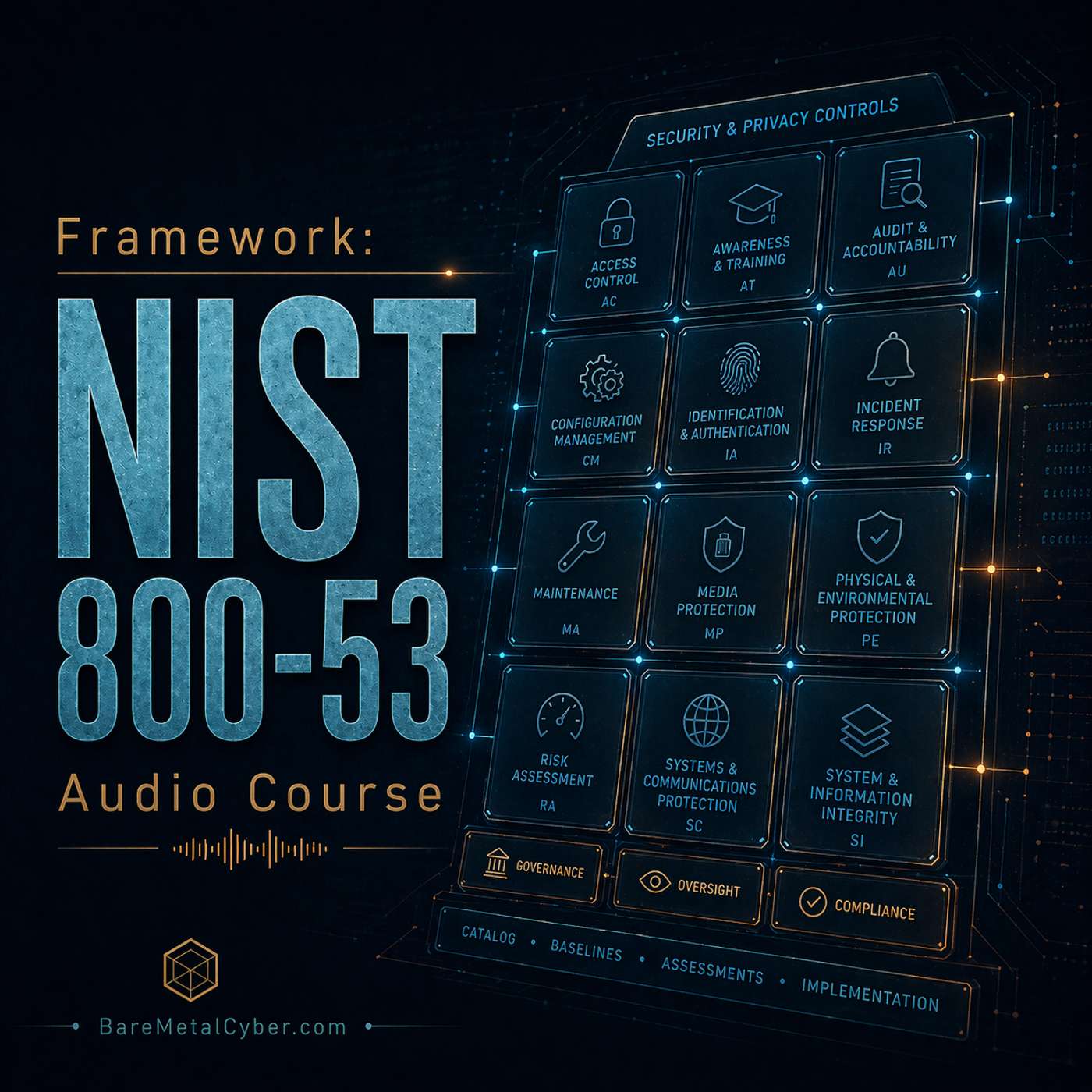
Framework: NIST 800-53 Audio Course
This **NIST Special Publication 800-53 Audio Course** is a complete, audio-first learning series designed to make one of the most comprehensive cybersecurity standards both clear and approachable. Through structured, plain-language narration, each episode walks you through the controls, objectives, and principles that form the foundation of modern federal and enterprise security programs. You’ll learn how NIST 800-53 defines safeguards across access control, incident response, risk assessment, system integrity, and continuous monitoring—building both exam readiness and real-world comprehension...
Author
Jason Edwards
Category
Podcast website
Latest episode
Oct 20, 2025
Where to listen?
Podcasts in the app Replaio Radio Coming soonPodcasts are coming to the app soon. Install now and be the first to see a whole new take on podcasts
 Install for free
Android 5M+ downloads · 4.8 rating
iOS soon
Install for free
Android 5M+ downloads · 4.8 rating
iOS soon
Episodes
Episode 47 — Contingency Planning — Part Three: Evidence, tests, and pitfalls 20.10.2025 8:50
Evidence for contingency planning demonstrates that recovery strategies are not just written but operationally validated. For the exam, candidates must understand that credible evidence includes test reports, recovery logs, after-action reviews, and updated plan revisions reflecting lessons learned. Testing proves that backups restore correctly, alternate sites activate as designed, and personnel...
Episode 46 — Contingency Planning — Part Two: Backup, alternate sites, and continuity patterns 20.10.2025 10:05
Backups and alternate sites form the operational backbone of contingency planning under NIST 800-53. For exam preparation, candidates should know that backups protect data availability, while alternate sites preserve processing capacity when primary facilities are lost. A sound continuity strategy defines not only what data is copied, but how often, where it resides, and who validates its integrit...
Episode 45 — Contingency Planning — Part One: Plans, roles, and objectives 20.10.2025 10:36
Contingency planning ensures that critical missions continue despite disruptions such as cyber incidents, natural disasters, or hardware failures. In NIST 800-53, this family of controls requires organizations to prepare, test, and maintain recovery plans tailored to their system impact levels. For the exam, candidates must understand that contingency planning extends beyond backups—it includes de...
Episode 44 — System and Communications Protection — Part Four: Advanced topics and metrics 20.10.2025 9:52
Advanced system and communications protection extends traditional boundary security into adaptive, context-aware controls. For exam readiness, candidates should recognize that zero trust architecture exemplifies this evolution—every connection is verified continuously rather than assumed safe based on network location. Micro-segmentation, software-defined perimeters, and encrypted east-west traffi...
Episode 43 — System and Communications Protection — Part Three: Evidence, coverage, and pitfalls 20.10.2025 9:37
Evidence for system and communications protection confirms that segmentation, encryption, and traffic controls function as designed. For the exam, candidates must know that sufficient evidence includes firewall configurations, packet capture samples, key rotation records, and network diagrams showing logical boundaries. Coverage checks verify that every communication path, including management and...
Episode 42 — System and Communications Protection — Part Two: Cryptography and session protections 20.10.2025 7:36
Cryptography within NIST 800-53 provides confidentiality and integrity for information in transit and at rest. Exam candidates must grasp that cryptographic protections are not abstract—they are measurable implementations that depend on algorithms, key management, and protocol configurations. Session protection mechanisms such as Transport Layer Security (T L S) ensure that communication between u...
Episode 41 — System and Communications Protection — Part One: Segmentation and boundary thinking 20.10.2025 10:44
System and communications protection within NIST 800-53 establishes how data and traffic are isolated, filtered, and secured across system boundaries. For exam purposes, candidates should understand that segmentation is not limited to network diagrams—it represents a strategy to contain faults, reduce attack surfaces, and enforce least privilege between zones. Boundary protection defines where org...
Episode 40 — System and Information Integrity — Part Four: Advanced topics and metrics 20.10.2025 8:16
Advanced integrity programs combine analytics, automation, and threat intelligence to predict and prevent compromise before symptoms appear. For exam purposes, candidates should understand how continuous scanning, integrity verification tools, and behavioral baselining raise detection speed and accuracy. Metrics quantify success through measures such as vulnerability closure rates, mean time to de...
Episode 39 — System and Information Integrity — Part Three: Evidence, signals, and pitfalls 20.10.2025 9:46
Evidence of system and information integrity proves that protective measures function consistently and effectively. For the exam, candidates must identify credible sources of such evidence: vulnerability reports, malware scan results, change logs, and alert histories. These records confirm that systems detect anomalies and respond as documented. Signals—such as sudden log changes, configuration dr...
Episode 38 — System and Information Integrity — Part Two: Flaw remediation and protection patterns 20.10.2025 9:59
Flaw remediation defines how organizations identify, prioritize, and correct vulnerabilities that threaten system integrity. NIST 800-53 requires a repeatable process for receiving updates, testing patches, and deploying them promptly across affected components. For exam readiness, candidates should understand that remediation involves both speed and control—patches must be applied quickly enough...
Episode 37 — System and Information Integrity — Part One: Purpose, scope, and outcomes 20.10.2025 7:54
System and information integrity ensures that systems detect, report, and correct errors in a timely manner. Within NIST 800-53, this control family addresses how organizations maintain trustworthy operation by identifying unauthorized changes, malicious code, and corrupted data. For exam preparation, candidates must recognize that integrity is not just about protection—it is about assurance that...
Episode 36 — Risk Assessment — Part Four: Advanced topics and metrics 20.10.2025 10:19
Advanced risk assessment techniques refine precision and speed without losing transparency. For exam purposes, candidates should understand how automation, analytics, and scenario modeling extend traditional frameworks. Advanced methods use dynamic data feeds—from vulnerability scanners, incident logs, and threat intelligence—to update likelihood and impact values automatically. This transforms th...
Episode 35 — Risk Assessment — Part Three: Evidence, registers, and pitfalls 20.10.2025 9:33
Evidence in risk assessment demonstrates that inputs are accurate, analyses are reproducible, and decisions follow stated criteria. For exam readiness, focus on the risk register as the organizing artifact that ties scenarios, ratings, owners, and treatments into a single, trackable structure. Each entry should cite sources—asset inventories, vulnerability scans, incident statistics, supplier atte...
Episode 34 — Risk Assessment — Part Two: Assessment practices and prioritization 20.10.2025 9:43
Assessment practices convert contextual understanding into prioritized action. For the exam, distinguish qualitative methods that use calibrated scales from quantitative approaches that assign numerical values to frequency and loss, and recognize hybrid models that mix both to balance rigor with feasibility. Asset discovery and data flow mapping establish what can be harmed and where controls must...
Episode 33 — Risk Assessment — Part One: Categorization, context, and threats 20.10.2025 9:15
Risk assessment in NIST 800-53 begins with system categorization, which anchors everything that follows by aligning confidentiality, integrity, and availability needs with impact levels. For exam purposes, understand that categorization is not a paperwork label; it reflects mission sensitivity, data types, and downstream dependencies that shape control selection and oversight. Context frames the s...
Episode 32 — Incident Response — Part Four: Advanced topics and metrics 20.10.2025 7:49
Advanced incident response integrates automation, threat intelligence enrichment, and cross-domain rehearsals to compress dwell time and standardize outcomes. On the exam, expect to reason about how orchestration platforms translate playbooks into machine-executed steps—isolating hosts, blocking indicators, and opening tickets—while still preserving human decision points for irreversible actions....
Episode 31 — Incident Response — Part Three: Evidence, timing, and pitfalls 20.10.2025 10:15
Evidence in incident response must show what happened, when it happened, who acted, and how decisions were made. For the exam, focus on the principle that response artifacts need to be contemporaneous, tamper-evident, and traceable to specific procedures. Time is a controlling factor: accurate, synchronized timestamps across sensors, systems, tickets, and communications are essential to reconstruc...
Episode 30 — Incident Response — Part Two: Implementation patterns and roles 20.10.2025 9:31
Implementing incident response effectively requires aligning roles, processes, and tools around a clear command structure. For exam readiness, candidates must identify core roles such as incident coordinator, technical responder, communications lead, and executive sponsor. NIST 800-53 expects documented responsibilities and defined escalation paths so incidents are handled consistently and efficie...
Episode 29 — Incident Response — Part One: Purpose, scope, and maturity markers 20.10.2025 10:16
Incident response under NIST 800-53 defines how organizations detect, analyze, contain, and recover from cybersecurity events. For the exam, candidates must understand that its purpose extends beyond reaction—it builds resilience through structured readiness. The scope covers both technical and organizational responses, from minor anomalies to full-scale breaches. Maturity markers include document...
Episode 28 — Configuration Management — Part Four: Advanced topics and metrics 20.10.2025 10:19
Advanced configuration management integrates continuous compliance verification, automated rollback, and predictive analytics to prevent drift before it occurs. For exam preparation, candidates should understand how metrics quantify configuration health. Common indicators include the percentage of assets compliant with baselines, mean time to remediate unauthorized changes, and frequency of config...
Episode 27 — Configuration Management — Part Three: Evidence, sampling, and pitfalls 20.10.2025 10:29
Evidence in configuration management proves that baselines are defined, implemented, and enforced. Candidates must recognize that sufficient evidence may include configuration files, system snapshots, scan results, or change logs that show compliance with approved settings. Sampling allows assessors to verify a representative subset of configurations, confirming that implementation is consistent a...
Episode 26 — Configuration Management — Part Two: Build patterns and approvals that scale 20.10.2025 9:17
Building scalable configuration management processes requires defining repeatable patterns and governance checkpoints that sustain control integrity across diverse environments. Within NIST 800-53, these patterns ensure that approved baselines can be deployed consistently to hundreds or thousands of systems without deviation. For exam purposes, candidates should understand how automation and human...
Episode 25 — Configuration Management — Part One: Baselines, change control, and integrity 20.10.2025 9:30
Configuration management defines how systems maintain secure, consistent, and verifiable states over time. In NIST 800-53, configuration controls ensure that every system component is deployed and maintained according to approved baselines. Exam candidates must understand that baselines represent the known, secure configurations from which all changes are measured. Change control processes evaluat...
Episode 24 — Audit and Accountability — Part Four: Advanced topics and metrics 20.10.2025 8:58
Advanced auditing extends beyond compliance into proactive security intelligence. For the exam, candidates must grasp how metrics transform raw log data into actionable insights. Metrics may measure detection latency, event volume by source, false-positive ratios, or review completion rates. These indicators reflect program health and help optimize analyst workload. Advanced audit architectures in...
Episode 23 — Audit and Accountability — Part Three: Evidence, coverage checks, and pitfalls 20.10.2025 9:51
Evidence for audit and accountability controls verifies that logging, review, and retention processes are functioning as described. Candidates preparing for the exam must understand that this evidence includes configuration files, sample log records, alert screenshots, and review reports. Coverage checks confirm that all required systems and components generate the expected logs. A common pitfall...
Similar podcasts







Listen to the Framework: NIST 800-53 Audio Course podcast in Replaio
Radio and podcasts in one app - free, with no sign-up. Install today and do not miss the launch
Replaio is not a podcast publisher; show names, artwork and audio belong to their authors and are distributed through public RSS feeds.