Jason Edwards
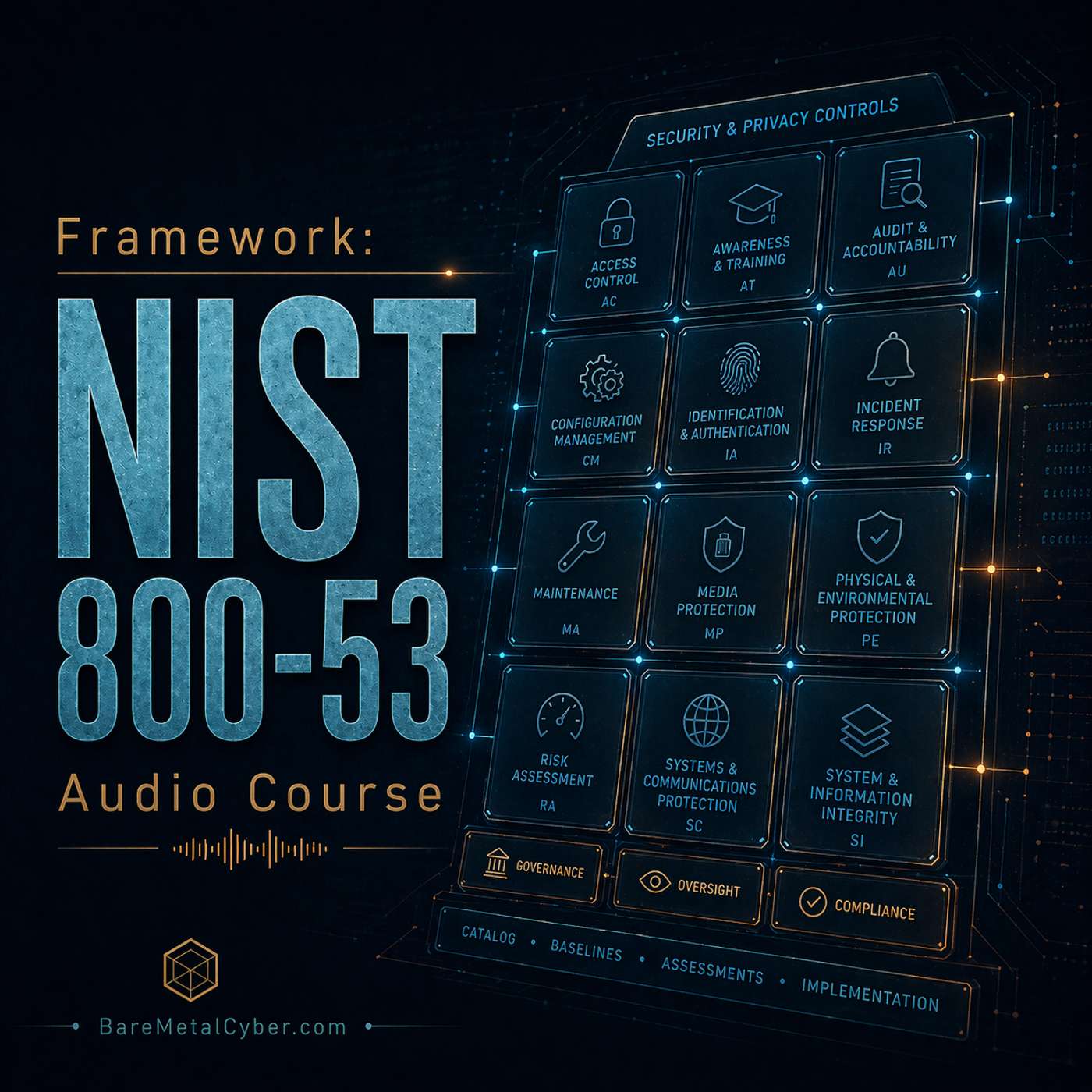
Framework: NIST 800-53 Audio Course
This **NIST Special Publication 800-53 Audio Course** is a complete, audio-first learning series designed to make one of the most comprehensive cybersecurity standards both clear and approachable. Through structured, plain-language narration, each episode walks you through the controls, objectives, and principles that form the foundation of modern federal and enterprise security programs. You’ll learn how NIST 800-53 defines safeguards across access control, incident response, risk assessment, system integrity, and continuous monitoring—building both exam readiness and real-world comprehension...
Author
Jason Edwards
Category
Podcast website
Latest episode
Oct 20, 2025
Where to listen?
Podcasts in the app Replaio Radio Coming soonPodcasts are coming to the app soon. Install now and be the first to see a whole new take on podcasts
 Install for free
Android 5M+ downloads · 4.8 rating
iOS soon
Install for free
Android 5M+ downloads · 4.8 rating
iOS soon
Episodes
Episode 72 — Physical and Environmental Protection — Part Three: Evidence, logs, and pitfalls 20.10.2025 9:14
Evidence of physical and environmental protection verifies that access and monitoring controls function consistently. For exam readiness, candidates should recognize that key evidence includes visitor logs, badge records, surveillance footage summaries, alarm reports, and maintenance tickets for environmental systems. These records must demonstrate not only that controls exist but that they are ac...
Episode 71 — Physical and Environmental Protection — Part Two: Access control and monitoring patterns 20.10.2025 7:47
Physical access control extends logical security principles into the built environment. For exam preparation, candidates must understand how layers of barriers, authentication devices, and monitoring systems enforce who can enter sensitive areas and under what conditions. Typical patterns include electronic badges linked to identity management, biometric readers for critical spaces, and mantraps t...
Episode 70 — Physical and Environmental Protection — Part One: Purpose, scope, and boundaries 20.10.2025 8:39
Physical and environmental protection in NIST 800-53 safeguards facilities, equipment, and supporting infrastructure so that logical controls can operate reliably. For exam readiness, understand that the purpose is twofold: prevent unauthorized physical access to systems and maintain environmental conditions—power, cooling, fire suppression—that preserve availability and integrity. Scope spans sit...
Episode 69 — Media Protection — Part Three: Evidence, chain of custody, and pitfalls 20.10.2025 10:03
Evidence in media protection demonstrates that handling rules were followed and that sensitive content remained controlled throughout its lifecycle. For exam purposes, candidates should connect specific artifacts to each lifecycle stage: storage access logs and location inventories for custody at rest, transfer forms and courier receipts for movement, and destruction certificates linked to unique...
Episode 68 — Media Protection — Part Two: Storage, transport, and destruction patterns 20.10.2025 8:30
Storage patterns for sensitive media combine physical control with cryptographic safeguards. On the exam, be ready to explain how locked rooms, safes, and controlled racks complement encryption, key management, and access logging for drives and backup sets. Transport patterns define secure movement between locations: tamper-evident packaging, sealed containers, documented couriers, and chain-of-cu...
Episode 67 — Media Protection — Part One: Purpose, scope, and handling basics 20.10.2025 10:34
Media protection in NIST 800-53 safeguards information recorded on physical and logical media across its lifecycle—creation, use, storage, transport, reuse, and destruction. For the exam, understand that “media” spans disk drives, removable storage, printed output, backups, and cloud-managed removable volumes. The purpose is to prevent unauthorized access, disclosure, alteration, or loss by enforc...
Episode 66 — Maintenance — Part Three: Evidence, approvals, and pitfalls 20.10.2025 9:18
Evidence for maintenance controls in NIST 800-53 proves that servicing actions were authorized, executed within guardrails, and verified after completion. For exam readiness, focus on the artifacts that demonstrate this chain: approved work orders referencing change tickets, identity-verified technician records, time-bounded access grants, session transcripts or logs, and post-maintenance validati...
Episode 65 — Maintenance — Part Two: Local and remote maintenance patterns 20.10.2025 8:58
Maintenance activities occur in two primary contexts—local and remote—each carrying distinct security implications. For exam preparation, candidates must understand that local maintenance involves physical presence at the system, while remote maintenance uses network connections that require heightened control. Local patterns emphasize physical access restrictions, escorting, and secure storage of...
Episode 64 — Maintenance — Part One: Purpose, scope, and guardrails 20.10.2025 10:54
The maintenance control family in NIST 800-53 governs how systems are serviced, updated, and repaired while preserving security and privacy. For exam readiness, candidates must understand that maintenance activities—whether routine patches, hardware replacement, or emergency fixes—introduce risk because they temporarily alter system states and often require elevated access. The purpose of these co...
Episode 63 — Awareness and Training — Part Three: Evidence, coverage, and pitfalls 20.10.2025 10:09
Evidence for awareness and training proves that the organization’s workforce received, understood, and applied security guidance. For exam purposes, candidates should recognize that valid evidence includes attendance records, course completions, quiz results, and feedback summaries. Coverage analysis ensures that all required audiences—employees, contractors, and privileged users—are included and...
Episode 62 — Awareness and Training — Part Two: Implementation patterns and delivery 20.10.2025 8:59
Implementing awareness and training requires combining instructional design principles with operational discipline. For exam readiness, candidates should understand how delivery patterns vary based on audience, technology, and mission. Core patterns include classroom sessions for policy orientation, e-learning for scalability, simulated exercises for behavioral reinforcement, and just-in-time modu...
Episode 61 — Awareness and Training — Part One: Purpose, scope, and audiences 20.10.2025 9:37
Awareness and training under NIST 800-53 ensure that every individual with system access understands their security responsibilities and possesses the skills to fulfill them. For exam purposes, candidates must know that awareness programs target all users with baseline messaging about threats, policies, and safe behavior, while training programs focus on specific job roles requiring deeper knowled...
Episode 60 — Supply Chain Risk Management — Part Four: Advanced topics and metrics 20.10.2025 8:51
Advanced supply chain programs treat dependency risk as a quantifiable, continuously monitored portfolio. For exam readiness, understand how metrics expose weak links and drive prioritized action. Leading indicators include evidence freshness across critical suppliers, percentage of components with verified provenance, median time for suppliers to remediate disclosed vulnerabilities, and coverage...
Episode 59 — Supply Chain Risk Management — Part Three: Evidence, approvals, and pitfalls 20.10.2025 9:31
Evidence in the supply chain domain must show that components are authentic, code is untampered, and providers are meeting obligations over time. For the exam, be able to cite examples that matter: signed release artifacts matched to hash values, software bill of materials linked to vulnerability scans, manufacturer certificates tied to lot numbers, and service control attestations that align with...
Episode 58 — Supply Chain Risk Management — Part Two: Supplier controls and assurance patterns 20.10.2025 10:48
Supplier controls translate expectations into operating rules that suppliers must follow and prove. For exam preparation, understand the assurance patterns that make those rules testable: secure development life cycle documentation, software bill of materials, code integrity attestations, penetration test summaries, vulnerability remediation timelines, and incident notification procedures. Assuran...
Episode 57 — Supply Chain Risk Management — Part One: Purpose, scope, and outcomes 20.10.2025 10:50
Supply chain risk management in NIST 800-53 addresses the reality that modern systems depend on providers, components, and services outside direct organizational control. For the exam, recognize that the purpose is to identify, assess, and treat risks that originate in design choices, sourcing decisions, build pipelines, and operational dependencies. The scope spans hardware provenance, software i...
Episode 56 — Assessment, Authorization, and Monitoring — Part Four: Advanced topics and metrics 20.10.2025 9:26
Advanced practices in assessment, authorization, and monitoring focus on compressing the time between change and assurance while preserving evidence quality. For exam readiness, understand how risk scoring models, automated control tests, and assurance tiers allow programs to allocate review depth where it matters most. Continuous control assessment platforms can execute scripted tests against con...
Episode 55 — Assessment, Authorization, and Monitoring — Part Three: Evidence, POA&M, and pitfalls 20.10.2025 9:51
Evidence in the AAM process substantiates that control testing, authorization, and remediation are properly executed. Candidates should recognize that a strong evidence package includes completed assessment procedures, assessor notes, test results, and Plan of Action and Milestones (POAM) entries for any deficiencies. Each item must be traceable to specific controls and updated as actions progress...
Episode 54 — Assessment, Authorization, and Monitoring — Part Two: Assessment practices and monitoring 20.10.2025 9:05
Assessment practices within NIST 800-53 define how controls are tested, reviewed, and scored. For exam readiness, candidates should understand the role of assessment procedures—who performs them, how independence is ensured, and what constitutes sufficient coverage. Assessments evaluate design adequacy, implementation effectiveness, and ongoing performance. Monitoring extends these results into op...
Episode 53 — Assessment, Authorization, and Monitoring — Part One: Purpose, scope, and outcomes 20.10.2025 8:53
Assessment, authorization, and monitoring—often referred to collectively as A A M—form the governance framework for verifying and maintaining system security. NIST 800-53 defines this family to ensure that implemented controls are evaluated objectively before and after operation. For exam preparation, candidates should understand that assessment measures effectiveness, authorization grants risk-ba...
Episode 52 — System and Services Acquisition — Part Four: Advanced topics and metrics 20.10.2025 9:12
Advanced acquisition management applies continuous assurance and data-driven oversight to supplier relationships. For exam purposes, candidates should understand that metrics convert supplier performance into measurable accountability. Indicators may include average response time to vulnerabilities, frequency of control evidence submission, and number of unresolved audit findings. Automated dashbo...
Episode 51 — System and Services Acquisition — Part Three: Evidence, contract hooks, and pitfalls 20.10.2025 11:29
Evidence in system and services acquisition demonstrates that suppliers have met agreed security and privacy obligations throughout the lifecycle. For exam readiness, candidates should recognize that acceptable evidence includes test results, code analysis reports, component inventories, and compliance attestations. Contract hooks refer to the clauses and mechanisms that require suppliers to provi...
Episode 50 — System and Services Acquisition — Part Two: Security engineering and supplier controls 20.10.2025 8:13
Security engineering integrates protection principles into product and service design, ensuring risks are mitigated before deployment. Under NIST 800-53, acquisition processes must verify that suppliers follow secure development practices, perform vulnerability testing, and deliver verifiable results. For the exam, candidates should understand that supplier controls extend beyond initial selection...
Episode 49 — System and Services Acquisition — Part One: Purpose, scope, and sourcing options 20.10.2025 9:32
System and services acquisition ensures that cybersecurity requirements are embedded from the start of procurement and development. NIST 800-53 positions this family of controls to align acquisition activities with security and privacy obligations. For exam readiness, candidates should understand that acquisition scope includes hardware, software, and managed services—each introducing different as...
Episode 48 — Contingency Planning — Part Four: Advanced topics and metrics 20.10.2025 9:47
Advanced contingency planning merges automation, analytics, and integrated resilience design. For exam purposes, candidates should understand how metrics validate readiness and drive improvement. Metrics include mean time to recover, data loss in bytes versus recovery point objectives, and test success rate across sites. Advanced programs employ orchestration platforms that automate failover, rehy...
Similar podcasts







Listen to the Framework: NIST 800-53 Audio Course podcast in Replaio
Radio and podcasts in one app - free, with no sign-up. Install today and do not miss the launch
Replaio is not a podcast publisher; show names, artwork and audio belong to their authors and are distributed through public RSS feeds.