Jason Edwards
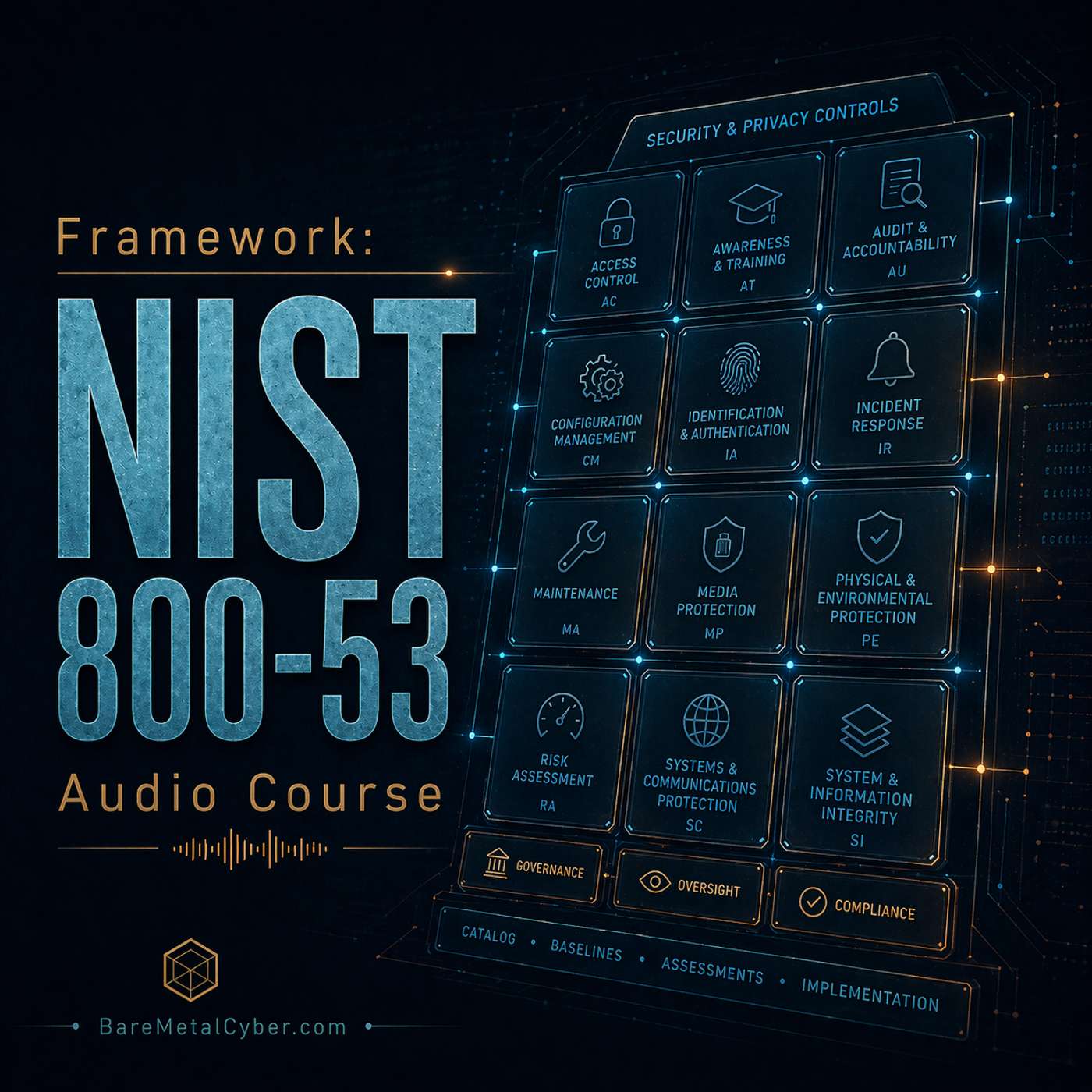
Framework: NIST 800-53 Audio Course
This **NIST Special Publication 800-53 Audio Course** is a complete, audio-first learning series designed to make one of the most comprehensive cybersecurity standards both clear and approachable. Through structured, plain-language narration, each episode walks you through the controls, objectives, and principles that form the foundation of modern federal and enterprise security programs. You’ll learn how NIST 800-53 defines safeguards across access control, incident response, risk assessment, system integrity, and continuous monitoring—building both exam readiness and real-world comprehension...
Author
Jason Edwards
Category
Podcast website
Latest episode
Oct 20, 2025
Where to listen?
Podcasts in the app Replaio Radio Coming soonPodcasts are coming to the app soon. Install now and be the first to see a whole new take on podcasts
 Install for free
Android 5M+ downloads · 4.8 rating
iOS soon
Install for free
Android 5M+ downloads · 4.8 rating
iOS soon
Episodes
Episode 97 — Spotlight: Baseline Configuration (CM-2) 20.10.2025 8:57
Baseline Configuration (CM-2) establishes the approved, secure starting point for systems and components, defining the specific settings, versions, and controls that must be present before operation. For the exam, recognize that a baseline is not a generic hardening guide; it is a tailored, version-controlled specification mapped to risk tolerance, mission needs, and technology stack. CM-2 require...
Episode 96 — Spotlight: Audit Record Retention (AU-11) 20.10.2025 8:03
Audit Record Retention (AU-11) specifies how long organizations must keep audit logs and related records so they remain available for investigations, compliance reviews, and operational analysis. For exam purposes, understand that retention is a risk-based, policy-driven decision influenced by legal, regulatory, contractual, and mission requirements. AU-11 ensures that retention periods are define...
Episode 95 — Spotlight: Protection of Audit Information (AU-9) 20.10.2025 7:14
Protection of Audit Information (AU-9) ensures that collected logs and audit data remain complete, accurate, and tamper-resistant. For exam readiness, candidates should recognize that audit data often contains sensitive details about system operations, making it a target for attackers seeking to hide traces of intrusion. AU-9 mandates safeguards to restrict access, maintain integrity, and separate...
Episode 94 — Spotlight: Audit Record Review, Analysis, and Reporting (AU-6) 20.10.2025 9:34
Audit Record Review, Analysis, and Reporting (AU-6) focuses on how organizations interpret and act upon the logs collected under AU-2. For exam purposes, candidates must understand that collecting audit records has no value unless those records are analyzed for indicators of compromise, anomalies, or policy violations. AU-6 requires scheduled reviews, automated correlation, and reporting to respon...
Episode 93 — Spotlight: Event Logging (AU-2) 20.10.2025 8:12
Event Logging (AU-2) defines which system activities must be recorded to support accountability, detection, and analysis. For exam readiness, candidates should know that AU-2 requires identifying events significant to security, privacy, and operational assurance—such as logins, privilege changes, data access, and configuration modifications. The control ensures that event selection aligns with mis...
Episode 92 — Spotlight: Identifier Management (IA-4) 20.10.2025 10:44
Identifier Management (IA-4) establishes rules for creating, assigning, and maintaining unique identifiers for all users, devices, and processes that interact with organizational systems. For exam purposes, candidates should understand that identifiers—such as usernames or system IDs—form the foundation of accountability by linking actions to individuals or components. IA-4 ensures that identifier...
Episode 91 — Spotlight: Non-Organizational User Authentication (IA-8) 20.10.2025 10:05
Non-Organizational User Authentication (IA-8) ensures that external users—such as partners, contractors, and customers—are verified before accessing organizational systems or data. For exam purposes, this control recognizes that trust boundaries extend beyond internal staff and must be governed by equivalent assurance standards. IA-8 requires authentication mechanisms that confirm the identity of...
Episode 90 — Spotlight: Authenticator Management (IA-5) 20.10.2025 9:01
Authenticator Management (IA-5) ensures that credentials—passwords, tokens, keys, or certificates—are created, stored, distributed, and revoked securely. For the exam, candidates should understand that IA-5 defines the lifecycle of authenticators, addressing generation strength, protection during storage and transmission, and prompt revocation when compromised or no longer needed. This control pre...
Episode 89 — Spotlight: Identification and Authentication (Organizational Users) (IA-2) 20.10.2025 8:43
Identification and Authentication (IA-2) establishes the foundation of trust by ensuring that only verified users gain access to organizational systems. For exam purposes, this control requires that every user be uniquely identified and authenticated before establishing a session or performing an action. Authentication mechanisms can include passwords, multi-factor authentication (MFA), smart card...
Episode 88 — Spotlight: Least Privilege (AC-6) 20.10.2025 10:22
Least Privilege (AC-6) enforces that users and processes operate with the minimum access necessary to perform assigned duties. For exam preparation, candidates must know this principle reduces attack surface and limits damage if credentials are compromised. The control applies to all environments—on-premises, cloud, and hybrid—requiring that permissions be granted only for legitimate business need...
Episode 87 — Spotlight: Separation of Duties (AC-5) 20.10.2025 8:20
Separation of Duties (AC-5) prevents fraud, error, and unauthorized activity by dividing critical functions among different individuals or roles. On the exam, candidates should recognize that this control enforces checks and balances within processes such as system administration, financial transactions, or access provisioning. No single person should be able to initiate and approve the same actio...
Episode 86 — Spotlight: Access Enforcement (AC-3) 20.10.2025 10:03
Access Enforcement (AC-3) defines how authorized permissions are technically applied once accounts are approved. For exam purposes, this control ensures that access decisions are enforced consistently through system mechanisms—operating systems, applications, or network devices—according to policies defined in AC-2. Enforcement determines who can perform specific actions such as read, write, execu...
Episode 85 — Spotlight: Account Management (AC-2) 20.10.2025 8:08
Account Management, designated as control AC dash two in NIST 800-53, governs the creation, use, modification, and termination of system accounts. For exam readiness, candidates should understand that this control ensures each account has a defined owner, authorized purpose, and approval chain. It requires periodic reviews to confirm that active accounts remain necessary and aligned with current r...
Episode 84 — Personally Identifiable Information Processing and Transparency — Part Three: Evidence, notices, and pitfalls 20.10.2025 10:08
Evidence for PII processing controls demonstrates that privacy obligations are implemented and verifiable. For the exam, candidates should know that strong evidence includes published privacy notices, consent logs, data inventory updates, and records of fulfilled data subject requests. Notices must be accurate, accessible, and consistent across platforms, outlining what data is collected, how it i...
Episode 83 — Personally Identifiable Information Processing and Transparency — Part Two: Processing, minimization, and consent patterns 20.10.2025 8:16
Processing personally identifiable information responsibly means handling data only for legitimate, documented purposes. For exam readiness, candidates should know that NIST 800-53 emphasizes minimization—collecting the least amount of PII necessary to accomplish the mission. Consent patterns ensure individuals understand and agree to data use when appropriate, through clear notices and accessible...
Episode 82 — Personally Identifiable Information Processing and Transparency — Part One: Purpose, scope, and responsibilities 20.10.2025 10:33
Personally identifiable information, or PII, requires special protection because it links data to individuals, creating privacy and reputational risks if mishandled. Under NIST 800-53, this control family ensures organizations collect, process, store, and share PII responsibly and transparently. For the exam, candidates should understand that the purpose is to uphold fairness, accountability, and...
Episode 81 — Personnel Security — Part Three: Evidence, sanctions, and pitfalls 20.10.2025 10:01
Evidence for personnel security validates that screening, agreements, and access management are conducted according to policy. For exam purposes, candidates should recognize that valid evidence includes completed background check forms, signed nondisclosure and acceptable use agreements, role reassignment records, and offboarding checklists confirming account deactivation. This documentation demon...
Episode 80 — Personnel Security — Part Two: Screening, agreements, and access lifecycle 20.10.2025 11:14
Personnel screening and access management form the operational heart of personnel security. For exam readiness, candidates should understand how pre-employment, periodic, and post-incident screenings align with system sensitivity and regulatory requirements. Screening verifies identity, qualifications, and background integrity, while agreements formalize obligations to protect information. The acc...
Episode 79 — Personnel Security — Part One: Purpose, scope, and roles 20.10.2025 10:09
Personnel security ensures that individuals granted system access are trustworthy and that risks from human factors are managed systematically. Within NIST 800-53, this control family’s purpose is to verify suitability before employment, maintain accountability during tenure, and mitigate risks upon departure. For exam purposes, candidates must understand that personnel controls complement technic...
Episode 78 — Program Management — Part Three: Evidence, metrics, and pitfalls 20.10.2025 8:52
Evidence for program management demonstrates that strategic oversight, funding, and governance occur as planned. For the exam, candidates should identify acceptable artifacts such as charters, policy approval records, committee minutes, budget justifications, and metric dashboards. These documents prove that leadership is actively managing risk rather than passively endorsing policies. Metrics qua...
Episode 77 — Program Management — Part Two: Governance rhythms and portfolios 20.10.2025 9:28
Governance rhythms give structure to program management by defining how often performance is reviewed, decisions are made, and adjustments are implemented. For exam readiness, candidates must recognize that a rhythm includes recurring activities such as steering committee meetings, risk reviews, control updates, and audit follow-ups. Consistency in these cycles prevents drift and keeps leadership...
Episode 76 — Program Management — Part One: Strategy, roles, and alignment 20.10.2025 8:50
Program management within NIST 800-53 defines how an organization builds and sustains a coordinated security and privacy program that aligns with mission objectives. For exam purposes, candidates must understand that this family operates above individual systems, establishing enterprise-level strategy, resource allocation, and oversight. Strategy expresses risk tolerance, priority frameworks, and...
Episode 75 — Planning — Part Three: Evidence and common pitfalls 20.10.2025 10:55
Evidence in planning demonstrates that documentation accurately reflects system implementation and governance practice. For exam purposes, candidates should recognize that supporting proof includes version histories, approval signatures, update logs, and correspondence showing review participation. These artifacts confirm that plans are maintained, reviewed, and approved at required intervals. A f...
Episode 74 — Planning — Part Two: Plan structure, updates, and integration 20.10.2025 10:24
Plan structure provides the scaffolding that keeps documentation consistent and auditable across systems. For the exam, candidates must recognize that a complete plan includes context, control implementation details, responsibilities, frequencies, and linkages to related procedures. Updates ensure plans reflect current reality—when controls evolve, ownership changes, or inherited services are repl...
Episode 73 — Planning — Part One: Purpose, scope, and artifacts 20.10.2025 9:06
Planning in NIST 800-53 establishes how security and privacy programs are documented, organized, and maintained. For exam purposes, candidates should understand that planning controls ensure systems operate under clear intent rather than ad hoc decisions. The purpose is to translate organizational risk strategy into concrete guidance for each system, defining who does what, how often, and under wh...
Similar podcasts







Listen to the Framework: NIST 800-53 Audio Course podcast in Replaio
Radio and podcasts in one app - free, with no sign-up. Install today and do not miss the launch
Replaio is not a podcast publisher; show names, artwork and audio belong to their authors and are distributed through public RSS feeds.