Jason Edwards
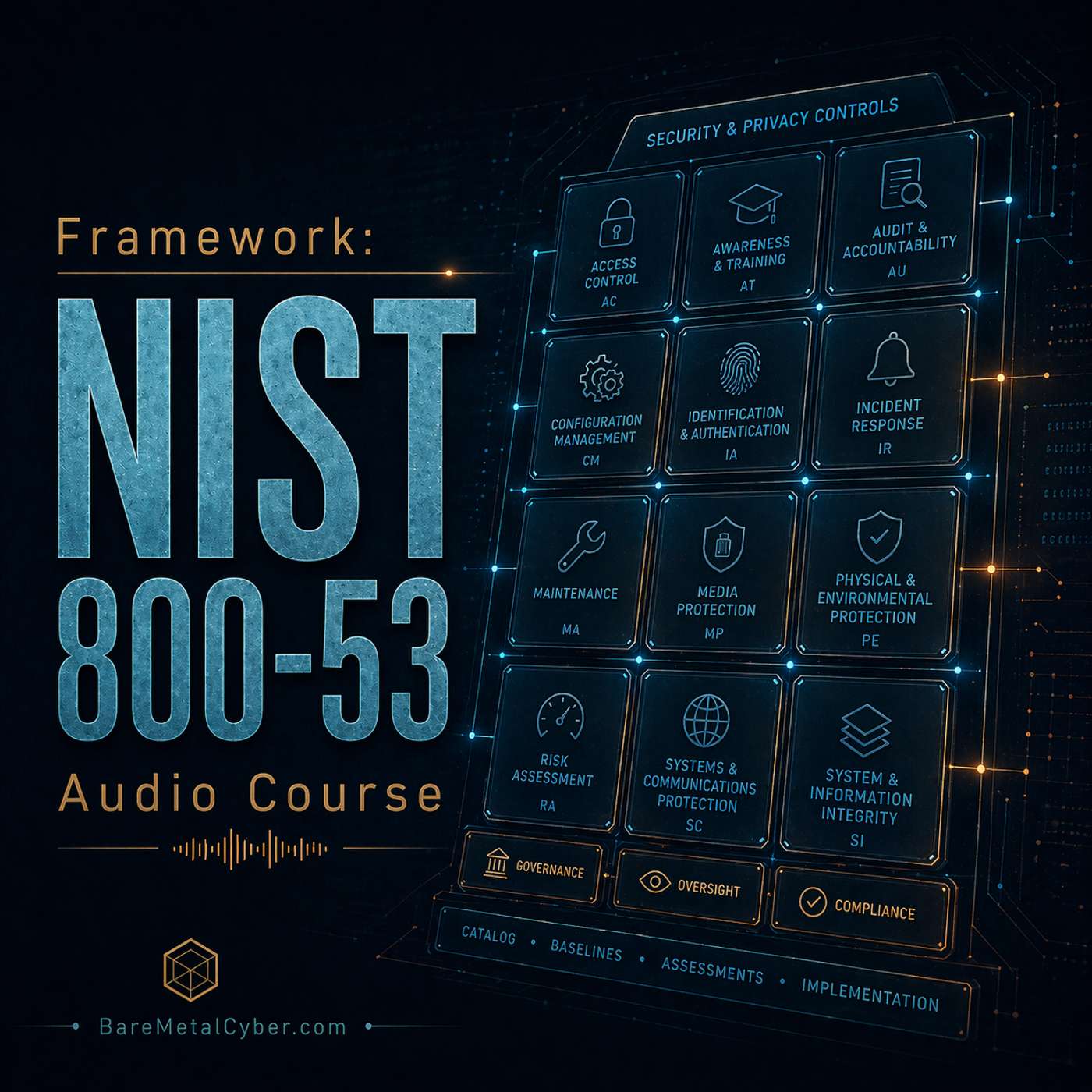
Framework: NIST 800-53 Audio Course
This **NIST Special Publication 800-53 Audio Course** is a complete, audio-first learning series designed to make one of the most comprehensive cybersecurity standards both clear and approachable. Through structured, plain-language narration, each episode walks you through the controls, objectives, and principles that form the foundation of modern federal and enterprise security programs. You’ll learn how NIST 800-53 defines safeguards across access control, incident response, risk assessment, system integrity, and continuous monitoring—building both exam readiness and real-world comprehension...
Author
Jason Edwards
Category
Podcast website
Latest episode
Oct 20, 2025
Where to listen?
Podcasts in the app Replaio Radio Coming soonPodcasts are coming to the app soon. Install now and be the first to see a whole new take on podcasts
 Install for free
Android 5M+ downloads · 4.8 rating
iOS soon
Install for free
Android 5M+ downloads · 4.8 rating
iOS soon
Episodes
Episode 123 — Spotlight: Software, Firmware, and Information Integrity (SI-7) 20.10.2025 9:45
Software, Firmware, and Information Integrity (SI-7) ensures that system components and data remain trustworthy throughout their lifecycle. For the exam, understand that SI-7 requires mechanisms to detect unauthorized changes, corruption, or tampering in code and stored information. Integrity checks include digital signatures, cryptographic hashes, and validation at load time or execution. The con...
Episode 122 — Spotlight: System Monitoring (SI-4) 20.10.2025 10:15
System Monitoring (SI-4) provides the visibility necessary to detect, analyze, and respond to security-relevant events across networks and systems. For exam readiness, understand that SI-4 expands on the audit controls by defining how real-time detection, alerting, and analysis occur. It requires continuous observation of key metrics, anomaly detection, and integration with incident response. The...
Episode 121 — Spotlight: Flaw Remediation (SI-2) 20.10.2025 8:38
Flaw Remediation (SI-2) ensures that software and system vulnerabilities are identified, prioritized, and corrected in a timely and verifiable manner. For exam purposes, recognize that SI-2 connects vulnerability discovery to patch management and change control. It requires that organizations track all known flaws, evaluate risk impact, and implement corrective actions according to documented time...
Episode 120 — Spotlight: Denial-of-Service Protection (SC-5) 20.10.2025 10:11
Denial-of-Service Protection (SC-5) requires organizations to anticipate and withstand attempts to degrade or exhaust system resources, whether through volumetric floods, protocol abuse, or application-layer exhaustion. For the exam, understand that SC-5 links architecture decisions—capacity planning, network peering, CDN usage, and scrubbing services—to control mechanisms like rate limiting, circ...
Episode 119 — Spotlight: Public Key Infrastructure Certificates (SC-17) 20.10.2025 10:37
Public Key Infrastructure Certificates (SC-17) governs the issuance, management, and validation of digital certificates that anchor trust for users, services, and devices. For exam purposes, recognize that SC-17 focuses on how identities are bound to keys and how that binding is proven during communications or code signing. It expects approved certificate authorities, documented certificate profil...
Episode 118 — Spotlight: Session Authenticity (SC-23) 20.10.2025 8:28
Session Authenticity (SC-23) ensures that once a user or service is authenticated, the resulting session remains bound to that identity, protected from hijacking, replay, or fixation. For exam readiness, understand that SC-23 ties identity proof from IA controls to the ongoing conversation between client and system, using cryptographic binding, robust token design, and lifecycle rules to keep the...
Episode 117 — Spotlight: Protection of Information at Rest (SC-28) 20.10.2025 9:44
Protection of Information at Rest (SC-28) mandates that stored data remain confidential and tamper-evident wherever it resides—primary storage, backups, snapshots, removable media, or replicated copies. For the exam, recognize that SC-28 is broader than “turn on disk encryption.” It requires mapping data sensitivity to storage locations, selecting cryptographic protections that fit the medium and...
Episode 116 — Spotlight: Cryptographic Protection (SC-13) 20.10.2025 11:03
Cryptographic Protection (SC-13) requires organizations to protect the confidentiality and integrity of information through approved cryptographic mechanisms that are selected, configured, and governed according to risk and policy. For exam purposes, understand that SC-13 is the umbrella requirement that binds algorithm choice, mode selection, key sizes, and protocol baselines to mission needs and...
Episode 115 — Spotlight: Cryptographic Key Establishment and Management (SC-12) 20.10.2025 10:29
Cryptographic Key Establishment and Management (SC-12) ensures that encryption keys are generated, distributed, stored, and retired securely throughout their lifecycle. For exam readiness, candidates must understand that key management is the foundation of all cryptographic trust. SC-12 requires strong random generation methods, separation of key roles, and protection of keys during storage and tr...
Episode 114 — Spotlight: Transmission Confidentiality and Integrity (SC-8) 20.10.2025 10:01
Transmission Confidentiality and Integrity (SC-8) safeguards information as it travels across networks by preventing unauthorized disclosure or modification. For the exam, understand that SC-8 requires cryptographic protections such as TLS, VPNs, or IPsec for data in transit between systems, services, and users. It also mandates verification that data received is complete and unaltered. This contr...
Episode 113 — Spotlight: Boundary Protection (SC-7) 20.10.2025 10:44
Boundary Protection (SC-7) governs how networks, systems, and data flows are isolated and controlled to prevent unauthorized access or leakage. For exam purposes, SC-7 ensures that organizations define and enforce boundaries through mechanisms like firewalls, gateways, routers, and intrusion prevention systems. The control requires separation between internal, external, and restricted network zone...
Episode 112 — Spotlight: Unsupported System Components (SA-22) 20.10.2025 9:39
Unsupported System Components (SA-22) addresses the risk of operating hardware or software that vendors no longer support. For the exam, candidates must understand that unsupported components lack security patches, compatibility updates, and warranty protections, creating potential entry points for exploitation. The control requires organizations to identify such components, document exceptions, a...
Episode 111 — Spotlight: External System Services (SA-9) 20.10.2025 9:11
External System Services (SA-9) ensures that when organizations rely on external providers—such as cloud platforms, SaaS applications, or managed services—security and privacy requirements remain enforced and verifiable. For exam readiness, understand that this control extends system boundaries to include the responsibilities of third parties. SA-9 mandates formal agreements that specify control i...
Episode 110 — Spotlight: Developer Testing and Evaluation (SA-11) 20.10.2025 9:54
Developer Testing and Evaluation (SA-11) requires that software be verified through systematic testing to uncover defects and security weaknesses before release. For the exam, distinguish breadth of techniques—unit tests, integration tests, static application security testing (SAST), dynamic application security testing (DAST), software composition analysis (SCA), interactive testing, fuzzing, and...
Episode 109 — Spotlight: Security and Privacy Engineering Principles (SA-8) 20.10.2025 9:17
Security and Privacy Engineering Principles (SA-8) codify design tenets that make systems trustworthy by default rather than retrofitted after deployment. For exam purposes, know the core ideas: least privilege, defense in depth, fail-safe defaults, secure by design, privacy by design, complete mediation, economy of mechanism, and separation of duties, among others. SA-8 expects organizations to t...
Episode 108 — Spotlight: Criticality Analysis (RA-9) 20.10.2025 10:41
Criticality Analysis (RA-9) identifies the components, services, and data flows whose compromise would create disproportionate harm, enabling focused protection where failure would be most damaging. For the exam, understand that RA-9 goes beyond general risk lists by ranking elements inside the system: specific microservices, encryption key stores, identity providers, message queues, build pipelin...
Episode 107 — Spotlight: Security Categorization (RA-2) 20.10.2025 9:14
Security Categorization (RA-2) anchors the entire control selection process by determining the potential impact of a loss of confidentiality, integrity, or availability for each system. For exam readiness, recognize that RA-2 is not a clerical step; it ties mission objectives, data sensitivity, and operational dependencies to an impact level that drives baselines, overlays, and parameter choices....
Episode 106 — Spotlight: Vulnerability Monitoring and Scanning (RA-5) 20.10.2025 10:51
Vulnerability Monitoring and Scanning (RA-5) ensures organizations continuously identify weaknesses in systems, applications, and configurations before adversaries do. For exam purposes, understand that RA-5 is broader than scheduled scans; it encompasses a full lifecycle that ingests threat intelligence, evaluates exposure across on-premises and cloud assets, and tunes discovery methods to evolvi...
Episode 105 — Spotlight: Risk Assessment (RA-3) 20.10.2025 9:03
Risk Assessment (RA-3) defines how organizations identify threats, vulnerabilities, and potential impacts to determine the likelihood and magnitude of adverse events. For exam readiness, candidates should understand that RA-3 formalizes risk evaluation by combining asset value, threat capability, vulnerability severity, and control effectiveness into actionable insights. The control ensures that a...
Episode 104 — Spotlight: Information Spillage Response (IR-9) 20.10.2025 10:09
Information Spillage Response (IR-9) focuses on detecting, containing, and remediating incidents where classified, controlled, or otherwise sensitive information is transferred to unauthorized systems or users. For exam purposes, this control requires rapid isolation of affected systems, analysis of exposure scope, and documented cleanup procedures that ensure contaminated environments are sanitiz...
Episode 103 — Spotlight: Incident Response Plan (IR-8) 20.10.2025 8:36
Incident Response Plan (IR-8) ensures that organizations maintain a documented, tested, and updated plan guiding all activities related to incident management. For exam readiness, understand that this control formalizes the structure described in IR-4 and IR-6 by defining objectives, roles, communication flows, escalation criteria, and integration with other plans such as contingency and continuit...
Episode 102 — Spotlight: Incident Reporting (IR-6) 20.10.2025 10:23
Incident Reporting (IR-6) ensures that detected security incidents are promptly communicated to appropriate parties so that response and oversight occur without delay. For the exam, candidates must understand that this control establishes reporting thresholds, timelines, and communication paths based on incident type and severity. Reports typically include event details, affected systems, scope, i...
Episode 101 — Spotlight: Incident Handling (IR-4) 20.10.2025 8:20
Incident Handling (IR-4) defines how organizations detect, analyze, contain, eradicate, and recover from security incidents in a structured and repeatable manner. For exam purposes, understand that this control operationalizes the entire incident response process by prescribing standard procedures, communication paths, and decision-making authorities. IR-4 ensures incidents are managed consistentl...
Episode 100 — Spotlight: Least Functionality (CM-7) 20.10.2025 9:33
Least Functionality (CM-7) requires systems to provide only the capabilities essential to mission needs, removing or disabling unnecessary services, features, roles, and ports. For exam purposes, understand that reducing functionality directly reduces attack surface and operational complexity, improving both security and reliability. CM-7 builds on CM-2 and CM-6 by ensuring that what is not in the...
Episode 98 — Spotlight: Configuration Change Control (CM-3) 20.10.2025 9:18
Configuration Change Control (CM-3) governs how proposed modifications to systems and baselines are evaluated, approved, implemented, and recorded. For exam readiness, understand that CM-3 is the gatekeeper preventing unvetted changes from introducing vulnerabilities or breaking compliance. The control requires a documented process that captures the change description, risk and impact assessment,...
Similar podcasts







Listen to the Framework: NIST 800-53 Audio Course podcast in Replaio
Radio and podcasts in one app - free, with no sign-up. Install today and do not miss the launch
Replaio is not a podcast publisher; show names, artwork and audio belong to their authors and are distributed through public RSS feeds.