Jason Edwards
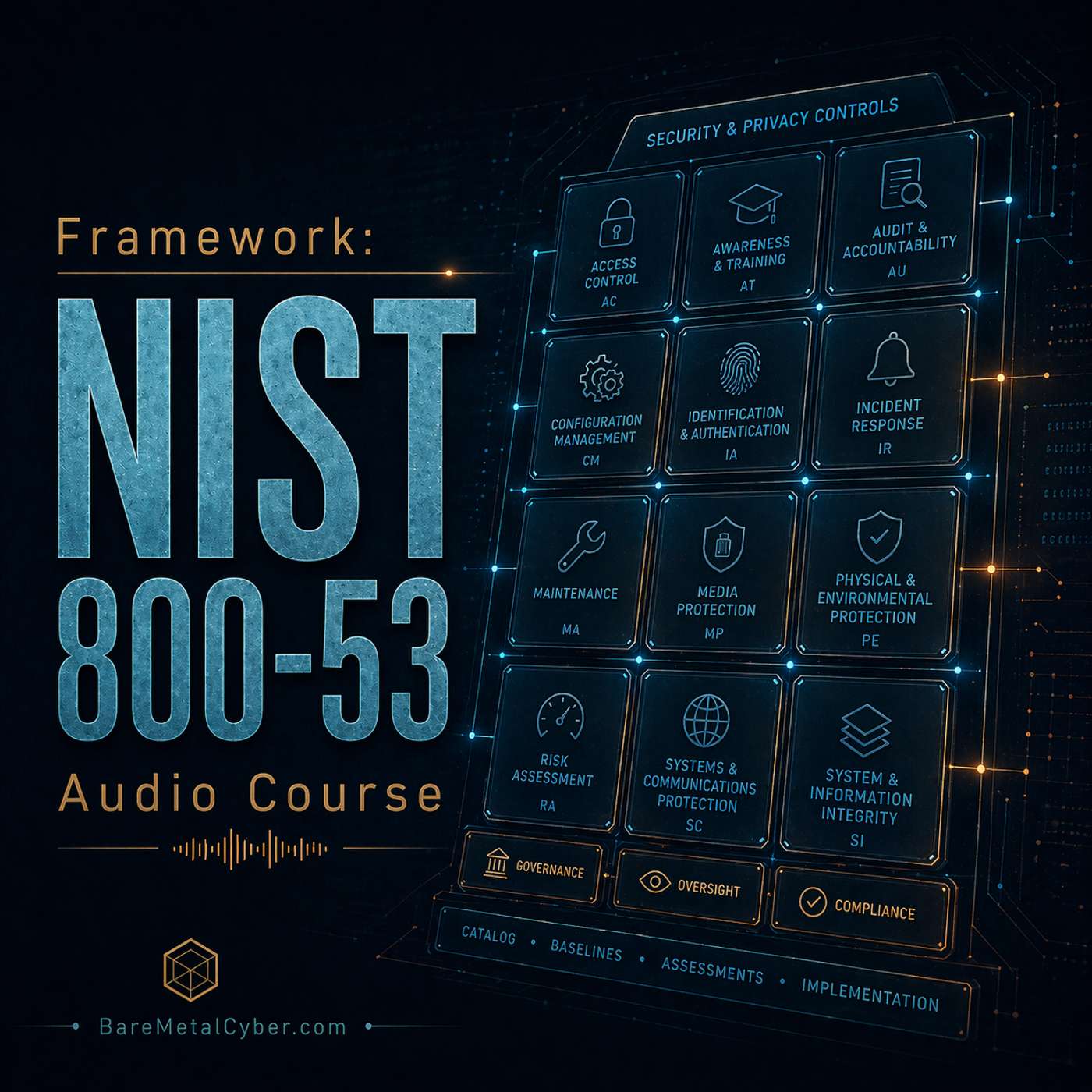
Framework: NIST 800-53 Audio Course
This **NIST Special Publication 800-53 Audio Course** is a complete, audio-first learning series designed to make one of the most comprehensive cybersecurity standards both clear and approachable. Through structured, plain-language narration, each episode walks you through the controls, objectives, and principles that form the foundation of modern federal and enterprise security programs. You’ll learn how NIST 800-53 defines safeguards across access control, incident response, risk assessment, system integrity, and continuous monitoring—building both exam readiness and real-world comprehension...
Author
Jason Edwards
Category
Podcast website
Latest episode
Oct 20, 2025
Where to listen?
Podcasts in the app Replaio Radio Coming soonPodcasts are coming to the app soon. Install now and be the first to see a whole new take on podcasts
 Install for free
Android 5M+ downloads · 4.8 rating
iOS soon
Install for free
Android 5M+ downloads · 4.8 rating
iOS soon
Episodes
Episode 22 — Audit and Accountability — Part Two: Collection, transport, and retention patterns 20.10.2025 10:41
Collecting and retaining audit records securely ensures that data remains accurate, complete, and accessible for analysis. Under NIST 800-53, audit records must be generated by each component within the system boundary and transmitted to a centralized location for correlation. For exam readiness, candidates should know that the collection process must protect logs in transit and at rest to prevent...
Episode 21 — Audit and Accountability — Part One: Logging purpose, scope, and event taxonomy 20.10.2025 9:01
Audit and accountability controls within NIST 800-53 ensure that system activities are recorded, traceable, and reviewable to detect misuse or policy violations. For exam purposes, candidates must understand that auditing supports both security and operational assurance by capturing evidence of user actions, system events, and security responses. Logs provide a historical record essential for inve...
Episode 20 — Identification and Authentication — Part Four: Advanced topics and metrics 20.10.2025 8:38
Advanced identification and authentication approaches align with zero trust architectures, emphasizing continuous validation rather than one-time login events. For exam preparation, candidates should understand how behavioral analytics, adaptive authentication, and device trust integrate into NIST 800-53 control objectives. Metrics such as failed login attempts, credential reuse rates, and time-to...
Episode 19 — Identification and Authentication — Part Three: Evidence across the credential lifecycle 20.10.2025 8:30
Evidence for identification and authentication controls demonstrates that identity verification, credential issuance, and periodic validation occur as designed. For the exam, candidates must identify what qualifies as sufficient evidence, such as enrollment records, issuance logs, and revocation confirmations. Traceability ensures that every credential can be linked to an individual, an authorizat...
Episode 18 — Identification and Authentication — Part Two: Implementation patterns and enrollment 20.10.2025 8:42
Implementing identification and authentication within NIST 800-53 involves lifecycle management, from identity proofing to credential issuance, renewal, and revocation. Exam candidates should understand how these patterns differ between organizational and non-organizational users. Enrollment establishes initial trust through identity verification, often supported by documentation or automated vali...
Episode 17 — Identification and Authentication — Part One: Authentication goals and threats 20.10.2025 10:04
Identification and authentication underpin every security boundary. In NIST 800-53, this control family ensures that entities prove who they are before being granted access to systems or data. For exam purposes, candidates must understand that identification assigns a unique identity, while authentication verifies it through credentials such as passwords, tokens, or certificates. The goal is to en...
Episode 16 — Access Control — Part Four: Advanced topics and metrics 20.10.2025 9:09
Advanced access control concepts expand from traditional identity enforcement into dynamic, context-aware decision-making. Within NIST 800-53, advanced patterns include continuous authentication, just-in-time privilege elevation, and policy enforcement points integrated with zero trust architectures. For the exam, candidates must understand how metrics and automation support these evolutions. Metr...
Episode 15 — Access Control — Part Three: Evidence, reviews, and pitfalls 20.10.2025 9:32
Evidence in the access control domain confirms that permissions are granted appropriately and reviewed regularly. For NIST 800-53, this involves maintaining records such as access approval forms, access logs, and review reports. On the exam, candidates should recognize that evidence must link user identities to their assigned roles and demonstrate periodic validation of these relationships. Review...
Episode 14 — Access Control — Part Two: Implementation patterns and guardrails 20.10.2025 10:32
Implementation of access control requires balancing usability with enforcement strength. NIST 800-53 outlines patterns that include mandatory, discretionary, and role-based access control, each suited for specific environments. For exam purposes, candidates should understand how these models differ and where they apply. Mandatory models fit high-assurance or classified systems where users cannot a...
Episode 13 — Access Control — Part One: Principles, risks, and outcomes 20.10.2025 10:11
Access control defines how organizations enforce the principle of least privilege and protect information from unauthorized use or disclosure. Within NIST 800-53, this family of controls establishes the foundation for identity-based decision-making across all systems and applications. For the exam, it is critical to understand the core principles—identification, authentication, and authorization—a...
Episode 12 — Always-Ready Rhythm — Updates, reviews, and renewals 20.10.2025 10:02
An always-ready rhythm ensures that security documentation, control performance, and risk posture remain current without waiting for formal assessments. NIST 800-53 programs increasingly adopt this continuous authorization mindset, where updates, reviews, and renewals occur as part of daily operations. For exam purposes, candidates should understand that readiness is sustained through recurring co...
Episode 11 — Documentation Quality — Narratives that survive scrutiny 20.10.2025 10:08
In NIST 800-53 programs, documentation quality directly determines how well an organization can defend its security posture during assessments. The System Security Plan and its companion artifacts must convey not only what controls exist, but how they operate, who owns them, and how they are verified. For exam readiness, candidates must grasp that documentation is more than a compliance formality—...
Episode 10 — Tailoring Workflow — From assumption to parameter 20.10.2025 9:52
Tailoring in NIST 800-53 refers to the process of adjusting control sets to fit specific system missions, environments, and technologies while maintaining defensibility. For exam success, candidates should be able to outline the full tailoring workflow—from initial assumptions about impact levels to the final documentation of parameter values. Tailoring begins with identifying applicable controls,...
Episode 9 — Metrics — Choosing numbers that drive action 20.10.2025 8:43
Metrics transform control performance into measurable insights that inform management and improvement. In the NIST 800-53 context, metrics should align with organizational objectives and the risk management strategy rather than focusing on raw counts alone. For exam preparation, candidates must know that good metrics are relevant, reliable, and repeatable. They should measure both implementation e...
Episode 8 — Continuous Monitoring — Cadence, triggers, and tiles 20.10.2025 8:44
Continuous monitoring within the NIST 800-53 program extends the assessment process beyond the authorization decision, transforming security into an ongoing management function. For exam readiness, it is critical to understand that continuous monitoring encompasses data collection, analysis, and reporting cycles designed to detect changes in risk posture. The cadence defines how often information...
Episode 7 — Sampling — Populations, periods, and selection logic 20.10.2025 9:40
Sampling enables assessors and auditors to test representative subsets of evidence without examining every instance, saving time while maintaining confidence in control performance. NIST 800-53 does not define sampling methods directly but expects organizations to apply logical, risk-informed approaches. For exam preparation, it is essential to understand that a valid sample population must be com...
Episode 6 — Evidence — Definitions, sufficiency, and traceability 20.10.2025 9:30
Evidence in the NIST 800-53 framework forms the backbone of any credible assessment or authorization decision. It verifies that controls are not only documented but functioning as intended. For exam purposes, understanding what qualifies as sufficient evidence—whether configuration settings, screenshots, logs, or procedural outputs—is vital. Evidence must be authentic, recent, and clearly tied to...
Episode 5 — Roles and Artifacts — SSP, SAP, SAR, and POA&M that agree 20.10.2025 11:07
Every NIST 800-53 program depends on clear roles and aligned artifacts. The System Security Plan (SSP) documents control implementation, the Security Assessment Plan (SAP) outlines how those controls will be tested, the Security Assessment Report (SAR) presents results, and the Plan of Action and Milestones (POA&M) tracks remediation. Exam takers must understand how these artifacts interrelate...
Episode 4 — Parameters and ODPs — Making controls fit your system 20.10.2025 8:29
Parameters and organizationally defined parameters, or ODPs, give NIST 800-53 its flexibility by allowing organizations to specify how controls apply in their particular environment. A control may require a password length or a review frequency, but it leaves the numeric or procedural value open for definition. Candidates must recognize that completing these parameters is not optional—it is part o...
Episode 3 — Scoping and Inheritance — Boundaries, providers, and proofs 20.10.2025 10:03
Scoping and inheritance define where responsibility begins and ends within a system authorization boundary. In NIST 800-53, scoping determines which controls apply to the system based on its function, data sensitivity, and architecture. Inheritance describes when a control’s protection or function is provided by another system, typically a shared service or external provider. For the exam, knowing...
Episode 2 — Baselines and Overlays — Tailoring you can defend 20.10.2025 10:13
Baselines and overlays within NIST 800-53 define how control selections scale across systems of differing impact levels and mission contexts. Baselines represent the starting set of controls categorized as low, moderate, or high impact, while overlays modify those sets to reflect specific needs, such as cloud services, privacy protection, or classified environments. For exam purposes, it is crucia...
Episode 1 — Foundations — Why NIST 800-53 still anchors real programs 20.10.2025 10:14
NIST Special Publication 800-53 remains the cornerstone of modern cybersecurity compliance because it provides a unified control catalog that integrates security and privacy into every phase of system design and operation. The framework evolved through decades of federal and industry collaboration to define safeguards that protect confidentiality, integrity, and availability across technologies an...
Similar podcasts







Listen to the Framework: NIST 800-53 Audio Course podcast in Replaio
Radio and podcasts in one app - free, with no sign-up. Install today and do not miss the launch
Replaio is not a podcast publisher; show names, artwork and audio belong to their authors and are distributed through public RSS feeds.