Jolene Gaudet
Drive to Work - Drive it Home
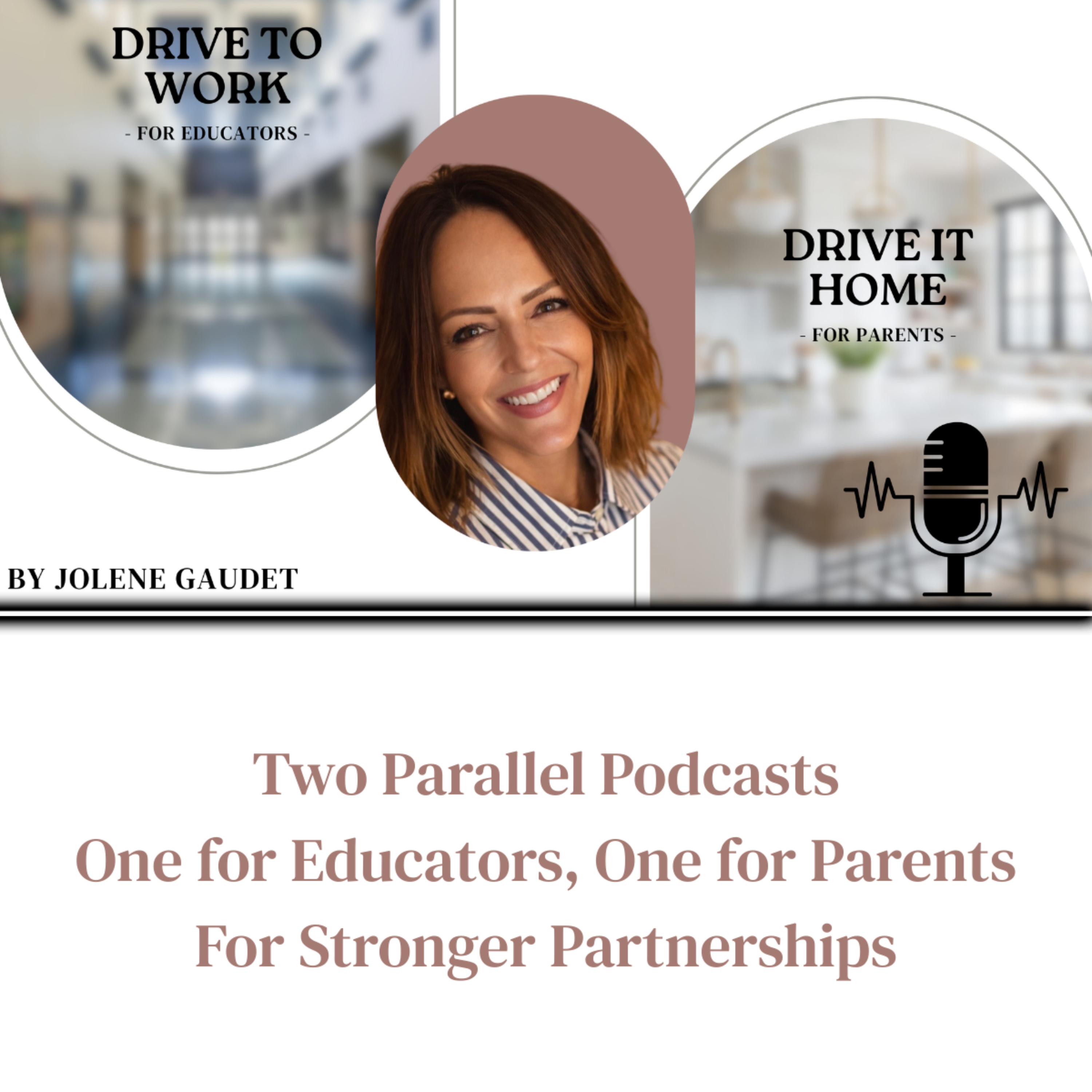
Drive to Work is a short podcast for educators. In a few thoughtful minutes, education designer Jolene Gaudet offers grounded reflections to help educators reconnect with why they began, and focus on what truly shapes young lives: practical, encouraging, research-based. Created for the moments between home and school! Drive It Home is a short podcast for parents who want to raise humans with intention. In a few thoughtful minutes, Jolene shares reflections and actions to help families move beyond pressure and toward growth.
Author
Jolene Gaudet
Category
Podcast website
Latest episode
Jun 20, 2026
Where to listen?
Podcasts in the app Replaio Radio Coming soonPodcasts are coming to the app soon. Install now and be the first to see a whole new take on podcasts
 Install for free
Android 5M+ downloads · 4.8 rating
iOS soon
Install for free
Android 5M+ downloads · 4.8 rating
iOS soon
Episodes
Your Child’s Grade: a Fit Score, not a Potential Score? (parents) 08.04.2026 4:57
Report cards feel definitive, but they may measure far less than most parents think. In this episode, we break down what grades actually capture: structure, consistency, and behavioral fit within the system. Not full potential. You’ll see why two children with similar ability can receive very different results. The goal isn’t to reject grades, but to read them more intelligently, and ask better qu...
The Grade You Gave Didn’t Just Measure, It Changed What You’ll See Next (educators) 08.04.2026 7:53
The moment a grade is assigned, it doesn’t just describe past performance, it shapes future expectations. In this episode, we unpack how grading quietly influences how teachers see, question, and challenge students. What if the number you give is not just a reflection of learning, but a filter on potential? This is a grounded look at expectation effects, hidden biases in grading, and how small shi...
When Being Right Becomes the Only Goal (educators) 07.04.2026 5:24
This episode explores how classrooms can unintentionally train students to prioritize being right over learning that lasts. It invites educators to rethink what their environment is actually rewarding, and how small shifts in task design can help. This episode draws in part on research in: Achievement Goal Theory : Mastery vs Performance Goals (Ames, 1992; Dweck, 1986) Error climate and classroom...
When “Doing Well” Hides What’s Missing (parents) 07.04.2026 4:37
This episode challenges the idea that doing well in school always means a child is growing. It explores how children can learn to succeed by staying within what feels comfortable, avoiding challenge without anyone noticing. It helps parents recognize the difference between performance and growth, and invites them to look beyond results to see where their child is truly being stretched. This episod...
The Fix Might be Costing You the Genius (educators) 02.04.2026 7:26
This episode challenges a common pattern in classrooms: identifying what students struggle with faster than what they do well. It explores how repeated correction and narrow definitions of competence can quietly reduce participation, risk-taking, and engagement. It also highlights how some students are misread, not because they lack ability, but because their strengths show up in ways the system i...
Your Child Doesn’t Need Fixing (parents) 02.04.2026 5:42
This episode explores how school definitions of success can shape how parents interpret their child’s ability, behavior, and potential. It shows how children who think differently are often misread, not because they lack ability, but because they don’t match the patterns being measured. This episode invites parents to question the lens they’ve inherited from school and to recognize strengths that...
AI: Students Learned the Tool, But Did You Update the Task (educators) 01.04.2026 4:59
Students are performing better with AI and learning less without it. In this episode, we look at what the research actually shows about AI-assisted learning, and why the gap between output and understanding is growing in classrooms right now. The fix isn't less AI. It's better task design. This episode draws in part on research in: AI-assisted learning and performance transfer (Stanford SC...
AI is There. Are You? (parents) 01.04.2026 4:39
When your child uses AI, they feel more confident and get things done faster. Research shows that's real, and incomplete. This episode explains what's actually being built when AI does the reaching for them. You don't need to understand AI to do this. You just need to stay in the process with them. This episode draws in part on research in: AI-assisted learning and performance transfer...
The Difficulty Audit for Educators 01.04.2026 7:02
You designed the AI-assisted writing task carefully, brainstorming and outlining handled by AI so students can focus on the argument. Here's the problem: the messy beginning you just removed was the learning... Not the warm-up, the learning. This episode introduces the Difficulty Audit, a three-category design tool that tells you exactly where AI belongs in a task, and where it cancels the enc...
The Difficulty Audit for educators 01.04.2026 7:02
You designed the AI-assisted writing task carefully: brainstorming and outlining handled by AI so students can focus on the argument. Here's the problem: the messy beginning you just removed was the learning. Not the warm-up, the learning. This episode introduces the Difficulty Audit, a three-category design tool that tells you exactly where AI belongs in a task, and where it cancels the encod...
Is This On The Test?" May Be a Relevance Problem (educators) 31.03.2026 4:19
When students ask if something will be on the test, they may just be logical, not lazy. This episode reframes one of the most common classroom question as useful information. You'll learn why relevance predicts engagement more reliably than ability or interest, why students prioritize what they can see the purpose of, and how one sentence before a lesson can change what students are willing to...
When Your Kid Says School Is Pointless (parents) 31.03.2026 3:58
When your child says they don't know why they're learning something, that's useful information. This episode explains why near-term relevance matters more than future payoff for adolescents, why telling kids to try harder without addressing meaning doesn't work, and how parents can build part of the relevance bridge at home with one question and one connection. This episode draws i...
Homework Doesn't Work the Way You Think It Does (parents) 30.03.2026 5:33
At the elementary level, homework has near-zero effect on learning outcomes. At the secondary level, it only works under three conditions most homework never meets. This episode draws in part on research in: Homework effectiveness across grade levels (Cooper, Hattie) Retrieval practice versus passive review (Roediger, Karpicke) Stress, cortisol, and memory consolidation (Lupien, McEwen) Working me...
Homework Is Costing You More Than It's Worth (educators) 30.03.2026 6:34
Most educators assign homework because it signals effort, but research tells a different story. At the elementary level, homework has near-zero effect on learning outcomes. At the secondary level, it works, but only under three specific conditions that most assignments never meet. This episode draws in part on research in: Homework effectiveness and effect sizes (Cooper, Hattie) Retrieval practice...
Stop Asking if You Should Use AI (educators) 27.03.2026 5:37
AI is fast, tireless, and completely indifferent to your students. That indifference is exactly why you matter. This episode reframes the question educators are asking about AI, and replaces it with a better one. We break down what AI actually is, what it handles well, and what it will never be able to do in your classroom. Plus a practical AI amplifier that builds differentiated tasks at three re...
AI: You Don't Have to Be a Tech Expert, but You Have to Be Present (parents) 27.03.2026 5:34
Your child's work got done. That doesn't mean they learned anything. This episode explains what AI actually is, why productive struggle is the part of learning that can't be outsourced, and what happens when AI quietly removes that struggle. No tech expertise is required; just a conversation, a question to ask your kid, and an idea that turns AI into a thinking partner instead of an answer machine...
The Quiet Trap of “Doing Fine” (educators) 26.03.2026 3:01
In this episode, we look at the students who are easy to miss: the ones who complete their work, follow expectations, and stay under the radar. This episode challenges educators to look beyond completion and start noticing where real thinking is happening, and where it isn’t. This episode draws in part on research in: Desirable Difficulties & effortful learning (Bjork) Depth of processing &...
“ Fine” Is Not the Same as Growing (parents) 26.03.2026 3:04
When a child is “doing fine”, it’s easy to assume everything is on track. But some children avoid challenge by staying comfortable, and over time, it an limit growth. This episode helps parents recognize the difference between being comfortable and actually building confidence. This episode draws in part on research in: Growth through challenge and mastery experiences (Bandura) Motivation and pers...
Misalignment, Not Deficit: When Engagement Drops (educators) 25.03.2026 3:55
A disengaged student is not always a struggling learner. This episode challenges the assumption that disengagement is a behavior problem and reframes it as a potential issue of misalignment between the learner and the environment. Through a concrete example, it highlights how students can demonstrate focus, persistence, and creativity outside of school, yet appear disengaged in class. Educators ar...
When School Doesn’t Fit: The Cost (parents) 25.03.2026 3:24
When school doesn’t fit, the impact goes beyond academics. This episode explores how ongoing misalignment can shape a child’s motivation, effort, and sense of identity. It shows how children can be highly engaged in some contexts while disconnected in others, and why that matters. Parents are guided to recognize boredom as information, not laziness, and to better understand the conditions where th...
Before Content, There’s Trust (educators) 24.03.2026 4:10
We spend so much time refining lessons, content, and assessments. But what if one of the most impactful factors in learning isn’t in the lesson plan at all? This episode explores how trust shapes a student’s ability to think, engage, and learn. When students feel emotionally safe, they are more likely to take risks, ask questions, and persist. When that trust is missing, even strong instruction ma...
Your Child Learns Best From People They Trust (parents) 24.03.2026 3:36
What if one of the strongest influences on your child’s learning is trust? This episode explores how trust and emotional safety shape a child’s willingness to try, ask questions, and persist. When children feel safe, they engage. When they don’t, they protect themselves, often by avoiding effort or challenge. You’ll be invited to rethink your role, not as a performance manager, but as a secure bas...
When Your Child Won’t Start, Look at the Task (parents) 23.03.2026 3:05
When a child avoids or delays a task, it’s easy to assume why. This episode reframes that moment. Parents are guided to recognize how unclear, overwhelming, or inaccessible tasks can block a child from even starting, and how shifting the entry point can change everything. With practical examples and simple AI-supported strategies, this episode shows how to move from pushing to making learning easi...
It’s Not the Student, It’s the Conditions (educators) 23.03.2026 3:49
This episode challenges a common assumption: when students don’t start, it’s not always a motivation issue. It can be a design issue. Educators are invited to look beyond behavior and examine the conditions around the task. This episode shows how small changes in task design can increase student engagement, and how AI can support faster, more responsive differentiation without replacing profession...
Drive : A Moment Between the Miles (parents and educators) 20.03.2026 5:45
This isn't a regular episode: no framework, no practical move... Just a moment to pull over before continuing. Drive to Work - Drive It Home started as two parallel roads : one for educators, one for parents, side by side toward the same direction. This episode names what that means. It draws on network science to explain why the position between two worlds is often the most powerful one. It e...
Similar podcasts







Listen to the Drive to Work - Drive it Home podcast in Replaio
Radio and podcasts in one app - free, with no sign-up. Install today and do not miss the launch
Replaio is not a podcast publisher; show names, artwork and audio belong to their authors and are distributed through public RSS feeds.