Jolene Gaudet
Drive to Work - Drive it Home
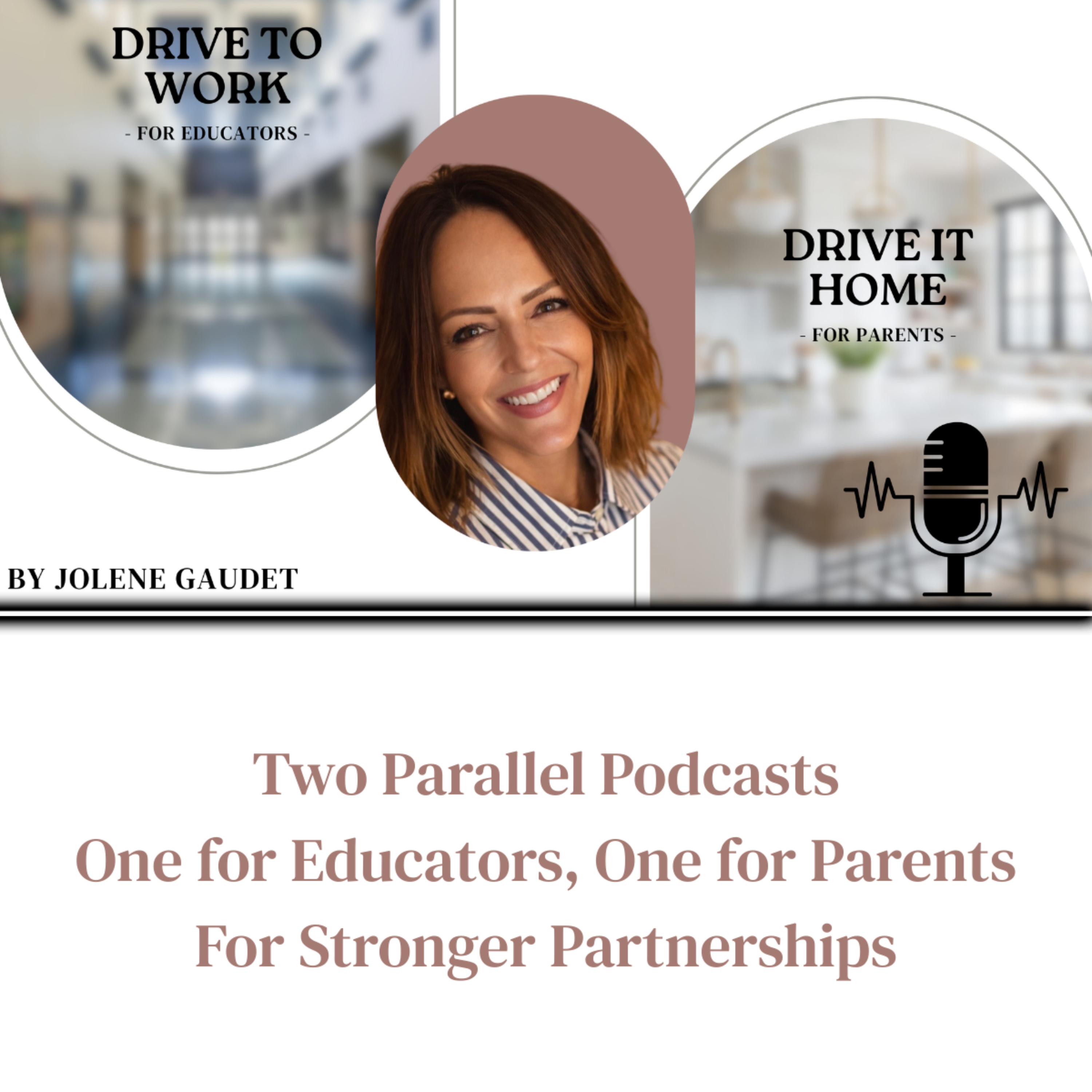
Drive to Work is a short podcast for educators. In a few thoughtful minutes, education designer Jolene Gaudet offers grounded reflections to help educators reconnect with why they began, and focus on what truly shapes young lives: practical, encouraging, research-based. Created for the moments between home and school! Drive It Home is a short podcast for parents who want to raise humans with intention. In a few thoughtful minutes, Jolene shares reflections and actions to help families move beyond pressure and toward growth.
Author
Jolene Gaudet
Category
Podcast website
Latest episode
Jun 20, 2026
Where to listen?
Podcasts in the app Replaio Radio Coming soonPodcasts are coming to the app soon. Install now and be the first to see a whole new take on podcasts
 Install for free
Android 5M+ downloads · 4.8 rating
iOS soon
Install for free
Android 5M+ downloads · 4.8 rating
iOS soon
Episodes
You Run Systems at Work, But Do You Run One at Home? (parents) 27.04.2026 4:55
You've built systems at work before, and they work, and then you come home and manage your child through reminders and pressure. This episode makes the case that your home has an architecture, and right now, it's shaping habits you didn't design. This episode draws in part on research in: Behavioral defaults and environmental design (Thaler & Sunstein, 2008) Parental autonomy suppo...
The Room Is Giving You Data (educators) 27.04.2026 5:06
Your students aren't broken. They're adapting, rationally, precisely, to exactly what your classroom has trained them to do. The student who only answers when certain hasn't lost his curiosity. He's learned that wrong answers cost something. The one who rushes isn't careless. She's learned that speed is what gets noticed. This episode reframes classroom management as a desi...
What if it’s Not a Student Problem, but a Design Outcome (educators and parents) 24.04.2026 9:23
This episode challenges one of the most persistent beliefs in education: that poor outcomes reflect student limitations. They don’t. Across classrooms, the same patterns emerge: * capable students disengage * high achievers become anxious and risk-averse * learning is optimized for completion, not understanding These are not isolated issues. They are predictable outputs of system design. This epis...
Too Many Classrooms Don't Require Thinking - AI Just Made that More Obvious (educators) 23.04.2026 5:50
We keep asking whether students should be allowed to use AI, as if the tool is the problem. The uncomfortable reality is that many students have always been able to complete schoolwork without thinking, long before AI existed. This episode breaks down what cognitive science has made clear for decades: learning does not come from completion, or time-on-task. AI didn’t create a new problem. It expos...
Your Child Might Be Finishing Their Work Without Learning Anything (parents) 23.04.2026 4:50
When your child uses AI, something feels off. The work gets done faster. The answers sound better. And yet, something doesn’t sit right. This episode explains why. The real issue isn’t AI. It’s that it makes it almost impossible to see whether your child actually thought about the work. Before AI, students could copy from a textbook. Now, the same bypass is faster, smoother, and invisible. And her...
The Comment Isn’t the Problem, the Format Is (educators) 22.04.2026 6:02
You don’t struggle to understand your students, you struggle to transmit what you know, on a report card. In this episode, we unpack the hidden constraint behind report card comments: a format designed for institutions, not precision. This episode reframes the problem and introduces a simple shift: using AI not to replace your judgment, but to translate your real observations into language parents...
Report Cards: “No Red Flags” Is Not Information (parents) 22.04.2026 5:26
You read the report card. Nothing alarming! You move on, but that conclusion might be wrong. What you receive is a compressed version of months of professional observation, stripped of the very patterns you need to act on. You’ll learn why “everything seems fine” is often a signal of missing information, and how to ask the right questions to access what the teacher actually knows. Because your chi...
Rules Don’t Build Behavior, Design Does (educators) 21.04.2026 5:17
Most classroom rules only work when you're watching. The moment your attention shifts, so does student behavior. This episode reframes classroom management as a design problem, not a behavior problem. Instead of relying on enforcement, what if the environment itself made the right behavior the easiest one to choose? A simple shift in how you structure key moments in your classroom can change w...
You Removed the Screen, But You Didn’t Replace the Default (parents) 21.04.2026 6:07
Limiting screen time feels like the right move, but what happens after you remove it matters more. This episode explores why restriction alone doesn’t build better habits. Children don’t develop new preferences from what’s taken away, but from what’s consistently within reach. If nothing intentional replaces the old default, something else will. Learn how small shifts in your child’s environment c...
The Task Is the Variable (educators) 20.04.2026 4:45
The screen ban debate is back, and most educators already know it is the wrong conversation. A classroom full of paper worksheets produces just as many students who never have to think as a classroom full of tablets. The medium was never the variable. The task was. Let's talk about the filter that changes how you build anything. This episode draws in part on research in: Productive failure and...
The Screen Was Never the Variable (parents) 20.04.2026 4:09
The screen time debate has been running for a while and the problem hasn't moved. That's because screen time is measuring the wrong thing. The real question is what your child's environment - everything in it, not just the devices - is training their brain to prefer. Let's talk about designing screen time instead of restricting it. This episode draws in part on research in: Executi...
The Gap Is the Point (educators) 17.04.2026 5:21
You already know which moments changed students — not the planned lessons, but the ones that happened in the margins. The problem is, the margins are gone. Thisepisode is about clearing enough Kronos to give Kairos somewhere to land. Research Sources: Attention as prerequisite for memory encoding (Baddeley, 2000; Sweller, 1988) Teacher autonomy, workload, and emotional exhaustion (Skaalvi...
Buy That Time Back (parents) 17.04.2026 5:36
The moments your kid tells you something real - what they're actually thinking, what's been sitting with them - don't usually happen on schedule. They happen when you're genuinely there. This episode is about finding tasks you can hand off toAI so you can be present. Let's talk about Kronos and Kairos! Research Sources: · Adolescent disclosure in unstructured, side-by-si...
You Were There. You Just Weren't Available (parents) 16.04.2026 4:52
High-performers schedule quality time with their kidsand wonder why nothing real gets said. This episode explains why structured conversation is often the thing that kills disclosure, and what the research on adolescent psychology actually says about when kids open up. The reframe isprecise and immediately usable and relates to Chronos time versus Kairos time. In This Episode: The optimization hab...
The Clock Doesn't Know What It's Interrupting (educators) 16.04.2026 7:46
Your efficiency as a teacher, the skill that keeps thirty students on pace, is the same skill that trains your brain to treat unexpected student moments as threats. This episode introduces the Greek distinction between Chronos andKairos, and makes the case that your highest-value work as an educator happens in the moments you're most likely to redirect. In This Episode: The same clock-manageme...
The AI Attention Problem, but Not the One You Think (educators) 15.04.2026 4:57
You didn't become a teacher to spend half your week on forms, data entry, and email chains, and you know it. This episode makes the case that AI isn't primarily a teaching tool, but it can be an attention-recovery tool. And the question you should be asking about every AI tool isn't whether it makes you more efficient, it's whether it gets you more present to the students you'r...
The Noise Around You, and How AI Could Help You (parents) 15.04.2026 4:42
The conversation about AI and parenting is focused on the wrong threat. AI isn't coming for your role, it's coming for the noise that keeps you away from it. This episode asks the question most high-performing parents haven't thought to ask: what does this free up, so I can actually show up? This episode draws in part on research in: Work-to-home cognitive spillover and psychological detachment (C...
What Are Students Actually Doing in Class? (Educators) 14.04.2026 5:00
Most teachers already sense it: a lot of what gets celebrated as innovation in schools is designed to survive a walkthrough, not produce learning. This episode names that tension directly, and offers one honest diagnostic that cuts through the performance and gets back to the question that actually matters: what are students being asked to figure out? This episode draws in part on research in: Cog...
Finished Isn't the Same as Learned (Parents) 14.04.2026 4:35
Most parents know somewhere that the relief they feel when homework is done isn't really about learning; it's about homework being done. This episode draws in part on research in: Retrieval practice and the testing effect (Roediger & Karpicke, 2006) Desirable difficulties and memory consolidation (Bjork, 1994) Generative learning and knowledge reconstruction (Fiorella & Mayer, 2015...
The System Isn't Broken. It Is Doing What It Was Designed to Do. (Educators) 13.04.2026 5:33
The education system produces high-performing students every year, so it isn't 100% broken; medicine, engineering and aviation fields need it. But what it optimizes for - following structure, applying knowledge, performing under controlled conditions - are some of the skills most exposed to automation. This episode challenges educators to look at what the system actually rewards, and to ask whethe...
Your Child Is Doing Well; That Doesn't Mean They're Ready. (Parents) 13.04.2026 4:03
If your child gets good grades, it's easy to assume the work is done. This episode asks a harder question: is your child learning, or just getting better at avoiding mistakes? The same system that rewards structured, high-performing students also trains them to protect their score rather than take risks. This episode draws in part on research in: Performance goals vs. learning goals (Dweck, 1986;...
Your Child’s Report Card Is Not a Future Plan 10.04.2026 6:24
Most parents still focus on one question: How is my child doing in school? This episode challenges that. You’ll hear why school performance is only one piece of the puzzle, and how relying on it alone can lead to incomplete or misleading conclusions about your child’s true abilities. This episode introduces a different role for parents: not just supporting school, but becoming a learning leader. I...
School Was Built for Standardization (educators) 10.04.2026 7:09
There is a shift happening, and we can feel it. More parents are beginning to question what school actually measures, and what it misses. This episode breaks down a core tension: a system designed to standardize learning is now expected to develop adaptable, independent learners for a rapidly changing world. This episode draws in part on research in: Historical foundations of standardized schoolin...
Who Gets Told They Have Potential? (parents) 09.04.2026 3:21
In this episode, we bring an idea home. Who do you naturally say “you have potential” to? And who do you not? And what does potential mean anyway? It is always an ideal, or something real, now? This episode draws in part on research in: Teacher Expectations and Student Outcomes (Good, 1987; Rubie-Davies, 2010) Attribution Theory and Feedback (Weiner, 1985; Graham, 1991) Feedback and Learning Proce...
We Tell Some Kids They Have Potential… But What Does That Actually Mean? (educators) 09.04.2026 5:32
We often tell children, “You have so much potential”. But we rarely stop to define what it actually means. How are we defining potential in the first place, and who gets included? This episode draws in part on research in: Expectancy Effects and Teacher Expectations (Rosenthal and Jacobson, 1968; Jussim & Harber, 2005) Growth Mindset and Beliefs About Ability (Dweck, 2006; Yeager and Dweck, 20...
Similar podcasts







Listen to the Drive to Work - Drive it Home podcast in Replaio
Radio and podcasts in one app - free, with no sign-up. Install today and do not miss the launch
Replaio is not a podcast publisher; show names, artwork and audio belong to their authors and are distributed through public RSS feeds.