Jolene Gaudet
Drive to Work - Drive it Home
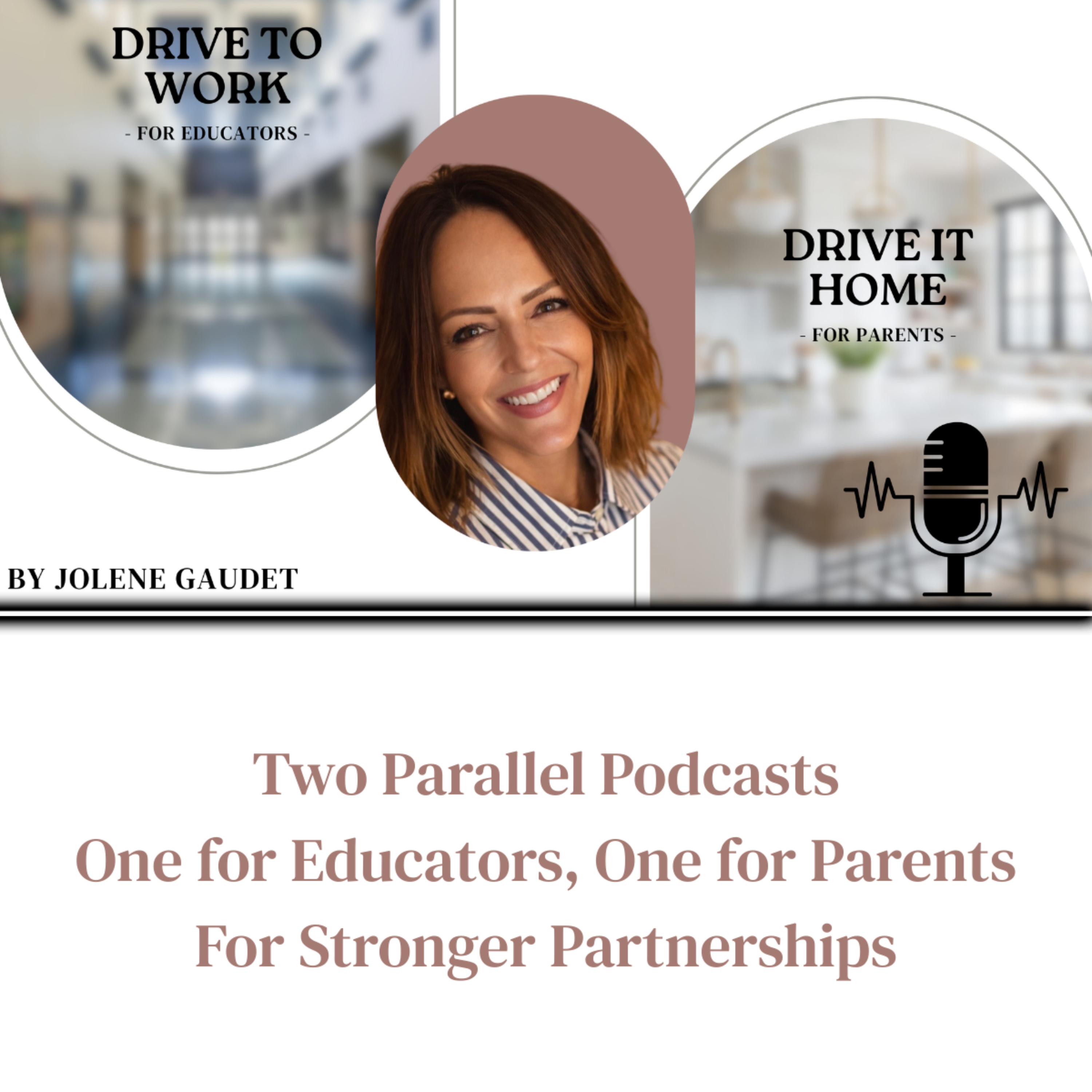
Drive to Work is a short podcast for educators. In a few thoughtful minutes, education designer Jolene Gaudet offers grounded reflections to help educators reconnect with why they began, and focus on what truly shapes young lives: practical, encouraging, research-based. Created for the moments between home and school! Drive It Home is a short podcast for parents who want to raise humans with intention. In a few thoughtful minutes, Jolene shares reflections and actions to help families move beyond pressure and toward growth.
Author
Jolene Gaudet
Category
Podcast website
Latest episode
Jun 20, 2026
Where to listen?
Podcasts in the app Replaio Radio Coming soonPodcasts are coming to the app soon. Install now and be the first to see a whole new take on podcasts
 Install for free
Android 5M+ downloads · 4.8 rating
iOS soon
Install for free
Android 5M+ downloads · 4.8 rating
iOS soon
Episodes
Drive to Work - The Other 12 Hours 14.05.2026 9:44
You have six hours with that student. The next 12-18 are a blank. Most teachers design around that gap without questioning it, but a growing body of learning science suggests the after-school window is where consolidation actually happens or doesn't. This episode introduces one small protocol that turns a parent into a structured observer, gives the teacher behavioral data they can't gener...
Drive It Home - The Other 12 Hours 14.05.2026 10:36
You monitor the grades. And at 4pm, you hand the evening to the default. This episode is not about doing more, it's about understanding what those 12-18 hours at home actually build or quietly undo. The mechanism: academic self-concept forms through low-stakes mastery experiences, and school is not low-stakes... Home is. Most parents are not using those hours for this. Here's what using th...
Drive It Home - The Room Without a Rubric 13.05.2026 5:37
Your child's environment is excellent: stable, structured, responsive. The problem is: none of those things exist in a room without a rubric. This episode is about what happens to a high-performing child when the structure disappears, and the one move that changes the equation. This episode draws in part on research in: Executive function development in childhood (Diamond, 2013) Parental scaff...
Drive to Work - Yes. Good. 13.05.2026 5:36
You say "yes, good" dozens of times a day. You don't think of it as a choice. But it is, and it's removing the one condition that builds judgment. This episode is about one replacement move, and the AI prompt that helps you find it. This episode draws in part on research in: Desirable difficulties and retrieval practice (Bjork & Bjork, 2011) Testing effect and memory consolid...
Drive It Home - The Help Trap 12.05.2026 5:54
The most present, most engaged parents are often the ones most likely to fall into this trap. Every time you step in to solve the problem, something else happens; quieter than the solution, and more consequential. This episode names the mechanism, and gives you one move for tomorrow. The four-minute rule starts tonight. This episode draws in part on research in: Academic self-concept and persisten...
Drive to Work - The Help Trap 12.05.2026 6:12
You have a student in front of you who is stuck. Your instinct is to help. That instinct is exactly where the trap is. This episode unpacks the science of productive failure, and what it costs students every time we move in before the struggle has done its work. Let's talk about The Help Trap. This episode draws in part on research in: Productive failure and pre-instruction struggle (Kapur, 20...
Post-Mother’s Day Special: What Mothers See That Systems Often Miss (Educators and Parents) 11.05.2026 2:26
Some mothers carry a version of their child that the world has never fully seen. Beyond the report cards, routines, and expectations, they notice the quiet things: the hidden curiosity, the confidence shifts, the emotional weight, the resilience, and the spark that appears when a child feels safe enough to be fully themselves. This episode is a reminder that some of the most important human abilit...
Unique Ability (parents) 08.05.2026 6:40
Meaning in a child does not form from encouragement. It forms when they activate genuine strength, produce something real, and get witnessed by someone who matters. This episode names the piece parents most underestimate. This episode draws in part on research in: Flow theory and intrinsic motivation — the signal of lost time (Csikszentmihalyi, 1990) Parental reflected appraisals and children'...
Unique Ability - What the Rubric Can't See (educators) 08.05.2026 7:10
Your rubric measures whether a student met the standard. It does not measure whether they came alive meeting it. This episode breaks down why meaning in learning requires a specific structural condition - one most classrooms are never designed to create. Let's talk about unique ability. This episode draws in part on research in: Self-determination theory and competence need in educational sett...
The Score Is Not the Story (parents) 07.05.2026 5:48
The report card came back lower than you expected. This episode is about how a single data point from a standardized environment - one designed to measure some things and structurally miss others - becomes the story a child tells about what they are capable of. And about how to build a competence profile from outside the school's measurement window, using AI to find the pattern in what you'...
What the Room Can't See (educators) 07.05.2026 7:47
There's a student in your school right now with a file that says one thing. The system responds to underperformance with one diagnostic: what's wrong with this child? This episode reframes the question. The standardized classroom is not a neutral measurement tool. It is a designed environment, one built for a specific kind of performance that leaves whole categories of competence invisible...
The Student Who Flinches at a 95% (educators) 06.05.2026 5:43
That student with straight A's who cannot handle a 95 is not fragile. This episode names what your recognition systems are actually installing alongside the grades, and gives you one audit to run from memory, one AI move to make it visible, and one substitution to make. This episode draws in part on research in: Contingent regard and conditional approval in achievement environments (Assor, Roth &a...
The Kid Who Flinches at a 95% (parents) 06.05.2026 4:42
Your child is anxious. It may not despite your involvement, but maybe in part because of it. Because the pattern of when your energy changes has been teaching them something, and they drew the obvious conclusion. This episode gives you one audit, one AI move, and one moment in the car ride home that starts contradicting the model. This episode draws in part on research in: Contingent regard in par...
The Phone is Winning (educators) 05.05.2026 6:02
The phone didn't win because your students have bad habits. It won because it was built by teams of engineers whose job was to make sure it won. When it comes out during independent practice, it's not a discipline signal. It's an instructional design signal. This episode names the three conditions your lesson needs to meet - the same three the phone already meets - and gives you a one-sentence dia...
The Phone is Winning (parents) 05.05.2026 7:41
Phone off at eight. No screens at dinner. Thirty-minute limit. Real decisions. And the attention problem was still there the next morning, fully intact, waiting for the restriction to lift. The phone isn't competing with your rules. It's competing with your environment. And most home environments were never designed to win that competition. One observational window, one distinction, and on...
The Skill That's Not on the List (parents) 04.05.2026 5:51
You have been building the skills list: leadership, public speaking... Every skill on that list has the same thing underneath, the one capacity that is never on the list itself. This episode names it, shows what it looks like in practice, and gives you a four-weekend build you can run at home. Plus the one rule that turns AI into a learning accelerator instead of a dependency builder. This episode...
Who Does the Thinking in Your Classroom? (educators) 04.05.2026 6:22
Every rubric, every scaffold, every clearly posted objective has a cost nobody talks about. When you remove uncertainty before students can feel it, you remove the experience that builds their capacity to navigate it. This episode names that capacity - metacognitive monitoring - explains why the well-designed classroom quietly works against it, and gives you one standing weekly condition that buil...
The Difficulty Audit for Educators 01.05.2026 7:02
You designed the AI-assisted writing task carefully; brainstorming and outlining handled by AI so students can focus on the argument. Here's the problem: the messy beginning you just removed was the learning... Not the warm-up, the learning! This episode introduces the Difficulty Audit, a three-category design tool that tells you exactly where AI belongs in a task, and where it cancels the enc...
The Mental Load Audit for Parents 01.05.2026 7:57
Last Thursday at 9pm, your teenager said she wanted to talk. You said five minutes. She didn't come back. That wasn't a choice; your cognitive account was already overdrawn before she walked in. This episode introduces the Mental Load Audit: three categories for systematically handing family operations to AI, so you arrive at the moments that matter with something left to give. Let's t...
The Behavior IS the Capacity (educators) 30.04.2026 5:57
The kid you've redirected the most this week isn't failing at behavior. They're a capacity your classroom doesn't have a container for yet. Here's what changes - for them and for you - when you stop asking what they need to work on, and start asking what the system is too small to hold. This episode draws in part on research in: Teacher expectancy effects and student performanc...
The Behavior IS the Capacity (parents) 30.04.2026 5:44
You've been told what your child needs to work on. You've passed the message along. And somewhere along the way, you've started to believe it. But the behavior the school keeps correcting and the capacity your child was born with might be the exact same thing, just in the wrong room. Let's talk about how to tell the difference, and what AI can help you find once you do. This episod...
AI Is Going to Replace Everything That Was Never Worth Your Time (educators) 29.04.2026 3:38
You adapted to the admin. You got efficient at the emails, the forms, the back-and-forth that never fully ends. What you didn't notice is what it's been costing you: not only hours, but cognitive capacity. Every task you process draws from the same account, meaningful or not. This episode is about what returns when the low-value fill clears, and why presence, judgment, and the ability to r...
AI Is Going to Replace Everything That Was Never Worth Your Time (parents) 29.04.2026 3:23
You've been in the room. You just haven't always really been there. The mental overhead of managing a life doesn't stop when you walk through the door, and research on attentional residue shows it quietly degrades the quality of attention you can bring to your child. The things AI cannot replace are exactly the things your child needs most from you. This episode is about what gets free...
Let's Talk, Again, About What School is Actually Measuring (educators) 28.04.2026 6:48
Your gradebook is doing exactly what it was built to do. The problem is that we have been treating a performance signal as a learning signal and they are not the same thing. References: Desirable difficulties and retrieval effort (Bjork & Bjork, 2011) Test-enhanced learning / retrieval practice effect (Roediger & Karpicke, 2006) Spacing effect on long-term retention (Cepeda, Pashler, Vul,...
What School Is Actually Measuring : The difference between your child performing and your child learning (parents) 28.04.2026 5:42
Your child's "A" is accurate. It just has an expiration date you were not told about. This episode explains what the test was actually measuring and gives you one low-key checkyou can run yourself, no homework required. References: Learning vs. performance distinction ? fluency vs. durability (Kornell & Bjork, 2008) Metacognitive calibration ? Accuracy of self-assessed understand...
Similar podcasts







Listen to the Drive to Work - Drive it Home podcast in Replaio
Radio and podcasts in one app - free, with no sign-up. Install today and do not miss the launch
Replaio is not a podcast publisher; show names, artwork and audio belong to their authors and are distributed through public RSS feeds.