Jolene Gaudet
Drive to Work - Drive it Home
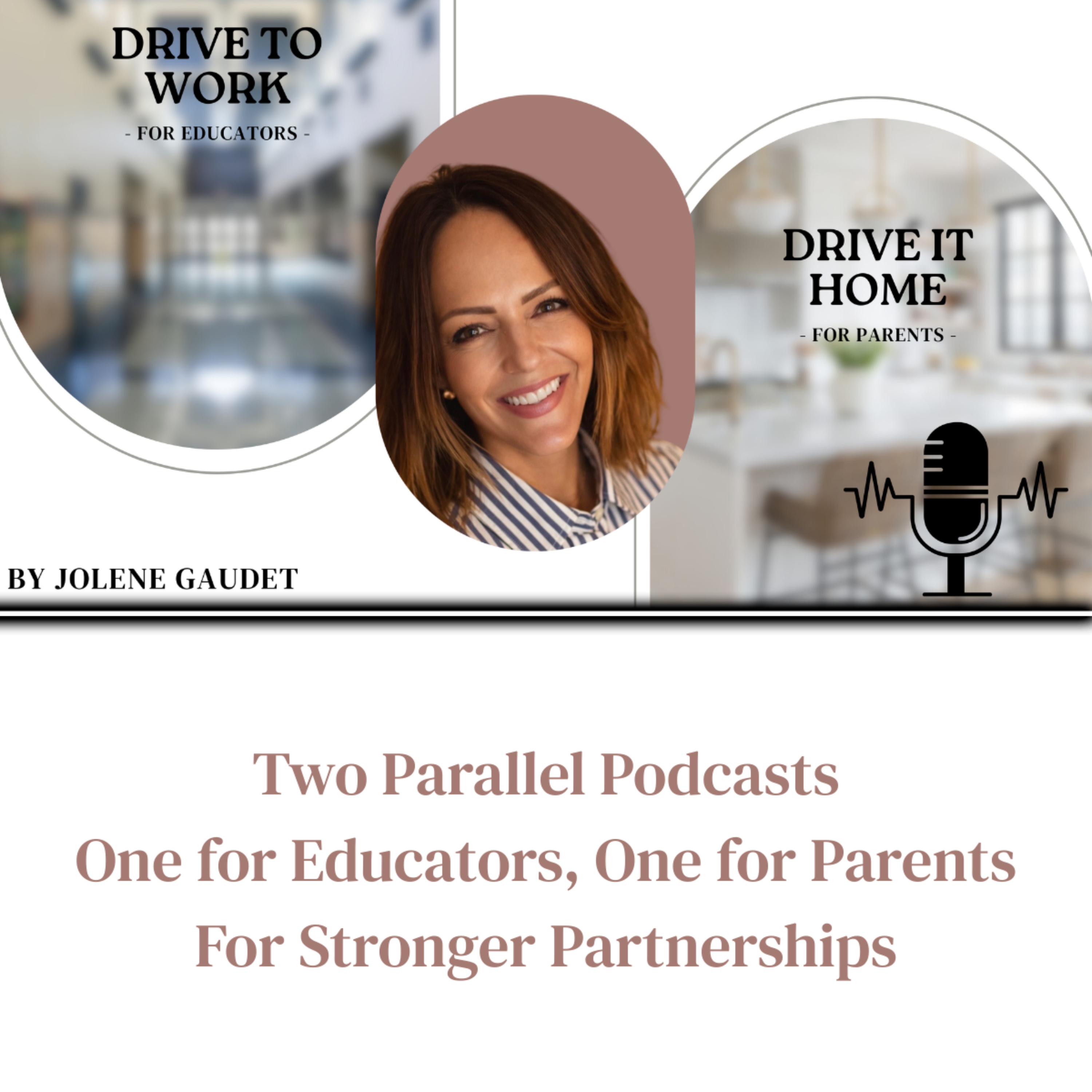
Drive to Work is a short podcast for educators. In a few thoughtful minutes, education designer Jolene Gaudet offers grounded reflections to help educators reconnect with why they began, and focus on what truly shapes young lives: practical, encouraging, research-based. Created for the moments between home and school! Drive It Home is a short podcast for parents who want to raise humans with intention. In a few thoughtful minutes, Jolene shares reflections and actions to help families move beyond pressure and toward growth.
Author
Jolene Gaudet
Category
Podcast website
Latest episode
Jun 20, 2026
Where to listen?
Podcasts in the app Replaio Radio Coming soonPodcasts are coming to the app soon. Install now and be the first to see a whole new take on podcasts
 Install for free
Android 5M+ downloads · 4.8 rating
iOS soon
Install for free
Android 5M+ downloads · 4.8 rating
iOS soon
Episodes
Design Over Control (educators) 19.03.2026 4:14
Students’ behavior is often treated as something to manage, although research suggests behavior is largely shaped by environment, not willpower. This episode explores how shifting from control to design, through clarity, structure, and reduced cognitive load, can increase engagement and reduce friction in the classroom and in school. A simple but powerful reframing is this : stop managing behavior...
Structure Creates Freedom (parents) 19.03.2026 3:41
Daily struggles at home are often seen as behavior problems, but they’re frequently the result of unclear structure. This episode explains why children rely on predictable routines to regulate themselves, and how simple, consistent structures can reduce conflict and build independence, because structure doesn’t limit freedom, it makes it possible. This episode draws in part on research in: • Behav...
Don’t Just Solve a Problem, Show Them How (parents) 18.03.2026 3:58
Your child learns how to think by watching you. This episode shows how thinking out loud in everyday moments helps children understand their own thinking and handle challenges with more confidence. This episode draws in part on research in: • Metacognition and self-regulated learning (Flavell, Zimmerman) • Think-aloud protocols and cognitive strategy instruction (Ericsson & Simon, Pressley) •...
The Part of Your Lesson Students Need to See (educators) 18.03.2026 3:48
Students see the answer, but often miss the thinking behind it. This episode shows how making your thinking visible can help students learn how to adjust, persist, and solve problems more effectively. This episode draws in part on research in: • Metacognition and self-regulated learning (Flavell, Zimmerman) • Think-aloud protocols and cognitive strategy instruction (Ericsson & Simon, Pressley)...
Confidence and Competence (educators) 17.03.2026 4:33
Confidence doesn’t come from encouragement alone. It grows most when students experience themselves becoming capable. In this episode, we explore how deliberate practice and well-designed learning experiences build the kind of confidence that lasts. This episode draws in part on research in: • Deliberate practice and expertise development (Ericsson) • Self-efficacy and mastery experiences (Bandura...
Confidence and Competence (parents) 17.03.2026 3:43
Parents often say “You’re so smart” with the best intentions. But noticing effort and strategy may better support children when learning becomes difficult. This episode explores how small shifts in praise can shape how children approach challenges. This episode draws in part on research in: • Deliberate practice and expertise development (Ericsson) • Self-efficacy and mastery experiences (Bandura)...
More Is Not Always Better (parents) 16.03.2026 3:13
Children’s weeks are often filled with activities with the best of intentions: more opportunities, more advantages. But research reminds us of the importance of unstructured time. In this episode, we reflect on the role of free time, boredom, and autonomy in children’s development. A simple experiment is proposed: clear one hour in the week and see what happens. This episode draws in part on resea...
Subtract Before You Add (educators) 16.03.2026 5:41
Innovation in education doesn’t always come from adding something new. In this episode, we explore a counterintuitive idea: sometimes the best improvement is to remove, to subtract. It’s an invitation to ask a different question: what could you take away so that what remains works better? This episode draws in part on research in: Cognitive Load Theory (Sweller, Kirschner) Attention and cognitive...
The Long Game: Teach for the Life They Will Live (educators) 13.03.2026 5:49
Did you just teach it… or did students actually learn it? This episode explores the difference between covering content and building learning that lasts. Research shows durable understanding comes from depth, practice, and feedback, not simply exposure. It's a reflection for educators on slowing down, focusing on fewer concepts, and designing learning that students can transfer beyond the clas...
The Long Game: Think in Decades, Not Report Cards (parents) 13.03.2026 5:29
Are you focused on the next report card, or the next decade? This episode invites parents to zoom out and look beyond short-term academic results. Research shows that qualities like persistence, curiosity, and self-regulation play a powerful role in long-term success. It's a reminder that what adults notice and reinforce shapes how children see themselves as learners. The episode draws mainly...
The Power of Thinking Out Loud (educators) 12.03.2026 4:39
A quiet classroom doesn’t always mean learning is happening. Research shows students understand more deeply when they actively explain and discuss ideas. In this episode, we rethink silence, explore the power of metacognition, and design one simple discussion move.
The Power of Thinking Out Loud (parents) 12.03.2026 4:27
Your dinner table may be one of the most powerful learning spaces your child has. When children talk through their thinking, understanding deepens. This episode explores how simple conversations at home can strengthen learning, curiosity, and reflection.
What to Say After a "Bad" Grade (parents) 11.03.2026 5:35
When a test or report card comes home, what parents say next can shape how a child sees learning, failure, and effort. Research on feedback shows that learning improves when children can answer three simple questions: Where am I going ? (Feed Up). How am I doing? (Feedback). What’s my next step? (Feed Forward). This episode explores how parents can turn a "disappointing" grade into usefu...
Feedback That Works: Less Grading, More Guiding 11.03.2026 6:18
Research shows feedback can be one of the most powerful influences on learning, but only when it helps learners answer three key questions, often described as: • Feed Up - Where am I going? • Feedback - How am I doing? • Feed Forward - Where to next? In this episode, we help educators rethink grading culture and explore how feedback can move from judgment to guidance; a simple shift that can help...
Pressure Is Not the Problem (educators) 10.03.2026 5:16
That knot in your stomach. The endless to-do list. The feeling that you’re never quite caught up. What if pressure isn’t the real problem in education? In this episode, we explore how isolation, not pressure, may be the real challenge, and how small professional conversations can strengthen collective efficacy.
Growth (parents) 10.03.2026 4:21
Is pressure helping or hurting your child’s learning? Research in developmental psychology suggests children grow best when high expectations are paired with high support. In this episode, we share how parents can create the emotional climate that helps children handle difficulty and thrive.
Questions (for parents) 09.03.2026 4:01
Questions
Similar podcasts







Listen to the Drive to Work - Drive it Home podcast in Replaio
Radio and podcasts in one app - free, with no sign-up. Install today and do not miss the launch
Replaio is not a podcast publisher; show names, artwork and audio belong to their authors and are distributed through public RSS feeds.