Med School Audio - Medical Knowledge Reimagined & Learning Made Memorable.
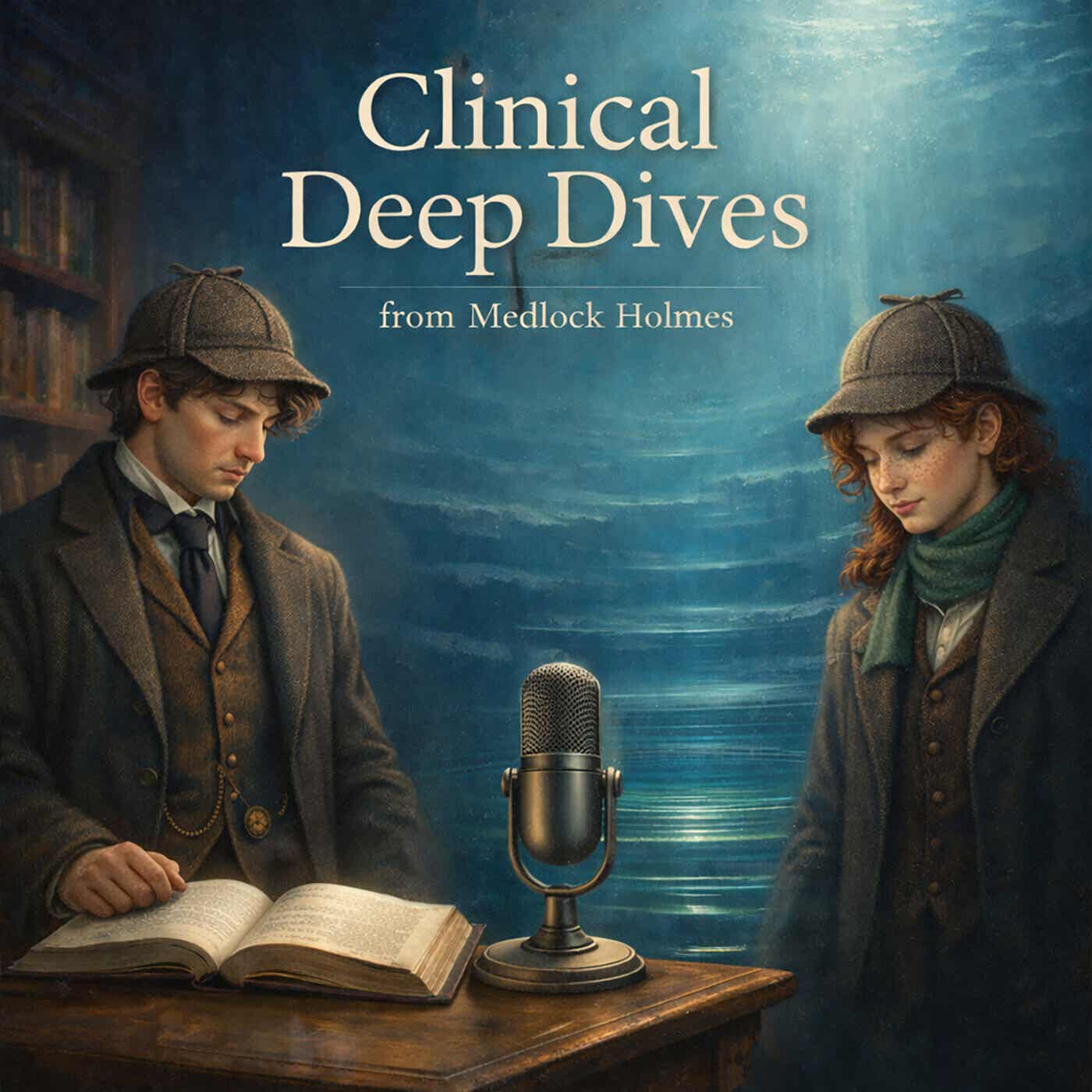
Clinical Deep Dives
Clinical Deep Dives is a Medlock Holmes podcast for clinicians and learners who want understanding, not just information. Using classic medical and surgical texts as a guide and the generative power of AI, each episode explores ideas with curiosity and clarity, designed for learning on the move and knowledge that actually sticks. drmanaankarray.substack.com
Author
Med School Audio - Medical Knowledge Reimagined & Learning Made Memorable.
Category
Podcast website
Latest episode
Jul 10, 2026
Where to listen?
Podcasts in the app Replaio Radio Coming soonPodcasts are coming to the app soon. Install now and be the first to see a whole new take on podcasts
 Install for free
Android 5M+ downloads · 4.8 rating
iOS soon
Install for free
Android 5M+ downloads · 4.8 rating
iOS soon
Episodes
Biochem 10: Lipids 24.01.2026 38:14
Lipids rarely receive the attention they deserve. Often reduced to fats and fuels, they are in fact some of the most versatile and consequential molecules in biology. In this episode, Medlock Holmes investigates lipids as architects of boundaries and modulators of behaviour. We explore their structural diversity — fatty acids, triacylglycerols, phospholipids, sterols — and see how chemical propert...
Biochem 9: DNA-Based Information Technologies 24.01.2026 37:26
Understanding information is one thing. Learning how to access, amplify, edit, and interpret it is another entirely. In this episode, Medlock Holmes examines the tools that allow humans to question the genetic archive directly. DNA, once seen as untouchable record-keeping, becomes a working document — copied, cut, sequenced, and recombined with precision. These technologies do not change the logic...
Biochem 8: Nucleotides and Nucleic Acids 24.01.2026 34:14
Every investigation eventually leads to records: ledgers, archives, instructions left behind. In biology, those records are written in nucleotides. In this episode, Medlock Holmes examines the molecular basis of biological information. We explore how simple nucleotide units assemble into nucleic acids capable of storing, transmitting, and preserving instructions across time. Sugar–phosphate backbo...
Biochem 7: Carbohydrates and Glycobiology 24.01.2026 14:50
Carbohydrates are often introduced as energy sources — quick fuel, stored reserve, metabolic currency. In this episode, Medlock Holmes looks beyond that narrow framing and uncovers a far richer story. Here, carbohydrates emerge as architects of structure and arbiters of recognition. We explore how monosaccharides combine into diverse polymers, how branching patterns encode function, and how glycoc...
Biochem 6: Enzymes 24.01.2026 39:42
If proteins are the workforce of the cell, enzymes are its master craftsmen. They do not merely participate in reactions — they make life feasible by accelerating chemistry that would otherwise take centuries. In this episode, Medlock Holmes turns his attention to enzymes as agents of transformation. We explore how enzymes lower activation energy, stabilise transition states, and impose extraordin...
Biochemistry 5: Protein Function 24.01.2026 42:28
Structure explains how a protein can exist. Function explains why it matters. In this episode, Medlock Holmes follows proteins out of the abstract and into action. Having understood their architecture, we now observe how proteins bind, transport, signal, defend, and regulate. Function is revealed not as a static role, but as a relationship — between protein and ligand, protein and environment, pro...
Biochem 4: The Three-Dimensional Structure of Proteins 24.01.2026 39:04
Knowing the characters is not enough. To understand behaviour, you must understand form . In this episode, Medlock Holmes steps away from linear sequences and into three dimensions, where proteins stop behaving like strings of beads and start behaving like machines. Here, we explore how primary structure folds into secondary motifs, assembles into tertiary forms, and sometimes collaborates into qu...
Biochem 3: Amino Acids, Peptides, and Proteins 24.01.2026 35:06
Every mystery has its characters. In biochemistry, they are not suspects or witnesses, but amino acids — small, deceptively simple molecules whose personalities determine everything that follows. In this episode, Medlock Holmes begins the careful task of identification. We explore amino acids not as a list to memorise, but as a diverse cast with distinct chemical behaviours: charged, polar, hydrop...
Biochem 2: Water — The Solvent of Life 24.01.2026 26:01
At first glance, water seems unremarkable — colourless, tasteless, and everywhere. Yet in biochemistry, nothing happens without it. In this episode, Medlock Holmes turns his attention to the most underestimated participant in life’s molecular drama. Rather than treating water as background scenery, we examine it as an active force : shaping protein structure, driving molecular interactions, buffer...
Biochem 1: Foundations of Biochemistry 24.01.2026 29:49
Every investigation needs a starting point. Before enzymes, pathways, or genes, there is a deeper question: why does life behave the way it does at all? In this opening episode, Medlock Holmes steps back from the bench and the bedside to examine the foundations of biochemistry itself. We explore how chemistry becomes biology, how physical laws shape living systems, and why metabolism, structure, a...
20. Embryology (Teratology): When Development Falters 22.01.2026 26:01
The final episode brings the series full circle, returning to the question of why embryology matters. Here, we explore how timing, exposure, and vulnerability intersect to produce congenital anomalies. Langman provides the conceptual framework of critical periods and signalling disruption, IB Singh reinforces applied clinical patterns, and Moore grounds the discussion in prenatal diagnosis, ultras...
19. Embryology (Endocrine System): Messages Without Wires 21.01.2026 27:33
The endocrine system develops quietly, without ducts or obvious boundaries, yet its influence is global. This episode explores how dispersed endocrine organs arise from multiple embryological origins and come to regulate growth, metabolism, and internal balance across the body. Drawing on IB Singh’s clear sequencing, we trace the embryological origins of key endocrine organs — including the thyroi...
18. Embryology (Integumentary System): Where the Body Meets the World 21.01.2026 27:55
The skin is often taught as a static covering, yet embryologically it is a dynamic, multifunctional organ that mediates the body’s earliest relationship with its environment. This episode explores how the integumentary system develops from surface ectoderm and mesenchyme to form a protective, sensory, and regenerative boundary. Drawing on Langman’s developmental framework, IB Singh’s structured se...
17. Embryology (Eye & Ear): Seeing and Hearing the World 21.01.2026 27:52
Vision and hearing arise from intricate interactions between surface ectoderm, neuroectoderm, and mesenchyme. In this episode, we explore how the eye and ear form through reciprocal induction and precise spatial relationships. Langman explains optic cup formation and otic vesicle development, IB Singh provides structured recall of stages, and Moore links development to congenital blindness, deafne...
16. Embryology (Nervous System): Wiring the Body 21.01.2026 26:31
The nervous system integrates every other system, and its development reflects that complexity. This episode explores how the brain, spinal cord, and peripheral nerves emerge from simple beginnings into a highly organised network. Langman provides clarity on neural tube differentiation and brain vesicles, IB Singh reinforces spatial and temporal sequencing, and Moore anchors the discussion in neur...
15. Embryology (Musculoskeletal System): Built to Move 21.01.2026 26:41
Movement is not an afterthought in development — it is built into the body from the start. This episode explores how somites, limb buds, cartilage, bone, and muscle form a coordinated system designed for structure and motion. Langman explains segmentation and patterning, IB Singh offers clarity on limb rotations and skeletal timelines, and Moore highlights clinically relevant conditions such as li...
14. Embryology (Cardiovascular System): The First Rhythm 21.01.2026 27:20
Episode description The cardiovascular system is the first to function, and its development sets the tempo for everything that follows. In this episode, we explore how a simple linear tube becomes a four-chambered heart, capable of supporting the growing embryo long before birth. Langman clarifies looping, septation, and signalling pathways; IB Singh provides the essential structural sequencing; a...
13. Embryology (Urogenital System): Paths of Water and Reproduction 21.01.2026 33:05
Few systems illustrate embryology’s layered logic as clearly as the urogenital system. In this episode, we explore how kidneys ascend, ducts repurpose themselves, and reproductive organs differentiate from shared beginnings. Langman helps clarify the transitions from pronephros to mesonephros to metanephros, IB Singh provides a clear structural sequence, and Moore anchors the discussion in clinica...
12. Embryology (Gastrointestinal System): The Long Road Through the Gut 21.01.2026 25:14
The gastrointestinal tract tells one of embryology’s most dramatic stories: rapid growth, temporary displacement, and precise return. In this episode, we follow the gut tube as it lengthens, rotates, herniates, and ultimately settles into its adult configuration. Using Moore’s strong clinical emphasis on malrotation, atresias, and hernias, supported by Langman’s developmental logic and IB Singh’s...
11. Embryology (Respiratory System): Breathing Into Being 21.01.2026 29:39
The respiratory system develops through a simple but powerful idea: branching in response to space and need. This episode traces the journey from a small lung bud to a complex gas-exchanging organ capable of sustaining life at birth. Langman’s explanations of signalling and branching morphogenesis are woven together with IB Singh’s clear staging of lung development and Moore’s clinically focused d...
10. Embryology (Pharyngeal Apparatus): Faces, Arches, and Identity 21.01.2026 29:44
The pharyngeal apparatus is one of the most conceptually dense areas of embryology — and one of the most clinically revealing. In this episode, we explore how arches, pouches, grooves, and membranes collaborate to shape the face, neck, and upper aerodigestive tract. Rather than memorising derivatives in isolation, we trace a single organising idea: repetition with variation . Langman clarifies the...
09. Embryology (Placenta): The Lifeline Between Two Worlds 21.01.2026 30:39
The placenta is often taught as a temporary organ, but its role is anything but minor. This episode explores how the placenta and fetal membranes function as interfaces — exchanging gases, nutrients, hormones, and immune signals while maintaining separation. IB Singh reinforces organisation and placental development timelines, and Moore anchors the discussion in clinical realities such as placenta...
08. Embryology (Foetal Period): Growing Without a Blueprint 21.01.2026 26:26
Once the basic body plan is established, development enters a new phase — one less about formation and more about refinement. This episode focuses on the fetal period, where growth, differentiation, and functional maturation dominate. Using Moore’s trimester-based clinical framing, supported by Langman’s developmental principles and IB Singh’s structured summaries, we explore how organs mature at...
07. Embryology (Body Cavities): Making Room for Life 21.01.2026 25:33
As organs grow, they do not simply appear — they must be given space, orientation, and freedom to move. This episode focuses on the development of the intraembryonic coelom , the formation of the pericardial, pleural, and peritoneal cavities , and the crucial role these spaces play in allowing organs to function. Drawing on Langman’s clear developmental logic, IB Singh’s structured sequencing, and...
06. Embryology (Embryonic Folding): From Flat Disc to Living Form 21.01.2026 29:43
One of the most transformative moments in embryology is when the embryo folds. This episode explores how a flat, layered disc becomes a three-dimensional body with a gut tube, body cavities, and defined axes. Folding is not a single event, but a choreography of growth occurring in multiple directions at once. Drawing on Langman’s spatial explanations, IB Singh’s stepwise clarity, and Moore’s clini...
Similar podcasts






Listen to the Clinical Deep Dives podcast in Replaio
Radio and podcasts in one app - free, with no sign-up. Install today and do not miss the launch
Replaio is not a podcast publisher; show names, artwork and audio belong to their authors and are distributed through public RSS feeds.