Med School Audio - Medical Knowledge Reimagined & Learning Made Memorable.
Clinical Deep Dives
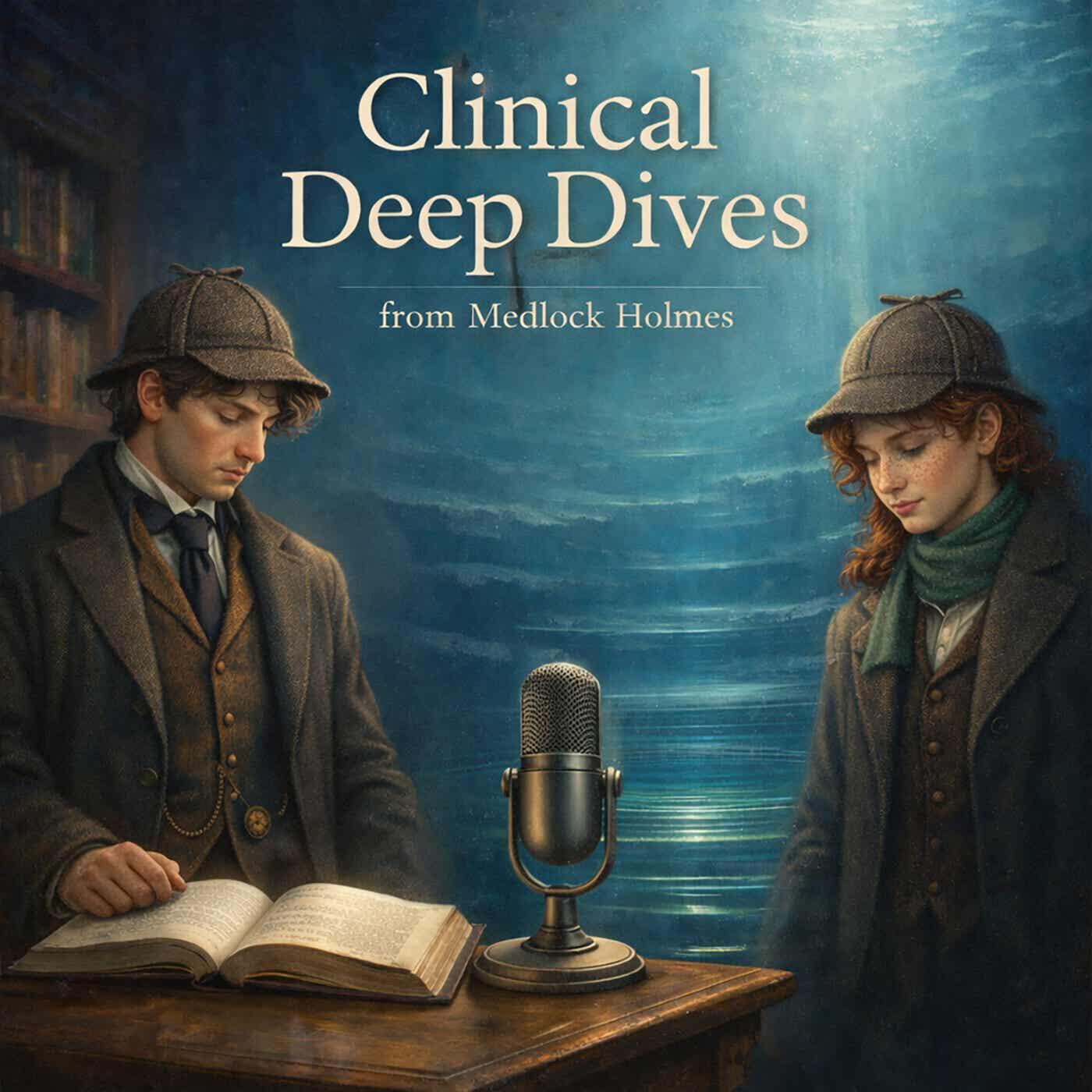
Clinical Deep Dives is a Medlock Holmes podcast for clinicians and learners who want understanding, not just information. Using classic medical and surgical texts as a guide and the generative power of AI, each episode explores ideas with curiosity and clarity, designed for learning on the move and knowledge that actually sticks. drmanaankarray.substack.com
Be sure to visit the podcast's website and support the creator: drmanaankarray.substack.com
Author
Med School Audio - Medical Knowledge Reimagined & Learning Made Memorable.
Category
Podcast website
Latest episode
Nov 3, 2026
Where to listen?
Podcasts in the app Replaio Radio Coming soonPodcasts are coming to the app soon. Install now and be the first to see a whole new take on podcasts
 Install for free
Android almost 10M downloads · 4.8 rating
iOS soon
Episodes
GPH 4: Development of Public Health in Economic Transition - The Middle-Income Countries 11.03.2026 1:55
This is a free preview of a paid episode. To hear more, visit drmanaankarray.substack.com Middle-income countries occupy a uniquely complex position in global public health. No longer classified as low-income, yet far from fully industrialised welfare states, these nations experience rapid economic growth alongside persistent inequality. In this episode, we explore how public health evolves during...
GPH 3: The History and Development of Public Health in Low- and Middle-Income Countries 11.03.2026 1:40
This is a free preview of a paid episode. To hear more, visit drmanaankarray.substack.com Public health in low- and middle-income countries (LMICs) followed a markedly different trajectory from that of industrialised nations. While European public health evolved alongside domestic urban reform, much of public health infrastructure in LMICs emerged within colonial systems - often designed to protec...
GPH 2 – The History and Development of Public Health in Developed Countries 11.03.2026 1:39
This is a free preview of a paid episode. To hear more, visit drmanaankarray.substack.com Public health did not emerge in lecture theatres. It emerged in overcrowded cities, in the shadow of epidemics, and in response to social upheaval. In this episode, we trace the development of public health in high-income countries - from the sanitary movement of the nineteenth century to the institutionalisa...
GPH 1 – The Scope and Concerns of Public Health 11.03.2026 1:22
This is a free preview of a paid episode. To hear more, visit drmanaankarray.substack.com In this opening episode of the Public Health series, we explore the intellectual and moral foundations of public health as a discipline. This chapter defines what public health is - and crucially, what it is not. Public health moves beyond the clinic. It shifts the focus from treating individual disease to pr...
FSM 26: Miscellaneous Poisons 11.03.2026 45:22
Not all poisons fit neatly into pharmaceutical or recreational categories. Some are industrial, environmental, botanical, or chemical - encountered rarely, yet capable of profound harm. In this final episode of Season 10, we explore miscellaneous poisons and unusual toxic agents that challenge forensic interpretation. We examine: * Carbon monoxide and other toxic gases. * Cyanide and cellular hypo...
FSM 25: Medicinal Poisons 11.03.2026 53:45
Many substances designed to heal can harm when misused, miscalculated, or maliciously administered. In this episode, we examine medicinal poisons - therapeutic agents that may become toxic in overdose, error, or deliberate ingestion. These cases often involve complex pharmacology, variable tolerance, and subtle pathological findings. We explore: * Paracetamol toxicity and delayed hepatic failure....
FSM 24: Licit and Illicit Drugs 10.03.2026 1:11:36
Drugs sit at the intersection of medicine, behaviour, and law. Some are prescribed. Some are prohibited. All demand careful interpretation in forensic practice. In this episode, we explore the wide spectrum of licit and illicit drugs encountered in medico-legal investigation. The forensic practitioner must understand pharmacology, toxicity, behavioural effects, and post-mortem interpretation. We e...
FSM 23: Alcohol 10.03.2026 58:53
Alcohol is among the most frequently encountered substances in forensic practice - yet its interpretation is rarely straightforward. In this episode, we examine the pharmacology, physiology, and medico-legal implications of ethanol in forensic contexts. From road traffic fatalities to custodial deaths and accidental injury, alcohol often plays a contributory role. We explore: * Absorption and meta...
FSM 22: Principles of Toxicology 09.03.2026 1:01:17
Not all causes of death are visible to the eye. Some leave no bruise, no fracture, no tear - only biochemical disruption. In this episode, we explore the principles of forensic toxicology: the science of detecting and interpreting drugs, poisons, and chemical agents within the body. Toxicology often transforms uncertainty into clarity - but only when results are interpreted with precision. We exam...
FSM 21: Principles of Forensic Science and Crime Scene Investigation 09.03.2026 59:40
The forensic story does not start in the mortuary. It begins at the scene. In this episode, we explore the foundational principles of forensic science and crime scene investigation. Before pathology can interpret findings, evidence must be preserved, documented, and collected with methodical discipline. We examine: * The concept of scene integrity. * Securing and preserving evidence. * The forensi...
FSM 20: Torture and Cruel, Inhuman and Degrading Treatment 09.03.2026 43:15
Forensic medicine does not exist only within criminal courts - it also stands at the frontier of human rights. In this episode, we explore the medical documentation of torture and cruel, inhuman, or degrading treatment. These cases require not only clinical expertise, but moral clarity and independence. The forensic practitioner may become a key witness in asylum claims, international tribunals, o...
FSM 19: Transportation Medicine 09.03.2026 34:34
Episode Description Roads, railways, skies, and sea routes all carry risk. When transportation incidents result in injury or death, forensic medicine must reconstruct not only pathology, but physics and circumstance. In this episode, we examine the medico-legal aspects of transport-related injury and fatality. These cases often involve high-energy transfer, complex scene investigation, and multi-a...
FSM 18: Safeguarding and Protection of Children and Vulnerable Adults 09.03.2026 58:27
Forensic medicine does not only investigate harm - it also prevents it. In this episode, we explore safeguarding responsibilities in the context of children and vulnerable adults. These cases often sit at the intersection of medicine, social care, law enforcement, and the courts. The practitioner’s role extends beyond documentation to risk recognition and escalation. We examine: * Definitions of v...
FSM 17: Sexual Assault, Genitoanal Injury and Female Genital Mutilation 09.03.2026 44:24
Few areas of forensic medicine demand greater sensitivity, technical skill, and ethical clarity than the examination of sexual assault and genitoanal injury. In this episode, we explore the structured forensic approach to allegations of sexual violence. The practitioner’s role is not to determine guilt, but to document findings objectively while safeguarding the dignity and autonomy of the individ...
FSM 16: Police Custodial Healthcare 08.03.2026 53:56
A police cell is not a hospital ward - yet medical responsibility does not pause at the custody threshold. In this episode, we explore the provision of healthcare within custodial environments. Police detention facilities present unique clinical, ethical, and legal challenges. The practitioner must balance duty of care to detainees with operational realities and legal oversight. We examine: * The...
FSM 15: Restraint and Control Techniques 08.03.2026 1:03:59
Restraint is sometimes necessary - but it is never neutral. In this episode, we explore the forensic and medical implications of restraint and control techniques used in policing, custodial settings, healthcare, and security environments. When physical force is applied, injury risk and legal scrutiny follow. We examine: * Types of restraint: manual holds, mechanical restraints, prone positioning....
FSM 14: Identification of the Living and the Dead 07.03.2026 57:27
Before cause, before mechanism, before manner - comes identity. In forensic medicine, identifying both the living and the deceased is fundamental. Without confirmed identity, legal processes cannot proceed, families cannot grieve with certainty, and justice cannot be served. This episode explores the structured approaches to identification across different contexts - from disaster victim identific...
FSM 13: Immersion and Drowning 07.03.2026 1:06:01
Water is both life-sustaining and lethal. In forensic medicine, immersion deaths present complex interpretive challenges - particularly when distinguishing drowning from post-mortem disposal. This episode explores the physiology and pathology of drowning and immersion. We examine how aspiration of fluid disrupts gas exchange, leading to hypoxia and death. Yet the external findings may be subtle. W...
FSM 12: Heat, Cold and Electrical Trauma 07.03.2026 30:51
Not all fatal forces are wielded by human hands. Sometimes, it is temperature or current that becomes the agent of death. In this episode, we examine injuries and fatalities caused by extremes of heat, cold, and electricity. These mechanisms often produce distinctive patterns - yet interpretation requires careful differentiation between ante-mortem injury and post-mortem artefact. We explore: Heat...
FSM 11: Pressure to the Neck and Asphyxia Deaths 07.03.2026 42:24
Breathing is instinctive - until it is obstructed. This episode examines deaths resulting from pressure to the neck and other forms of asphyxia. These cases are often medically complex and legally sensitive, demanding careful distinction between mechanism, cause, and circumstance. We explore: * Manual strangulation and ligature strangulation. * Hanging - complete and partial suspension. * Position...
FSM 10: Regional Injuries and Patterns of Injury 06.03.2026 56:21
Episode Description In forensic medicine, location matters. This episode examines how injuries distributed across specific regions of the body can reveal mechanism, force, intent, and circumstance. Rather than viewing wounds in isolation, we explore how patterns - spatial relationships and combinations - guide interpretation. We examine regional injury considerations, including: * Head and facial...
FSM 9: Ballistic Injuries 06.03.2026 55:17
Firearms introduce a different language of injury - one written in velocity, energy transfer, and trajectory. In this episode, we examine the forensic principles underpinning ballistic trauma. Understanding firearm injury requires integration of anatomy, physics, scene investigation, and careful morphological analysis. We explore: * Basic firearm mechanics and ammunition types. * Entry and exit wo...
FSM 8: Assessment, Classification and Documentation of Injury 06.03.2026 57:55
In forensic medicine, words matter as much as wounds. This episode focuses on the structured assessment and documentation of injury - a core skill that underpins criminal proceedings, civil litigation, and safeguarding processes. Injuries must be observed, described, classified, and recorded with precision. The integrity of the case often rests not on dramatic findings, but on careful language. We...
FSM 7: Deaths and Injury in Infancy 06.03.2026 1:08:05
Few areas in forensic medicine require more sensitivity, precision, and restraint than the investigation of deaths and injuries in infancy. In this episode, we examine the complex interplay between natural vulnerability, accidental harm, and inflicted injury in babies and young children. The stakes are profound: protecting children, safeguarding families, and ensuring justice without assumption. W...
FSM 6: Death from Natural Causes 05.03.2026 52:45
Not all unexpected deaths are criminal. Many are sudden, silent, and entirely natural. In this episode, we explore the forensic approach to deaths caused by disease. The central challenge is not dramatic injury, but careful differentiation: distinguishing natural pathology from trauma, poisoning, or neglect. We examine: * Sudden cardiac death - including ischaemic heart disease and arrhythmogenic...
Similar podcasts








Listen to the Clinical Deep Dives podcast in Replaio
Radio and podcasts in one app - free, with no sign-up. Install today and do not miss the launch
Replaio is not a podcast publisher; show names, artwork and audio belong to their authors and are distributed through public RSS feeds.