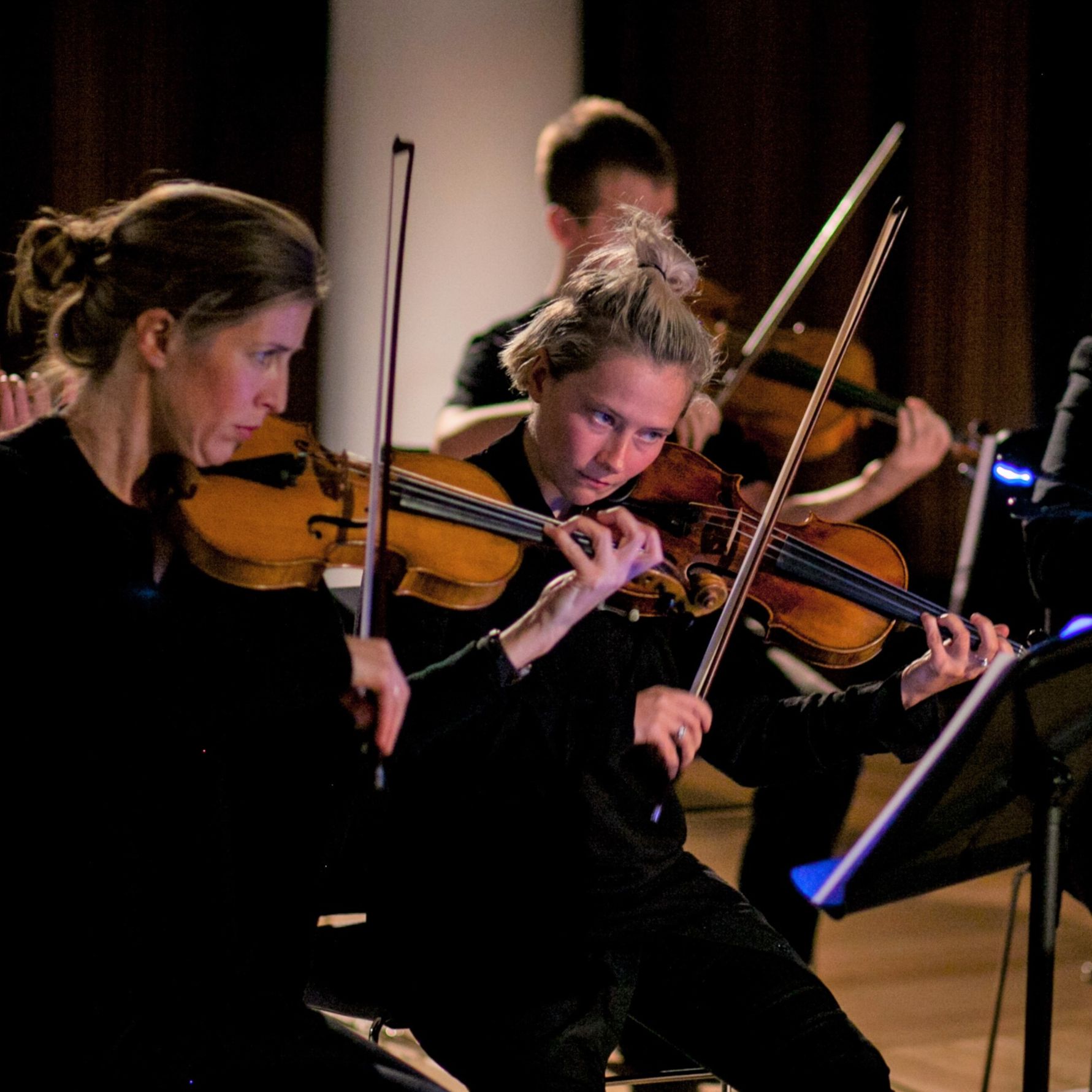
Daniel Leech-Wilkinson
Challenging Performance: Classical Music Performance Norms and How to Escape Them
Challenging Performance offers a new approach to western classical music, encouraging and enabling performers to be more individual and creative. It shows how and why creativity is normally discouraged, why it should not be, and how it can become part of everyday performance. The linked website, challengingperformance.com, features podcasts, a free online book, and many new and highly imaginative performances. The project is aimed at young professional performers, musicians in the making, and open-minded lovers of classical music. We showcase recordings by contemporary performers who use a ran...
Author
Daniel Leech-Wilkinson
Category
Podcast website
Latest episode
Dec 31, 2024
Where to listen?
Podcasts in the app Replaio Radio Coming soonPodcasts are coming to the app soon. Install now and be the first to see a whole new take on podcasts
 Install for free
Android almost 10M downloads · 4.8 rating
iOS soon
Install for free
Android almost 10M downloads · 4.8 rating
iOS soon
Episodes
Challenging Performance, Chapter 2 : The fabulous status quo 10.12.2024 14:34
The factors that make modern performance so effective, and the problems they bring.
Challenging Performance, Chapter 3 : Performance changes over time 10.12.2024 29:06
Early recordings prove that 'correct' performance style changes over time. So what's 'proper' now was 'unmusical' 100 years ago, and vice versa. Are there yet other ways of making great performances?
Challenging Performance, Chapter 4 : Performing identity 10.12.2024 13:15
As performance style changes, so score and composer identity change. Examples from Schubert, Boulez, Barber, and Brahms. None is who they were -- or will be.
Challenging Performance, Chapter 5 : The (actual) music, the music itself, musical 10.12.2024 22:18
What do these phrases really mean? What kind of work do they try to do? What weaknesses in thinking about the nature of classical music do they hide?
Challenging Performance, Chapter 6.1 : Delusions -- Introduction: naturalised beliefs 10.12.2024 8:34
Beliefs about the 'proper' performance of classical scores are so deeply inculcated in musicians' training that they come to seem natural. Yet many (most?) are delusions.
Challenging Performance, Chapter 6.2 : Delusions -- You need to know about music to appreciate it 10.12.2024 6:23
You don't need musical training or knowledge to have powerful experiences listening to classical music; you simply need exposure to it. Sometimes 'knowledge' makes it harder to enjoy...
Challenging Performance, Chapter 6.3 : Delusions -- You must play structure 10.12.2024 20:32
To perform one is supposed to sound the composer-god's structural plan, as revealed by music theory. But music is not like architecture: it has other ways of engaging us.
Challenging Performance, Chapter 6.4 : Delusions -- Current performances work best 10.12.2024 2:54
Current performance practice has to be believed to be the best possible practice, because the classical music State is (isn't it?) the best possible state.
Challenging Performance, Chapter 6.5 : Delusions -- We learn natural musicianship 10.12.2024 3:51
Training musicians to think of current performance style as 'natural' musicianship is one of the most insidious processes involved in coercing musicians into musicking as they are told.
Challenging Performance, Chapter 6.6 : Delusions -- Performances today are very unalike 10.12.2024 7:55
We’re trained to notice tiny differences between performances, and to imagine them as huge, because this is the only space within which -- given the ideology of performer obligations to the composer’s imagined wishes -- we are allowed to imagine these scores.
Challenging Performance, Chapter 6.7 : Delusions -- Music makes better sense performed ‘historically’ 10.12.2024 6:07
Whatever we claim, we don't believe in faithfulness to the composer's intentions when it comes to the uncomfortable truths of recorded performance styles.
Challenging Performance, Chapter 6.8 : Delusions -- Texts document sounds 10.12.2024 5:02
As recordings prove, words are seriously insufficient to describe performance styles, and so written records alone cannot lead to substantially historical performances.
Challenging Performance, Chapter 6.9 : Delusions -- Everything is in the score 10.12.2024 9:29
Until the 20th century no one believed that notation adequately specified performance. And they were correct!
Challenging Performance, Chapter 6.10 : Delusions -- A work is greater than any performance of it 10.12.2024 5:48
That a score can give rise, given fine performers, to so many enriching musical experiences makes us want to imagine something lying behind them that contains all that greatness. But what could it consist of, that does not involve sound and thus already a (particular) performance?
Challenging Performance, Chapter 6.11 : Delusions -- Scores have limited interpretative possibilities 10.12.2024 7:42
Old recordings and modern experimental performances prove that there are many radically different persuasive readings that can start from the same score. What are the limits? It's too soon to say.
Challenging Performance, Chapter 6.12 : Delusions -- The composer knows best 10.12.2024 8:56
Living composers are usually keen to hear performers make new sense of their scores. Only dead composers seem to need to be copied slavishly for ever. Why is that?
Challenging Performance, Chapter 6.13 : Delusions -- Composers’ intentions are known 10.12.2024 8:42
Not only do we not know composers’ intentions in sound before the late nineteenth century, we cannot.
Challenging Performance, Chapter 6.14 : Delusions -- The performer should be inaudible 10.12.2024 4:08
No one hears the performance style of their own era: thus, to perform normatively is to be unnoticeable, in a sense inaudible. This is supposed to be a good thing for a musician to be...
Challenging Performance, Chapter 6.15 : Delusions -- Composers are alive and listening 10.12.2024 3:58
Except for those still alive, the composer is dead and usually has been for a very long time. They’re not likely to be listening to us, or minding if we do things differently.
Challenging Performance, Chapter 6.16 : Delusions -- Composers are gods 10.12.2024 8:07
The composer is not a god, but a musician on a par with the performer; both are creative, though only the performer is essential.
Challenging Performance, Chapter 6.17 : Delusions -- 'Works' 10.12.2024 13:40
Can music exist? Or can it only happen? Is speaking of musical 'works' a category error? Who benefits? Only those who want something (some thing) to sell.
Challenging Performance, Chapter 6.18 : Delusions -- So music is…. What is it? 10.12.2024 2:58
Rather than a work, music is one’s experience of a performance: each individual experience in itself, each one unique.
Challenging Performance, Chapter 6.19 : Why do we maintain these delusions? 10.12.2024 8:37
All these delusions limit decision-making for the performer. In some ways that's an advantage. It certainly makes music cheaper for the employer. But it doesn't help performers to be healthy and happy, as we shall see in Part 2 of this book, from chapter 7.
Challenging Performance podcast: Episode 3 05.06.2020 19:36
Daniel Leech-Wilkinson introduces the third in a series of podcasts based on his book, Classical Performance Norms and How to Escape Them, which is free online at https://challengingperformance.com/the-book/. In this episode David Dolan speaks about his improvisation practice, and we hear how an improvisational attitude can improve performances of scores for audiences and players.
Challenging Performance podcast: Episode 2 17.05.2020 22:14
Daniel Leech-Wilkinson introduces the second in a series of podcasts based on his book, Classical Performance Norms and How to Escape Them, which is free online at https://challengingperformance.com/the-book/
Similar podcasts





Listen to the Challenging Performance: Classical Music Performance Norms and How to Escape Them podcast in Replaio
Radio and podcasts in one app - free, with no sign-up. Install today and do not miss the launch
Replaio is not a podcast publisher; show names, artwork and audio belong to their authors and are distributed through public RSS feeds.