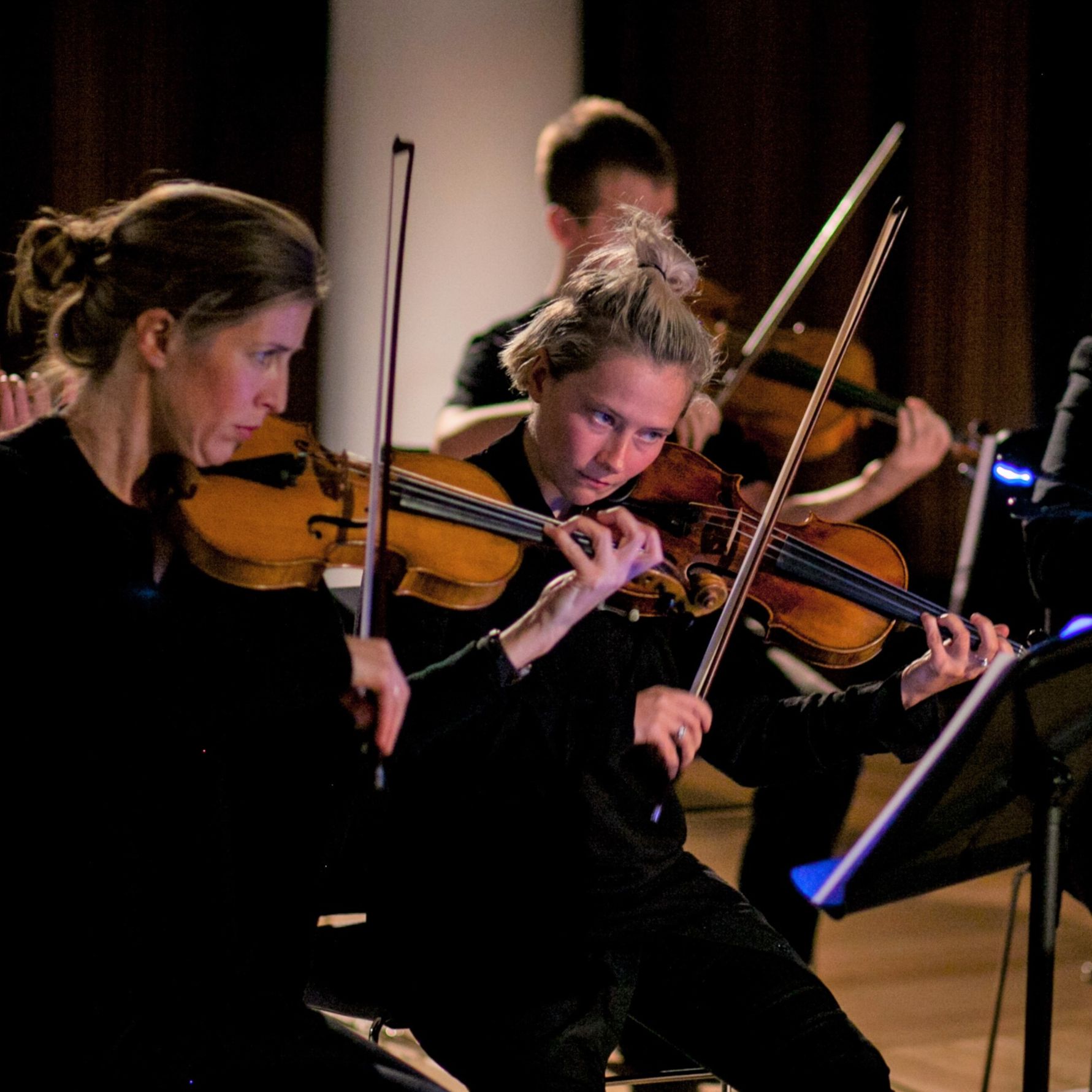
Daniel Leech-Wilkinson
Challenging Performance: Classical Music Performance Norms and How to Escape Them
Challenging Performance offers a new approach to western classical music, encouraging and enabling performers to be more individual and creative. It shows how and why creativity is normally discouraged, why it should not be, and how it can become part of everyday performance. The linked website, challengingperformance.com, features podcasts, a free online book, and many new and highly imaginative performances. The project is aimed at young professional performers, musicians in the making, and open-minded lovers of classical music. We showcase recordings by contemporary performers who use a ran...
Author
Daniel Leech-Wilkinson
Category
Podcast website
Latest episode
Dec 31, 2024
Where to listen?
Podcasts in the app Replaio Radio Coming soonPodcasts are coming to the app soon. Install now and be the first to see a whole new take on podcasts
 Install for free
Android almost 10M downloads · 4.8 rating
iOS soon
Install for free
Android almost 10M downloads · 4.8 rating
iOS soon
Episodes
Challenging Performance, Chapter 9.1 : Criticism 21.12.2024 5:21
Performance criticism identifies details that the critic feels do not belong. And so critics draw easily, unthinkingly, on metaphors of difference, often indexing gender, sexuality, class and race.
Challenging Performance, Chapter 9.2 : The language of record reviews 21.12.2024 28:43
The purpose of journalistic performance criticism is to promote and reward the most persuasive normative performances and to discourage everything else. Quotations representing almost 100 years of record reviewing illustrate how that is achieved through their reaching into, and faithfully mirroring, many dark corners of white western heritage.
Challenging Performance, Chapter 9.3 : The value of record reviewing 21.12.2024 4:03
How buying advertising can lead to favourable reviews.
Challenging Performance, Chapter 9.4 : Performance criticism in social media 21.12.2024 5:41
Vicious comments typical of social media can be used by distinguished musicians to criticise their peers.
Challenging Performance, Chapter 9.5 : The risk performers take 21.12.2024 3:23
Classical musicians would be healthier, happier, and classical music more widely enjoyed and better rewarded if there were more of the non-normative performances that critics spend too much of their lives trying to prevent.
Challenging Performance, Chapter 9.6 : The lack of intellectual debate about classical music 21.12.2024 4:49
Among the educated liberal elite classical music is no longer seen as something that they need know anything about. For this it has only itself, and its parochial ideology, to blame.
Challenging Performance, Chapter 10 : Normativities 21.12.2024 13:28
Norms from the past -- unwavering obedience, faithfulness to tradition, patriarchy, homophobia, misogyny, class entitlement -- are reproduced and naturalised in a great variety of ways in classical music culture.
Challenging Performance, Chapter 11.1 : Piety and the dead composer 21.12.2024 14:17
Is it sensible to believe that the word of a long-dead composer must for ever be obeyed? Are the dead composers somehow still alive, able to be hurt? Are scores their wills, to be executed repeatedly? Is it healthy to think like this about composers and scores?
Challenging Performance, Chapter 11.2 : Philosophical obligations to dead composers 21.12.2024 7:54
Some recent philosophers' views on obligations to the dead, some of them very curious indeed.
Challenging Performance, Chapter 11.3 : Ethical obligations to composers 21.12.2024 5:03
An attempt to take an unsuperstitious and humane approach to thinking about what we might ethically owe composers, living and dead, and what we might owe new generations of performers and listeners.
Challenging Performance, Chapter 12.1 : Policing 21.12.2024 5:16
Teachers, examiners, adjudicators, fixers, concert planners, managers, record companies, music journalists, critics, broadcasters, bloggers, musicologists, and co-performers: all are in effect policing musicians’ performances to ensure conformity with norms.
Challenging Performance, Chapter 12.2 : Music as Utopia 21.12.2024 10:20
Music that is well-composed and well-performed always seems, unlike the sequences of feelings we experience in everyday life, to be ideally shaped: it models a better self than ourselves, and allows us to practice, in a safe space, how to have a good relationship with our feelings and with others’.
Challenging Performance, Chapter 12.3 : Self-policing 21.12.2024 4:52
The incentives for classical performers to police themselves are many and irresistible. Only superlative obedience and competence succeed. And so the normative highest standard is the only target at which one dare aim. Hence, self-policing plays a large role in the construction of current classical music Utopia.
Challenging Performance, Chapter 8 : Musicology and editions 17.12.2024 6:07
Musicology, too, plays a role in the policing and oppression of classical performers, both through wielding texts from the past—and also through endless new 'Urtext' editions (for somehow the previous Ur-text is never quite Ur enough)—as police batons to keep the performer in their place.
Challenging Performance, Chapter 7.1 : The place of teachers in the classical music State 15.12.2024 7:40
Performer-teachers lie at the centre of a circular Classical Music State. As teachers they police, and as performers are policed by, a shared ideology which is thus constantly repeated and reinforced.
Challenging Performance, Chapter 7.2 : Childhood lessons 15.12.2024 8:40
Through the way classical music is taught to young children, obedience, hard work, love, praise and musicianship are all bound-up together at a formative stage, as self-esteem interlocks with self-discipline and self-policing: the teacher’s guidance, the composer’s intentions, the score’s instructions all come to seem indistinguishable.
Challenging Performance, Chapter 7.3 : Exam boards and the space for creativity 15.12.2024 15:37
Through their criteria for good marks, the music exam boards schematise and institutionalise standard practice and enforce conformity. But they could and should encourage creativity.
Challenging Performance, Chapter 7.4 : Conservatoire and creativity 15.12.2024 8:50
Juniper Hill calls for 'a relatively judgment-free space in which musicians experience less fear and anxiety about receiving negative feedback and thus feel freer to explore, experiment, develop new ideas, and take creative risks.'
Challenging Performance, Chapter 7.5 : Conservatoire and conformity 15.12.2024 28:54
We may readily agree that it’s the job of conservatoires to fit their students for work. But an ethical music school should not be gatekeeping to suit the gatekeepers: it should be putting pressure on them to rise to the challenge of thinking and responding as imaginatively as its most creative students.
Challenging Performance, Chapter 7.6 : Izabela Wagner on the training of virtuosi 15.12.2024 17:48
Izabela Wagner’s Producing Excellence: The Making of Virtuosos (2015) raises huge questions about classical music training, and whether the artistic results, wonderful as they are, are truly worth the level of physical and psychological pain or the level of abuse that children suffer in the (usually fruitless) quest for success.
Challenging Performance, Chapter 7.7 : Micro schools and their discontents 15.12.2024 7:10
A model of classical music policing shows how normative concert life is squeezed between the pressures applied by critics, agents, etc., and the long preparations through teaching and competition.
Challenging Performance, Chapter 7.8 : Competitions 15.12.2024 11:58
While jurors may claim that they are looking for a performer who can bring something new to the performance of a score, they often disagree so much on what is good that only the most brilliant performer of convention can emerge as their winner.
Challenging Performance, Chapter 7.9 : Alternatives 15.12.2024 17:26
Whether we look at childhood teaching, examining, conservatoire, the virtuoso studio, competitions, the same abuses are found. Much better protection of students is needed. We need to foster teaching of classical performers that encourages and accepts more, and denigrates and punishes less.
Challenging Performance: Classical Music Performance Norms and How to Escape Them 13.12.2024 2:20
What is this audiobook about? Who is it for? Will you like it? How to provide feedback.
Challenging Performance, Chapter 1 : Introduction and Examples. 10.12.2024 32:50
Classical music can be -- and has been -- performed very differently and still be wonderful. Why is the classical music business so frightened of difference? Alternatives are illustrated. How might performers benefit from them?
Similar podcasts






Listen to the Challenging Performance: Classical Music Performance Norms and How to Escape Them podcast in Replaio
Radio and podcasts in one app - free, with no sign-up. Install today and do not miss the launch
Replaio is not a podcast publisher; show names, artwork and audio belong to their authors and are distributed through public RSS feeds.