Jason Edwards
Certified: The PMI-RMP Audio Course
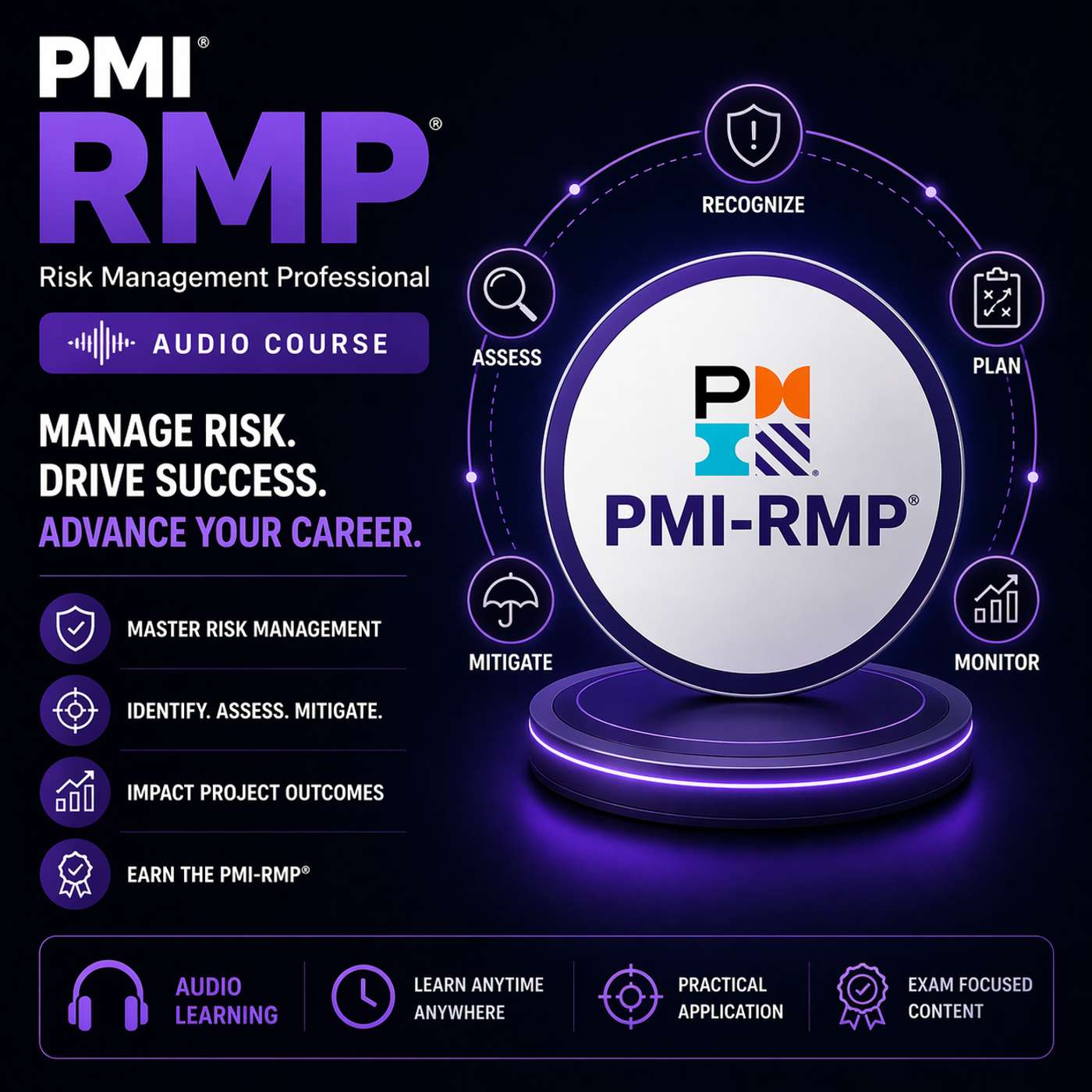
The PMI-RMP Audio Course is your complete audio companion for mastering risk management—designed for professionals who need both exam confidence and real-world fluency. Across 80+ focused episodes, you’ll learn how to think like a risk leader: shaping strategy, identifying threats and opportunities, analyzing exposure, and crafting responses that stand up to scrutiny. Each episode blends clear explanations with relatable project scenarios, helping you connect every domain of the Project Management Institute – Risk Management Professional (PMI-RMP) blueprint to practical evidence, decision flow...
Author
Jason Edwards
Category
Podcast website
Latest episode
Nov 11, 2025
Where to listen?
Podcasts in the app Replaio Radio Coming soonPodcasts are coming to the app soon. Install now and be the first to see a whole new take on podcasts
 Install for free
Android 5M+ downloads · 4.8 rating
iOS soon
Install for free
Android 5M+ downloads · 4.8 rating
iOS soon
Episodes
Episode 83 — Crisis Communication and Stakeholder Trust 10.11.2025 10:20
When risk becomes reality, communication determines whether stakeholders remain confident or the project loses support. This episode teaches crisis communication as a disciplined extension of risk governance: speak early, state facts, name owners, explain actions, and set the next update time. You will learn to align messages to thresholds and triggers already agreed in the plan so escalation feel...
Episode 82 — Hybrid Risk: Guardrails and Touchpoints 10.11.2025 9:43
Hybrid delivery mixes gated planning with iterative build, which multiplies handoffs—and risk—unless you design clear guardrails. This episode defines those guardrails as explicit policies on what must be decided at stage gates, what can evolve within sprints, and how information flows between the two. We link appetite, tolerance, and thresholds to both layers so the program board, change control,...
Episode 81 — Agile Risk: Backlogs, Sprints, and Reviews 10.11.2025 9:43
Agile does not eliminate risk; it changes its rhythm. This episode explains how uncertainty flows through product backlogs, sprint planning, daily scrums, reviews, and retrospectives so you can manage exposure without breaking agility. We show how to translate classic risk concepts into Agile terms: the backlog becomes a risk radar when items carry risk flags and acceptance criteria; sprint goals...
Episode 80 — Portfolio and Program Risk vs. Project Risk 10.11.2025 10:07
Not all risks live at the project level. This episode differentiates portfolio, program, and project risks—each with distinct horizons and governance layers. Portfolio risks affect strategic objectives and resource allocation across multiple initiatives; program risks arise from interdependencies among related projects; project risks stay within a single delivery scope. The PMI-RMP exam tests your...
Episode 79 — Operational Readiness and Transition Risk 10.11.2025 9:48
A project’s finish line is not delivery—it is sustained operation. This episode examines operational readiness and transition risk: whether people, processes, and systems can absorb the new capability without disruption. The PMI-RMP exam often frames scenarios where technical success hides readiness gaps, expecting you to propose proactive verification steps. You will learn to define acceptance cr...
Episode 78 — Cyber and Information Security Risk for PMs 10.11.2025 9:28
Digital assets and data flows create vulnerabilities every project manager must understand. This episode outlines how to identify and treat cyber and information security risks within project scope, even when a dedicated security team exists. We define common exposures—data breach, unauthorized access, loss of confidentiality or availability—and link them to project objectives, contracts, and comp...
Episode 77 — Financial and Currency Exposure in Projects 10.11.2025 9:31
Exchange rates, inflation, and interest fluctuations can quietly shift project economics. This episode teaches you to identify, quantify, and respond to financial and currency risks through the same structured framework used for technical exposures. The PMI-RMP exam often tests whether you recognize hidden volatility—for example, multi-currency procurement or long lead-time funding—as a risk requi...
Episode 76 — Quality Risk and Fitness-for-Use 10.11.2025 10:31
Quality risk concerns whether deliverables will meet functional expectations and stakeholder satisfaction, not just specifications. This episode clarifies how to express “fitness-for-use” as an exposure: performance shortfalls, missed acceptance criteria, or defects that erode trust. The PMI-RMP exam frequently embeds quality cues inside scenario stems, requiring you to connect test results, proce...
Episode 75 — Safety, Environmental, and Social Risk 10.11.2025 10:26
Projects operate within communities and ecosystems, making safety, environmental, and social risk both ethical imperatives and governance requirements. This episode frames these domains as objectives alongside cost and schedule, not as afterthoughts. You will learn to translate hazards, emissions, and community impacts into explicit risks with indicators, thresholds, and response owners. The PMI-R...
Episode 74 — Compliance, Legal, and Regulatory Risk 10.11.2025 9:59
Compliance, legal, and regulatory exposures introduce hard constraints and nonnegotiable timelines. This episode clarifies how to convert obligations—privacy rules, safety codes, licensing, export controls, and sector standards—into concrete risk statements, indicators, and triggers. The PMI-RMP exam often embeds a new or changed rule inside a scenario, expecting you to reassess thresholds, adjust...
Episode 73 — Vendor and Supply Chain Risk Fundamentals 10.11.2025 11:45
Vendor and supply chain risks compound because they cross organizational boundaries. This episode outlines fundamentals the exam expects you to apply: segmentation of suppliers by criticality, mapping of dependencies and single points of failure, and alignment of contract obligations with monitoring cadence. You will learn how to translate due diligence into practical indicators—on-time performanc...
Episode 72 — Procurement and Contract Risk (T&M, FP, CP) 10.11.2025 8:56
Procurement shifts portions of risk to or from suppliers, and contract type determines how exposure is shared. This episode compares time-and-materials (T&M), fixed-price (FP), and cost-plus (CP) arrangements through a risk lens the PMI-RMP exam frequently leverages. T&M places variability on the buyer unless guardrails cap hours or rates; FP transfers performance and cost risk to the sell...
Episode 71 — Integrated Change Control and Risk 10.11.2025 9:15
Integrated change control is where risk management meets governance in real time. This episode explains how proposed changes—scope adjustments, schedule shifts, cost reallocations, or quality criteria updates—intersect with the risk strategy, register, and reserves. You will learn to assess whether a requested change creates new risks, alters probability/impact of existing entries, or consumes con...
Episode 70 — Issue vs. Risk: Boundaries and Hand-Offs 10.11.2025 9:38
Understanding where a risk ends and an issue begins is vital to governance control. This episode clarifies that a risk is an uncertain event that may occur, while an issue is a realized event already affecting objectives. The PMI-RMP exam tests your ability to decide when to escalate a risk into an issue and update the appropriate logs. You will learn to establish clear hand-offs between risk mana...
Episode 69 — Executive Dashboards as Narratives 10.11.2025 9:14
Dashboards tell stories, and this episode explains how to design risk dashboards that inform decisions instead of simply displaying colors. We shift the mindset from reporting metrics to narrating change: what has improved, what remains critical, and what action is needed. You will learn how to balance visuals with concise commentary so executives grasp meaning in seconds. The PMI-RMP exam often f...
Episode 68 — Reporting Overall Risk Exposure 10.11.2025 10:13
Beyond individual entries, leaders need to understand overall project risk—the integrated effect of all uncertainties on objectives. This episode explains how to synthesize exposure into narratives that show whether the project is trending safer, riskier, or stable. The PMI-RMP exam often tests this skill through questions about aggregation and communication. You will learn to group risks by categ...
Episode 67 — Close Criteria and Administrative Closure 10.11.2025 9:56
Knowing when a risk is truly closed is just as important as identifying it in the first place. This episode defines closure criteria: the trigger window has passed without occurrence, residual exposure is within tolerance, all responses are complete and verified, and required documentation is signed off. The PMI-RMP exam frequently tests this concept by offering options that close risks prematurel...
Episode 66 — Updating Registers, Plans, and Baselines 10.11.2025 10:09
Risk information is perishable, so this episode explains how to keep your registers, management plans, and baselines synchronized as the project evolves. You will learn how to treat updates as controlled changes rather than casual edits, preserving audit trails that show who made a decision, when, and why. The PMI-RMP exam often tests this governance awareness—selecting the answer that records upd...
Episode 65 — Trigger Watchlists and Early Warning 10.11.2025 9:44
A trigger watchlist is the practical bridge between indicators and action. This episode shows how to build and operate one: list each trigger with its threshold, the associated risk ID, the owner to notify, the decision forum to convene, and the time limit for response. You will learn to integrate the watchlist into daily or weekly rhythms so it is reviewed briefly but consistently, and to automat...
Episode 64 — Monitoring Residuals and Secondaries 10.11.2025 10:39
After responses deploy, the job is not over—residual and secondary risks must be tracked with the same rigor as original entries. This episode explains how to reassess exposure once mitigations are in place, confirm whether residuals fall within tolerance, and determine if secondary risks merit their own responses or can be accepted. We emphasize lineage: each residual or secondary item should ref...
Episode 63 — Risk Reviews vs. Retrospectives 10.11.2025 9:47
Risk reviews and retrospectives both look back, but they serve different purposes and happen on different cadences. This episode defines a risk review as a governance forum focused on current exposure, decision readiness, and the effectiveness of responses; a retrospective reflects on how the team worked, extracting process improvements. On the exam, stems often confuse these meetings to test your...
Episode 62 — Tracking Indicators, Variance, and Trends 10.11.2025 9:47
Effective monitoring begins with meaningful measures. This episode clarifies how to select indicators that align with causes and objectives, how to distinguish variance from noise, and how to communicate trends that drive decisions. We separate leading indicators (precursors you can influence) from lagging indicators (outcomes you can only record), then explain sampling frequency, control limits,...
Episode 61 — Domain V Overview: Monitor and Close 10.11.2025 9:45
Domain V unifies everything you have built so far into a disciplined loop of observation, decision, and closure. The exam expects you to demonstrate how risks are monitored against indicators and triggers, how results are communicated, and how items are formally closed with evidence. We define the core activities: tracking leading and lagging indicators, reassessing exposure after responses, valid...
Episode 60 — Implementing Responses with Governance 10.11.2025 9:15
Implementation discipline ensures responses become real actions, not promises. This episode ties execution to governance structures: approvals, documentation, reporting cadence, and closure criteria. You will learn how to align each response with change control, verify funding sources, and confirm authority before work begins. The PMI-RMP exam frequently tests this coordination—whether an option r...
Similar podcasts







Listen to the Certified: The PMI-RMP Audio Course podcast in Replaio
Radio and podcasts in one app - free, with no sign-up. Install today and do not miss the launch
Replaio is not a podcast publisher; show names, artwork and audio belong to their authors and are distributed through public RSS feeds.