Jason Edwards
Certified: The PMI-RMP Audio Course
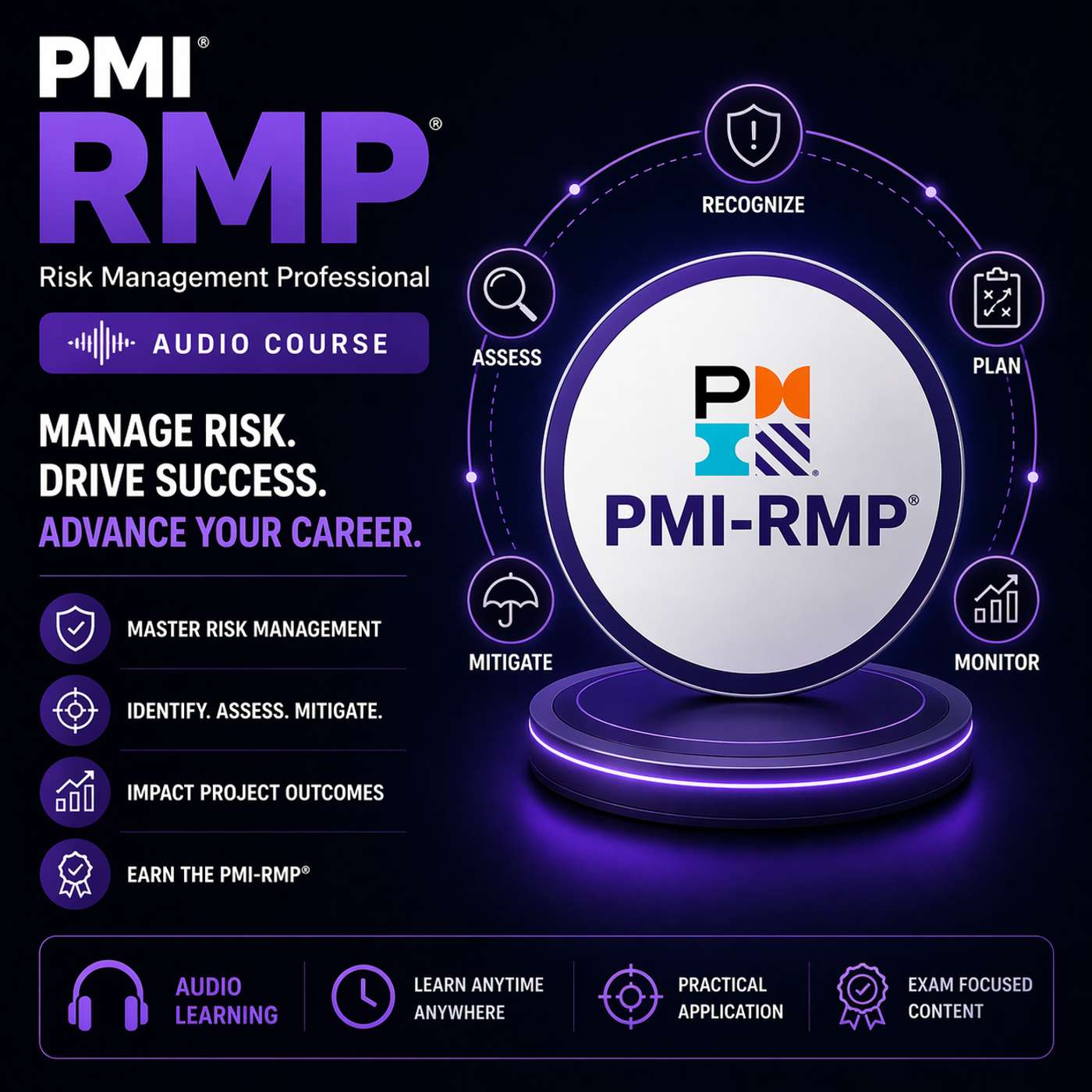
The PMI-RMP Audio Course is your complete audio companion for mastering risk management—designed for professionals who need both exam confidence and real-world fluency. Across 80+ focused episodes, you’ll learn how to think like a risk leader: shaping strategy, identifying threats and opportunities, analyzing exposure, and crafting responses that stand up to scrutiny. Each episode blends clear explanations with relatable project scenarios, helping you connect every domain of the Project Management Institute – Risk Management Professional (PMI-RMP) blueprint to practical evidence, decision flow...
Author
Jason Edwards
Category
Podcast website
Latest episode
Nov 11, 2025
Where to listen?
Podcasts in the app Replaio Radio Coming soonPodcasts are coming to the app soon. Install now and be the first to see a whole new take on podcasts
 Install for free
Android 5M+ downloads · 4.8 rating
iOS soon
Install for free
Android 5M+ downloads · 4.8 rating
iOS soon
Episodes
Episode 59 — Leading Indicators and Trend Watching 10.11.2025 9:13
Leading indicators offer early warning of emerging exposure before triggers are hit. This episode explains how to identify, monitor, and interpret these signals as part of continuous risk control. We define leading indicators as measurable factors that change ahead of outcomes—like defect discovery rates predicting test failure, or supplier response times forecasting delivery issues. The PMI-RMP e...
Episode 58 — Communicating Response Effectiveness 10.11.2025 8:42
Response actions must be measured and communicated so stakeholders see progress and remaining exposure. This episode outlines how to evaluate effectiveness through indicators like probability reduction, impact change, trigger frequency, and response timeliness. You will learn to differentiate between completion and effectiveness—a completed mitigation that fails to reduce exposure is still inadequ...
Episode 57 — Integrating Responses into Schedule and Budget 10.11.2025 8:58
Responses gain credibility only when embedded in the project’s schedule and budget, not left in isolation. This episode explains how to translate response actions into scheduled tasks with durations, dependencies, and cost allocations. The PMI-RMP exam expects you to understand this linkage: a risk response without time or cost integration is incomplete. You will learn to coordinate with planning...
Episode 56 — Assigning Risk Owners and Action Owners 10.11.2025 9:40
Clear ownership is the backbone of effective risk management. This episode distinguishes between a risk owner—the person accountable for monitoring and deciding future actions—and an action owner—the individual or team responsible for executing a specific response. The PMI-RMP exam frequently tests this difference, embedding clues about accountability and authority within scenarios. You will learn...
Episode 55 — Residual and Secondary Risks 10.11.2025 8:45
Every response leaves behind residual risk and may create new secondary risks. This episode defines both and explains how to record, analyze, and monitor them to preserve traceability. Residual risk remains after a response is implemented; secondary risk emerges as a direct consequence of that response. The PMI-RMP exam expects you to recognize when to accept, further treat, or transfer these foll...
Episode 54 — Contingency, Fallback, and Triggers 10.11.2025 9:25
Even the best responses can falter, so contingency and fallback planning ensure continuity. This episode clarifies the hierarchy: contingency plans are predefined actions triggered when specific conditions occur, while fallback plans activate if contingencies fail or residual risk materializes. You will learn how to define, fund, and test these plans, and how to write measurable triggers that link...
Episode 53 — Selecting Responses for Opportunities 10.11.2025 9:14
Opportunity management uses the same rigor applied to threats, framed for upside. This episode defines the four strategies: exploit, share, enhance, and accept. You will learn to decide which one fits by assessing control, resources, and timing. Exploit ensures an opportunity occurs, share allocates benefit and responsibility with a partner, enhance increases probability or impact, and accept reco...
Episode 52 — Selecting Responses for Threats 10.11.2025 9:31
Threat response selection demands clear cause-and-effect reasoning. This episode teaches how to match strategy to risk characteristics such as controllability, proximity, and potential impact. Avoidance removes exposure entirely, transfer shifts it to a willing third party, mitigation reduces probability or impact, and acceptance acknowledges exposure within tolerance. The exam frequently asks whi...
Episode 51 — Domain IV Overview: Risk Response 10.11.2025 9:27
Domain IV translates analysis into deliberate action, defining how risks will be addressed, owned, and tracked. This episode introduces the full range of response strategies—avoid, transfer, mitigate, accept for threats; exploit, share, enhance, accept for opportunities—and explains how they align with governance and appetite. You will learn the decision logic behind selecting each option, how to...
Episode 50 — Threats vs. Opportunities in Analysis 10.11.2025 9:51
Balanced risk management evaluates downside and upside with equal rigor. This episode explains how to analyze opportunities alongside threats using the same structures—clear statements, calibrated scales, urgency, proximity, and sensitivity to drivers—so leadership sees a complete picture of uncertainty. We clarify common exam pitfalls: treating opportunities as guaranteed benefits, scoring them w...
Episode 49 — Presenting Analysis to Executives 10.11.2025 8:30
Analysis only matters when it changes decisions, so this episode teaches you to translate findings into clear, credible executive narratives. We focus on four elements: the question being answered, the few drivers that matter, the decision options with implications, and the confidence level with key assumptions. You will learn to trim heat maps and model details in favor of a concise storyline: wh...
Episode 48 — Correlation, Dependencies, and Common Causes 10.11.2025 8:39
Many analyses fail because they assume inputs vary independently when, in practice, they rise and fall together. This episode clarifies correlation (variables moving in related ways), explicit dependencies (logic or resource links), and common causes (a single driver affecting several risks). We show how ignoring these relationships underestimates tail risk and overstates confidence in meeting tar...
Episode 47 — Critical Path vs. Risk-Adjusted Paths 10.11.2025 9:54
Traditional plans highlight a single critical path based on deterministic durations, but risk-aware planning recognizes that “critical” can shift as uncertainty plays out. This episode contrasts the textbook critical path with risk-adjusted thinking: multiple near-critical paths, merge points with high convergence risk, and activities whose variance, not mean duration, creates exposure. We define...
Episode 46 — Sensitivity and Drivers: Tornado Explained 10.11.2025 8:59
Sensitivity analysis helps you discover which uncertain inputs actually move outcomes, and the tornado diagram is the clearest way to show that hierarchy. This episode defines sensitivity as the change in a result—such as cost, finish date, or probability of meeting a target—when one input varies across a plausible range while holding others constant. We explain why tornado charts sort inputs from...
Episode 45 — Decision Trees and Expected Value, Verbally 10.11.2025 9:24
Decision trees turn uncertainty into structured reasoning, and this episode teaches how to interpret them verbally—the way the exam presents them. We explain how each branch represents an option with associated probabilities and payoffs, and how expected monetary value (EMV) is calculated conceptually without needing a calculator. You will learn to recognize the logic of folding back decisions, co...
Episode 44 — Cost Risk Concepts and Ranges 10.11.2025 10:20
Cost uncertainty deserves the same rigor as schedule uncertainty, and this episode clarifies how to interpret ranges, contingencies, and reserves in both predictive and Agile settings. We define contingency as funding set aside for known-unknowns within the project baseline and management reserve as organizational-level funding for unknown-unknowns outside the baseline. The exam expects you to con...
Episode 43 — Schedule Risk Concepts (No Software Needed) 10.11.2025 10:21
Understanding schedule risk analysis does not require advanced tools—it requires conceptual clarity. This episode explains how uncertainty in task duration, sequencing, and dependencies translates into exposure against milestones and delivery dates. You will learn foundational terms: deterministic vs. probabilistic schedules, critical vs. near-critical paths, and risk-adjusted completion forecasts...
Episode 42 — Data Quality and Calibration Concepts 10.11.2025 8:48
Accurate risk models depend on data quality, so this episode teaches how to evaluate and calibrate inputs before analysis. We define completeness, accuracy, consistency, and timeliness as the four quality dimensions most often referenced in exam questions. Calibration means adjusting expert judgment or historical data so probabilities and impacts reflect reality rather than optimism. You will lear...
Episode 41 — Quantitative Analysis: When and Why 10.11.2025 9:23
Quantitative analysis applies mathematics and modeling to express risk exposure in numerical terms, but the exam expects you to know when it adds value and when it wastes effort. This episode defines the conditions that justify it—high-value decisions, complex interdependencies, or mandated compliance requirements—and contrasts them with situations where qualitative analysis suffices. You will lea...
Episode 40 — Prioritization and Heat Map Pitfalls 10.11.2025 9:46
Prioritization converts analysis into action, but common traps make results unreliable. This episode critiques heat maps as communication tools: they are fine for orientation, poor for nuanced decisions if scales are vague, bins are uneven, or colors imply precision that doesn’t exist. We explain how to avoid visual bias, ensure consistent binning, and prevent the “everything is red” problem that...
Episode 39 — Beyond P-I: Urgency and Proximity 10.11.2025 9:44
Probability and impact are necessary, not sufficient. This episode adds urgency—the need to act quickly due to accelerating exposure—and proximity—the time until a risk could occur—to refine prioritization. We define each term, contrast them with one another, and show how they interact with governance cadence. For example, a medium-impact risk with near-term proximity may outrank a high-impact ite...
Episode 38 — Scales, Probability–Impact, and Scoring 10.11.2025 9:06
Scales are the language of qualitative analysis, and sloppy definitions produce unreliable results. This episode shows you how to design probability and impact scales that align to objectives and thresholds, using clear anchors such as ranges of delay, cost variance bands, quality defects, or stakeholder outcomes. We explain ordinal versus quasi-interval scales, why five levels often balance discr...
Episode 37 — Qualitative Analysis: Objectives and Flow 10.11.2025 9:34
Qualitative analysis converts a long list of identified risks into a prioritized, comprehensible set of concerns that leaders can act on quickly. In this episode, we define the objective as comparative discrimination, not precision: your task is to sort by materiality using calibrated scales and agreed criteria. We clarify the exam’s favored flow—validate data quality, confirm categories and objec...
Episode 36 — Domain III Overview: Risk Analysis 10.11.2025 10:03
Domain III moves from collecting risks to interpreting their meaning with disciplined judgment. This episode orients you to the analysis objectives, artifacts, and logic the exam expects you to apply under time pressure. We differentiate qualitative analysis—fast, comparative, decision-support scoring—from quantitative analysis—deeper, model-based estimation suitable when stakes justify additional...
Episode 35 — Opportunity Identification and Framing 10.11.2025 9:25
Opportunity management is risk management applied to positive outcomes, and this episode ensures you can frame it with the same rigor. We define opportunity as an uncertain event that could deliver beneficial impact if realized, and we explain why exam questions often penalize candidates who ignore upside potential. You will learn to elicit opportunities during identification by prompting for acce...
Similar podcasts







Listen to the Certified: The PMI-RMP Audio Course podcast in Replaio
Radio and podcasts in one app - free, with no sign-up. Install today and do not miss the launch
Replaio is not a podcast publisher; show names, artwork and audio belong to their authors and are distributed through public RSS feeds.