Jason Edwards
Certified - ITIL Foundation v4 Audio Course
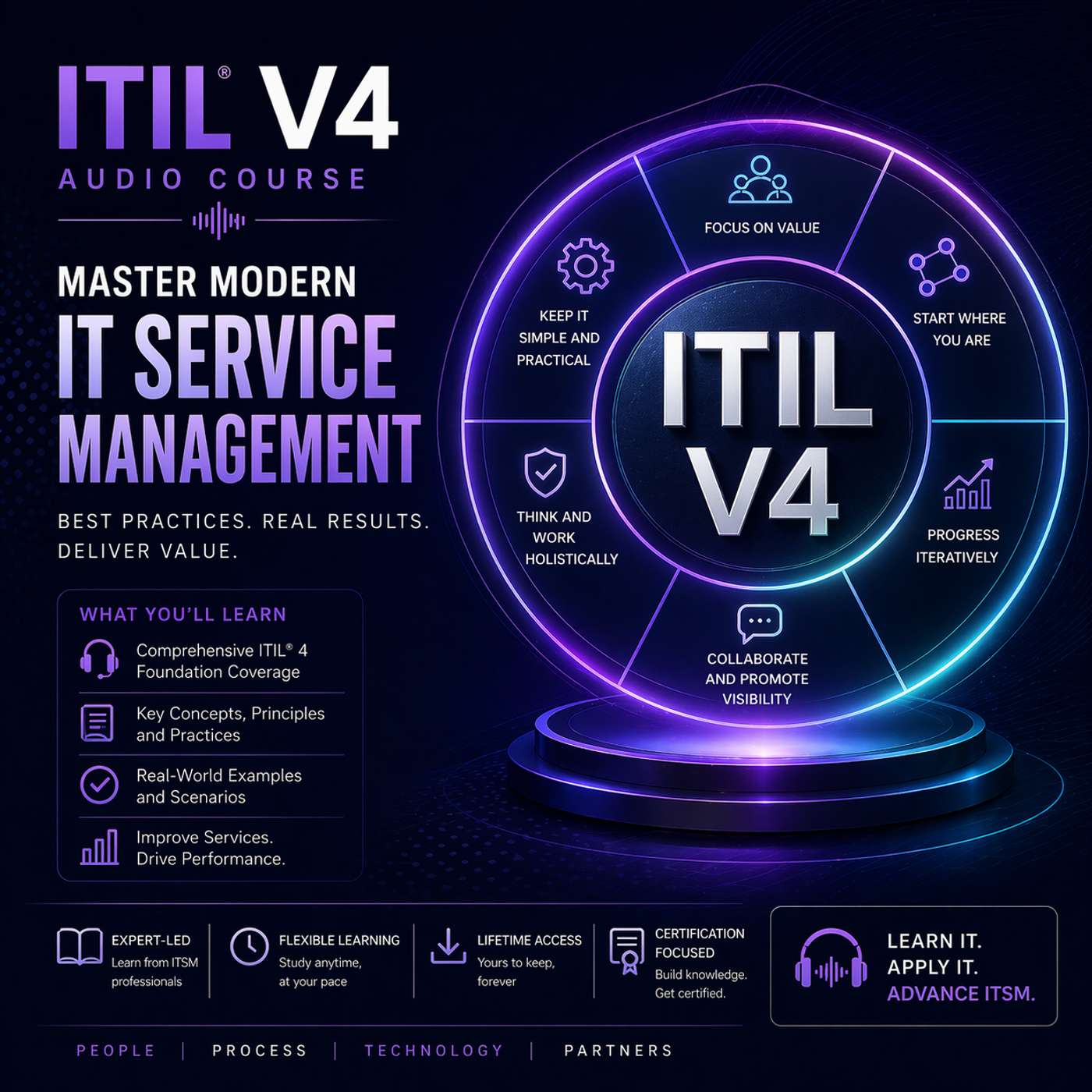
Start your journey into ITIL with the ITIL Foundation Audio Course—your complete, audio-first companion for mastering modern service management. Designed for learners who want clarity and flexibility, this Audio Course breaks down every key concept from the ITIL framework, including guiding principles, the service value system, continual improvement, and the essential management practices. Each episode transforms abstract ideas into real-world understanding, showing how ITIL methods drive efficiency, alignment, and value across technology and business operations. Whether you’re new to IT servi...
Be sure to visit the podcast's website and support the creator: baremetalcyber.com
Author
Jason Edwards
Category
Podcast website
Latest episode
Oct 14, 2025
Where to listen?
Podcasts in the app Replaio Radio Coming soonPodcasts are coming to the app soon. Install now and be the first to see a whole new take on podcasts
 Install for free
Android almost 10M downloads · 4.8 rating
iOS soon
Install for free
Android almost 10M downloads · 4.8 rating
iOS soon
Episodes
Episode 58: Service Level Management 01.09.2025 22:19
Service level management ensures that expectations are clear and performance is measured against agreed standards. In this episode, we’ll define how service level management establishes, monitors, and reviews service level agreements (SLAs) between providers and consumers. Its purpose is to make sure that services are delivered at levels that meet business needs and that both parties share a commo...
Episode 57: Service Desk 01.09.2025 22:14
The service desk is often described as the “face of IT,” serving as the single point of contact between users and service providers. In this episode, we’ll explain how the service desk practice supports users by handling incidents, service requests, and communications. Its role is not only technical but also relational, ensuring that users feel supported and valued. ITIL highlights the importance...
Episode 56: Service Request Management 01.09.2025 22:26
Service request management is one of the most common and visible practices in ITIL, as it deals with handling user requests in a consistent and efficient way. In this episode, we’ll define service requests as formal user-initiated actions such as asking for access to an application, requesting new equipment, or seeking information. The goal of this practice is to provide a streamlined and standard...
Episode 55: Problem Management 01.09.2025 22:26
Where incident management is about quick restoration, problem management focuses on addressing the root cause of recurring issues. In this episode, we’ll dive into how problem management identifies underlying faults, performs root cause analysis, and reduces the likelihood and impact of future incidents. ITIL makes a clear distinction between incidents, which are immediate disruptions, and problem...
Episode 54: Incident Management 01.09.2025 22:47
Incident management is one of the most visible ITIL practices because it deals directly with restoring services when disruptions occur. In this episode, we’ll explain how the purpose of incident management is to minimize negative impact by restoring normal operations as quickly as possible. An incident can be anything from a password reset request to a system outage affecting thousands of users. W...
Episode 53: Change Enablement 01.09.2025 23:04
Change enablement is one of the most examined practices in ITIL 4, reflecting its importance in balancing agility with stability. In this episode, we’ll explain how change enablement ensures that risks are assessed and approvals are in place before modifications are made to services, infrastructure, or processes. It doesn’t exist to block progress but to ensure that changes happen safely and deliv...
Episode 52: Release Management + Continual Improvement 01.09.2025 23:58
Release management and continual improvement may seem very different, but both play critical roles in keeping services relevant and reliable. Release management ensures that new software, updates, or service components are bundled and introduced into production environments in a structured and safe way. It coordinates planning, testing, and communication so that releases don’t disrupt service deli...
Episode 51: Monitoring & Event Management + Deployment Management 01.09.2025 24:07
This episode covers two practices that ensure services stay healthy and evolve effectively: monitoring and event management, and deployment management. Monitoring and event management focus on observing services, detecting conditions, and interpreting events to maintain stability. They allow organizations to spot incidents before they escalate, reducing downtime and impact. Deployment management,...
Episode 50: IT Asset Management + Service Configuration Management 01.09.2025 24:16
Assets and configurations form the backbone of service delivery, and ITIL provides two practices to manage them. In this episode, we’ll explore IT asset management, which tracks the financial, contractual, and lifecycle aspects of assets like hardware and software. Service configuration management complements this by managing the technical details and relationships of configuration items (CIs) wit...
Episode 49: Relationship & Supplier Management 01.09.2025 25:09
Strong relationships are central to successful services, and this episode explores two practices that enable them: relationship management and supplier management. Relationship management ensures that customers, users, and stakeholders feel heard, valued, and supported, building trust that sustains service delivery. Supplier management ensures that external partners deliver what’s needed, when it’...
Episode 48: Information Security Management 01.09.2025 26:15
Information security is a foundational practice in ITIL, ensuring that confidentiality, integrity, and availability of information are protected at all times. In this episode, we’ll explain how the information security management practice establishes policies, roles, and controls that safeguard services against threats. It’s not just about technical defenses like firewalls and encryption, but also...
Episode 47: Design & Transition, Obtain/Build, Deliver & Support — End-to-End Flow 01.09.2025 25:00
The remaining three activities of the service value chain — design and transition, obtain/build, and deliver and support — represent the heart of operational service delivery. In this episode, we’ll explain how design and transition ensures that new or changed services meet quality and business requirements before they go live. Obtain/build focuses on acquiring or creating the necessary resources,...
Episode 46: Engage Activity — Interacting with Stakeholders 01.09.2025 23:50
The “Engage” activity ensures that all stakeholder needs are understood, communicated, and met throughout the service lifecycle. In this episode, we’ll explore how engagement creates a two-way relationship between service providers and consumers. Effective engagement captures requirements, manages expectations, and builds trust. It ensures that feedback loops remain open, so that value is co-creat...
Episode 45: Improve Activity — Continual Improvement Mindset 01.09.2025 23:30
Improvement is not a one-time project but a continuous cycle, and the service value chain embeds this philosophy in the “Improve” activity. In this episode, we’ll explain how the improve activity ensures that services, practices, and processes are always evaluated and refined. Improvement is guided by feedback, performance data, and alignment to business goals, allowing organizations to adapt quic...
Episode 44: Plan Activity — Setting Direction and Goals 01.09.2025 24:44
The first activity in the service value chain is “Plan,” and in this episode we’ll explain its purpose and relevance. Planning provides a shared vision and direction for all aspects of service management, ensuring that goals, strategies, and policies align with organizational objectives. Without effective planning, efforts across the value chain become fragmented, leading to inefficiency and waste...
Episode 43: Service Value Chain Overview — Six Activities 01.09.2025 25:10
At the heart of the SVS is the Service Value Chain, which represents the core activities required to create and manage services. In this episode, we’ll introduce its six activities: plan, improve, engage, design and transition, obtain/build, and deliver and support. Each activity plays a unique role, but together they form a dynamic model rather than a rigid process. Unlike older process-heavy fra...
Episode 42: Governance, Practices, and Guiding Principles Inside SVS 01.09.2025 24:36
Governance, practices, and guiding principles are three of the most important elements within the SVS, and in this episode we’ll look at how they function. Governance ensures that policies, decision-making, and accountability are aligned to organizational strategy. Practices provide the structured approaches and resources that keep work consistent and effective. Guiding principles offer flexible a...
Episode 41: What is the ITIL Service Value System (SVS)? 01.09.2025 26:19
The Service Value System, or SVS, is one of the defining innovations of ITIL 4, and this episode introduces it in detail. The SVS provides a holistic model that shows how all the components of ITIL — guiding principles, governance, service value chain, practices, and continual improvement — fit together to create value. Rather than treating these elements as separate, the SVS integrates them into...
Episode 40: Four Dimensions in Balance — Avoiding Weak Spots 01.09.2025 23:22
Individually, each dimension is important, but ITIL stresses that they must work in balance. In this episode, we’ll explore how overemphasizing one dimension at the expense of others creates weaknesses. For example, focusing too much on technology without investing in people leads to tools that are underutilized. Over-reliance on suppliers without strong governance can expose organizations to risk...
Episode 39: Value Streams and Processes — Linking Activities to Results 01.09.2025 23:16
The fourth dimension brings the focus back to how work is organized and delivered. In this episode, we’ll explain value streams as end-to-end sequences of activities that create value for customers. Processes are structured sets of activities that transform inputs into outputs, supporting those value streams. Together, they ensure that services aren’t random tasks but coordinated flows designed to...
Episode 38: Partners and Suppliers — External Support Explained 01.09.2025 23:54
The third dimension of service management highlights that no organization operates alone. Partners and suppliers play a critical role in delivering value, whether through hardware, software, cloud hosting, or specialized expertise. In this episode, we’ll explain how ITIL defines the relationship between providers, partners, and suppliers, and why managing these relationships carefully is vital. Su...
Episode 37: Cloud, Automation, and Emerging Tech in ITIL 01.09.2025 26:02
Technology never stands still, and ITIL 4 recognizes that organizations must embrace change while managing risks. In this episode, we’ll focus on how cloud services, automation, and emerging technologies fit into the information and technology dimension. Cloud computing provides scalability and flexibility, allowing organizations to deliver services faster and more reliably. Automation reduces rep...
Episode 36: Information and Technology — Tools That Enable Services 01.09.2025 24:58
The second dimension of service management, information and technology, provides the tools and data that enable modern services. In this episode, we’ll discuss how this dimension includes everything from enterprise software and automation platforms to monitoring systems and knowledge repositories. Information refers not just to raw data but to how it is managed, secured, and shared. Technology ref...
Episode 35: Communication and Collaboration in Teams 01.09.2025 23:48
Strong collaboration is essential for organizational success, and ITIL underscores the need for effective communication within the people dimension. In this episode, we’ll explore why collaboration matters, how silos can weaken value creation, and what practices improve teamwork. Effective communication ensures that goals are shared, progress is visible, and challenges are addressed quickly. Colla...
Similar podcasts







Listen to the Certified - ITIL Foundation v4 Audio Course podcast in Replaio
Radio and podcasts in one app - free, with no sign-up. Install today and do not miss the launch
Replaio is not a podcast publisher; show names, artwork and audio belong to their authors and are distributed through public RSS feeds.