Jason Edwards
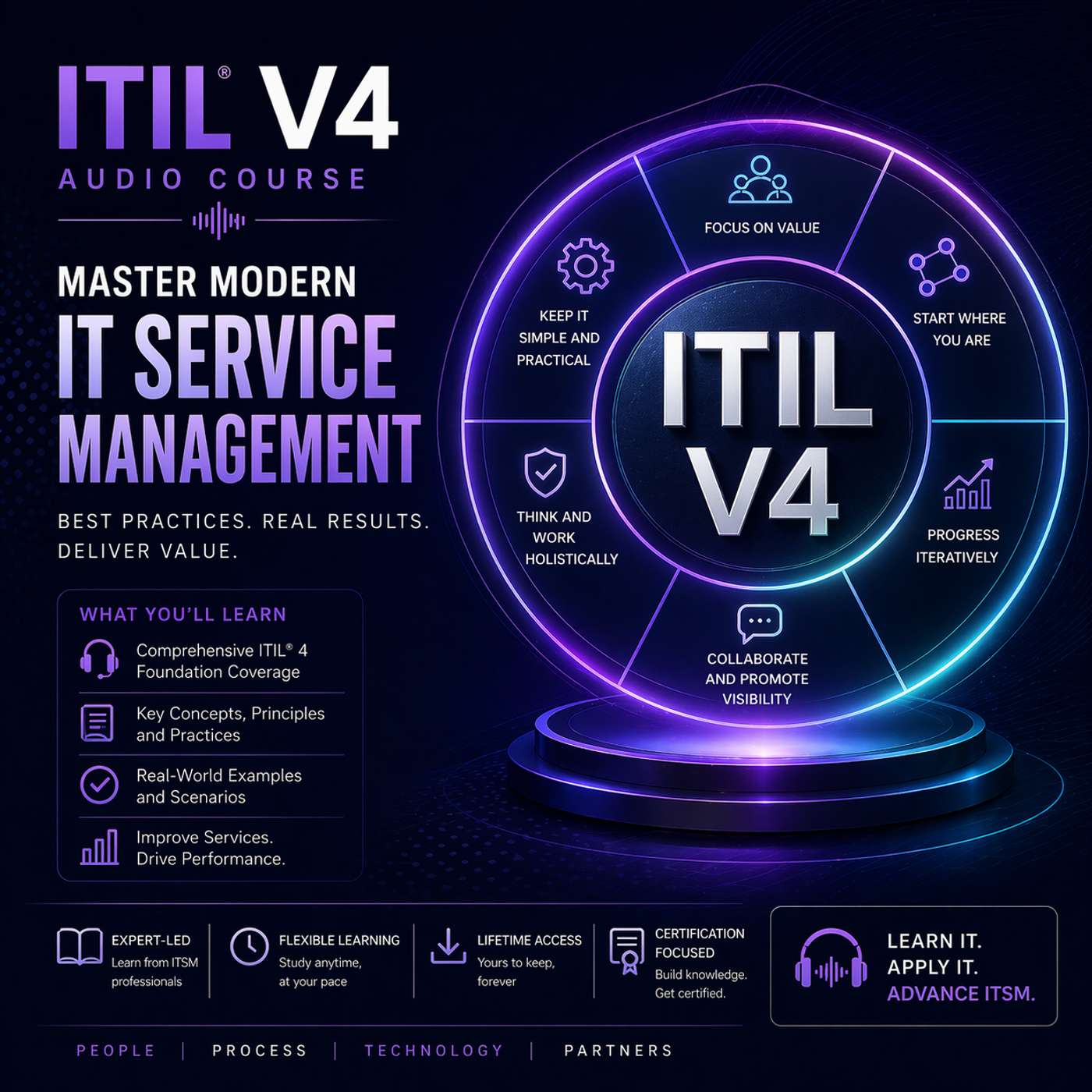
Certified - ITIL Foundation v4 Audio Course
Start your journey into ITIL with the ITIL Foundation Audio Course—your complete, audio-first companion for mastering modern service management. Designed for learners who want clarity and flexibility, this Audio Course breaks down every key concept from the ITIL framework, including guiding principles, the service value system, continual improvement, and the essential management practices. Each episode transforms abstract ideas into real-world understanding, showing how ITIL methods drive efficiency, alignment, and value across technology and business operations. Whether you’re new to IT servi...
Be sure to visit the podcast's website and support the creator: baremetalcyber.com
Author
Jason Edwards
Category
Podcast website
Latest episode
Oct 14, 2025
Where to listen?
Podcasts in the app Replaio Radio Coming soonPodcasts are coming to the app soon. Install now and be the first to see a whole new take on podcasts
 Install for free
Android almost 10M downloads · 4.8 rating
iOS soon
Install for free
Android almost 10M downloads · 4.8 rating
iOS soon
Episodes
Episode 34: Organizations and People — Roles, Culture, Competence 01.09.2025 24:51
The first of the four dimensions focuses on organizations and people, reminding us that technology alone cannot deliver value. In this episode, we’ll explore how organizational structure, defined roles, skills, and culture directly shape the effectiveness of service management. People provide creativity, decision-making, and accountability, while organizational design ensures they work together ef...
Episode 33: Introduction to the Four Dimensions 01.09.2025 25:01
To understand ITIL 4 fully, you must see service management as more than just processes or technologies. In this episode, we’ll introduce the four dimensions of service management: organizations and people, information and technology, partners and suppliers, and value streams and processes. These dimensions are the lenses through which services must be designed and managed. Together, they ensure a...
Episode 32: Mini-Review: Seven Principles Recap 01.09.2025 25:21
After exploring each guiding principle in detail, this episode serves as a recap to lock the concepts firmly in your memory. We’ll briefly revisit each principle — from “Focus on Value” through “Optimize and Automate” — and remind you of their definitions, key applications, and exam cues. This mini-review is designed to reinforce your learning through repetition, ensuring you can recall principles...
Episode 31: Exam Pitfalls Around Principles 01.09.2025 24:44
Principles are straightforward in theory, but exam questions often test them in tricky ways. In this episode, we’ll walk through the most common pitfalls candidates face when answering principle-related questions. A frequent mistake is treating the principles as isolated rather than interconnected. Another is misapplying them — for example, confusing “Keep It Simple and Practical” with cutting cor...
Episode 30: Guiding Principles in Daily Work 01.09.2025 26:23
The value of guiding principles is proven not only in theory but in the everyday work of IT professionals. In this episode, we’ll translate the principles into relatable analogies and daily practices. For instance, “Keep It Simple and Practical” might be compared to writing a clear grocery list — it’s short, direct, and ensures you get what you need without overcomplicating things. “Collaborate an...
Episode 29: Interactions Between Principles — How They Work Together 01.09.2025 24:59
While each guiding principle can stand alone, their true power emerges when they are applied together. In this episode, we’ll explore how the seven principles interact, often reinforcing each other in practice. For example, “Start Where You Are” works naturally with “Progress Iteratively with Feedback,” ensuring that teams evolve existing processes step by step. Similarly, “Collaborate and Promote...
Episode 28: Optimize and Automate — Efficiency and Tools 01.09.2025 26:44
The final guiding principle, “Optimize and Automate,” reflects modern IT realities where efficiency and technology play critical roles. In this episode, we’ll explain how optimization comes first: before automating, organizations must understand their processes, remove waste, and ensure the work adds value. Only then does automation make sense, because it amplifies what already works. Automating f...
Episode 27: Keep It Simple and Practical — Avoiding Complexity 01.09.2025 28:03
Complexity is one of the biggest threats to efficiency, and ITIL’s principle “Keep It Simple and Practical” addresses this directly. In this episode, we’ll explore how simplicity reduces errors, accelerates adoption, and makes processes more resilient. Simplicity means focusing only on the steps that truly add value, while discarding unnecessary complexity that creates confusion. Practicality ensu...
Episode 26: Think and Work Holistically — The Big Picture 01.09.2025 25:16
ITIL emphasizes that no element of a service operates in isolation, and this is captured in the guiding principle “Think and Work Holistically.” In this episode, we’ll explain how services, practices, teams, and processes are interconnected parts of a larger system. Thinking holistically means recognizing these interdependencies and managing services as complete value streams rather than fragmente...
Episode 25: Collaborate and Promote Visibility — Team and Transparency 01.09.2025 28:41
No service can succeed in isolation, which is why collaboration is essential in ITIL’s framework. In this episode, we’ll examine the guiding principle “Collaborate and Promote Visibility,” which emphasizes teamwork, communication, and openness as the drivers of success. Collaboration ensures that diverse perspectives are included in decision-making, preventing blind spots and reducing risks. Promo...
Episode 24: Progress Iteratively with Feedback — Why Small Steps Matter 01.09.2025 28:15
Big-bang changes often fail because they are too risky and too complex. The principle “Progress Iteratively with Feedback” reminds us that improvement should come in manageable steps, each guided by learning and user input. In this episode, we’ll explore why breaking work into smaller increments reduces risk, builds momentum, and allows teams to adjust quickly if something isn’t working. We’ll als...
Episode 23: Start Where You Are — Assess Before You Build 01.09.2025 26:26
Change and improvement are constant in IT, but too often organizations throw away what already works. This guiding principle, “Start Where You Are,” encourages you to first assess the current state before making changes. In this episode, we’ll explain how this principle helps avoid waste and ensures improvements are built on proven strengths. You’ll learn why careful measurement, baselining, and o...
Episode 22: Focus on Value — Customer First 01.09.2025 30:21
The first guiding principle is “Focus on Value,” and it captures the essence of why IT services exist at all. In this episode, we’ll explore how every decision, process, and improvement effort should be evaluated by the value it creates for customers and stakeholders. Value is not defined by the provider but by the consumer, meaning that understanding customer needs and expectations is essential....
Episode 21: What Are Guiding Principles? 01.09.2025 30:41
Guiding principles are one of the most distinctive features of ITIL 4, offering simple yet powerful advice that can be applied universally across organizations and situations. In this episode, we’ll introduce the seven guiding principles that serve as a compass for decision-making and service management activities. Unlike strict processes, these principles are flexible, designed to be adopted and...
Episode 20: Service Relationships: Provision, Consumption, Management 01.09.2025 29:41
Services don’t exist in a vacuum — they exist in relationships between providers and consumers. In this episode, we’ll examine the ITIL concept of service relationships, which involve three main elements: service provision, service consumption, and service relationship management. Provision refers to the provider delivering services, resources, and actions. Consumption refers to the customer using...
Episode 19: Service Offerings Explained 01.09.2025 20:03
Service offerings form the bridge between a service provider and the consumers who benefit from their services. In this episode, we’ll define what an offering is in ITIL terms — a formal description of one or more services, goods, or resources presented to a target consumer group. We’ll break down the components of offerings, which can include tangible goods, access to resources, and service actio...
Episode 18: Utility and Warranty — Twin Pillars of Service Value 01.09.2025 23:00
Utility and warranty together define whether a service truly delivers value. In this episode, we’ll revisit and expand on these two foundational concepts. Utility is fitness for purpose — does the service provide the functionality customers need? Warranty is fitness for use — does it perform reliably at the required level of availability, capacity, continuity, and security? Both must work together...
Episode 17: Understanding Risk in Services 01.09.2025 19:47
Risk is an unavoidable part of delivering services, and ITIL places strong emphasis on understanding how risk shapes outcomes. In this episode, we’ll explore the ITIL definition of risk as a possible event that could cause harm or make achieving objectives more difficult. Services always involve balancing risks against opportunities: every new feature, every supplier contract, and every technology...
Episode 16: Outputs vs. Outcomes — Getting Real Results 01.09.2025 22:24
One of the most important distinctions in ITIL is between outputs and outcomes. Outputs are the direct deliverables of a process — the things you produce, like a software update or a report. Outcomes are the results achieved by using those outputs — improved user productivity, reduced risk, or higher customer satisfaction. The exam often asks you to recognize this difference because it shapes how...
Episode 15: Cost and Value — What’s the Difference? 01.09.2025 23:57
In service management, cost and value are closely linked but not the same. This episode focuses on distinguishing these two concepts, which the exam often tests in subtle ways. Cost represents the resources required to deliver a service — the money, time, and effort invested. Value, on the other hand, is the benefit or outcome that the customer perceives from that service. For example, the cost of...
Episode 14: Value in Everyday Life 01.09.2025 23:23
Abstract definitions can be difficult to grasp, so this episode connects ITIL’s concept of value to examples you use every day. Think of subscribing to Netflix, hailing a ride on Uber, or ordering through a food delivery app. In each case, you are not buying technology; you are buying outcomes and experiences. ITIL defines value as the perceived benefits, usefulness, and importance of something. I...
Episode 13: Service Management as a Practice — What It Means 01.09.2025 24:19
Service management is more than a collection of processes; it is a professional practice that organizations adopt to consistently deliver value. In this episode, we’ll define what ITIL means by “service management as a practice” and why it is critical to success in modern IT. You’ll learn that it encompasses structured ways of working, standardized roles, and proven methods that allow teams to ali...
Episode 12: Customers, Users, and Sponsors — Roles in Service Management 01.09.2025 22:39
Service management is not just about technology; it’s about people and their roles in creating and consuming value. In this episode, we’ll explain the three primary roles ITIL identifies: customers, users, and sponsors. Customers define requirements for services and take responsibility for outcomes, while users are those who actually consume the service in their day-to-day work. Sponsors, on the o...
Episode 11: What is a Service? 01.09.2025 24:47
At the heart of ITIL lies one fundamental question: what is a service? In this episode, we’ll unpack the ITIL definition of a service as a means of enabling value co-creation by facilitating outcomes that customers want to achieve, without the customer having to manage specific costs and risks. Two key ideas drive this definition: utility and warranty. Utility is about fitness for purpose — does t...
Episode 10: Key Terms Q–Z 01.09.2025 24:40
The final part of our glossary journey takes you through the key terms from Q through Z. This segment closes the loop, ensuring you have the full language of ITIL at your fingertips before we dive deeper into frameworks and practices. Terms in this section often appear in exam questions where precision matters — knowing exactly how ITIL defines them can mean the difference between a right or wrong...
Similar podcasts







Listen to the Certified - ITIL Foundation v4 Audio Course podcast in Replaio
Radio and podcasts in one app - free, with no sign-up. Install today and do not miss the launch
Replaio is not a podcast publisher; show names, artwork and audio belong to their authors and are distributed through public RSS feeds.