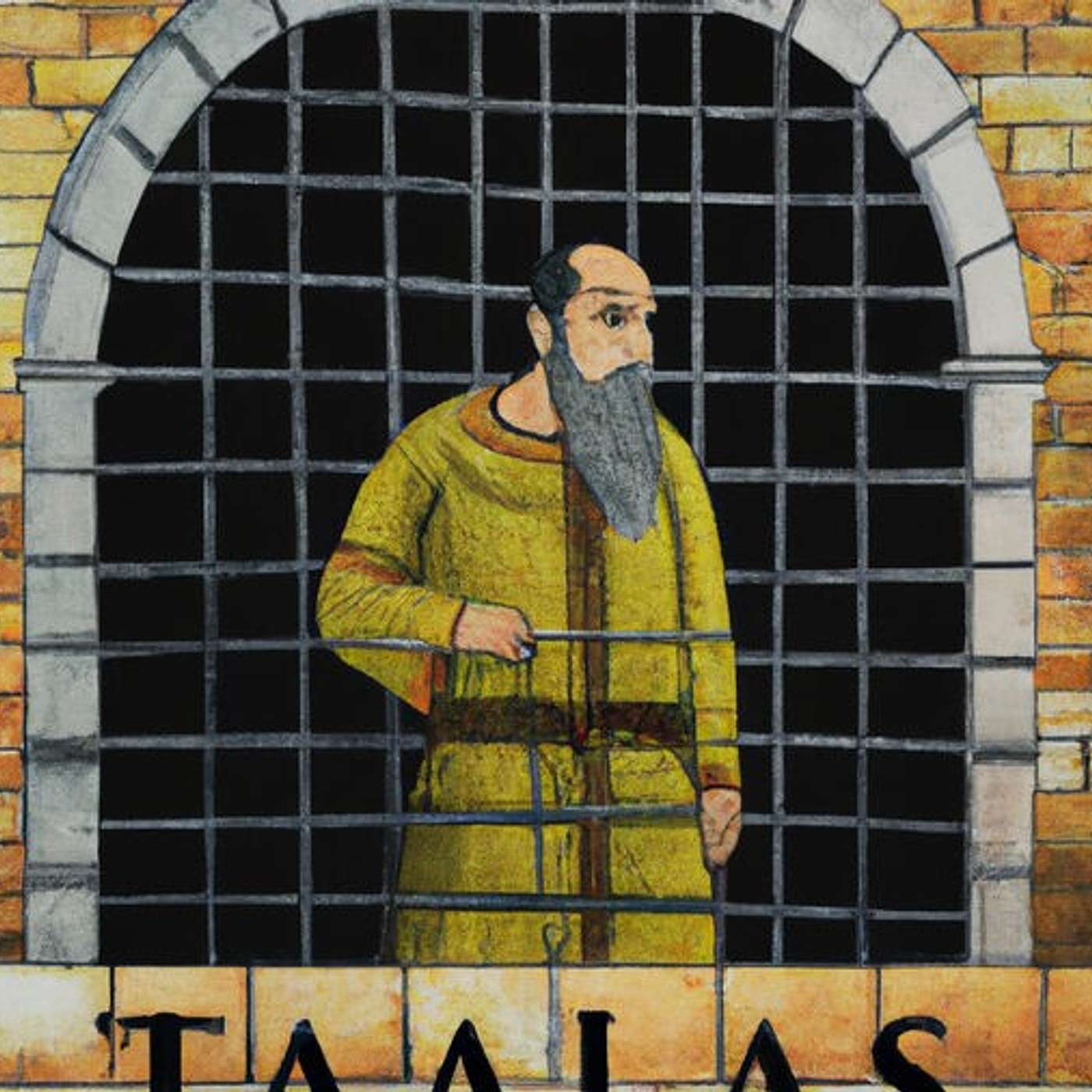
Dr. Thomas Constable, Plano Bible Chapel SonicLight.com
Bible Study with Dr. Thomas Constable
These are extremely informative and entertaining bible study lectures that have blessed many seekers of knowledge and faith over the last 20 years or more. Dr. Thomas L. Constable is a prominent theologian and former professor of Bible Exposition at Dallas Theological Seminary. He is also a pastor at Plano Bible Chapel in Plano, Texas, where he has served for over 50 years. Dr. Constable is widely known for his Bible commentary series, SonicLight.com, which includes Notes on the Bible, Notes on the Minor Prophets, and Notes on Revelation. He is also the author of several books, including "Talk...
Be sure to visit the podcast's website and support the creator: SonicLight.com
Author
Dr. Thomas Constable, Plano Bible Chapel SonicLight.com
Category
Podcast website
Latest episode
Aug 10, 2026
Where to listen?
Podcasts in the app Replaio Radio Coming soonPodcasts are coming to the app soon. Install now and be the first to see a whole new take on podcasts
 Install for free
Android almost 10M downloads · 4.7+ rating
iOS soon
Episodes
Philippians 3:1-11, The Spiritual Mind 28.07.2026 44:14
Chapter 3 opens with a sharp warning against 'the dogs, the evil workers, the false circumcision' (3:2) — Paul's vivid language for the Judaizing teachers who were insisting that Gentile believers must be circumcised and observe Torah. Constable notes that 'dogs' was a term Jews applied to Gentiles; Paul reverses it, applying it to those Jews whose gospel is no gospel. His counter-claim is radical...
Philippians 2:19-30, Timothy and Epaphroditus 28.07.2026 34:06
Chapter 2 closes with character sketches of two men Paul commends as embodiments of the Christ-like humility he has just described. Timothy is Paul's closest associate and most trusted envoy: Paul can think of no one 'of kindred spirit who will genuinely be concerned for your welfare' (2:20), and the contrast with others who 'seek after their own interests, not those of Christ Jesus' (2:21) sugges...
Philippians 2:5-18, Walking in Unity 28.07.2026 38:10
Philippians 2:5-11, the 'Christ hymn' (carmen Christi), is one of the most theologically significant passages in the New Testament and one of the most debated. Constable identifies its function in the letter as paraenetic (ethical): the humility Christ demonstrated in the incarnation and cross is the pattern for the humility Paul is asking the Philippians to practice with one another. The theologi...
Philippians 1:27-30; 2:1-4, A Worthy Walk 28.07.2026 32:49
The transition from Paul's personal circumstances to the congregation's conduct begins with what Constable identifies as the letter's foundational exhortation: 'Only conduct yourselves in a manner worthy of the gospel of Christ' (1:27). The Greek word translated 'conduct yourselves' (politeuesthe) is the citizenship verb — 'live as citizens worthy of the gospel.' In a city that was obsessively pro...
Philippians 1:12-26, Paul's Imprisonment and Anticipated Deliverance 28.07.2026 32:53
Chapter 1:12-26 is Paul's account of his own circumstances written with a deliberate purpose: to demonstrate that the gospel's progress does not depend on favorable conditions. His imprisonment, far from hindering the word, has advanced it — the whole Praetorian Guard knows he is imprisoned 'for Christ' (1:13), and most of the brothers in Rome have been emboldened to speak the word more fearlessly...
Philippians 1:6-11, Thanksgiving and Prayer 27.07.2026 38:20
The prayer of 1:9-11 is one of the most theologically precise intercessory prayers in Paul's letters. He prays that the Philippians' love 'may abound still more and more in real knowledge and all discernment' (1:9) — a construction Constable finds significant: love without knowledge becomes sentimental and undiscerning; the goal is love that grows in its capacity to distinguish what genuinely matt...
Philippians 1:1-6, Salutation; Thanksgiving 27.07.2026 29:29
Philippians was written by Paul from prison — almost certainly Rome, around A.D. 61-62 — to the church he planted in Philippi during his second missionary journey, the first church he established on European soil. Constable notes that Philippi was a Roman colony whose citizens were intensely proud of their Roman status, which makes Paul's counter-claim in 3:20 — 'our citizenship is in heaven' — a...
Acts 28, Malta, Rome, and Paul's Ministry 27.07.2026 42:57
The final chapter of Acts covers Paul's winter on Malta (28:1-10), the final voyage to Rome (28:11-16), his encounters with Jewish leaders in Rome (28:17-29), and the open-ended summary of his two-year house arrest ministry (28:30-31). Malta (28:1-10) provides two final miracles to authenticate Paul's apostolic status. The viper episode (28:3-6): Paul is gathering wood and a viper fastens on his h...
Acts 27, The Voyage and Shipwreck 27.07.2026 43:34
Acts 27 is one of the most vivid sea voyage narratives in ancient literature — a detailed account of a voyage, storm, and shipwreck that Luke himself experienced as a participant ('we' passages throughout). The chapter is also one of the most theologically instructive in Acts for the believer facing catastrophic circumstances. The voyage from Caesarea begins normally enough (27:1-8) with Paul acco...
Acts 26, Paul Before Agrippa 27.07.2026 49:25
Paul's speech before Herod Agrippa II (26:1-29) is the third account of his conversion in Acts and the most explicitly apologetic — aimed at a Jewish audience that knew 'all customs and questions among the Jews' (26:3). The speech's structure is autobiographical: his life as a Pharisee (26:4-8), his persecution of the church (26:9-11), his Damascus road encounter (26:12-18), and his subsequent mis...
Acts 25, Paul Before Festus and the Appeal to Caesar 27.07.2026 42:51
Chapter 25 opens a new phase of Paul's imprisonment when Festus replaces Felix as governor. Within three days of arriving in Caesarea, Festus goes up to Jerusalem where the high priest and Jewish leaders immediately press their case against Paul (25:1-3), requesting he be transferred to Jerusalem — 'planning an ambush to kill him on the way' (25:3). Festus declines to transfer Paul but offers the...
Acts 23-24, Paul Before Felix 27.07.2026 38:41
This combined session covers Acts 23's conspiracy against Paul and his transfer to Caesarea, followed by the full account of Paul's trial before Felix in Acts 24. The conspiracy (23:12-22) involves more than forty Jewish men binding themselves under an oath not to eat or drink until they had killed Paul — requesting a pretext audience with the commander to arrange an ambush. Paul's nephew hears of...
God's Encouragement to the Depressed — Acts 23 (partial recording) 27.07.2026 11:47
This partial recording focuses on Acts 23:11 — the night vision in which the Lord stood at Paul's side and said, 'Take courage; for as you have solemnly witnessed to My cause at Jerusalem, so you must witness at Rome also.' Constable frames this divine encouragement in the context of Paul's psychological and physical condition at this point in his captivity: he has been seized in the temple, beate...
Acts 21:27-40, The Riot in the Temple and Paul's Arrest 27.07.2026 44:04
Paul's arrest (21:27-40) is the fulfillment of every warning received on the journey to Jerusalem — and it unfolds with the speed and violence that had been predicted. Near the end of the seven days of the Nazirite vow, Jews from Asia (who had opposed Paul in Ephesus and elsewhere) see him in the temple and seize him, calling out to the crowd: 'Men of Israel, come to our aid! This is the man who p...
Acts 21:1-26, The Journey to Jerusalem and Agabus's Prophecy 27.07.2026 43:45
Chapter 21 narrates Paul's arrival in Jerusalem — each stop on the journey bringing increasingly urgent warnings about what awaits him there, and Paul's increasingly resolute determination to proceed. The sea journey from Miletus to Tyre (21:1-6) includes seven days with the disciples in Tyre, who 'kept telling Paul through the Spirit not to set foot in Jerusalem' (21:4). Constable notes the tensi...
Acts 20:17-38, Paul's Farewell to the Ephesian Elders 27.07.2026 39:51
The farewell address to the Ephesian elders at Miletus (20:17-38) is Paul's only speech in Acts directed to believers rather than unbelievers — and it is the most personally revealing of all his Acts discourses. Constable identifies it as Paul's pastoral and missiological testament, a summary of his three years in Ephesus and his apostolic ministry philosophy. The autobiographical section (20:18-2...
Acts 20:1-16, Paul's Journey to Jerusalem and Eutychus 27.07.2026 41:57
Chapter 20 narrates Paul's final journey toward Jerusalem — a journey marked by a growing sense of destiny and finality that Constable identifies as parallel to Jesus's final journey to Jerusalem in Luke's Gospel. The journey through Macedonia and Greece (20:1-6) includes a stay of three months in Greece (Corinth) during which, Constable believes, Paul wrote Romans. The conspiracy against Paul by...
Acts 19:21-41, The Riot of the Silversmiths 26.07.2026 40:49
The Demetrius riot (19:21-41) is the climax of the Ephesian narrative — the economic and religious establishment's resistance to the gospel's social impact. Demetrius is a silversmith who makes silver shrines of Artemis and 'provided no little business for the craftsmen' (19:24). His assembly of the craftsmen is a masterpiece of economic and religious manipulation: 'You see and hear that not only...
Acts 19:1-20, Ephesus — The Disciples of John and Paul's Ministry 26.07.2026 44:01
Chapter 19 records the most extended and fruitful city mission in Acts — Paul's two to three years in Ephesus, the capital of the Roman province of Asia and home of the Artemis temple (one of the Seven Wonders of the ancient world). The opening episode (19:1-7) — twelve disciples who knew only the baptism of John — is the companion passage to the Apollos episode. These men had received an incomple...
Acts 18:18-28, Paul's Journey and the Introduction of Apollos 26.07.2026 38:36
The second half of chapter 18 covers Paul's transitional journey from Corinth back to Antioch and the introduction of Apollos — a figure whose significance for the Corinthian church is impossible to overstate. Paul's departure from Corinth includes a Nazirite vow (18:18) — Constable treats this as evidence that Paul maintained Jewish practices personally while insisting they were not required for...
Acts 18:1-17, Corinth, Aquila and Priscilla, and Gallio's Ruling 26.07.2026 36:52
Corinth (18:1-17) becomes Paul's most sustained city mission in the second journey — eighteen months in a city that would become the most complex and challenging of all his churches. The providential provision of Aquila and Priscilla (18:2-3) is immediate: Jews who had come from Rome because of Claudius's expulsion edict (c. A.D. 49, recorded by Suetonius), they are tentmakers by trade, and Paul '...
Acts 17, Thessalonica, Berea, and Athens 26.07.2026 49:16
Chapter 17 covers three dramatically different responses to the gospel in three different cities — providing a study in the range of reception patterns from hostile rejection to eager receptivity to philosophical curiosity. Thessalonica (17:1-9): Paul follows his standard pattern (synagogue on three successive Sabbaths, reasoning from the Scriptures, explaining and giving evidence that 'it was nec...
Acts 16:25-40, The Philippian Jailer 26.07.2026 39:18
The Philippian earthquake and jailer conversion (16:25-40) is one of the most dramatically narrated episodes in Acts — a midnight prison earthquake becoming the occasion for a Roman jailer's conversion. At midnight Paul and Silas are 'praying and singing hymns of praise to God, and the prisoners were listening to them' (16:25). Constable draws the pastoral power: praying and singing in stocks at m...
Acts 16:16-24, The Slave Girl and Paul's Arrest in Philippi 26.07.2026 41:11
The slave girl episode (16:16-24) introduces the economic dimension of the gospel's conflict with the existing social order. A slave girl possessed by 'a spirit of divination' (literally: a Pythonic spirit, associated with the oracle at Delphi) follows Paul and his companions, crying out 'These men are bond-servants of the Most High God, who are proclaiming to you the way of salvation' (16:17). Co...
Acts 16:1-15, Timothy, the Macedonian Call, and Lydia 26.07.2026 41:12
Chapter 16 opens the Macedonian mission — the definitive crossing into Europe — prepared by two character introductions and a vision. Timothy (16:1-3) is introduced at Lystra — the city where Paul was stoned on the first journey. The community's report of Timothy ('well spoken of by the brethren who were in Lystra and Iconium,' 16:2) is the same commendation pattern as for the Seven in chapter 6....
Similar podcasts






Listen to the Bible Study with Dr. Thomas Constable podcast in Replaio
Radio and podcasts in one app - free, with no sign-up. Install today and do not miss the launch
Replaio is not a podcast publisher; show names, artwork and audio belong to their authors and are distributed through public RSS feeds.