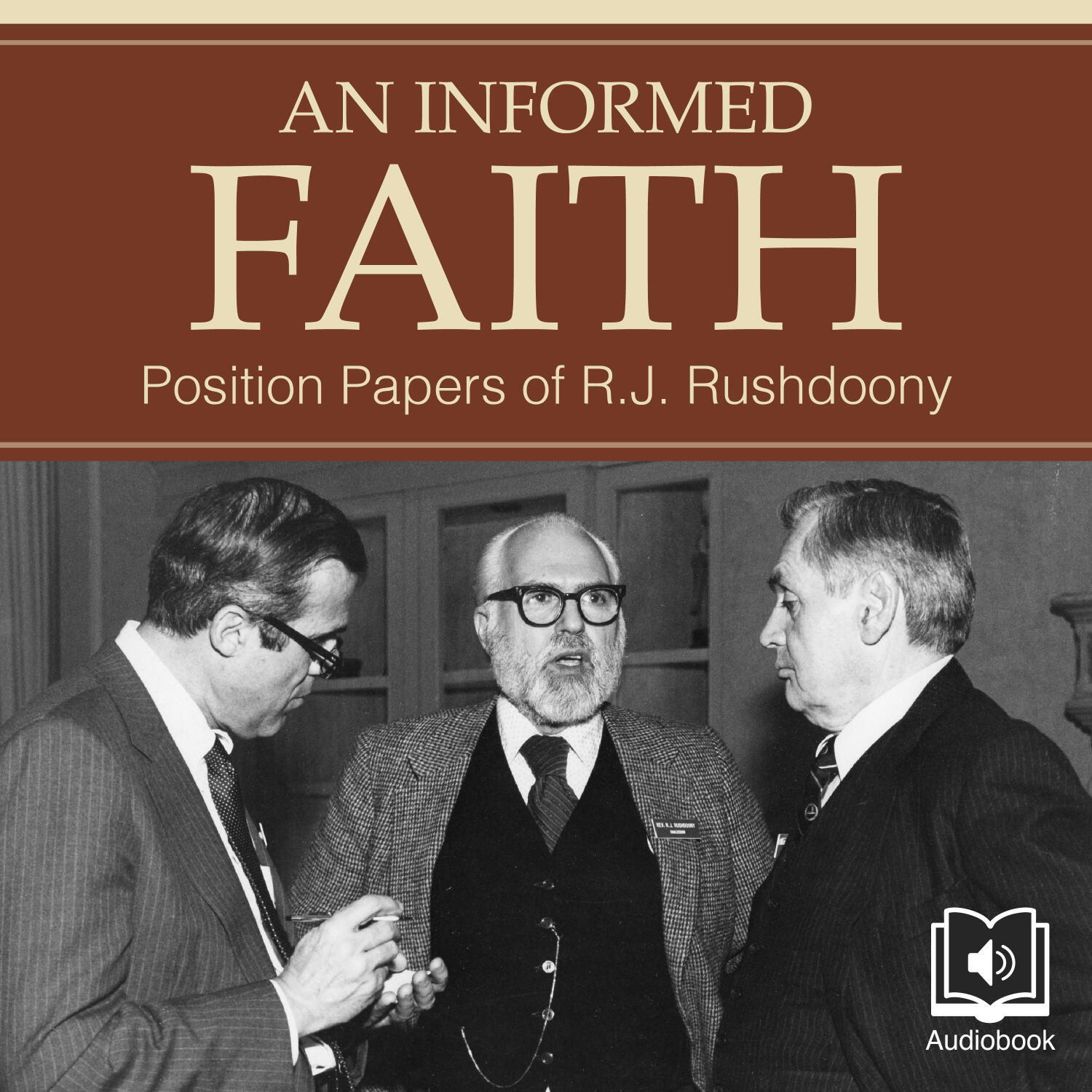
R.J. Rushdoony
An Informed Faith: The Position Papers of R.J. Rushdoony
Our faith should be an informed one because the God who created all things speaks to every sphere of life, and all facts should be studied in light of the revelation of God in Scripture. This is the foundation of Christian dominion. For R. J. Rushdoony, true government was the self-government of the Christian life in terms of God's law, so he wrote his position papers to better equip Christians to apply their faith to all of life. His objective was not to empower the state, or the organized church, but rather to call every person and institution to God's Word, which often put him at odds with...
Be sure to visit the podcast's website and support the creator: cr101radio.com
Where to listen?
Podcasts in the app Replaio Radio Coming soonPodcasts are coming to the app soon. Install now and be the first to see a whole new take on podcasts
 Install for free
Android almost 10M downloads · 4.8 rating
iOS soon
Install for free
Android almost 10M downloads · 4.8 rating
iOS soon
Episodes
Religious Liberty 11.07.2026 16:52
True religious liberty is not a gift of the state but a theological reality grounded in God’s sovereignty. During the Reformation, the relationship between Martin Luther and Frederick the Wise revealed this principle: faith, not political power, was the true source of protection. Liberty was understood as immunity from state control in matters of conscience, worship, speech, and instruction becaus...
Liberty 07.07.2026 6:52
Throughout history, “liberty” has carried radically different meanings. In pagan cultures, liberty meant freedom from restraint especially moral and sexual restraint. It was celebrated in fertility cults, festivals, and carnivals where lawlessness was treated as a virtue and indulgence as a social duty. This idea of liberty was not about justice, responsibility, or human dignity, but about license...
Religious Liberty Versus Religious Toleration 04.07.2026 17:36
Religious liberty recognizes Christ alone as Lord of the church and denies the state any authority to license, regulate, or define faith. Religious toleration, by contrast, makes the state supreme granting permission to religions only so long as they conform to government policy. History shows that toleration leads to control, corruption, and persecution, while liberty produces faithful, free chur...
Rationalism and God 30.06.2026 7:51
Rationalism treats human reason as the judge of reality and therefore reshapes God to fit man’s standards. By ignoring Scripture’s teaching that all people already know God and suppress that truth because of sin (Ps. 14:1; Rom. 1:18–22), rationalism misdefines atheism as an intellectual problem rather than moral rebellion. It assumes reason is autonomous, neutral, and capable of judging God, inste...
Rationalism and God 30.06.2026 7:51
Rationalism treats human reason as the judge of reality and therefore reshapes God to fit man’s standards. By ignoring Scripture’s teaching that all people already know God and suppress that truth because of sin (Ps. 14:1; Rom. 1:18–22), rationalism misdefines atheism as an intellectual problem rather than moral rebellion. It assumes reason is autonomous, neutral, and capable of judging God, inste...
Rationalism and the Chain of Being 27.06.2026 7:57
Rationalism inherits a Greek idea that treats good and evil as metaphysical states on a “chain of being” rather than moral obedience or rebellion against God. This view assumes a continuity of being between God and man, making human reason capable of accessing ultimate truth and reducing sin to a “thinness of being” instead of lawless defiance of God’s law. Biblically, however, God is uncreated an...
Rationalism and Tyranny 23.06.2026 6:29
Rationalism treats reason as ultimate, impersonal, and nonhistorical, reducing God to a logical concept rather than the living Lord who reveals Himself in history. By denying God’s incomprehensibility and replacing revelation with human reason, rationalism elevates intellectual elites as arbiters of truth. Historically, this leads not to freedom but to tyranny, as “philosopher-kings” claim authori...
Rationalism and History 20.06.2026 9:17
Rationalism consistently detaches truth from history, treating abstract ideas and human reasoning as ultimate rather than God’s acts in time. This stands in direct opposition to Christianity, which is grounded in real historical events—the Fall, the Incarnation, and the Atonement. Scripture proclaims that the Word became flesh, a claim Greek and modern philosophy reject because it unites truth wit...
The Bankruptcy of Rationalism 16.06.2026 7:41
Rationalism claims to prove God by human reason, but the “god” it produces is only a product of fallen imagination—acceptable to man but not the living God of Scripture. By ignoring the Fall and its corruption of the human mind, rationalism assumes reason is neutral and pure, when in fact sin has radically warped man’s thinking. Because fallen man resists a God who judges him, he reshapes truth to...
Rationalism and Heresy 13.06.2026 9:15
Rationalism becomes heresy when it places human reason in judgment over God’s revelation. By demanding that Scripture first satisfy the standards of fallen reason, rationalism enthrones man as judge and reduces God to an object needing validation. This repeats the original sin of Genesis 3:5—man seeking to be his own god. Scripture teaches that the Fall corrupted not only man’s will but also his m...
Rationalism and the Mind of Man 09.06.2026 6:12
Rationalism fails because it ignores the Fall. Scripture teaches that man’s original sin was the desire to be his own god, and as a result every part of his being—including his mind—is corrupted by sin. The Bible is explicit: “the carnal mind is enmity against God” (Rom. 8:7). Fallen reason is not neutral, nor capable of judging God rightly, because it refuses to submit to God’s law. Rationalism a...
Descartes and Rationalism 06.06.2026 8:26
Modern rationalism begins with René Descartes, whose famous claim “I think, therefore I am” made human self-consciousness the starting point of reality. Instead of God creating and defining all things, man’s thinking became the judge of what is real. God was reduced to an object that must be validated by human reason, laying the groundwork for the modern idea that God can be “created” or dismissed...
Reason and Rationalism 02.06.2026 7:10
Reason and rationalism are not the same. Reason is the God-given capacity to think, understand, and draw conclusions; rationalism makes human reason the final authority for truth, judging revelation instead of submitting to it. Christianity uses reason after faith—understanding the implications of God’s revealed truth—whereas rationalism demands that revelation first pass the test of human logic....
Invisible Rulers 30.05.2026 13:00
The belief in secret, unseen rulers controlling history is a way of avoiding responsibility. Scripture teaches that all men already know the truth of God but suppress it in unrighteousness (Rom. 1), choosing instead to be their own gods (Gen. 3:5). The real “strings” are pulled from the fallen human heart, not by hidden elites. Modern philosophy—from Kant to Hegel—reinforced this evasion by teachi...
The Hegelian Revolution 26.05.2026 14:34
The Hegelian revolution completed a long philosophical shift that began with Descartes: reality and truth were relocated from God and creation to the human mind. For Hegel, reason itself became sovereign, and what the rational elite declared to be true became reality. God was effectively replaced by human consciousness, and the state was elevated as the incarnation of reason on earth. This worldvi...
The Myth of Nature 23.05.2026 9:39
The myth of nature treats the created world as a moral authority—something inherently good, normative, and self-justifying. While nature is real, the myth arises when people read into it laws, meanings, and moral standards that belong only to God. From ancient Greek philosophy to the Enlightenment and Romanticism, “nature” was increasingly viewed as a guiding force rather than a fallen creation. T...
Titanism 16.05.2026 14:33
Titanism is the glorification of human effort that seeks to do the impossible, often disguising pride as virtue. Rooted in Greek mythology and revived by Romanticism, it celebrates defying limits, fate, and even God, treating failure itself as proof of greatness. Within the church, Titanism appears when believers ignore God’s clear commands about limits, stewardship of time, and fruitfulness. Scri...
Monergism and Synergism 12.05.2026 7:10
The debate over monergism vs. synergism concerns who is decisive in salvation. Monergism teaches that salvation is entirely the work of God’s sovereign grace from beginning to end; man contributes nothing but receives grace. Synergism teaches that God and man cooperate, making man’s decision the decisive factor in salvation. In practice, synergism shifts sovereignty from God to man. If man’s will...
Catharsis 09.05.2026 11:40
Catharsis is the belief that health—personal or social—comes through the uninhibited expression of inner impulses. Originating in Greek tragedy, it was later moralized by Christians but eventually reverted to its pagan meaning: purging through violence, sexuality, or emotional release rather than moral restoration. In modern times, catharsis has justified revolutionary violence, sexual permissiven...
The Mystery Religions 09.05.2026 7:49
Claims that Christianity borrowed from ancient mystery religions rest on superficial similarities and miss the real contrast. The mysteries offered secret rites, mystical experiences, spiritual escape, and vague hopes of immortality, with little concern for history, morality, or transforming society. Christianity, by contrast, proclaimed a public, historical faith grounded in God’s revealed Word,...
Kenoticism: the “Gospel” of Defeat 05.05.2026 18:16
Kenoticism turns Christianity into a religion of surrender, teaching that holiness means self-abasement, passivity, and acceptance of defeat. Borrowed largely from Eastern religions and filtered into the West through Pietism, Quietism, and modernism, it redefines virtue as submission to evil rather than obedience to God. By emptying Christ of power, kenoticism also empties the church of courage, r...
Kenosis: The-Great Modern Heresy 02.05.2026 18:56
Kenosis falsely teaches that Christ emptied Himself of divine power and that true Christianity means self-abasement, passivity, and surrender to evil. Over time, it turned humility into victimhood, portraying holiness as nonresistance, poverty, and submission rather than faithful obedience and righteous action. This doctrine has produced a suicidal faith—undermining justice, excusing sin, weakenin...
The Heresy of Theosis 28.04.2026 11:28
Theosis teaches that salvation is deification—that man becomes god. Rooted in Greek and Neoplatonic thought rather than Scripture, it blurs the Creator–creature distinction and drifts toward pantheism. Salvation is redefined as mystical union instead of deliverance from sin by God’s sovereign grace. By exalting man and diminishing Christ’s lordship, theosis replaces the biblical gospel with spirit...
The Great Fear and the Great Faith 25.04.2026 20:02
The Great Fear marks the collapse of societies when faith dies. As seen in the French Revolution and repeated throughout history, fear begins in the human conscience before it erupts socially. When people abandon God, meaning dissolves, reason falters, and irrational terror takes hold. Men believe anything because they believe nothing, and chaos follows. The only true antidote is the Great Faith—n...
Quietism 21.04.2026 9:45
Quietism turned Christianity into passive inward spirituality, separating heart from mind and prayer from action. It treated engagement with doctrine, law, and society as unspiritual, redefining holiness as withdrawal from the world. By minimizing moral struggle, Biblical law, and Christ’s lordship over history, Quietism replaced obedience with spiritual quietude. The result was an irrelevant fait...
Similar podcasts







Listen to the An Informed Faith: The Position Papers of R.J. Rushdoony podcast in Replaio
Radio and podcasts in one app - free, with no sign-up. Install today and do not miss the launch
Replaio is not a podcast publisher; show names, artwork and audio belong to their authors and are distributed through public RSS feeds.