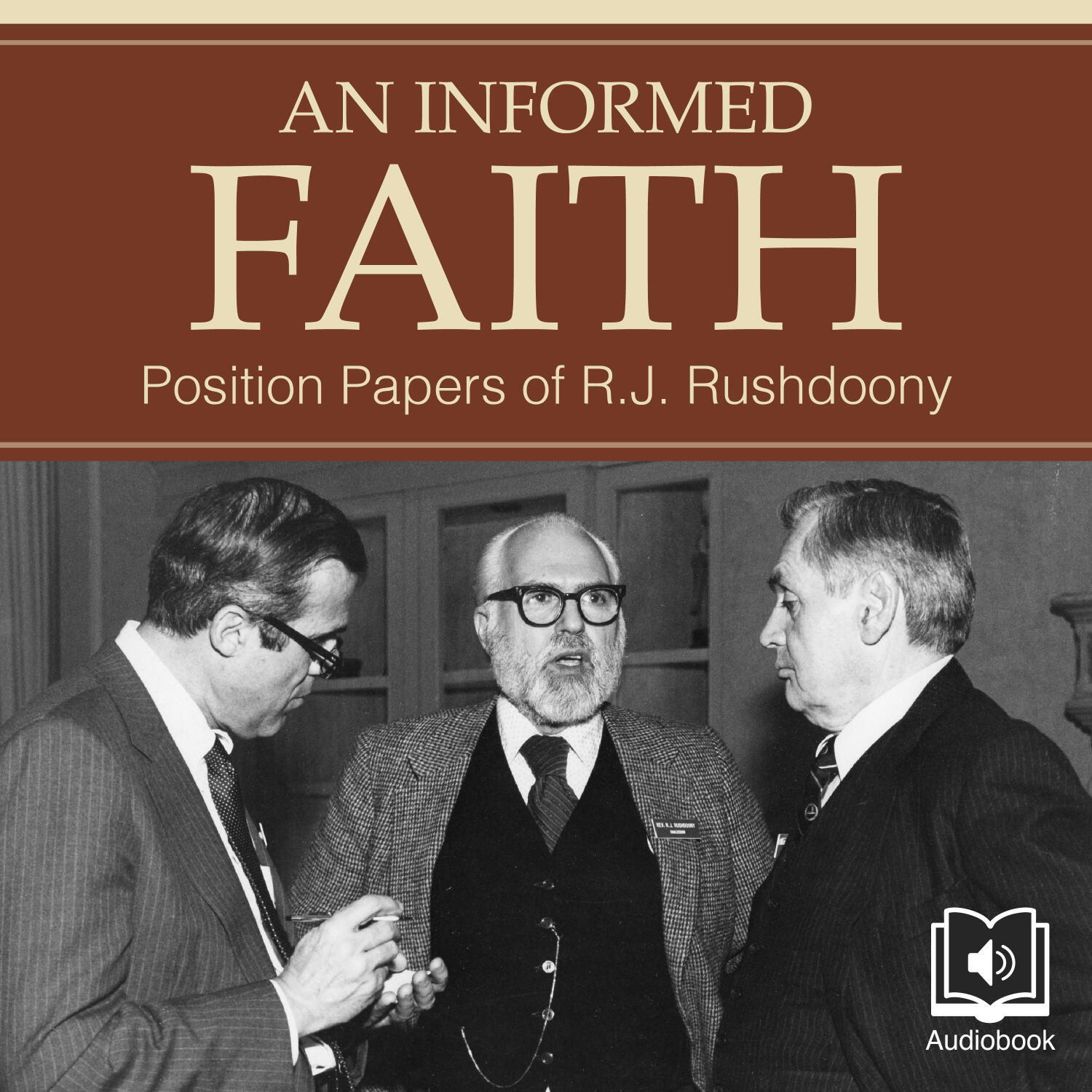
R.J. Rushdoony
An Informed Faith: The Position Papers of R.J. Rushdoony
Our faith should be an informed one because the God who created all things speaks to every sphere of life, and all facts should be studied in light of the revelation of God in Scripture. This is the foundation of Christian dominion. For R. J. Rushdoony, true government was the self-government of the Christian life in terms of God's law, so he wrote his position papers to better equip Christians to apply their faith to all of life. His objective was not to empower the state, or the organized church, but rather to call every person and institution to God's Word, which often put him at odds with...
Be sure to visit the podcast's website and support the creator: cr101radio.com
Where to listen?
Podcasts in the app Replaio Radio Coming soonPodcasts are coming to the app soon. Install now and be the first to see a whole new take on podcasts
 Install for free
Android almost 10M downloads · 4.8 rating
iOS soon
Install for free
Android almost 10M downloads · 4.8 rating
iOS soon
Episodes
The Cartesian Heresy 18.04.2026 12:50
Cartesianism makes the human mind the source of truth and reality (“I think, therefore I am”), replacing God’s revealed world with subjective ideas and symbols. In theology, this turns Biblical history into “myth” or “meaning” while denying real events like the incarnation or resurrection. At root, it repeats Genesis 3:5—man deciding reality for himself. Scripture teaches that man’s problem is sin...
Pietism Revisitied 14.04.2026 7:52
Pietism rejected doctrine as “dead” and reduced Christianity to emotion and private experience. Being “born again” was emphasized without Biblical definition, while theology, catechism, and the full counsel of God were sidelined. Faith became feeling rather than truth grounded in God’s Word. The result was a weakened church and a strengthened state. As Christianity turned inward and man-centered,...
Pietism 11.04.2026 11:09
Pietism began as a reaction against cold formalism, but it quickly became a distortion of the Christian faith. By dismissing doctrine, theology, and systematic teaching as “dead knowledge,” Pietism reduced Christianity to emotional experience and private devotion. Being “born again” was emphasized, yet stripped of clear Biblical meaning, while catechism, preaching the whole counsel of God, and int...
The Cathars 07.04.2026 16:23
Catharism was a medieval revival of Manichaean dualism that masqueraded as true Christianity while denying its foundations. By asserting two ultimate powers—a good spiritual god and an evil material god—the Cathars rejected creation, the incarnation, the resurrection of the body, and the Trinity. Christ, for them, was only an appearance, not God made flesh. Salvation was escape from matter, not re...
Pelagianism 04.04.2026 11:15
Pelagianism places man at the center of salvation, treating God’s grace as an aid rather than the decisive cause. By denying original sin and affirming human ability, it recasts conversion as a human choice God merely approves. In doing so, it rejects eternal security, minimizes Christ’s atoning work, and turns salvation into self-improvement rather than resurrection from spiritual death. The cons...
Pelagianism 31.03.2026 8:30
Pelagianism teaches that man is not fallen in his whole being and can choose God by the power of his own will. Sin is minimized, original guilt denied, and salvation becomes a cooperative project between human decision and divine help. Grace, rather than being sovereign and necessary, is treated as optional or proportionate to human effort. The result is a Christianity centered on enthusiasm, deci...
The Implications of Arianism 28.03.2026 13:20
Arianism denied that Jesus Christ is very God of very God, reducing Him to a created being and turning God into an unknowable force. What looked “reasonable” and culturally acceptable in its day had devastating long-term effects: it destroyed certainty in God’s Word, emptied revelation of final authority, and replaced divine truth with human power. When Christ is no longer the full and final revel...
Donatism 24.03.2026 16:30
Donatism arose from a sincere desire for a pure church, but it turned holiness into a test of legitimacy rather than a fruit of grace. By insisting that the validity of sacraments and the church itself depended on the personal purity of ministers, Donatism shifted confidence from Christ to men and institutions. This destroyed assurance, fostered separatism, and replaced faith in God’s sovereign gr...
The Heresy of Modalism 21.03.2026 10:58
Modalism: A Modern Return to an Ancient Error Modalism denies the Trinity by reducing Father, Son, and Spirit to temporary “modes” of a single, unknowable force. It presents God as evolving, changeable, and ultimately beyond clear revelation—making Scripture, theology, and doctrine negotiable rather than authoritative. When God is treated as a shifting life force instead of the unchanging Triune C...
Monarchianism 17.03.2026 6:51
Monarchianism: The Subtle Denial of the Trinity Monarchianism uses orthodox language while quietly emptying it of Trinitarian meaning. God is spoken of as the Father alone, while the Son and the Spirit are reduced to mere modes or manifestations. Jesus becomes a merely “historical” man ethically united to God, not God incarnate—someone to imitate, but not a Savior who redeems. This error drains Ch...
The Manichaean Heresy Today 14.03.2026 16:53
The Manichaean Heresy Today: From Conversion to Destruction Manichaeanism replaces the Bible’s moral conflict (sin vs. obedience) with a false conflict of being—spirit vs. matter, light vs. darkness. When evil is treated as something inherent in people, classes, races, or institutions, the solution is no longer repentance and conversion, but suppression, exclusion, or death. This logic has fueled...
The Carpocratians 10.03.2026 5:55
The Carpocratians: Remaking Jesus to Fit the Age The Carpocratians reshaped Jesus to suit their culture—turning Him into a religious genius, rejecting the Old Testament, denying His uniqueness, and redefining justice as radical equality. By accommodating Christ to contemporary philosophy, they created a fictitious “modern” Jesus whose relevance vanished with the culture that produced Him. This imp...
The Carpocratian Heresy 07.03.2026 10:57
The Carpocratian Heresy: “Spiritual” License to Sin Carpocratianism dressed itself up as Christianity while rejecting God’s law, Scripture’s authority, and Christ’s atonement. Claiming a “higher spirituality,” it taught that faith and love freed people from obedience, turning grace into permission for immorality and elitism. This heresy lives on wherever believers pick and choose God’s Word, spiri...
Marcionism 03.03.2026 16:45
Marcionism: The Gospel Cut in Half Marcionism divides Scripture, rejects God’s law, and pits the Old Testament against the New—turning grace into escapism and faith into retreat from the real world. By denying the unity of God’s revelation, it replaces Christ the King with a “spiritual” Christ who rules nothing. Biblical faith is not separation from creation but redemption of it. Grace restores us...
Easy Chair No. 133, October 30, 1986 28.02.2026 59:37
R.J. Rushdoony recounts his visit to Australia and New Zealand, praising the active Reconstruction movement under Howard Carter and urging prayer and support. He reviews books showing the importance of biblical knowledge, historical awareness, and societal responsibility: Whately’s Historic Doubts critiques rationalistic methods, Gura’s A Glimpse of Zion’s Glory highlights the Puritans’ focus on G...
The Montanist Outlook 28.02.2026 17:26
The Montanist Outlook: Zeal Without Wisdom Montanism began with a desire for spiritual purity and urgency but drifted into error by exalting personal revelation, instant holiness, and end-times obsession over Scripture, discipline, and growth. By dividing believers into “spiritual” and “carnal,” it undermined authority, fostered legalism, and replaced patient sanctification with demands for perfec...
Marcionism 24.02.2026 16:45
Marcionism: The Ancient Error Still with Us Marcionism separates law from grace, the Old Testament from the New, and faith from real life. By rejecting God’s law, creation, and covenant unity, it turns Christianity into escapism—“spiritual” but powerless. This error still weakens the church today whenever Scripture is divided and God’s law is dismissed. Biblical faith is not retreat from the world...
Easy Chair No. 132 September 19 1986 21.02.2026 58:48
In this episode, R.J. Rushdoony and Otto Scott interview Joseph McAuliffe about his Christian faith and business ministry. McAuliffe recounts his conversion in 1971 at Bowling Green State University, his early dispensational training, and eventual realization—through Rushdoony’s Institutes of Biblical Law—that God’s kingdom is relevant to all areas of life, including business. He emphasizes that b...
Docetism and the Mandate for Dominion 21.02.2026 20:26
Docetism and the Mandate for Dominion Docetism denies Christ’s true incarnation and, in doing so, empties Christianity of its power in history. By treating salvation as escape from the material world rather than deliverance from sin, it undermines God’s law, Christ’s kingship, and the biblical call to exercise dominion. The incarnate, crucified, and risen Christ redeems flesh and history, restorin...
Docetism, the Crippling Heresy 17.02.2026 10:43
Docetism: The Crippling Heresy Docetism denies the full humanity of Christ, treating His incarnation as a mere appearance rather than real flesh and blood. Scripture condemns this error plainly: “Jesus Christ is come in the flesh” (2 John 7). By spiritualizing Christ, Docetism also devalues God’s law, history, and the physical world, leading to retreatism and powerlessness in the church. A Christ...
Easy Chair No. 131, September 16, 1986 14.02.2026 1:00:09
In this wide-ranging episode (Sept. 16, 1986), R.J. Rushdoony opens with Tertullian’s striking line—“Your Emperor is more our Emperor than he is yours”—to argue that Christians alone can truly interpret civil power because they know rulers come by God’s providence, whether as judgment or blessing, and this certainty is part of why the early Church outlasted Rome. From there he surveys the spiritua...
Modern Gnosticism 14.02.2026 12:45
Modern Gnosticism Modern Gnosticism repeats an ancient error: it elevates elite “knowledge,” symbolism, and changing ideas above the plain Word of God. It rejects the literal meaning of Scripture, especially Genesis, downplays God’s law, and scorns ordinary believers as naïve, while adapting Christianity to current philosophy, science, and cultural fashion. Whether in theology, art, politics, or e...
Gnosticism 10.02.2026 16:20
Gnosticism Gnosticism teaches that evil lies in the material world and that salvation comes through secret knowledge, not through Christ’s finished work. It rejects the Old Testament, God’s law, and moral responsibility, replacing grace with human insight and autonomy. Though ancient, Gnosticism lives on today—in modern art, philosophy, theology, and ethics—where immediacy replaces mediation, feel...
Easy Chair No. 130, September 9, 1986 07.02.2026 57:18
Rushdoony highlights books connecting history, faith, and society. Ussher’s Annals of the World ties God’s blessings and judgments to Israel’s obedience. Early Christians, per Davies, practiced charity seriously, contrasting Pharisaic legalism. Verzone and Ferrar show the church’s spiritual and cultural significance. Modern works reveal God’s design in the immune system (In Self-Defence), social i...
The Spirit of Heresy 07.02.2026 6:28
Heresy today thrives under the banner of “personal choice.” In the name of peace, churches often silence defenders of orthodoxy while tolerating false teaching. Truth is sacrificed to harmony, and those who insist on Scripture are labeled divisive. Modern culture denies objective truth altogether, treating belief as personal preference rather than submission to God’s revealed Word. This spirit mak...
Similar podcasts






Listen to the An Informed Faith: The Position Papers of R.J. Rushdoony podcast in Replaio
Radio and podcasts in one app - free, with no sign-up. Install today and do not miss the launch
Replaio is not a podcast publisher; show names, artwork and audio belong to their authors and are distributed through public RSS feeds.