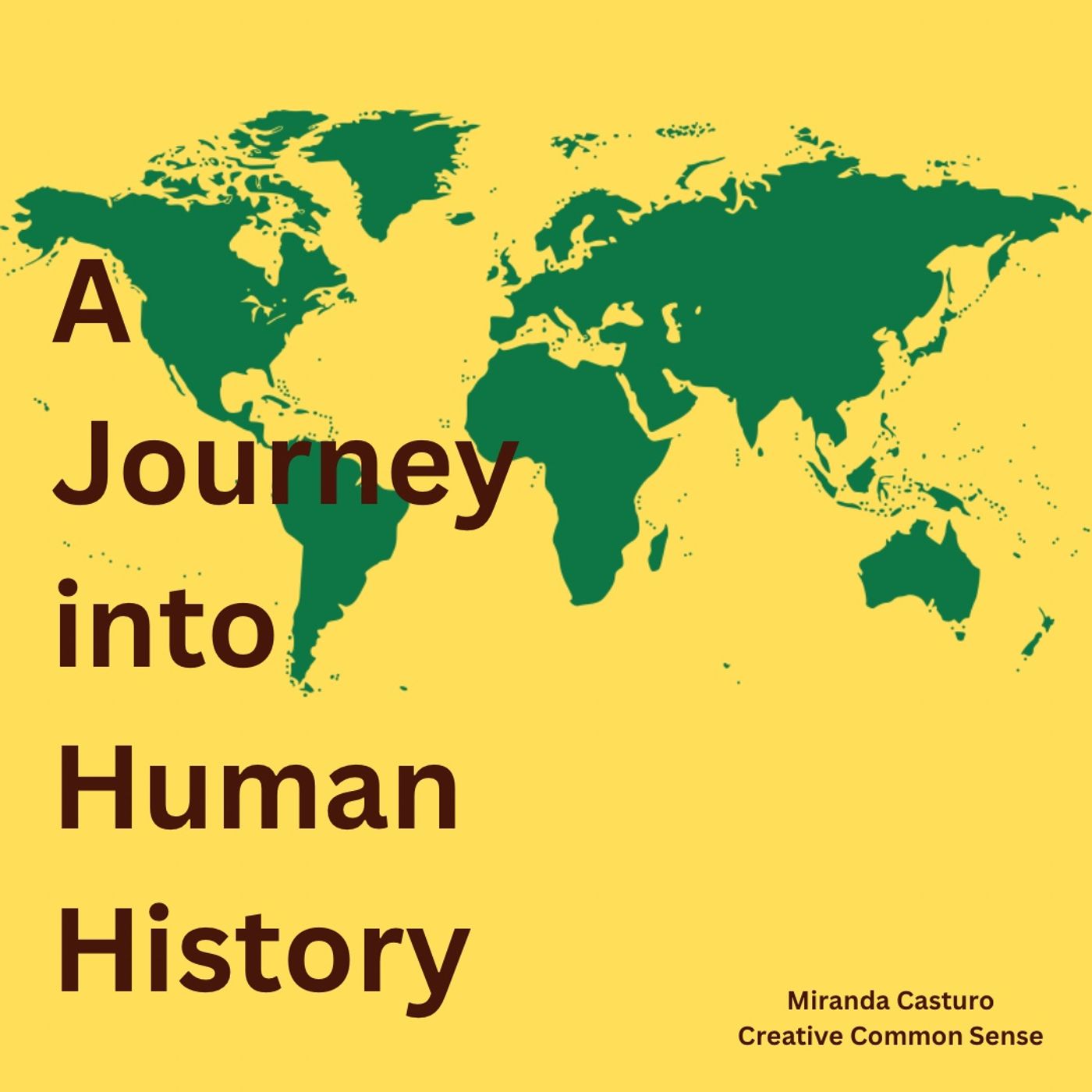
Miranda Casturo
A Journey into Human History
Welcome to a journey into human history. This podcast will attempt to tell the whole human story. You may be asking yourself what is history? Is it simply a record of things people have done? Is it what writer Maya Angelou suggested—a way to meet the pain of the past and overcome it? Or is it, as Winston Churchill said, a chronicle by the victors, an interpretation by those who write it? History is all this and more. Above all else, it is a path to knowing why we are the way we are—all our greatness, all our faults—and therefore a means for us to understand ourselves and change for the better....
Author
Miranda Casturo
Category
Podcast website
Latest episode
Jun 29, 2026
Where to listen?
Podcasts in the app Replaio Radio Coming soonPodcasts are coming to the app soon. Install now and be the first to see a whole new take on podcasts
 Install for free
Android 5M+ downloads · 4.8 rating
iOS soon
Install for free
Android 5M+ downloads · 4.8 rating
iOS soon
Episodes
Religious Upheavals in the Developing Atlantic World 05.01.2026 8:48
The sixteenth century witnessed a new challenge to the powerful Catholic Church. The reformist doctrines of Martin Luther and John Calvin attracted many people dissatisfied with Catholicism, and Protestantism spread across northern Europe, spawning many subgroups with conflicting beliefs. Spain led the charge against Protestantism, leading to decades of undeclared religious wars between Spain and...
Portuguese Exploration and Spanish Conquest 02.01.2026 16:29
Although Portugal opened the door to exploration of the Atlantic World, Spanish explorers quickly made inroads into the Americas. Spurred by Christopher Columbus’s glowing reports of the riches to be found in the New World, throngs of Spanish conquistadors set off to find and conquer new lands. They accomplished this through a combination of military strength and strategic alliances with native pe...
West Africa and the Role of Slavery 31.12.2025 8:38
Before 1492, Africa, like the Americas, had experienced the rise and fall of many cultures, but the continent did not develop a centralized authority structure. African peoples practiced various forms of slavery, all of which differed significantly from the racial slavery that ultimately developed in the New World. After the arrival of Islam and before the Portuguese came to the coast of West Afri...
Europe on the Brink of Change 29.12.2025 16:48
One effect of the Crusades was that a larger portion of western Europe became familiar with the goods of the East. A lively trade subsequently developed along a variety of routes known collectively as the Silk Road to supply the demand for these products. Brigands and greedy middlemen made the trip along this route expensive and dangerous. By 1492, Europe—recovered from the Black Death and in sear...
The Americas 27.12.2025 19:11
The Americas Great civilizations had risen and fallen in the Americas before the arrival of the Europeans. In North America, the complex Pueblo societies including the Mogollon, Hohokam, and Anasazi as well as the city at Cahokia had peaked and were largely memories. The Eastern Woodland peoples were thriving, but they were soon overwhelmed as the number of English, French, and Dutch settlers incr...
Ongoing Problems and Solutions 08.11.2024 30:46
When the Soviet Union collapsed in the early 1990s, it seemed possible to many in the West that the United States would lead the world into a new era of universal liberal democracy. But in 2001, the September 11 attacks by the terrorist group al-Qaeda prompted the United States to begin wars in Afghanistan and then in Iraq. The mistakes made in Iraq damaged the reputation of the United States and...
Science and Technology for Today’s World 06.11.2024 23:38
By the 1990s, computers had become commonplace in developed countries, though fears about their potential impact on privacy grew with the rise of the internet and social media. Easy access to social media over smartphones helped young protestors in Tunisia and Egypt organize to challenge their governments. The movement spread across the Middle East in the form of the Arab Spring. Some nations such...
Debates about the Environment 04.11.2024 17:47
In the 1950s and 1960s, some in developed countries began responding openly to the environmental problems they saw around them, including those caused by the Green Revolution. Scientists like Rachel Carson, author of Silent Spring, gave legitimacy to these concerns, and many people became environmental activists working to promote change. They and the environmental groups they created spoke of the...
A Global Economy 01.11.2024 38:33
In the aftermath of World War II, countries began to open trade and communications around the world. In Europe, the EEC or Common Market eventually grew into the EU. In Asia, countries worked together to create their own trading blocs like ASEAN and APEC. Canada, Mexico, and the United States signed the NAFTA treaty, later replaced by USMCA. All these trading blocs and organizations have made it e...
A New World Order 30.10.2024 18:02
In the 1980s, communism began to loosen its grip on parts of the world in which it had once been dominant. The Soviet Union found itself divided by the need to provide for its citizens at home, maintain control over its satellite states in Eastern Europe, fight a war in Afghanistan, and respond to the buildup of nuclear and conventional weapons that took place during the administrations of U.S. pr...
Global Tensions and Decolonization 28.10.2024 43:35
The Cold War was marked by global tensions. In Europe in the 1950s and 1960s, Soviet satellite states in the Eastern Bloc tested Moscow’s resolve to maintain control as their citizens pushed for greater freedoms and an end to Soviet domination. Rebellions in Poland, Hungary, and Czechoslovakia were quickly crushed by the USSR. The United States attempted to stem the tide of communist expansion in...
The Non-Aligned Movement 25.10.2024 23:22
Not all nations chose to align themselves with the United States or the Soviet Union during the Cold War. In Europe, Yugoslavia chose to remain outside the Soviet orbit even though it was a communist country. Many former European colonies became members of the Non-Aligned Movement, which sought to find a path to development that did not require becoming a satellite of either of the superpowers. Am...
The Spread of Communism 23.10.2024 27:26
In 1949, the Chinese Communist Party (CCP) led by Mao Zedong defeated the Guomindang (GMD, the Nationalists) led by Chiang Kai-shek (Jiang Jieshi) and founded the People’s Republic of China, which the United States refused to recognize. Communism spread elsewhere in Asia as well. In 1950, the communist leader of North Korea invaded South Korea and called on the Chinese to help him defeat South Kor...
The Cold War Begins 21.10.2024 21:56
Following World War II, the two remaining superpowers—the United States and the Soviet Union—entered the Cold War, an ideological contest in which each side competed for supremacy through the use of economic aid, military assistance, technology, and propaganda. U.S. foreign policy was focused on containment, preventing the influence of the Soviet Union and the ideology of communism from spreading...
Out of the Ashes 18.10.2024 25:24
Even before the end of the war, the Allied powers were confident that victory would come. In a series of meetings, Allied leaders arranged the postwar world they envisioned, including by deciding how Germany would be divided. In the Pacific theater of war, the showdown between the United States and Japan concluded with the dropping of the first nuclear bombs, first at Hiroshima and then at Nagasak...
Keeping the Home Fires Burning 16.10.2024 25:41
The war had massive effects for those on the home front, whose lives changed drastically as rationing and shortages became commonplace. Many nations had to mobilize their efforts to keep industry running and materials reaching the troops on the front lines, which brought women into offices and factories in new numbers. The focus on science and technology brought innovations such as radar, early co...
Theaters of War 14.10.2024 24:46
The United States and Great Britain engaged Hitler in actions in North Africa throughout 1942. The Allied successes there and in Italy helped destabilize Mussolini’s fascist government in Rome, and he was removed from power in 1943. On the eastern front, the Soviet Union fought protracted battles against the Nazis, with significant losses of civilian and military lives. The United States c...
An Unstable Peace 11.10.2024 36:41
As the 1930s unfolded, it became clear that peace would not last for long. Japan’s advances through China and its violent attack on Nanjing showed that its military-dominated government would continue to press aggressively for more territory. The rise of fascism in Italy and Germany continued unchecked. The Nazis were able to manipulate the situation to their diplomatic advantage and gai...
Resistance, Civil Rights, and Democracy 09.10.2024 27:49
The years following World War I left many democratic yearnings unfulfilled around the globe. African Americans in the United States were able to seize new job opportunities and greater mobility, but they still faced marked racism and limitations. Efforts toward self-rule in Ireland made substantial progress but were also tainted by violence. The promise of greater democracy in China was subsumed b...
Old Empires and New Colonies 07.10.2024 15:44
The Treaty of Versailles created new countries and new governments and encouraged many groups’ desire for independence. However, independence did not come without struggle. European powers hoped to retain their hold over resource-rich regions around the world through the colonial or mandate system. Still, many Jewish people celebrated the promise of a Jewish homeland, while rising nationalism in A...
The Great Depression 04.10.2024 24:02
The Great Depression of the 1930s was an economic downturn unparalleled in modern history. The interconnectedness of the world’s economies became clear as countries around the globe suffered the effects. While no single event caused the Great Depression, few people were left unscathed. Nations tried innovative ways to provide for their people, enacting work-relief programs, food programs, and new...
The Formation of the Soviet Union 02.10.2024 15:44
The Bolsheviks’ effort to wrest control of Russia did not go unchallenged, as evidenced by the civil war that unfolded after World War I. Though ultimately successful in consolidating power, throughout the 1920s the Bolsheviks continued to disagree among themselves about the proper application of communist principles. The power vacuum left after Vladimir Lenin’s death allowed Joseph Stalin to emer...
Recovering from World War I 30.09.2024 26:32
A period of significant change followed World War I. The 1919 Treaty of Versailles fully blamed Germany for the war and sought to punish it by assessing reparations of more than $33 billion and physically shrinking the country. New countries emerged through the redrawing of Europe’s maps. Massive physical rebuilding was necessary in former combat areas in Europe, while the United States emerged as...
The War Ends 27.09.2024 15:13
In 1905, the Russian people rose in rebellion after the government’s killing of peaceful protesters. Tsar Nicholas II allowed the creation of a legislature called the Duma, but he was still not ready to share power with the people. The tsarist government was unable to mount a successful war effort, however, and the tsar was forced to abdicate in 1917. The Bolshevik Revolution led by Vladimir Lenin...
War on the Homefront 25.09.2024 18:45
The war was so all-encompassing that governments had to find new ways to manage the supplies and support for the war, usually by taking tighter control of industrial output through new legislation. Women entered new types of work such as munitions manufacture to fill the gaps left by male workers now fighting in the military. Those on the home front found themselves confronting food shortages and...
Similar podcasts




Listen to the A Journey into Human History podcast in Replaio
Radio and podcasts in one app - free, with no sign-up. Install today and do not miss the launch
Replaio is not a podcast publisher; show names, artwork and audio belong to their authors and are distributed through public RSS feeds.