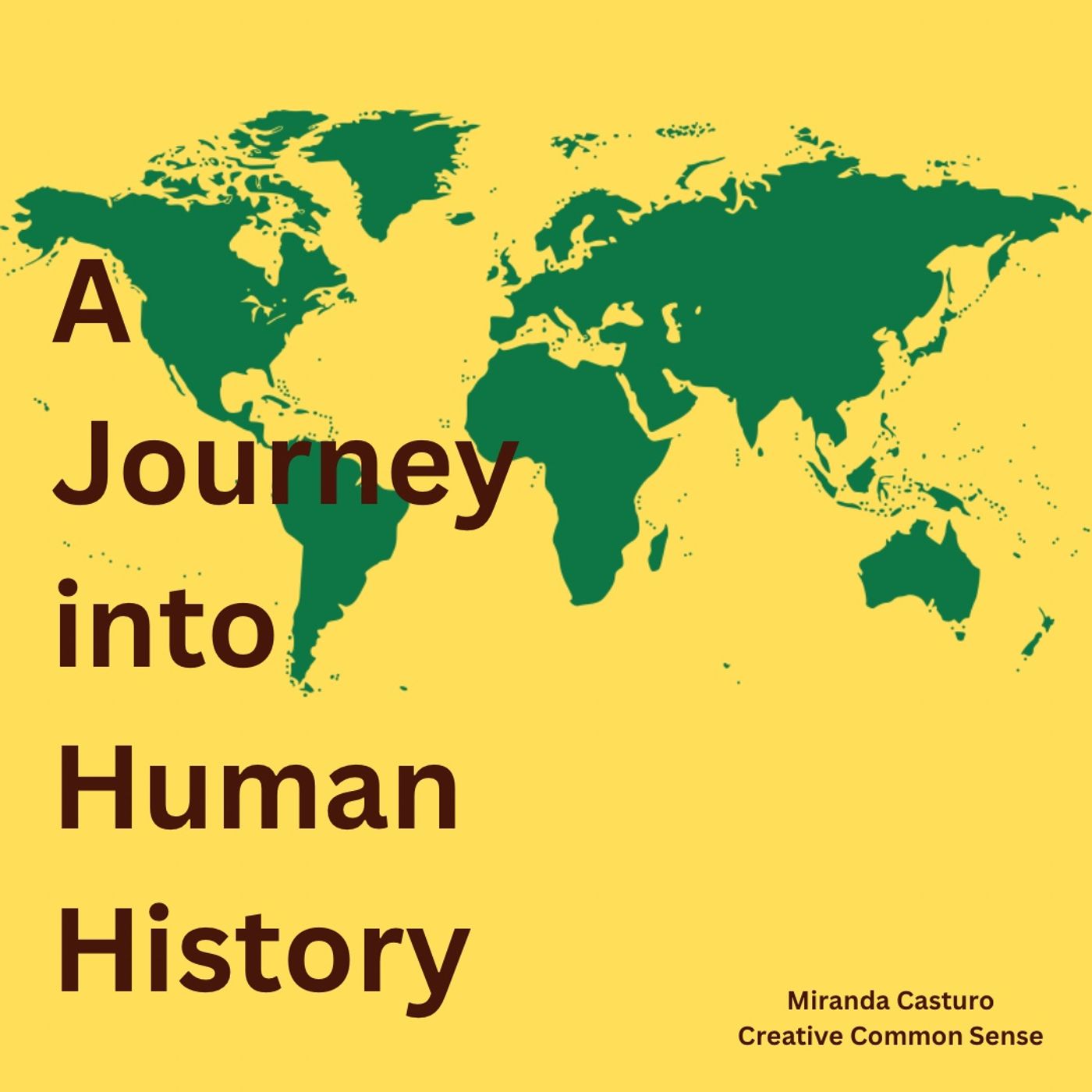
Miranda Casturo
A Journey into Human History
Welcome to a journey into human history. This podcast will attempt to tell the whole human story. You may be asking yourself what is history? Is it simply a record of things people have done? Is it what writer Maya Angelou suggested—a way to meet the pain of the past and overcome it? Or is it, as Winston Churchill said, a chronicle by the victors, an interpretation by those who write it? History is all this and more. Above all else, it is a path to knowing why we are the way we are—all our greatness, all our faults—and therefore a means for us to understand ourselves and change for the better....
Author
Miranda Casturo
Category
Podcast website
Latest episode
Jun 29, 2026
Where to listen?
Podcasts in the app Replaio Radio Coming soonPodcasts are coming to the app soon. Install now and be the first to see a whole new take on podcasts
 Install for free
Android 5M+ downloads · 4.8 rating
iOS soon
Install for free
Android 5M+ downloads · 4.8 rating
iOS soon
Episodes
Competing Visions: Federalists and Democratic-Republicans 04.03.2026 18:43
While they did not yet constitute distinct political parties, Federalists and Anti-Federalists, shortly after the Revolution, found themselves at odds over the Constitution and the power that it concentrated in the federal government. While many of the Anti-Federalists’ fears were assuaged by the adoption of the Bill of Rights in 1791, the early 1790s nevertheless witnessed the rise of two politic...
The Constitutional Convention and Federal Constitution 02.03.2026 14:47
The economic crisis of the 1780s, shortcomings of the Articles of Confederation, and outbreak of Shays’ Rebellion spurred delegates from twelve of the thirteen states to gather for the Constitutional Convention of 1787. Although the stated purpose of the convention was to modify the Articles of Confederation, their mission shifted to the building of a new, strong federal government. Federalists li...
Debating Democracy 27.02.2026 17:48
The late 1770s and 1780s witnessed one of the most creative political eras as each state drafted its own constitution. The Articles of Confederation, a weak national league among the states, reflected the dominant view that power should be located in the states and not in a national government. However, neither the state governments nor the Confederation government could solve the enormous economi...
How Much Revolutionary Change? 25.02.2026 16:49
After the Revolution, the balance of power between women and men and between White, Black, and Native American people remained largely unchanged. Yet revolutionary principles, including the call for universal equality in the Declaration of Independence, inspired and emboldened many. Abigail Adams and others pressed for greater rights for women, while the Pennsylvania Abolition Society and New York...
Common Sense: From Monarchy to an American Republic 23.02.2026 6:39
The guiding principle of republicanism was that the people themselves would appoint or select the leaders who would represent them. The debate over how much democracy (majority rule) to incorporate in the governing of the new United States raised questions about who was best qualified to participate in government and have the right to vote. Revolutionary leaders argued that property holders had th...
Identity during the American Revolution 20.02.2026 9:55
The American Revolution divided the colonists as much as it united them, with Loyalists (or Tories) joining the British forces against the Patriots (or revolutionaries). Both sides included a broad cross-section of the population. However, Great Britain was able to convince many to join its forces by promising them freedom, something the southern revolutionaries would not agree to do. The war prov...
War in the South 18.02.2026 7:34
The British gained momentum in the war when they turned their military efforts against the southern colonies. They scored repeated victories in the coastal towns, where they found legions of supporters, including people escaping bondage. As in other colonies, however, control of major seaports did not mean the British could control the interior. Fighting in the southern colonies devolved into a me...
The Early Years of the Revolution 16.02.2026 10:30
The British successfully implemented the first part of their strategy to isolate New England when they took New York City in the fall of 1776. For the next seven years, they used New York as a base of operations, expanding their control to Philadelphia in the winter of 1777. After suffering through a terrible winter in 1777–1778 in Valley Forge, Pennsylvania, American forces were revived with help...
Britain’s Law-and-Order Strategy and Its Consequences 13.02.2026 15:03
Until Parliament passed the Coercive Acts in 1774, most colonists still thought of themselves as proud subjects of the strong British Empire. However, the Coercive (or Intolerable) Acts, which Parliament enacted to punish Massachusetts for failing to pay for the destruction of the tea, convinced many colonists that Great Britain was indeed threatening to stifle their liberty. In Massachusetts and...
Disaffection: The First Continental Congress and American Identity 11.02.2026 6:25
The First Continental Congress, which comprised elected representatives from twelve of the thirteen American colonies, represented a direct challenge to British authority. In its Declaration and Resolves, colonists demanded the repeal of all repressive acts passed since 1773. The delegates also recommended that the colonies raise militias, lest the British respond to the Congress’s proposed boycot...
The Destruction of the Tea and the Coercive Acts 09.02.2026 10:20
The colonial rejection of the Tea Act, especially the destruction of the tea in Boston Harbor, recast the decade-long argument between British colonists and the home government as an intolerable conspiracy against liberty and an excessive overreach of parliamentary power. The Coercive Acts were punitive in nature, awakening the worst fears of otherwise loyal members of the British Empire in Americ...
The Townshend Acts and Colonial Protest 06.02.2026 14:23
Like the Stamp Act in 1765, the Townshend Acts led many colonists to work together against what they perceived to be an unconstitutional measure, generating the second major crisis in British Colonial America. The experience of resisting the Townshend Acts provided another shared experience among colonists from diverse regions and backgrounds, while the partial repeal convinced many that liberty h...
The Stamp Act and the Sons and Daughters of Liberty 04.02.2026 12:04
Though Parliament designed the 1765 Stamp Act to deal with the financial crisis in the Empire, it had unintended consequences. Outrage over the act created a degree of unity among otherwise unconnected American colonists, giving them a chance to act together both politically and socially. The crisis of the Stamp Act allowed colonists to loudly proclaim their identity as defenders of British libert...
Confronting the National Debt: The Aftermath of the French and Indian War 02.02.2026 14:20
The British Empire had gained supremacy in North America with its victory over the French in 1763. Almost all of the North American territory east of the Mississippi fell under Great Britain’s control, and British leaders took this opportunity to try to create a more coherent and unified empire after decades of lax oversight. Victory over the French had proved very costly, and the British governme...
Wars for Empire 30.01.2026 9:24
From 1688 to 1763, Great Britain engaged in almost continuous power struggles with France and Spain. Most of these conflicts originated in Europe, but their engagements spilled over into the colonies. For almost eighty years, Great Britain and France fought for control of eastern North America. During most of that time, neither force was able to win a decisive victory, though each side saw occasio...
Great Awakening and Enlightenment 28.01.2026 11:20
The eighteenth century saw a host of social, religious, and intellectual changes across the British Empire. While the Great Awakening emphasized vigorously emotional religiosity, the Enlightenment promoted the power of reason and scientific observation. Both movements had lasting impacts on the colonies. The beliefs of the New Lights of the First Great Awakening competed with the religions of the...
An Empire of Slavery and the Consumer Revolution 26.01.2026 10:06
The seventeenth and eighteenth centuries saw the expansion of slavery in the American colonies from South Carolina to Boston. The institution of slavery created a false sense of superiority in White people, while simultaneously fueling fears of slave revolt. White response to such revolts, or even the threat of them, led to gross overreactions and further constraints on enslaved people’s activitie...
The Glorious Revolution and the English Empire 23.01.2026 6:55
The threat of a Catholic absolute monarchy prompted not only the overthrow of James II but also the adoption of laws and policies that changed English government. The Glorious Revolution restored a Protestant monarchy and at the same time limited its power by means of the 1689 Bill of Rights. Those who lived through the events preserved the memory of the Glorious Revolution and the defense of libe...
Charles II and the Restoration Colonies 21.01.2026 17:32
After the English Civil War and interregnum, England began to fashion a stronger and larger empire in North America. In addition to wresting control of New York and New Jersey from the Dutch, Charles II established the Carolinas and Pennsylvania as proprietary colonies. Each of these colonies added immensely to the Empire, supplying goods not produced in England, such as rice and indigo. The Resto...
The Impact of Colonization 19.01.2026 11:58
The development of the Atlantic slave trade forever changed the course of European settlement in the Americas. Other transatlantic travelers, including diseases, goods, plants, animals, and even ideas like the concept of private land ownership, further influenced life in America during the sixteenth and seventeenth centuries. The exchange of pelts for European goods including copper kettles, knive...
English Settlements in America 16.01.2026 30:55
The English came late to colonization of the Americas, establishing stable settlements in the 1600s after several unsuccessful attempts in the 1500s. After Roanoke Colony failed in 1587, the English found more success with the founding of Jamestown in 1607 and Plymouth in 1620. The two colonies were very different in origin. The Virginia Company of London founded Jamestown with the express purpose...
Colonial Rivalries: Dutch and French Colonial Ambitions 14.01.2026 7:42
The French and Dutch established colonies in the northeastern part of North America: the Dutch in present-day New York, and the French in present-day Canada. Both colonies were primarily trading posts for furs. While they failed to attract many colonists from their respective home countries, these outposts nonetheless intensified imperial rivalries in North America. Both the Dutch and the French r...
Spanish Exploration and Colonial Society 12.01.2026 7:23
In their outposts at St. Augustine and Santa Fe, the Spanish never found the fabled mountains of gold they sought. They did find many native people to convert to Catholicism, but their zeal nearly cost them the colony of Santa Fe, which they lost for twelve years after the Pueblo Revolt. In truth, the grand dreams of wealth, conversion, and a social order based on Spanish control never came to pas...
New Worlds in the Americas: Labor, Commerce, and the Columbian Exchange 09.01.2026 14:05
In the minds of European rulers, colonies existed to create wealth for imperial powers. Guided by mercantilist ideas, European rulers and investors hoped to enrich their own nations and themselves, in order to gain the greatest share of what was believed to be a limited amount of wealth. In their own individual quest for riches and preeminence, European colonizers who traveled to the Americas blaz...
Challenges to Spain’s Supremacy 07.01.2026 14:17
By the beginning of the seventeenth century, Spain’s rivals—England, France, and the Dutch Republic—had each established an Atlantic presence, with greater or lesser success, in the race for imperial power. None of the new colonies, all in the eastern part of North America, could match the Spanish possessions for gold and silver resources. Nonetheless, their presence in the New World helped these...
Similar podcasts







Listen to the A Journey into Human History podcast in Replaio
Radio and podcasts in one app - free, with no sign-up. Install today and do not miss the launch
Replaio is not a podcast publisher; show names, artwork and audio belong to their authors and are distributed through public RSS feeds.