Miranda Casturo
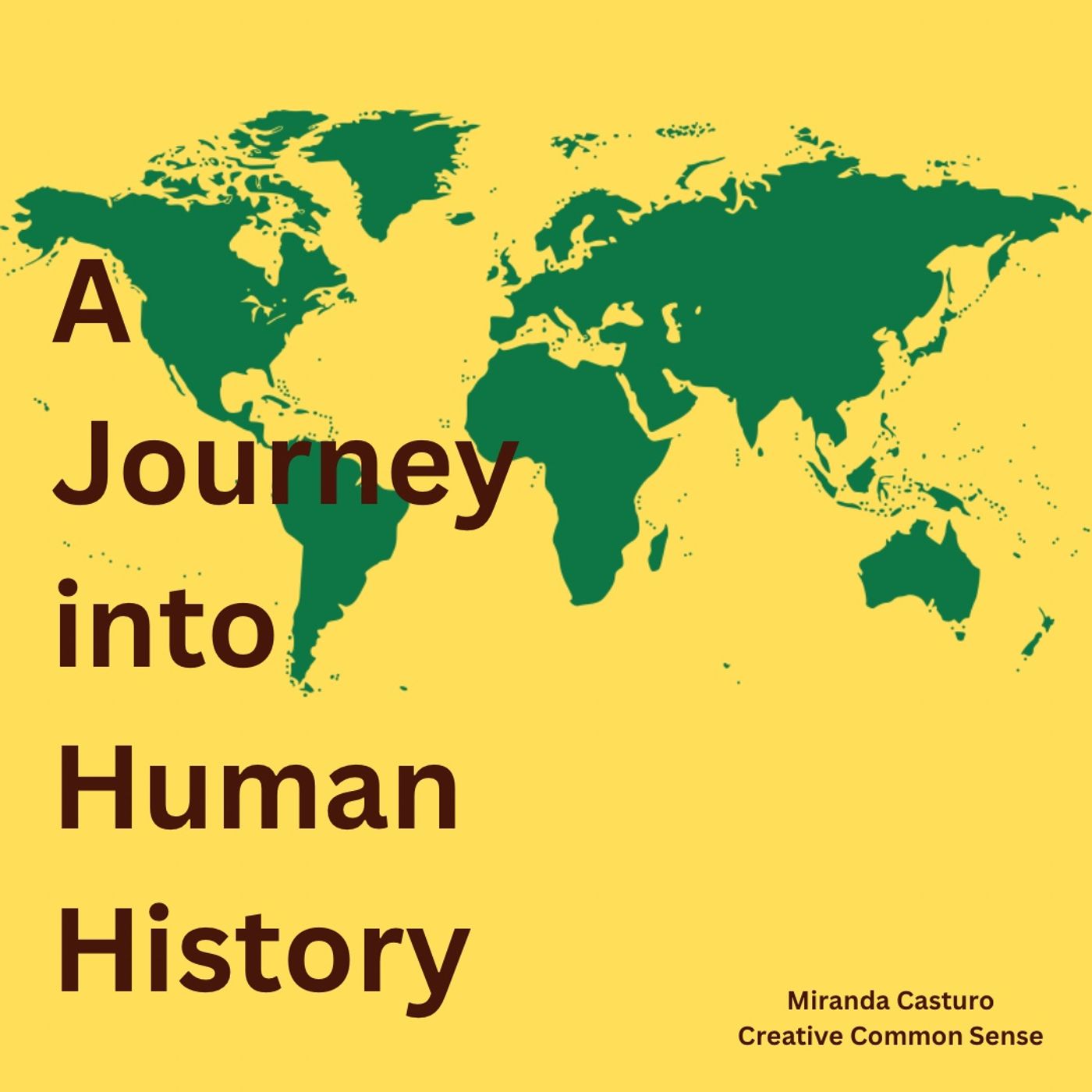
A Journey into Human History
Welcome to a journey into human history. This podcast will attempt to tell the whole human story. You may be asking yourself what is history? Is it simply a record of things people have done? Is it what writer Maya Angelou suggested—a way to meet the pain of the past and overcome it? Or is it, as Winston Churchill said, a chronicle by the victors, an interpretation by those who write it? History is all this and more. Above all else, it is a path to knowing why we are the way we are—all our greatness, all our faults—and therefore a means for us to understand ourselves and change for the better....
Author
Miranda Casturo
Category
Podcast website
Latest episode
Jun 29, 2026
Where to listen?
Podcasts in the app Replaio Radio Coming soonPodcasts are coming to the app soon. Install now and be the first to see a whole new take on podcasts
 Install for free
Android 5M+ downloads · 4.8 rating
iOS soon
Install for free
Android 5M+ downloads · 4.8 rating
iOS soon
Episodes
Total War 23.09.2024 32:03
World War I introduced many new technologies seen in warfare today—tanks, machine guns, long-range artillery, and airplanes. Most troops found themselves under constant threat of bombardment, injury, and death, and the casualties and destruction of total war were enormous. The large empires fighting in the conflict brought troops from their colonies and dominions to fight. Fighting also took place...
The Collapse of the Ottomans and the Coming of War 20.09.2024 24:53
The Ottoman Empire was disintegrating due to military losses prior to the war and the push for nationalism within its borders. The same drive toward nationalism occurred in Austria-Hungary. People of different nationalities wanted to live in their own independent nations rather than being forced into an empire that did not serve their needs. When Archduke Franz Ferdinand was assassinated by a Bosn...
Alliances, Expansion, and Conflict 18.09.2024 15:17
At the beginning of the twentieth century, Europe was controlled by a series of alliances that served to check any one power from becoming too large. These alliances had worked for a number of decades, and there had been little in the way of warfare on the continent. However, competition existed among the powers, especially in colonial development. In particular, Germany’s desire to have more colo...
Regulation, Reform, and Revolutionary Ideologies 16.09.2024 19:28
Attempts to solve the problems caused by industrialization and urbanization took a variety of forms. Some governments passed laws to abolish child labor, provide insurance for workers, ensure safe housing, prevent air and water pollution, and regulate prostitution. Middle-class reformers sought to improve society by altering personal behavior. They stressed the importance of morality and often att...
Communities in Diaspora 13.09.2024 11:25
Witnessed in the second half of the nineteenth century was the migration of large numbers of people fleeing poverty, violence, and natural disaster. Europeans emigrated to North and South America, Australia, New Zealand, and South Africa. Asians traveled to western Europe, the Americas, and Africa. Immigrants performed largely low-paid, physically demanding work on plantations and railroads and in...
Coerced and Semicoerced Labor 11.09.2024 11:17
Although working-class people in industrialized nations had limited choices about the place and terms of their employment, many other workers did not have even this small degree of freedom. Slavery continued into the second half of the nineteenth century in the United States and Brazil, as did serfdom in Russia. In other forms of unfree labor, contract laborers and indentured servants performed ag...
Life in the Industrial City 09.09.2024 26:46
By the end of the nineteenth century, cities in industrialized nations were filled with people in search of work. These cities offered many benefits. For those who preferred high culture, plays, concerts, operas, and ballets were regularly staged. Music halls, arcades, and burlesque shows catered to the popular taste, as did amusement parks. Libraries and parks were open to everyone. Department st...
Inventions, Innovations, and Mechanization 06.09.2024 29:36
During the Second Industrial Revolution, life in industrialized nations changed dramatically. The electrified, mechanized workplace meant long hours and low wages for unskilled factory workers. Work was often dangerous and unemployment precarious. Nevertheless, industrialization did bring benefits. Mass-produced consumer goods were priced so that by the end of the nineteenth century, members of th...
Exploitation and Resistance 04.09.2024 14:51
Colonization had a devastating effect on residents of African, Asian, and Pacific lands seized by imperial powers. People were exploited for their labor, made to grow cash crops, collect rubber and ivory, and transport European goods through difficult terrain. They received low wages if any, and failure to meet quotas was met with harsh punishment. Colonizers brought infectious diseases with them,...
Motives and Means of Imperialism 30.08.2024 14:47
The desire of industrialized nations for inexpensive raw materials led them to Africa, Asia, and the Pacific, where they took control of lands and established colonies that existed solely to provide resources, markets, and harbors for fleets of commercial steamships. Many tried to justify their overseas empires by claiming they benefited the people in conquered lands, despite clear evidence that h...
The Second Industrial Revolution 28.08.2024 41:36
In the second half of the nineteenth century, the world’s industrialized nations—Britain, France, Belgium, Germany, and the United States—entered the Second Industrial Revolution. They manufactured machines as well as other items to be used for industry, such as steel, rubber, and chemicals. The Second Industrial Revolution was indebted to new sources of power such as electricity and the internal...
Portuguese South America 26.08.2024 15:08
In 1807, when French forces attempted to invade Portugal, the Portuguese royal family and their court fled to Brazil. João VI, the former prince regent, ruled from Rio de Janeiro as head of the government in exile. In 1821, he returned to Portugal, leaving his son Pedro I to rule Brazil. When the Portuguese Cortes ordered Pedro I to return to Europe, he refused, and on September 7, 1822, he declar...
Spanish South America 23.08.2024 24:16
Venezuela’s junta declared its independence from Spain in 1811. In 1812, however, resistant conservative White Venezuelans were aided by mixed-race people who resented liberal creole privileges and remained loyal to the Spanish Crown. Following Fernando VII’s return to the Spanish throne, Spanish troops joined local royalist forces to fight the Venezuelan patriots being led by Simón Bolívar. By pr...
Spanish North America 21.08.2024 14:08
In the first few decades of the nineteenth century, two waves of revolutionary fervor swept New Spain. In 1816, Miguel Hidalgo proclaimed Mexico’s independence from Spain with the Grito de Dolores and led a largely Indigenous and mestizo army to overthrow the colony’s government. However, Hidalgo’s call for widespread social reforms and the violence of his followers led creoles to desert both his...
Revolution for Whom? 19.08.2024 22:41
The revolutionary examples of the United States and France encouraged creole elites in the Spanish American colonies to dream of independence. These educated people of European ancestry had been born in the Americas and resented both the political power held by the peninsulares and Spain’s economic restrictions. The overthrow of the Spanish monarchy by the French gave creoles the opportunity to pa...
Nationalism, Liberalism, Conservatism, and the Political Order 16.08.2024 18:19
As the revolutionary fervor of the eighteenth century faded, a desire to restore order and stability permeated the political and intellectual atmosphere of Europe. In particular, the ideologies of conservatism, nationalism, and liberalism represented different approaches to protecting the revolutionary gains of the eighteenth century and temporarily quieting the turbulence of the revolutionary era...
Revolutions: America, France, and Haiti 14.08.2024 13:13
Over the course of the eighteenth century, a series of famines and economic crises deepened wealth inequality and narrowed access to political power on both sides of the Atlantic. As the growing influence of the public sphere and Enlightenment ideas of equality and liberty shaped opposition to colonial and monarchical privilege, the century concluded with a series of revolutionary movements and th...
The Exchange of Ideas in the Public Sphere 12.08.2024 13:13
Over the course of the seventeenth and eighteenth centuries, the public sphere became an increasingly important component in the spread and development of Enlightenment ideas. As networks of informal socialization and intellectual exchange, coffeehouses provided a setting in which people from all social backgrounds who had the luxury of leisure could share ideas and opinions without fear of punish...
The Enlightenment 09.08.2024 17:37
The Enlightenment The eighteenth century marked the beginning of a new spirit of intellectual exchange in Europe known as the Enlightenment. Inspired by the Scientific Revolution’s spirit of critical thinking, the ideas of the Italian Renaissance, and the legacy of Muslim, Greek, and Indian scientific foundations, the Enlightenment centered on the role of reason and generated a newfound optimism i...
Capitalism and the First Industrial Revolution 07.08.2024 17:22
Mechanization and industrialization, motivated and enabled by capitalism, created tremendous wealth for eighteenth- and nineteenth-century business owners and middle-class professionals, but their profits often came at a high cost to workers. The production of goods shifted from the handiwork of highly skilled middle-class artisans to mechanized production done by low-paid unskilled laborers. Work...
The Rise of a Global Economy 05.08.2024 37:59
The Seven Years’ War (1754–1763) established a new balance of power in Europe in which Britain emerged as the dominant empire. The French surrendered their imperial possessions in North America and India to Britain, while the Spanish surrendered Florida and the French gave control of the Louisiana Territory to Spain. The Peace of Hubertusburg guaranteed Prussian control of Silesia and confirmed Pr...
European Colonization in the Americas 02.08.2024 25:41
European settlers in North America were a diverse group with a wide array of motives. Many Spaniards came as part of a broader search for “God, Gold, and Glory.” French settlers also hoped to find wealth, although they were more likely than other Europeans to cooperate with rather than exploit Indigenous peoples, whom they saw as economic allies. The Virginia Company of England founded Jamestown i...
Colonial Empires 02.08.2024 36:28
In the second half of the nineteenth century and the beginning of the twentieth, the world’s industrialized nations claimed colonies in Africa, Asia, and the Pacific. The “Scramble for Africa” resulted in nearly the entire continent falling under European control. France built an empire in Indochina while Japan did so in Korea. At times, the contest for colonies led the industrial powers to fight...
The Atlantic Slave Trade 31.07.2024 25:12
To extract wealth from their colonies, over the course of the late fifteenth through the early nineteenth centuries, European nations shipped approximately twelve million enslaved African people across the Atlantic Ocean on the Middle Passage. Some ten million arrived alive to satisfy the labor needs of European planters, who grew cash crops like sugar, rice, and tobacco. These agricultural goods...
The Mercantilist Economy 29.07.2024 16:35
According to mercantilist theory, to achieve power, nations must maximize their store of precious metals by importing as few goods as possible while profitably exporting products to other countries. In embracing the theory, European governments imposed tariffs, granted monopolies, and subsidized industries. They also sought to acquire colonies to supply natural resources and serve as markets for d...
Similar podcasts






Listen to the A Journey into Human History podcast in Replaio
Radio and podcasts in one app - free, with no sign-up. Install today and do not miss the launch
Replaio is not a podcast publisher; show names, artwork and audio belong to their authors and are distributed through public RSS feeds.