Kristy Anamoutou
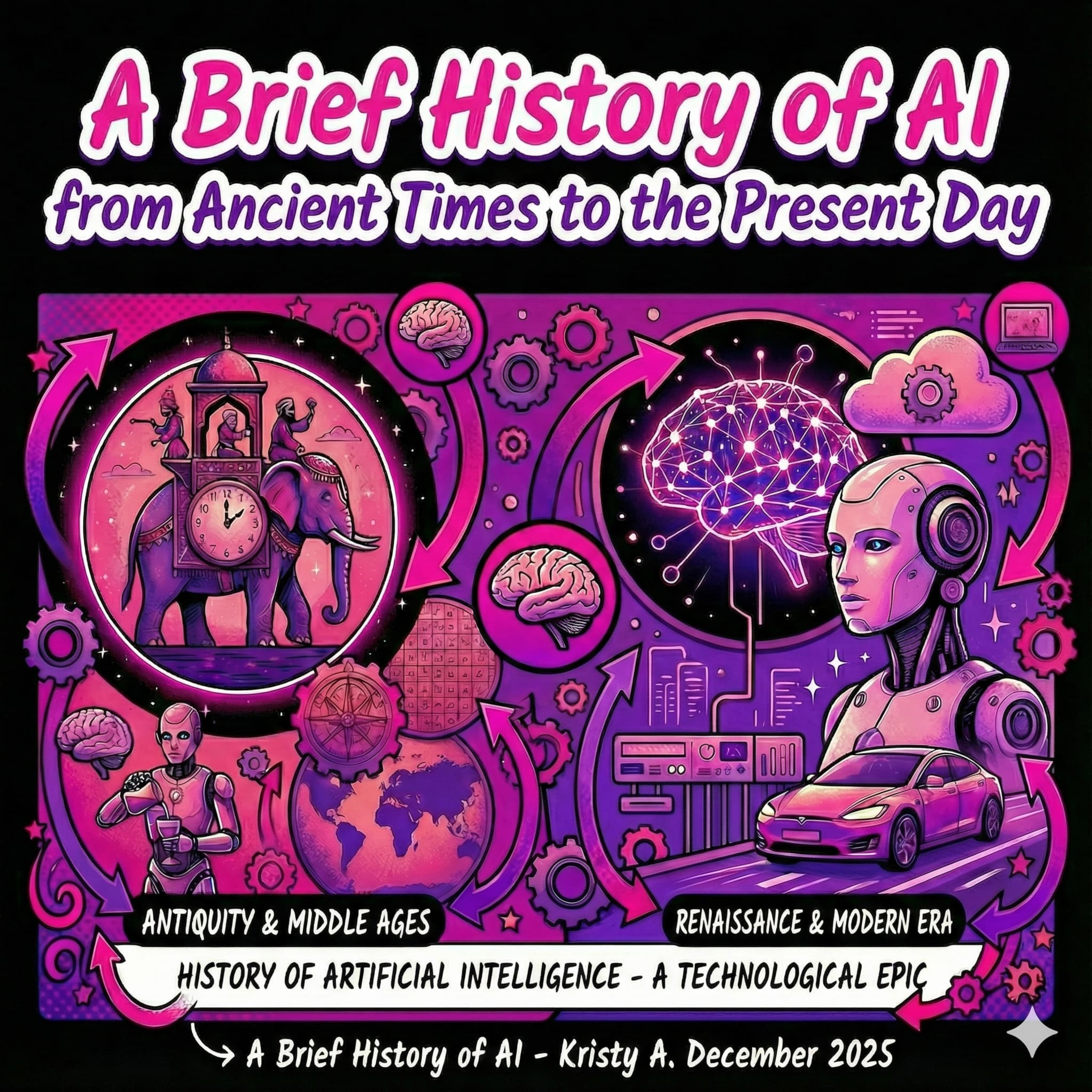
A brief history of AI from ancient times to the present day
AI didn't begin with ChatGPT. For curious minds and history geeks, this narrative podcast traces the history of artificial intelligence as a millennial human adventure across civilizations. From 8th-century BCE Greek automata to the 11th-century African Ifá binary system, from Al-Jazari's Islamic robotics to Japanese karakuri—discover how humanity dreamed of intelligent machines millennia before computers. Each episode (15-20 min) explores AI beyond pure technology: history, culture, philosophy. https://us.histoire-ia.fr/introduction
Author
Kristy Anamoutou
Category
Podcast website
Latest episode
Jan 18, 2026
Where to listen?
Podcasts in the app Replaio Radio Coming soonPodcasts are coming to the app soon. Install now and be the first to see a whole new take on podcasts
 Install for free
Android 5M+ downloads · 4.8 rating
iOS soon
Install for free
Android 5M+ downloads · 4.8 rating
iOS soon
Episodes
6.7 Conclusion — What This Revolution Teaches Us 18.01.2026 16:31
What the Deep Learning Revolution Teaches Us: Conclusion and opening toward the future From AlexNet to ChatGPT. From DeepMind to DeepSeek. From Mistral to African-language models. From the AI Act to silicon gardens. Six continents. Fifteen years. What does this journey teach us? Four threads run through it. Exponential acceleration — each year brings capabilities that the previous year would have...
6.6 Oceania — Archipelago of Innovation 18.01.2026 11:43
Archipelago of Innovation: How Australia seeks its place in the AI revolution Australia produces one point six percent of global AI research — but only zero point two percent of patents. The Australian paradox: scientific excellence is not converting quickly enough into economic power. Publications have doubled in ten years. Patents have quadrupled. CSIRO Data61 hosts one of the largest concentrat...
6.5 Middle East — Silicon Gardens 18.01.2026 15:43
Silicon Gardens: How the desert became an artificial intelligence laboratory In 2017, the United Arab Emirates appointed Omar Al Olama as Minister of Artificial Intelligence. He was thirty years old. It was a world first. This was not a symbolic gesture. It was a declaration of intent. In 2019, MBZUAI became the first university in the world entirely dedicated to AI. In 2022, Falcon LLM proved the...
6.4 Europe — Rule and Exception 18.01.2026 14:31
Rule and Exception: How Europe regulated AI and made Mistral emerge from the improbable In 2016, AlphaGo defeated the world champion of Go. In 2020, AlphaFold solved the protein folding problem. In 2024, Demis Hassabis received the Nobel Prize in Chemistry. DeepMind, founded in London, had proven that Europe could produce AI excellence. Then came the rule. On July 12, 2024, the European AI Act was...
6.3 Asia — The New Center of Gravity 18.01.2026 16:54
The New Center of Gravity: How Asia became the beating heart of global artificial intelligence In May 2023, a Chinese company named DeepSeek was founded. Less than two years later, its models rivaled those of OpenAI — at a fraction of the cost. The world was surprised. It should not have been. China had one million six hundred seventy thousand AI-related companies. It was filing seventy percent of...
6.2 Americas — Godfathers and Giants 18.01.2026 19:28
Godfathers and Giants: How America created deep learning and became the theater of the AI race During the winters of artificial intelligence — those periods when no one believed — three researchers persisted. Geoffrey Hinton in Toronto. Yoshua Bengio in Montreal. Yann LeCun in New York. They were nicknamed the "godfathers of deep learning." In 2019, they received the Turing Prize — the &...
6.1 Africa — The Quantum Leap 18.01.2026 20:53
The Quantum Leap: How Africa built its own models and revealed the biases of global AI The electron, physicists say, does not cross the space between two orbits. It disappears from one and appears in the other. A quantum leap. Africa made this leap. In 2007, M-Pesa transformed global financial inclusion from Kenya — before Apple even thought of Apple Pay. In 2023, InstaDeep, founded in Tunis, was...
6.0 Introduction — The Deep Learning Revolution 18.01.2026 14:26
The Deep Learning Revolution: How fifteen years upended everything we thought we knew about intelligence On September 30, 2012, in a bedroom at his parents' house, a Canadian doctoral student trained a neural network on two video game graphics cards. Eight days later, his system shattered all image recognition records. The world of artificial intelligence shifted. AlexNet. ChatGPT. AlphaFold....
5.7 Conclusion — What the Information Age Left Us 11.01.2026 26:25
What the Information Age Left Us: Conclusion and Opening Toward the Deep Learning Revolution From the CSIRAC in Sydney to the WEIZAC in Rehovot. From the ruins of Berlin to Bletchley Park laboratories. From M-Pesa in Kenya to TSMC in Taiwan. From Dartmouth to ImageNet. Six continents. Sixty-five years. What does this crossing teach us? Four threads run through this period. The leap across the abys...
5.6 Oceania — The Antipodes of Innovation 11.01.2026 21:26
The Antipodes of Innovation: How Geographic Isolation Became an Advantage In November 1949, in Sydney, a machine of two thousand vacuum tubes executed its first calculation. The CSIRAC joined an exclusive club: stored-program computers. There were only four others in the world — all in Great Britain or the United States. Australia had built the fifth. Trevor Pearcey worked "largely independen...
5.5 Middle East — Gardens of the Desert 11.01.2026 25:57
Gardens of the Desert: How Necessity Made Innovation Bloom in the Middle East No one expects flowers in the desert. Yet that is where they grow fastest — when the rain finally comes. In 1954, a six-year-old country undertook to build a computer. Israel had just emerged from its war of independence. The borders were hostile. The economy fragile. The advisory committee included Albert Einstein — ske...
5.4 Europe — Digital Reconstruction 11.01.2026 28:06
Digital Reconstruction: How Europe Invented the Computer, Scuttled Its Future, and Rebuilt Itself Europe invented the computer twice. The first time in secret. The second time in oblivion. In 1941, Konrad Zuse completed the Z3 in Berlin — the world's first programmable computer. The Nazi regime saw no use in it. A bombing raid destroyed it. In 1944, Tommy Flowers delivered Colossus to Bletchle...
5.3 Asia — Parallel Paths 11.01.2026 23:54
Parallel Paths: How Asia Discovered, Invented, and Dominated the Foundations of AI In 1937, Claude Shannon defended his legendary thesis at MIT. He demonstrated that Boolean algebra could describe electrical circuits. The same year, in Tokyo, Akira Nakashima published the same discovery. Shannon cited him. Then one became a legend. The other was forgotten. Two men. Two continents. The same idea. T...
5.2 The Americas — The Forge and the Forgetting 11.01.2026 34:27
The Forge and the Forgetting: The Summers, Winters, and Invisible Women of American Artificial Intelligence In 1956, twenty-one researchers gathered at Dartmouth College for an eight-week summer conference. They had an ambitious goal: create a "machine capable of simulating every aspect of human intelligence." They thought they could do it in one generation. They were wrong — by a great...
5.1 Africa — The Digital Palaver Tree 11.01.2026 25:53
The Digital Palaver Tree: How Africa Invented Financial Inclusion and Algorithmic Bias In every African village, there is a tree beneath which people gather to talk, listen, and decide together. The palaver tree. A patient democracy where decisions are binding only when all parties agree. No majority vote crushing the minority. An inclusive consensus. Ubuntu: "I am because we are." This...
5.0 Introduction — The Information Age 11.01.2026 4:24
The Information Age: From the Ashes of the World War to Leaps Across the Abyss In February 1948, in a Sydney laboratory, an engineer named Trevor Pearcey wrote a sentence that still resonates: "It is not inconceivable that an automatic encyclopaedic service operated through the existing telephone system will one day exist." The Internet. Predicted from Australia. Forty years before the W...
4.7 Conclusion — What the Age of Revolutions and Total War Bequeathed to Us 11.01.2026 26:26
What the Age of Revolutions Bequeathed to Us: Conclusion and Opening Toward the Information Age From the African aquifers to the burned codices of Yucatan. From Ramanujan's notebooks to the secret laboratories of Bletchley Park. From Aboriginal stars to the dried springs of Baghdad. Six continents. One hundred and fifty-six years. What does this crossing teach us? Four threads run through this per...
4.6 Oceania — Forgotten Stars 11.01.2026 23:33
Forgotten Stars: How Oceania Developed Humanity's First Astronomy — and Was Erased There is an emu that crosses the southern sky. You cannot see it by looking at the bright stars, but by observing the darkness between them. The Aboriginal peoples of Australia had developed what researchers call humanity's first astronomy. Sixty-five thousand years of observing the sky. Constellations in th...
4.5 The Middle East — Dried Springs 11.01.2026 24:40
Dried Springs: How the Middle East Bequeathed the Words and Lost the Institutions Every time a computer executes an operation, it performs an algorithm. The word comes from al-Khwarizmi — a ninth-century Persian mathematician. "Algebra" comes from al-Jabr. "Arabic numerals" still carry the memory of a transmission. Words survive. Institutions die. The House of Wisdom in Baghdad...
4.4 Europe — The Forge and the Inferno 11.01.2026 29:45
The Forge and the Inferno: How Europe Invented Artificial Intelligence on the Ashes of the Libraries It Burned A forge is not only a place of creation. It is also a place of fire. In 1679, Leibniz conceived the binary system. In 1854, Boole formalized the algebra of logic. In 1843, Ada Lovelace wrote the first computer program for a machine that did not exist. In 1936, Turing invented the universa...
4.3 Asia — Parallel Paths 11.01.2026 29:50
Parallel Paths: How Asia Discovered the Same Truths as the West — and Was Forgotten Great discoveries never occur just once. They emerge simultaneously, in places that know nothing of each other. In Japan's closed Edo period, Seki Takakazu discovered infinitesimal calculus independently of Newton. He presented the concept of the determinant ten years before Leibniz. His disciple Takebe Katahir...
4.2 The Americas — Lost Memories 11.01.2026 25:39
Lost Memories: How the Americas Invented and Forgot the Foundations of Artificial Intelligence A knot can be a memory. A memory can be burned. On July 12, 1562, a Franciscan monk named Diego de Landa ordered twenty-seven Maya codices thrown into fire — centuries of astronomical observations reduced to ashes. Of the entire Maya civilization, four books survived. Four books to bear witness to an ent...
4.1 Africa — The Invisible Threads 11.01.2026 24:55
The Invisible Threads: How Africa Wove the Foundations of Computing That Colonialism Tried to Erase There exist transmissions that official history refuses to see. Threads of knowledge running beneath the surface of dominant narratives, invisible but never broken. In 1884, fourteen European powers partitioned Africa in Berlin as one might cut up a fabric — with no regard for the patterns already w...
4.0. Introduction — The Age of the Forge and the Inferno 11.01.2026 4:25
The Age of the Forge and the Inferno: How the Age of Revolutions Created and Destroyed the Foundations of Artificial Intelligence In 1937, a student at MIT defended what some consider the most important master's thesis of the twentieth century. Claude Shannon demonstrated that Boolean algebra could describe how electrical circuits function. That same year, in Tokyo, an engineer named Akira Nak...
3.8. Conclusion — What the Early Modern Period Bequeathed Us 04.01.2026 23:21
What the Early Modern Period Bequeathed Us: Conclusion and Opening Toward the Contemporary Era From African aquifers to the colonial archives of Mexico. From the imperial courts of Beijing to the watchmaking workshops of La Chaux-de-Fonds. From the ruins of Istanbul's observatory to Tupaia's canoes. Six continents. Three centuries of history. What does this journey teach us? In this final...
Similar podcasts








Listen to the A brief history of AI from ancient times to the present day podcast in Replaio
Radio and podcasts in one app - free, with no sign-up. Install today and do not miss the launch
Replaio is not a podcast publisher; show names, artwork and audio belong to their authors and are distributed through public RSS feeds.