Kristy Anamoutou
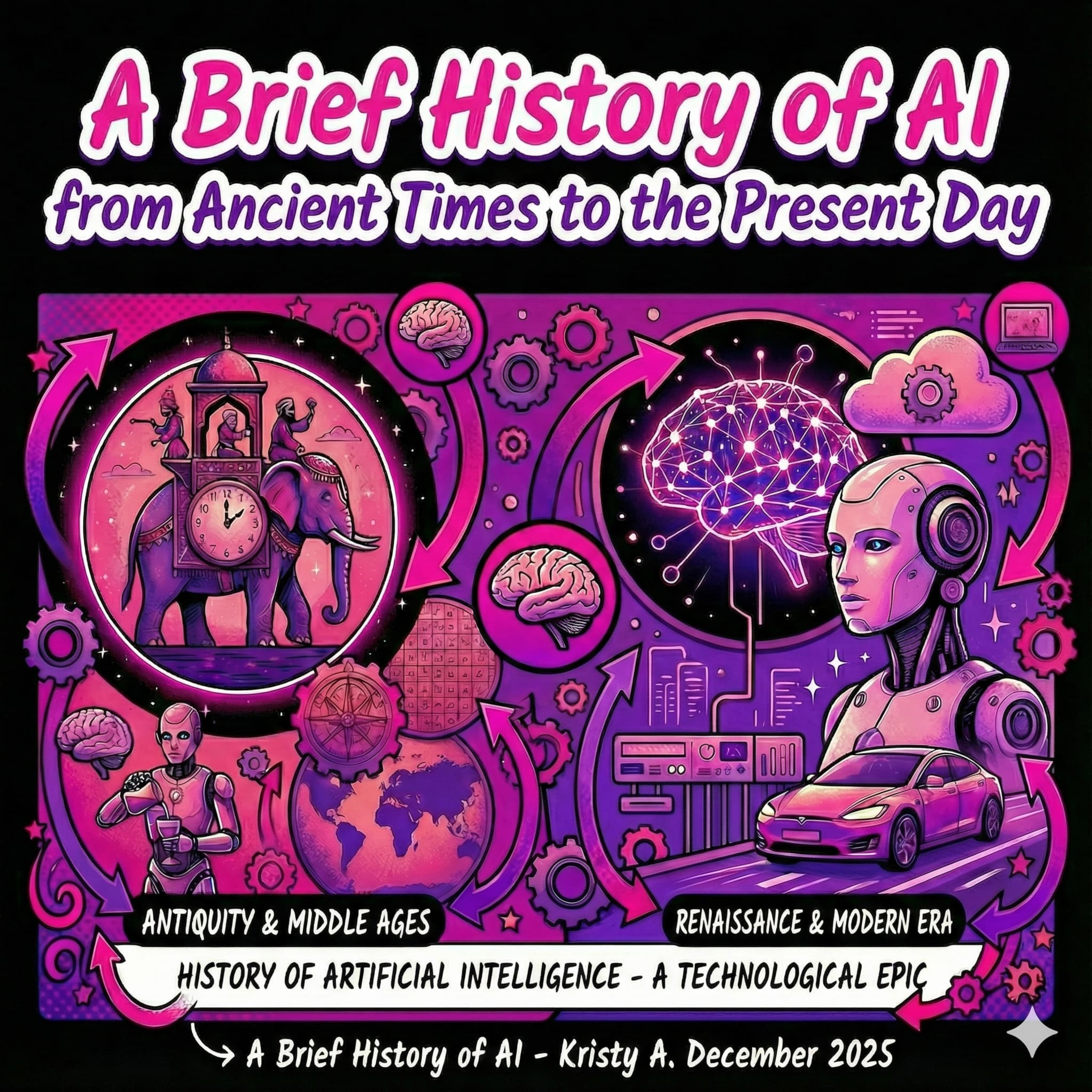
A brief history of AI from ancient times to the present day
AI didn't begin with ChatGPT. For curious minds and history geeks, this narrative podcast traces the history of artificial intelligence as a millennial human adventure across civilizations. From 8th-century BCE Greek automata to the 11th-century African Ifá binary system, from Al-Jazari's Islamic robotics to Japanese karakuri—discover how humanity dreamed of intelligent machines millennia before computers. Each episode (15-20 min) explores AI beyond pure technology: history, culture, philosophy. https://us.histoire-ia.fr/introduction
Author
Kristy Anamoutou
Category
Podcast website
Latest episode
Jan 18, 2026
Where to listen?
Podcasts in the app Replaio Radio Coming soonPodcasts are coming to the app soon. Install now and be the first to see a whole new take on podcasts
 Install for free
Android 5M+ downloads · 4.8 rating
iOS soon
Install for free
Android 5M+ downloads · 4.8 rating
iOS soon
Episodes
3.7. Oceania — The Map and the Song 04.01.2026 13:18
The Map and the Song: How Early Modern Oceania Reveals What We Do Not Know How to See There exist maps that cannot be read. In this episode, we discover the story of a missed encounter—between two forms of intelligence that could not translate each other. In July 1769, a Polynesian priest named Tupaia boarded the Endeavour, Captain James Cook's ship. He was no ordinary navigator. Trained at th...
3.6 Middle East — Windows That Close 04.01.2026 17:07
Windows That Close: How the Early Modern Middle East Warns Us of the Dangers of Institutional Choices A window can open onto the world. It can also close—sometimes for centuries. In this episode, we discover what happens when a civilization that had been at the forefront of scientific thought decides to turn its back on its own inventions. In 1577, Ottoman astronomer Taqi al-Din completed in Istan...
3.5 Europe — Clocks of the Soul 04.01.2026 23:57
Clocks of the Soul: How Early Modern Europe Formulated the Program of Artificial Intelligence A clock can measure time. But can it think? In this episode, we discover how Early Modern Europe dared a vertiginous question—and built the conceptual framework that would one day make artificial intelligence thinkable. In 1637, René Descartes published the Discourse on Method. He declared animals to be p...
3.4 Asia — Bridges and Mirrors 04.01.2026 18:59
Bridges and Mirrors: How Early Modern Asia Revealed the Universality of Mathematical Structures A bridge connects what was separated. A mirror reveals that the same face can appear on both sides. In this episode, we discover the great encounter of East-West knowledge—and the parallel discoveries that prove certain mathematical truths are universal. In 1581, an Italian Jesuit named Matteo Ricci arr...
3.3 Americas — Threads Knotted by Conquest 04.01.2026 17:41
Threads Knotted by Conquest: How American Knowledge Survived Its Destruction A thread can be cut. It can also, sometimes, be reknotted. In this episode, we explore what survived of American thought after the cataclysm of conquest—and what this thought might teach us about artificial intelligence. When the conquistadors landed, they found civilizations whose knowledge systems rivaled their own. The...
3.2 Africa — The Aquifers of Knowledge 04.01.2026 8:40
The Aquifers of Knowledge: How Early Modern Africa Secretly Nourished European Thought There exist transmissions that cannot be seen. Like water seeping into the ground and resurfacing kilometers from its source, certain knowledge traveled through underground channels that official history has not traced. In this episode, we follow a trail that ethnomathematician Ron Eglash spent years reconstruct...
3.1 Introduction to the Early Modern Period 04.01.2026 4:02
The Age of Encounters: How the Early Modern Period Formulated the Program of Artificial Intelligence In 1703, Gottfried Wilhelm Leibniz published an article on binary arithmetic—that system of zeros and ones upon which all our computers rest today. The same year, a French Jesuit in China revealed a troubling coincidence: the hexagrams of the I Ching, three millennia old, formed exactly the same sy...
2.7 Conclusion — What the Middle Ages Bequeathed Us 31.12.2025 13:15
What the Middle Ages Bequeathed Us: Conclusion and Opening to the Renaissance From the sand libraries of Timbuktu to the stone observatories of the Yucatan. From the clockmaking workshops of Kaifeng to the scriptoria of European monasteries. From the House of Wisdom in Baghdad to the canoes crossing the Pacific. Six continents. A thousand years of history. What does this journey teach us? In this...
2.6 Oceania — The Navigators of the Invisible 31.12.2025 19:56
The Navigators of the Invisible: How Medieval Oceania Invented Technologies of the Mind There are technologies that cannot be held in the hand. In this episode, we discover another path to intelligence — a path that does not pass through ink and metal, but through the body, the voice, the waves, and the stars. Between 800 and 1200, the Polynesians reached Hawaii, Easter Island, and New Zealand. Th...
2.5 Middle East — The Architects of Mechanical Thought 31.12.2025 24:18
The Architects of Mechanical Thought: How the Medieval Middle East Laid the Foundations of Artificial Intelligence Every technological revolution has its forgotten ancestors. Artificial intelligence was born in Baghdad, in the ninth century. In this episode, we discover the architects who built, brick by brick, the conceptual edifice on which AI rests today. In 813, Caliph Al-Ma'mun founded th...
2.4 Europe — The Wheels of Reason 31.12.2025 10:50
The Wheels of Reason: How Medieval Europe Built the First Thinking Machines A wheel can transmit movement or transform it. It can also reproduce the path of thought in a mind. In this episode, we discover how medieval Europe invented the first reasoning machines. On the island of Majorca, around 1275, Ramon Llull conceived a strange machine. Concentric disks bearing letters and symbols, which coul...
2.3. Asia — The Clocks of Heaven 31.12.2025 10:31
The Clocks of Heaven: How Medieval Asia Mechanized Time and Knowledge A clock is not just a measuring instrument. It is a promise: that the world obeys rules, that the future can be predicted. In this episode, we discover how medieval Asia built machines capable of reproducing the movement of the heavens — two centuries before Europe. In 725, in the capital of the Tang Dynasty, a Buddhist monk nam...
2.2 Americas — The Knots of Time 31.12.2025 12:31
The Knots of Time: How Medieval Americas Wove the Future into Their Calculations A knot can be an obstacle or a memory. In the medieval Andes, it was both at once — and much more. In this episode, we discover how American civilizations invented information systems of a sophistication we are only beginning to measure. Around the year 1100, in the Yucatan, a Maya scribe finished painting the Dresden...
2.1 Africa — The Sand Libraries 31.12.2025 11:45
The Sand Libraries: How Medieval Africa Inscribed Thought in Memory There are libraries that the wind cannot erase. In 1324, a man crossed the Sahara with a caravan so sumptuous that it shook Egypt's economy. Mansa Musa, Emperor of Mali, carried so much gold that his passage caused an inflation that lasted for decades. But the true wealth he brought back from his pilgrimage was not metallic: i...
2. Introduction to the Middle Ages 31.12.2025 3:20
The Age of Foundations: How the Middle Ages Laid the Groundwork for Artificial Intelligence The official history will tell you that the Middle Ages was a dark age. A thousand years of obscurantism between the glory of Antiquity and the brilliance of the Renaissance. This history is false. Between 476 and 1492, while Europe sought light in its monasteries, the rest of the world was building the fou...
1.8 Antiquity - Conclusion 30.12.2025 16:40
From the Lebombo caves to the tropical forests of Mesoamerica. From the workshops of imperial China to the temples of the Nile. From Yoruba shrines to Pacific atolls. Nine stories. Six continents. Fifty millennia of human history. What does this journey teach us? In this episode, we weave together the threads that connect all the stories we have told. And we discover that humanity, regardless of l...
1.7 Middle East - Temples of Illusion 30.12.2025 13:08
The temples of illusion: When the ancient Middle East invented the first thinking machines There was a time when the gods spoke. In the temples of Thebes, statues bowed their heads to designate the future pharaoh. In Babylon, superhuman guardians watched over the sacred forests. In Alexandria, the doors of the sanctuaries opened of their own accord when the faithful approached. Pilgrims marveled,...
1.6 Europe - The Forges of the Mind in Greece 30.12.2025 9:31
The forges of the mind: when ancient Greece dreamed of thinking machines In the Greek Olympus, one god stood out from the rest. While Zeus wielded lightning bolts, Hephaestus worked with metal. Lame, rejected, and solitary, the blacksmith god spent his days in the volcanic depths of his workshop. From his blackened hands came wonders. In this episode, we discover that artificial intelligence is ne...
1.5 Central Europe - Arcs and Stars 30.12.2025 12:38
Arcs and Stars: How Central Europe Measured the Sky and the Earth Before Greek philosophers, before marble temples, there was bronze and silence. In the plains of Central Europe, peoples without writing observed the sky with a patience that we can hardly imagine. They left no texts or legends behind. They left behind objects. In this episode, we set out to discover this Europe of shadows—that of t...
1.4 Asia - Bronze guardians in India 30.12.2025 10:24
The Bronze Guardians: When Ancient India Created Spirit-Powered Machines There is a story told in ancient Indian texts. It tells of warrior robots guarding the sacred relics of the Buddha, flying ships crossing the skies at the speed of thought, and engineer gods forging mechanical marvels. This story is over two thousand years old. In this episode, we delve into the technical imagination of ancie...
1.3 Asia - The Empire of Automata in China 30.12.2025 10:40
The Empire of Automata: When Ancient China Invented Thinking Machines Three thousand years before the word “robot” was invented, a Chinese craftsman dismantled the insides of an artificial creature capable of singing, dancing, and seducing before an astonished king. The story begins in the 10th century BCE. King Mu of Zhou received a man named Yan Shi, who presented him with a life-size human figu...
1.2 Americas - Zero and the Stars 30.12.2025 8:43
Zero and the Stars: How Ancient Mesoamerica Invented the Language of Time There is a concept without which no computer could function. Without which no algorithm could run. Without which modern mathematical thinking would be unthinkable. That concept is zero—the revolutionary idea that an absence can be represented, that a void can have value, that nothing can count. And this concept was invented...
1.1 Africa - Notches and stars 30.12.2025 13:35
Notches and stars: How Africa invented the languages of calculation Forty-three thousand years ago, a human hand carved twenty-nine notches on a baboon bone in a cave in southern Africa. Twenty-nine marks—the exact length of a lunar cycle. The Lebombo bone is the oldest evidence of numerical thinking ever discovered. And it may have been created by a woman, tracking the phases of the moon in relat...
1.0 Antiquity: the forgotten origins of AI 30.12.2025 2:28
What if everything you've been told about artificial intelligence was incomplete? The official story begins in 1956, in an American conference room, when a handful of researchers coined the term. This story is true. It is also radically incomplete. Because the dream of creating artificial beings capable of thinking, deciding, and acting—that dream did not wait for electricity to be born. It ha...
Similar podcasts








Listen to the A brief history of AI from ancient times to the present day podcast in Replaio
Radio and podcasts in one app - free, with no sign-up. Install today and do not miss the launch
Replaio is not a podcast publisher; show names, artwork and audio belong to their authors and are distributed through public RSS feeds.