Robert Weinstein
BIPEDAL
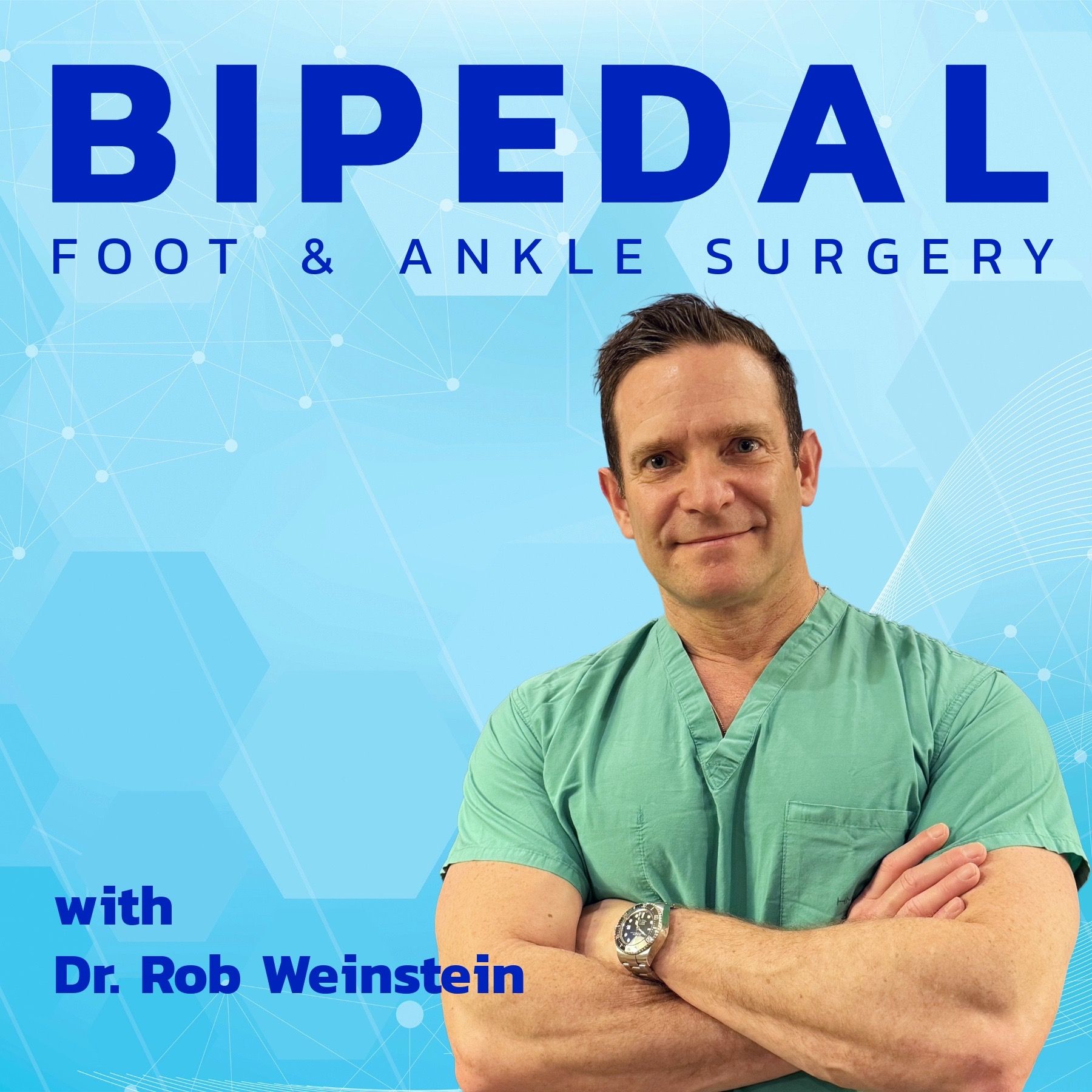
Surgeon, Author, Educator and Inventor Dr. Robert Weinstein discusses all things foot and ankle health related. From common conditions and their conservative treatments to complex reconstructive surgical challenges, every topic will be explained in plain language for all audiences.
Koniecznie odwiedź stronę podcastu i wesprzyj twórcę: bipedal.simplecast.com
Autor
Robert Weinstein
Kategoria
Strona podcastu
Ostatni odcinek
27 wrz 2026
Gdzie słuchać?
Podcasty w aplikacji Replaio Radio Już wkrótcePodcasty trafią do aplikacji już wkrótce. Zainstaluj teraz i jako pierwszy zobacz nowe podejście do podcastów
 Zainstaluj za darmo
Android prawie 10 mln pobrań · ocena 4,8
iOS niedługo
Zainstaluj za darmo
Android prawie 10 mln pobrań · ocena 4,8
iOS niedługo
Odcinki
Achilles Tendinosis and Heel Spurs 27.09.2026 32:55
Approximately 6% of the general population reports Achilles tendon pain during their lifetime , and roughly one-third of those cases are insertional. This is a large amount of the population suffering a specific clinical condition. The pathomechanics are complex. The Achilles tendon is under resting tension, ready to pull the calcaneus upward causing forward propulsion the second the brain d...
Plantar Fibromatosis 20.09.2026 38:57
Plantar fibromas are nodules in the plantar arch area, which may or may not be painful. Histologically a collection of fibroblasts and myofibroblasts, the lesions lie somewhere between excessive scar formation and muscle tissue. Notoriously resistant to conservative care, these lesions sometimes are simply monitored. If they do not fit a classic pattern, show rapid expansion or become painfu...
Osteogenesis and Bone Lengthening 13.09.2026 30:01
The core biology and historical framework are consistent with the orthopedic literature: Codivilla described early limb-lengthening work in the early 1900s, while Ilizarov's later work established distraction osteogenesis as a reproducible clinical method and characterized the importance of distraction rate and frequency. Modern bone transport remains an important option for critical-sized defects...
Platelet Rich Plasma 06.09.2026 34:59
Platelet-rich plasma has become a popular treatment in sports medicine, orthopedics, and podiatry. But what exactly is PRP, and how much evidence do we actually have that it works? In this episode, we break down the science, clinical applications, and controversies surrounding PRP. What Is PRP? PRP is a concentrated preparation of a patient's own blood containing a higher concentration of platelet...
Arthroscopic Foot and Ankle Surgery 22.08.2026 34:58
Arthroscopy involves using small scopes placed into a joint to evaluate or treat intraarticular conditions. The ankle, subtalar, and first metatarsophalangeal joints are commonly explored using this technique. Needle arthroscopy has presented a newer modality for even smaller joints in the foot. Classically, exploration of a joint in this manner was for evaluating tissues that we can't normally se...
Surgery for the Rigid Flatfoot 15.08.2026 36:40
This episode is designed for anyone interested in foot and ankle health, including patients considering flatfoot surgery, athletes dealing with progressive deformity, medical students, residents, podiatrists, orthopedic surgeons, and anyone interested in understanding how complex reconstructive foot surgery actually works. The rigid flatfoot is not simply an arch that has fallen. It is a three-d...
Surgery for the High Arch - Pes Cavus 07.08.2026 20:57
Pes cavus (high arch) is notoriously difficult to approach since there are so many manifestations. It may be masked since there are a variety of ways the foot and leg will compensate, and often the presenting symptoms seemingly have nothing to do with the deformity. A classic example is the chronic ankle sprainer. While the injury is in the ankle, the set up for the injury is rigidity in the foot...
Total Ankle Replacement 31.07.2026 26:24
End stage of arthritis in the distal lower extremity has almost always dictated fusion of a joint. Until relatively recently this was the case in the ankle. However, due to its essential role in normal gait, surgeons have long sought ways to replace rather than fuse this joint. Replacement joints have existed for decades. Early versions were fraught with complications and required revision and co...
Hammertoe Surgery 24.07.2026 18:53
Boradly speaking, there are three types of digital contractures or hammertoes: Flexor Stabilization: This is the most common mechanism, often driven by overpronation (flat feet). As the foot flattens, it unlocks the midfoot, causing the flexor tendons (the muscles underneath the foot) to fire earlier and longer to stabilize the foot. These overactive flexors overpower the smaller stabilizing muscl...
Nonunions 17.07.2026 26:37
The "Diamond Model" (or Diamond Concept) of bone healing is a theoretical framework in orthopedic surgery and regenerative medicine that outlines five interdependent factors needed for successful fracture repair and non-union treatment: Osteogenic cells, Osteoinductive mediators, Osteoconductive scaffold, Mechanical stability, and adequate Vascularity. The first four are connected by vascularity -...
Reconstruction of the Flexible Flatfoot 10.07.2026 25:57
Instead of understanding a flexible flatfoot as a single condition, it should be understood that it is in fact multiple simultaneously occurring conditions resulting in mechanical failure. And since there are multiple components: The surgeon should ask themselves "What component of the deformity am I correcting?" Every operation has a purpose. Every procedure corrects a different deforming force....
Cartilage Structure and Function 04.07.2026 15:34
There are three types of cartilage in the human body, although the one we most commonly pay attention to is hyaline cartilage since this makes up the articulation between bones. The gliding and shock absorbing function of type 2 collagen makes hyaline cartilage particularly suited for absorbing force. It is arranged in a very specific manner to absorb forces and maintain structural integrity under...
Ankle OCD 27.06.2026 15:39
Symptomatic OLTs represent one of the most common causes of persistent pain following ankle injury. The condition is often missed due to the volume of ankle sprains seen in clinics that are routinely imaged with plain film X-ray only. These lesions not only do not appear on xray unless there is obvious bone involvement but sometimes evolve over time after the initial insult. Therefore the foot and...
Ankle Instability and Reconstruction 23.06.2026 16:43
The lateral collateral complex is made up of the ATFL, CFL and PTFL. The ATFL is probably one of the most commonly injured ligaments in the human body, due to the relative weak nature of the ligament and anatomic position on the outside of the ankle joint. Along with the CFL they are poor resistors of inversion since the torque of the body over these small structures can easily overwhelm their abi...
Achilles Tendon Repair Rehabilitation 14.06.2026 15:10
Achilles tendon rupture is a potentially catastrophic injury. However modern repair methods can restore the integrity of the tendon complex regardless of age or extent of injury. It is the rehabilitation protocols afterwards that are the best predictors of complete recovery, not the ability to put the tendon back together. I have repaired tendons on relatively sedentary patients, weekend warriors...
Achilles Tendon Rupture Surgery 11.06.2026 17:11
There is debate among orthopedic and podiatric surgeons regarding operative and no operative repair of ruptured Achilles tendons. Why the debate? Because outcome studies have shown satisfactory results when comparing each treatment. These studies focus on strength restoration, pain scores, and quality of life. Unfortunately, we cannot directly compare individual patient outcomes, since a patient c...
Hallux Limitus Surgery 06.06.2026 18:21
Hallux limitus and rigidus are a spectrum of a disease involving progressive degeneration of the first metatarsophalangeal joint (MTPJ). There are multiple causes known to cause this condition, from biomechanical (elevated first metatarsal, elongated first metatarsal, etc.) to medical (gout, rheumatoid arthritis, infections, etc.) As a surgeon, I have to determine the condition of the joint at th...
Internal Fixation Part 3 - When Fixation Fails 30.05.2026 15:57
Most fixation failures are not really implant failures. They are failures of the interaction between biology, mechanics and time. When assessing broken bones (or fusions, osteotomies, etc) we have to appreciate that achieving the result of bone healing is a balance between mechanical and biologic forces. Too much or too little of either is not beneficial, and occasionally is deleterious. Modern o...
Internal Fixation Part 2 - Fracture Biomechanics 23.05.2026 16:02
A fracture heals biologically. But biology is governed by mechanics. Bone cells are mechanosensitive. They respond to motion, strain, compression, shear, and tension. And that means one central truth: The surgeon is not simply fixing bone. The surgeon is engineering the conditions under which biology can succeed. Strain in terms of bone healing describes the amount of motion relative to the fractu...
Internal Fixation 16.05.2026 19:42
Understanding internal fixation is critical to our later discussions on surgical techniques for a variety of conditions. We started in Episode 1 of Season 2 discussing bunion surgery. This was meant to be an introduction to how we approach realignment and repair of bone segments. Everything we have learned about fracture fixation in emergent conditions, we have refined and honed to use in our reco...
Bone Healing 09.05.2026 18:40
Bone is a Living Tissue. It is formed of living cells in a matrix designed to withstand load and to constantly replace and repair itself. When injured, bone immediately begins the repair process, with dedicated cells immediately taking over and beginning a complex signaling event that ultimately results in complete restoration. Because healing is phase oriented, certain systems must in place at t...
Bunion Surgery 02.05.2026 21:13
There is no simple solution to a complex problem. This is true in life, and in bunion surgery. A bunion is a complex condition resulting from either structural anomaly or biomechanical instability, and often both. Careful evaluation of the condition is required; no two bunion deformities are identical. Mistakes are made when patient expectations are unrealistic, physician capabilities are limited...
Biomechanics 17.04.2026 10:49
The bones of the foot are arranged to not only provide stability and absorb impact, but to provide maximal efficiency in movement. Beginning with their axes of motion, which are purposefully arranged to allow motion in a specific sequence as the body's weight transfers over the foot from posterior to anterior. The ankle allows dorsiflexion, the subtlalar and mid tarsal joints allow pronation (shoc...
Metatarsalgia 15.04.2026 9:38
Understanding biomechanics is essential to diagnosing and treating vague symptom descriptions such as metatarsalgia. If you remember back to our discussion on pronation and supination - the foot first must pronate when loading then convert into a supinated, rigid lever for propulsion. This occurs when the body weight moves over the center of the foot, tightening posterior structures and placing t...
Tarsal Tunnel Syndrome 13.04.2026 9:00
Painful burning, stinging, electrical shocks and possibly numbness in the plantar foot, especially with weight bearing and activity may be tarsal tunnel syndrome. This is an often misdiagnosed condition since the symptoms overlap with many other pathologies. Diagnostic testing such as MRI, CT, ultrasound and EMG/NCV studies are not consistently diagnostic, leading to many alternate theories for p...
Podobne podcasty






Słuchaj podcastu BIPEDAL w Replaio
Radio i podcasty w jednej aplikacji - za darmo, bez zakładania konta. Zainstaluj już dziś i nie przegap premiery
Replaio nie jest wydawcą podcastów; nazwy audycji, okładki i audio należą do ich autorów i są rozpowszechniane przez publiczne kanały RSS