Oliver Ashford
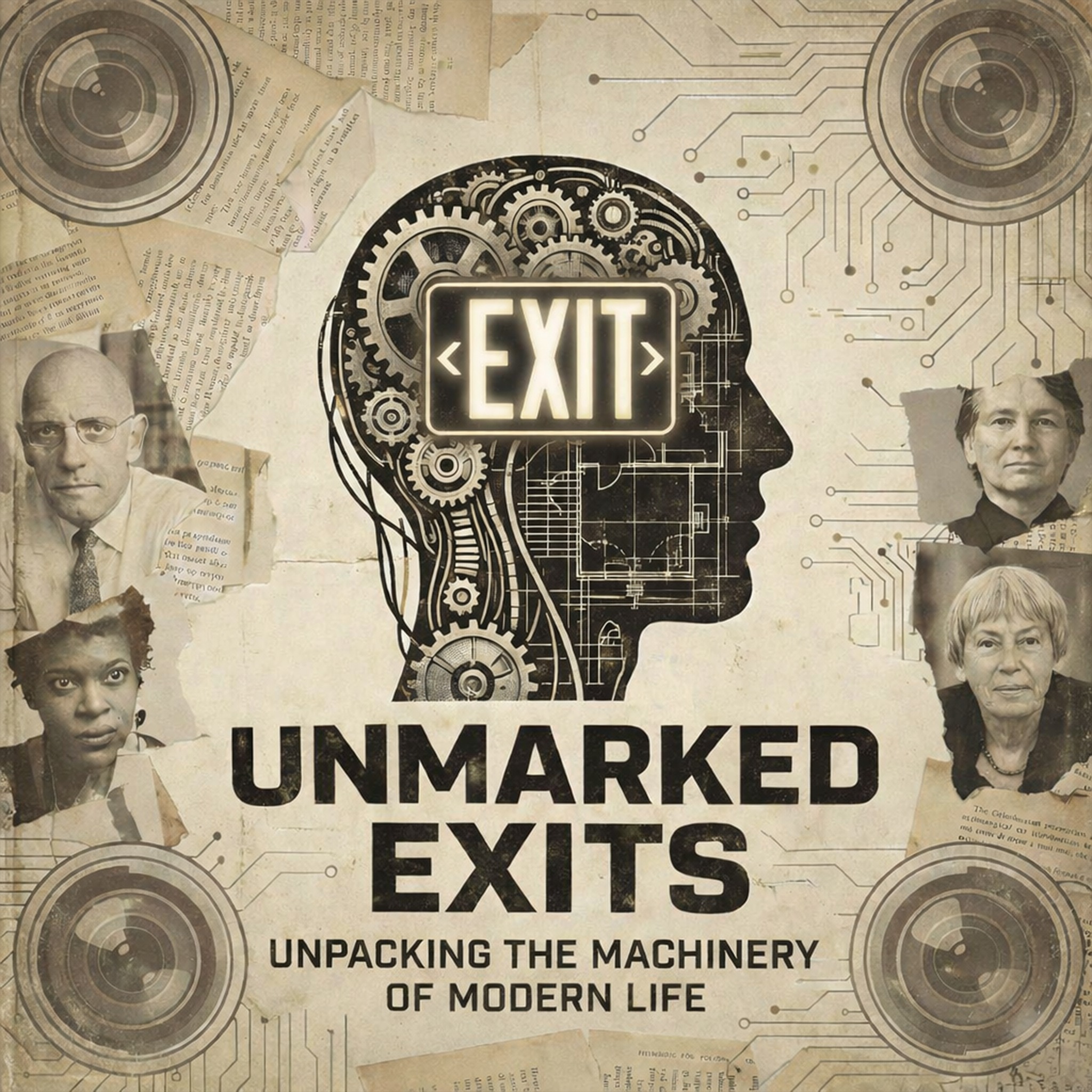
Unmarked Exits
The ideas that shape how you think, work, and consume weren't accidents. They were designed. Each episode unpacks one essential text from critical theory, philosophy, fiction, and media studies that reveals how power really operates. No jargon. No academic gatekeeping. Just genuine inquiry into the forces shaping modern life. We're exploring thinkers like Guy Debord, Michel Foucault, Naomi Klein, and Mark Fisher alongside fiction from Ursula K. Le Guin, Kurt Vonnegut, and Octavia Butler. Some of these works are decades old. All of them feel uncomfortably relevant. This isn't about telling you...
Mindenképp látogasd meg a podcast oldalát, és támogasd a készítőjét: redcircle.com
Szerző
Oliver Ashford
Kategória
A podcast weboldala
Legutóbbi epizód
2026. nov. 2.
Hol hallgathatod?
Podcastok az alkalmazásban Replaio Radio HamarosanA podcastok hamarosan megérkeznek az alkalmazásba. Telepítsd most, és láss elsőként egy teljesen új megközelítést a podcastokhoz
 Telepítsd ingyen
Android közel 10 M letöltés · 4,7+ értékelés
iOS hamarosan
Epizódok
S03 E44: The Managed Heart: Emotional Labour and the Commercialization of Feeling 02.11.2026 39:09
Flight attendants are paid to smile. Not just to perform tasks, but to feel, or convincingly fake, certain emotions. What does it do to a person when their feelings become part of the job? In this episode, we explore Hochschild’s study of emotional labour: work that requires managing your feelings as part of the product. Service workers must display cheerfulness, care workers must display warmth,...
S03 E43: The Organization Man: Belonging, Conformity, and the Death of Individualism 26.10.2026 45:23
The old American dream was individual: work hard, strike out on your own, succeed or fail by your own efforts. The new American dream is collective: belong to the organization, conform to its culture, find meaning in your position within the group. In this episode, we explore William Whyte’s study of the postwar corporate culture that replaced entrepreneurial individualism with organizational belo...
S03 E42: We: The One State, Glass Walls, and the Elimination of the Soul 19.10.2026 47:19
Before Nineteen Eighty-Four, before Brave New World, there was We: the grandfather of dystopian fiction, written in 1920s Soviet Russia and immediately banned. In this episode, we explore Zamyatin’s novel of the One State, where citizens are numbers, buildings are made of glass, and the only privacy is during scheduled sex. The protagonist, D-503, writes in praise of the system until he develops t...
S03 E41: The Sane Society: When Pathology Becomes the Norm 12.10.2026 55:33
We assume that if most people behave a certain way, that behaviour is normal, healthy, sane. But what if an entire society is sick? What if alienation, anxiety, and destructiveness are rational responses to an insane situation? In this episode, we explore Fromm’s argument that capitalism produces not just inequality but psychological damage. We’ve built societies that meet material needs while sta...
S03 E40: One Flew Over the Cuckoo’s Nest: The Institution as Instrument of Normalization 05.10.2026 53:03
McMurphy isn’t crazy. He faked it to get out of prison work detail and into what he assumed would be the easier environment of a psychiatric hospital. He discovers that the ward is its own prison, controlled not by locks but by routine, medication, and a nurse who knows exactly how to manipulate shame. In this episode, we explore Ken Kesey’s novel, told from the perspective of a patient everyone b...
S03 E39: Eichmann in Jerusalem: Bureaucracy and the Banality of Evil 28.09.2026 44:48
Adolf Eichmann helped orchestrate the Holocaust. When he was finally captured and tried in Jerusalem, he seemed… ordinary. Boring. A bureaucrat who spoke in clichés. In this episode, we explore Hannah Arendt’s controversial report on the trial and her concept of “the banality of evil.” Eichmann wasn’t a monster or a fanatic. He was a careerist who didn’t think about what he was doing. The evil he...
S03 E38: Obedience to Authority: The Experiment That Revealed Our Capacity for Harm 21.09.2026 53:05
How many people would deliver painful electric shocks to a stranger just because an authority figure told them to? In this episode, we explore Stanley Milgram’s famous, and controversial, experiments on obedience. Participants were instructed to administer escalating shocks to a learner who gave wrong answers. The shocks weren’t real. But the participants didn’t know that, and most delivered what...
S03 E37: The Power of the Powerless: Living in Truth Under Post-Totalitarianism 14.09.2026 50:13
A greengrocer puts a sign in his window: “Workers of the world, unite!” He doesn’t believe it. Nobody believes it. Everybody knows nobody believes it. But the sign stays up. Why? In this episode, we explore Havel’s essay on how totalitarian systems maintain themselves not through true believers but through ritual compliance. The greengrocer isn’t expressing conviction. He’s signalling that he will...
S03 E36: Player Piano: Automation, Dignity, and the Horror of Uselessness 07.09.2026 43:05
What happens when machines can do everything better than humans? Not unemployment exactly. There will always be make-work. But something worse: the knowledge that you’re not needed. In this episode, we explore Vonnegut’s first novel, published in 1952 but describing our future. A society where engineers and managers live in comfort while everyone else is assigned to the army or public works. Not b...
S03 E35: Escape from Freedom: The Psychological Appeal of Authoritarianism 31.08.2026 49:57
Freedom should feel good. So why do so many people run from it into the arms of authoritarianism? In this episode, we explore Erich Fromm’s psychological study of fascism, written in 1941, trying to understand how Germany happened. His answer: modern life gives us freedom but also isolation, anxiety, powerlessness. Faced with the burden of self-determination, many people would rather surrender to...
S03 E34: The Technological Society: Technique as Autonomous Force 24.08.2026 49:37
Technology isn’t just machines. It’s a way of thinking: the relentless pursuit of the most efficient means. And this way of thinking, Ellul argues, has become autonomous. It no longer serves human ends. We serve it. In this episode, we explore Ellul’s prophetic 1954 work on technique: his term for the totality of methods rationally arrived at for efficiency in every field of human activity. Techni...
S03 E33: Discipline and Punish: The Panopticon and the Production of Docile Bodies 17.08.2026 37:57
Prisons seem obvious: you do something wrong, you get locked up. But prisons as we know them are only about 200 years old. Before that, punishment was public spectacle: torture, execution, branding. What changed? In this episode, we explore Foucault’s history of how modern society learned to produce “docile bodies.” The prison isn’t just a building. It’s a model. The same principles of surveillanc...
S03 E32: Technological Rationality and the Mechanics of Social Conformity 10.08.2026 41:53
We think of technology as neutral. Just tools we choose to use. But what if the logic of efficiency and standardisation has quietly reshaped how we think, work, and obey? In this episode, we explore Herbert Marcuse’s argument that modern society has traded critical thinking for compliance. Once, rationality meant questioning authority. Now it means fitting seamlessly into the machine. From the fac...
S02 E31: Four Arguments for the Elimination of Television: The Case Against the Medium Itself 27.07.2026 42:52
Most media criticism assumes television could be better. What if television, as a technology, is inherently destructive? What if the only solution is elimination? In this episode, we explore Jerry Mander's radical argument: four interconnected cases against the medium itself. Not bad programmes, but the medium. He argues that television colonizes experience, replaces reality with images, centr...
S02 E30: How to Do Nothing: Resisting the Attention Economy 20.07.2026 48:12
Your attention is the product. Every app, every platform, every notification is designed to capture and extract it. So what would it mean to do nothing? In this episode, we explore Jenny Odell's meditation on attention, place, and resistance. Doing nothing isn't passivity. It's refusal. It's looking at the bird instead of the phone. It's insisting on a self that can't be op...
S02 E29: The Circle: Transparency, Connection, and the New Totalitarianism 14.07.2026 41:04
What if surveillance wasn't imposed on you? What if you demanded it? What if total transparency felt like freedom? In this episode, we explore Eggers' novel about a young woman who joins a tech company that combines the worst aspects of Google, Facebook, and a cult. The Circle's motto: "Secrets are lies. Sharing is caring. Privacy is theft." The horror of The Circle isn't t...
S02 E28: White Noise: Death, Consumerism, and the Background Hum of Modern Life 06.07.2026 41:29
The white noise is always there: the hum of appliances, the murmur of television, the constant low-frequency buzz of modern life. What if that noise is the sound of contemporary existence itself? In this episode, we explore DeLillo's novel about a professor of Hitler studies, his blended family, and an "airborne toxic event" that forces them to confront mortality. Except mortality is i...
S02 E27: Eight O'Clock in the Morning: Obey, Consume, Sleep 29.06.2026 35:59
A man wakes up and discovers that the world is run by aliens. They're everywhere: politicians, police, executives. They control humanity through subliminal messages in advertisements: OBEY. CONSUME. SLEEP. In this episode, we explore Ray Nelson's 1963 short story that John Carpenter later adapted into the cult film They Live. It's pulp science fiction with a sharp political edge. The a...
S02 E26: Network: The Prophecy of News as Entertainment 22.06.2026 51:18
"I'm mad as hell, and I'm not going to take it anymore!" In this episode, we explore Paddy Chayefsky's screenplay for Network: a satire about a news anchor who has a breakdown on air and is transformed into an entertainment phenomenon. The network doesn't cancel him. They exploit him. Made in 1976, it was dismissed as over-the-top. Now it looks like understatement. Reality...
S02 E25: The Image: Pseudo-Events and the Menace of Unreality 15.06.2026 52:26
What's the difference between a news event and a pseudo-event? A news event happens. A pseudo-event is staged to be reported. In this episode, we explore Boorstin's 1962 study of how American life became increasingly dominated by manufactured reality. Press conferences, celebrity culture, tourist attractions, political campaigns: all designed not to be experiences but to be images of exper...
S02 E24: Mythologies: Decoding the Hidden Meanings of Everyday Life 08.06.2026 45:18
A wrestling match is fake, and everyone knows it. So why do people watch? Because it's not about athletic competition. It's about the spectacle of justice, performed in exaggerated bodies. In this episode, we explore Barthes' collection of short essays decoding French popular culture: wrestling, steak and chips, soap advertisements, plastic, the face of Greta Garbo. Each essay peels ba...
S02 E23: No Logo: Brands, Sweatshops, and the Colonization of Public Space 01.06.2026 49:24
There was a time when companies made products. Then they discovered it was more profitable to make brands. Products can be manufactured anywhere. Brands are pure image. In this episode, we explore Naomi Klein's landmark study of how corporations colonized public space, culture, and identity itself. Nike doesn't sell shoes. It sells the idea of athletic transcendence. Starbucks doesn't...
S02 E22: The Work of Art in the Age of Mechanical Reproduction: Aura and Its Dissolution 25.05.2026 42:12
What makes an original artwork special? Something Benjamin called "aura": its unique presence in time and space, its unrepeatable existence. But what happens when perfect copies become possible? In this episode, we explore Benjamin's famous essay on how photography and film changed art forever. Reproduction destroys aura, but it also democratizes access. Art leaves the realm of ritua...
S02 E21: Amusing Ourselves to Death: Public Discourse in the Age of Show Business 18.05.2026 57:46
Orwell feared the banning of books. Huxley feared there would be no reason to ban them. Postman argues Huxley was right. In this episode, we explore how television changed not just what we think about, but how we think. Postman's argument isn't that TV shows bad content. It's that television as a medium is structurally incapable of supporting serious discourse. Everything becomes enter...
Hasonló podcastok





Hallgasd a(z) Unmarked Exits podcastot a Replaióban
Rádió és podcastok egy alkalmazásban - ingyen és regisztráció nélkül. Telepítsd még ma, és ne maradj le a premierről
A Replaio nem podcastkiadó; a műsorok nevei, borítóképei és hanganyagai a szerzőiket illetik, és nyilvános RSS-csatornákon keresztül terjednek.