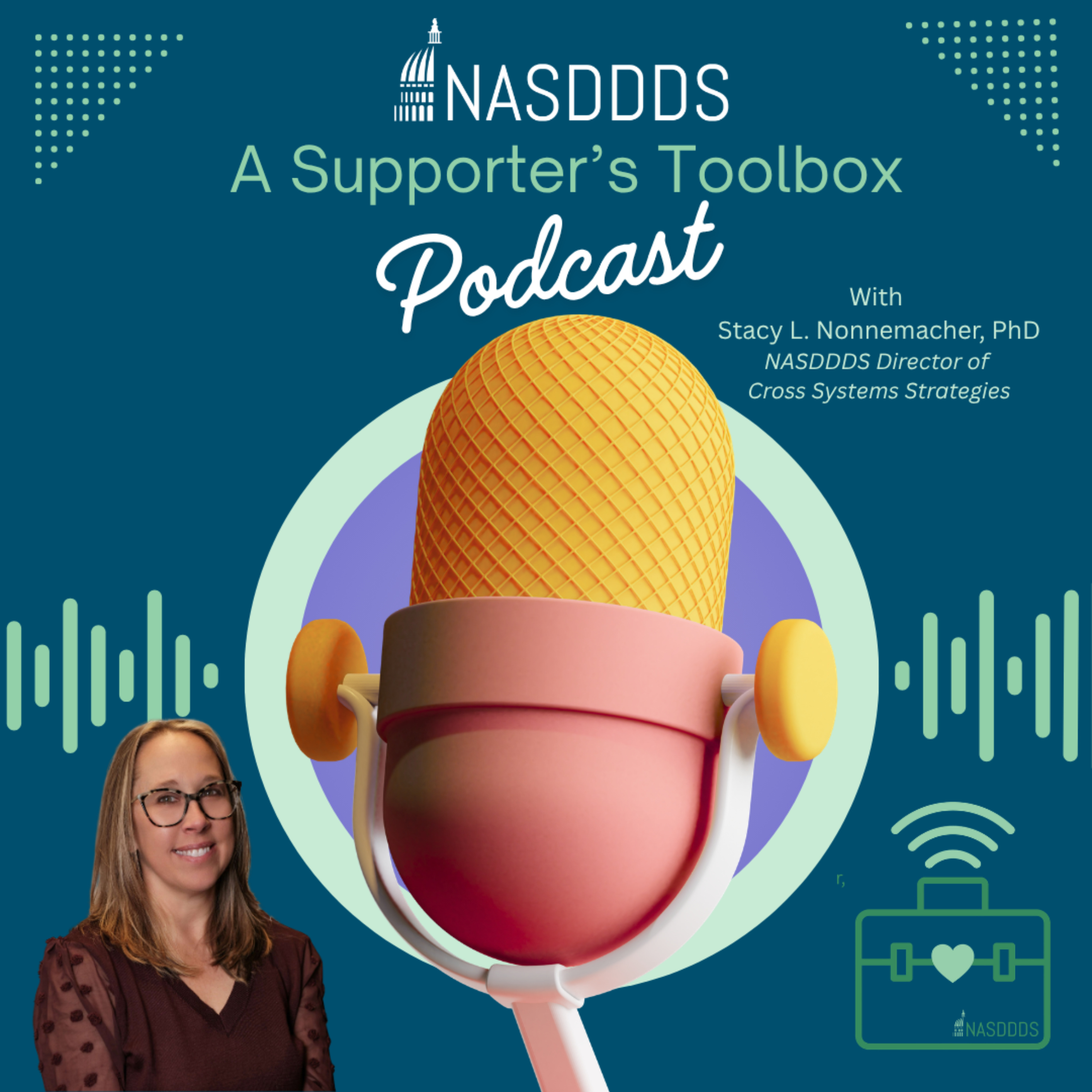
NASDDDS
A Supporter's Toolbox With Stacy L. Nonnemacher, PhD
A podcast from NASDDDS’ Director of Cross-Systems Strategies, Stacy Nonnemacher, PhD. This quarterly podcast features tips and strategies for state IDD systems to share with providers. The topics are targeted for the DSP workforce and full of information for these professionals to use daily in their work.
Besuch unbedingt die Website des Podcasts und unterstütze die Macher: podcasters.spotify.com
Wo hören?
Podcasts in der App Replaio Radio Bald verfügbarPodcasts kommen bald in die App. Installiere sie jetzt und erlebe als Erster einen ganz neuen Blick auf Podcasts
 Kostenlos installieren
Android 10 Mio.+ Downloads · Bewertung 4,7+
iOS bald
Folgen
A Place That Is Safe 19.08.2026 7:20
Stacy explores how trauma-informed support can help people with IDD feel physically, emotionally, and relationally safe. She highlights the importance of consistent connection, understanding triggers, and restoring choice and control. Stacy encourages supporters to prioritize safety over compliance and use “CPR”—Control, Predictability, and Routine—to help people build resilience, grow, and thrive...
The Two-Handed Clap: A Supporter's Role in Navigating Healthcare 06.04.2026 8:20
Stacy emphasizes the critical role supporters play in helping individuals navigate healthcare by preparing in advance, supporting self-advocacy, and ensuring clear, respectful communication. By combining preparation with person-centered support, supporters can help ensure individuals are heard, respected, and better equipped to navigate healthcare experiences.
The 3 Rs of Crisis: Regulate, Relate, and Reason 06.04.2026 7:02
Stacy draws on Dr. Bruce Perry’s “3 Rs” framework—regulate, relate, reason— emphasizing that supporters must first manage their own emotions to help others feel safe, then validate their experience, and only afterward reflect and problem-solve. By understanding what soothes, validates, and teaches each person, supporters can help expand a person’s Window of Tolerance, strengthen emotional regulati...
Points of Influence: Finding Places as a Supporter 06.04.2026 8:05
Stacy encourages supporters to recognize their “points of influence.” She encourages supporters to be educated and understand they have influence that can meaningfully impact outcomes for someone. Ultimately, she challenges listeners to step outside their lane and use their influence to help people receive comprehensive, coordinated support.
Being Prepared: Creating a Plan for Crisis 06.04.2026 6:56
Stacy emphasizes the importance of proactive, person-centered crisis planning to prevent escalation and improve outcomes when challenges arise. By planning ahead, when the person is calm and involved in the process, supporters can build trust, increase self-awareness, and reduce the likelihood of hospitalizations or law enforcement involvement.
The Right Questions, Better Support 06.04.2026 17:13
Stacy sits down with self-advocate, Perri Spencer, to explore how asking the right questions is essential to providing the right support. Through Perri’s lived experiences, particularly in medical and mental health settings, the conversation highlights how vague language, unclear timeframes, and abstract rating scales can lead to misunderstandings and inadequate care. Together, they underscore tha...
Meeting Them Where They Are: A Harm Reduction Approach 06.04.2026 5:40
Stacy introduces harm reduction as a compassionate, practical approach to supporting people who engage in risky behaviors, challenging the traditional “all-or-nothing” mindset. Drawing from its roots in the substance use field, she explains how harm reduction focuses on minimizing risk and increasing safety, such as through tapering or safer alternatives, while supporters work to understand the un...
When It Matters Most: The Vital Role of Relationships 06.04.2026 5:25
Stacy emphasizes the essential role relationships play in preventing, navigating, and healing from crises for people with disabilities. Stacy encourages supporters to strengthen communication tools and social skills, promote choice and control in relationships, actively address isolation in ways that reflect individual preferences, and help people identify and pursue meaningful relationship goals....
Social Connections: Decreasing Negative Effects of Trauma 06.04.2026 8:10
Stacy discusses how traumatic experiences can lead to post-traumatic growth, including greater appreciation for life, stronger relationships, and increased personal strength. She encourages supporters to proactively help people build meaningful, trusting relationships that foster resilience, belonging, and emotional support, noting that while trauma cannot always be prevented, strong social bonds...
Words Matter 06.04.2026 5:56
Stacy discusses the power of words and how the language we use, especially in the disability field, shapes self-perception, behavior, and even brain responses. Research shows words can influence pain, performance, and stress. She urges supporters to practice mindful, affirming language that builds confidence and positively influences how individuals see themselves and how others see them. Words, s...
Ähnliche Podcasts







Höre den Podcast A Supporter's Toolbox With Stacy L. Nonnemacher, PhD in Replaio
Radio und Podcasts in einer App - kostenlos und ohne Anmeldung. Installiere sie noch heute und verpasse den Start nicht
Replaio ist kein Herausgeber von Podcasts; die Namen der Sendungen, Cover und Audioinhalte gehören ihren Autoren und werden über öffentliche RSS-Feeds verbreitet