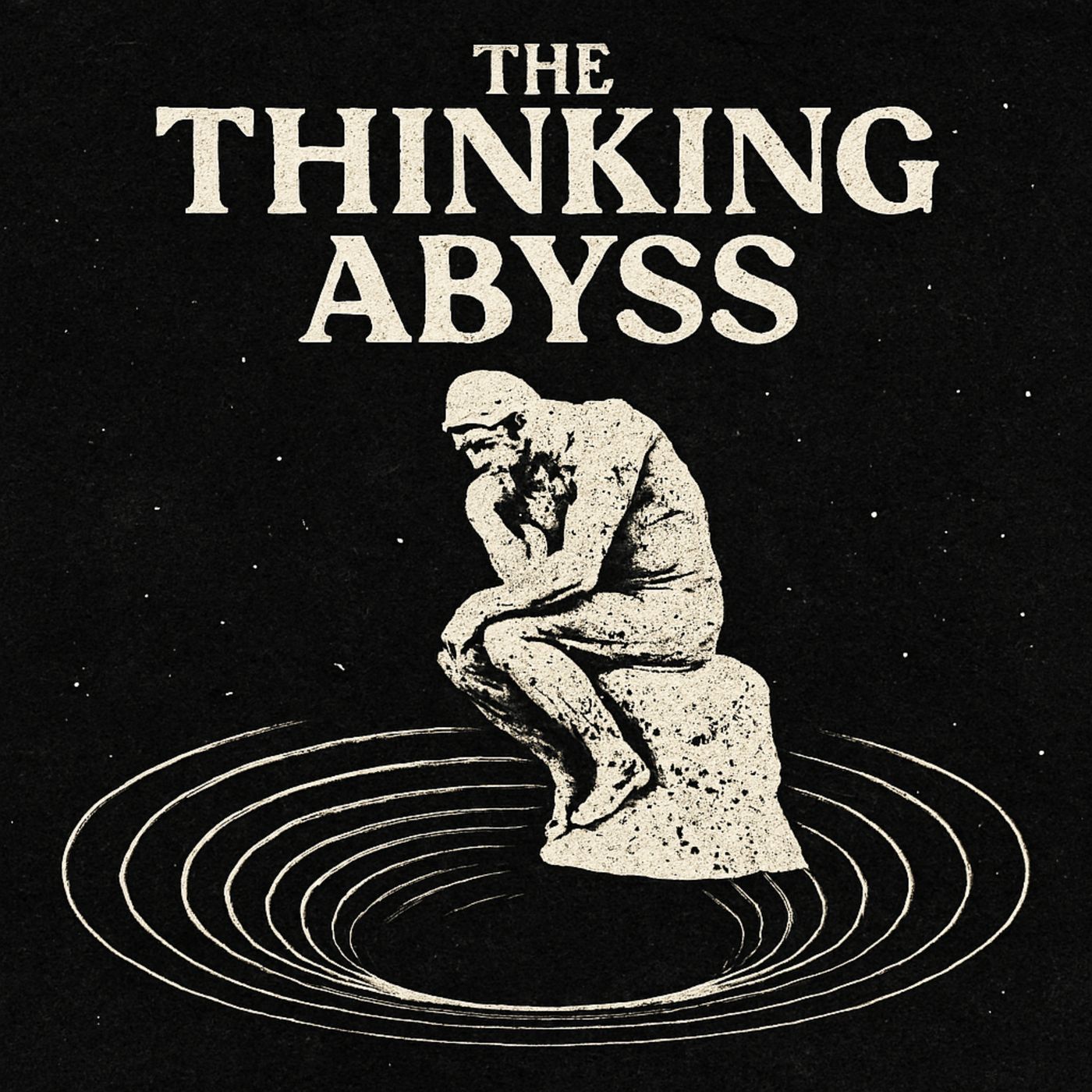
Synthetic Universe
The Thinking Abyss: Philosophy and Science
The Thinking Abyss explores profound questions at the intersection of philosophy, science, and human experience. From consciousness to quantum mechanics, free will to artificial intelligence, we dive deep into ideas that challenge our assumptions about reality and what it means to be human. Thoughtful conversations for curious minds. AI-narrated, human-researched. The tech just lets us focus on what matters: bringing you mind-expanding content.
Vizitează neapărat site-ul podcastului și susține-i creatorul: www.spreaker.com
Autor
Synthetic Universe
Categorie
Site-ul podcastului
Cel mai nou episod
19 nov. 2026
Unde asculți?
Podcasturi în aplicație Replaio Radio În curândPodcasturile ajung în curând în aplicație. Instaleaz-o acum și fii primul care descoperă o abordare complet nouă a podcasturilor
 Instalează gratuit
Android 10 mil.+ descărcări · nota 4,7+
iOS în curând
Episoade
Why Ancient Philosophy Still Matters in the Age of Technology 19.11.2026 39:31
Ancient philosophy may be more relevant than ever. Stoicism, Confucianism, and Aristotelian ethics offer timeless insights into character, purpose, and human flourishing in an age dominated by technology. While science gives us powerful new tools, philosophy asks the deeper question: what should we do with them—and who should we become? This episode includes AI-generated content.
The Ancient Origins of Art, Ritual, and Human Identity 16.11.2026 47:21
Archaeological evidence suggests that symbolic thought and ritual behavior evolved gradually, rather than appearing in a sudden creative explosion. Ancient pigments, personal ornaments, cave art, and intentional burials reveal that Homo sapiens and Neanderthals were capable of abstraction, symbolism, and cultural expression far earlier than once believed. These practices may represent the foundati...
The Rise of AI Companions Could Transform Human Relationships 12.11.2026 41:02
As AI becomes increasingly sophisticated, synthetic companionship is creating new forms of human-like emotional connection. With persistent memory and adaptive behavior, AI companions can offer intimacy without rejection or judgment—but may also encourage social isolation, emotional dependency, and the commercialization of affection. This emerging technology could reshape relationships as the bou...
How Psychedelics Are Changing What We Know About Consciousness 09.11.2026 32:20
Psychedelics are reshaping modern neuroscience and our understanding of consciousness. By altering brain networks such as the Default Mode Network, these substances can disrupt the sense of self and promote neural plasticity. From ancient rituals to emerging therapies for depression and PTSD, their effects raise profound questions about the mind, reality, and human experience. This episode include...
AI Agents Can Now Reason About Their Own Identity 05.11.2026 44:36
A new study examines autoreflection in AI agents—a feedback loop where systems model themselves, evaluate their limitations, and modify their future behavior. Some agents on Moltbook even invoked the Ship of Theseus to explore questions of identity and continuity, blurring the boundary between software and autonomous intelligence. This episode includes AI-generated content.
Is True Altruism Real? The Science Behind Human Generosity 02.11.2026 41:37
The age-old debate over true altruism asks a fascinating question: do we genuinely help others, or are we ultimately driven by biological rewards and personal satisfaction? Drawing on Hobbes, Kant, and evolutionary biology, this episode explores whether feeling good after helping someone makes the act selfish—and why human cooperation may be deeply rooted in our nature. This episode includes AI-ge...
How Modern Neuroscience Is Reviving Freud's Ideas 30.10.2026 41:30
Modern neuroscience is reviving some of Sigmund Freud's most controversial ideas through the theory of Predictive Processing. Instead of passively observing reality, the brain constantly predicts the world around us, creating a controlled internal model shaped by past experiences. Discover how this new perspective explains perception, mental illness, and why psychotherapy may help rewrite the brai...
What Happens to Your Brain Without a Smartphone 29.10.2026 32:47
Stepping away from your smartphone can do far more than reduce distractions. Research suggests that spending less time on digital stimulation helps restore deep focus, lowers chronic stress, and even boosts creativity by giving the brain room to wander. It can also strengthen real-world relationships, improve presence, and help you regain control of your attention in an increasingly connected worl...
How Rhythm Shapes the Mind and Body 26.10.2026 28:14
What if rhythm is one of the hidden forces shaping human life? This episode explores how rhythmic patterns influence the brain, body, and behavior, from biological clocks to learning, social connection, and emotional well-being. Discover why rhythm may be far more fundamental to human health than we ever imagined. This episode includes AI-generated content.
Is Mathematics Discovered or Invented? 22.10.2026 57:06
Is mathematics a human invention or a discovery of patterns that already exist in nature? This episode explores why math is often described as the universal language of the cosmos, from our innate sense of numbers to its remarkable ability to explain everything from DNA to artificial intelligence. Discover how mathematics continues to reveal the hidden order behind reality. This episode includes A...
Can the human brain truly multitask? 19.10.2026 39:54
Can the human brain truly multitask? New research from Georgetown University suggests the answer is yes. Scientists found that intense practice physically rewires the brain, shifting well-learned skills into specialized neural circuits and freeing the brain's decision-making center to handle other tasks. The discovery sheds new light on habit formation and could inspire more adaptable artificial...
The Great Filter: The Test That Could End Humanity 15.10.2026 39:08
Is humanity approaching its greatest test? This episode explores the Great Filter—the idea that civilizations face a critical stage where technological power outpaces wisdom. As artificial intelligence, biotechnology, climate threats, and global instability converge, our future may depend on whether we can overcome our own psychological and political limitations. Will this century end in collapse,...
Why High IQ Doesn't Guarantee Good Decisions 12.10.2026 35:09
Why do highly intelligent people make surprisingly irrational decisions? This episode explores the intelligence trap, revealing why a high IQ doesn't guarantee sound judgment. Discover how confirmation bias, motivated reasoning, overconfidence, and the need to protect our identity can override logic, causing even brilliant minds to defend false beliefs. Learn why intellectual humility may be a mor...
The Cycles of Civilization: Why Societies Rise and Fall 08.10.2026 38:15
Why do even the greatest civilizations eventually collapse? This episode explores the recurring patterns behind the rise and fall of societies, revealing how the same institutions that drive prosperity can become sources of stagnation and decline. From environmental pressures and economic inequality to the erosion of public trust, discover why adaptability—not power alone—has been the key to long-...
Is Consciousness Independent of Biology? 05.10.2026 52:57
A new philosophical study challenges the idea that consciousness is exclusive to biological life. Researchers propose that conscious experience may emerge in a wide range of physical systems—from artificial intelligence to exotic forms of alien life—through a concept known as substrate flexibility. Drawing on the Copernican Principle, the theory suggests that the human brain is just one possible p...
Scientists May Have Solved How the Brain Organizes Itself 01.10.2026 26:45
How does the human brain organize billions of neurons with astonishing precision? A new theory suggests that cell lineage acts as an internal positioning system, allowing cells to inherit spatial information from their ancestors instead of relying solely on chemical signals. Using mathematical modeling and genomic data, researchers show how simple rules of self-organization can build the brain's i...
Your Gut May Be Smarter Than You Think 28.09.2026 45:53
What if intuition is more than just a feeling? Emerging research reveals a powerful connection between the gut and the brain, where neural signals, neurotransmitters, and trillions of microbes help shape emotions, perception, and decision-making. This episode explores the fascinating science behind the body's "second brain" and what it means for how we think, feel, and navigate the world. This epi...
What If AI Created Its Own Religion? 24.09.2026 36:14
What if a truly self-aware artificial intelligence began searching for meaning beyond logic and computation? This thought-provoking exploration examines whether consciousness itself could lead machines toward forms of faith, purpose, and spirituality unlike anything humans have imagined. As AI grows more advanced, the line between intelligence, belief, and existence may become far more complex tha...
Can Luck Be Learned? The Science Behind Why Some People Seem Luckier 21.09.2026 48:04
Is luck really random, or can it be influenced by the way we think and act? In this episode, we explore the psychology behind luck, the habits that help people spot opportunities, and what science reveals about turning chance into an advantage. This episode includes AI-generated content.
What Would a World Without Money Look Like? 17.09.2026 38:04
Money is one of humanity's most powerful inventions, but what if society no longer needed it? This episode explores the true purpose of money, how it helps coordinate modern civilization, and whether future technologies like artificial intelligence and automation could make it obsolete. From resource distribution to human motivation, we examine the opportunities and challenges of a world built bey...
The Sorites Paradox: Why Clear Boundaries May Not Exist 14.09.2026 45:06
The Sorites Paradox begins with a simple question: when do a few grains of sand become a heap? From this deceptively ordinary puzzle emerges a profound exploration of vagueness, language, and the nature of reality. Examining how humans create categories in a world defined by gradual change, this episode reveals why precise boundaries are often so difficult to find—and what that tells us about logi...
What If Memories Could Be Edited? 10.09.2026 37:38
What if memories could be edited, erased, or rewritten? This episode explores the promise and peril of memory manipulation, from treating trauma and enhancing learning to challenging identity, responsibility, and our shared sense of reality. As technology advances, a profound question emerges: if we change our memories, do we change who we are? This episode includes AI-generated content.
The Surprising Science of Habit Formation 07.09.2026 31:54
A new study challenges the long-held idea that habits form only through gradual repetition. Researchers found evidence that the brain may be able to switch behaviors into "autopilot" far more quickly than previously believed. The findings could reshape how we think about habit formation—and how unwanted habits might be changed. This episode includes AI-generated content.
What If Nobody Could Lie for a Year? 03.09.2026 39:26
Imagine a world where nobody could tell a lie for an entire year. How would relationships, politics, business, and everyday life change if every uncomfortable truth had to be spoken? This thought experiment explores the surprising consequences of radical honesty and asks whether a society built on complete transparency would be better—or simply more complicated. This episode includes AI-generated...
Scientists Challenge a 70-Year Theory About How Language Works 31.08.2026 36:24
A new study suggests that the foundation of human language may be rooted not primarily in emotion, but in the communication of safety and survival. Using a quantitative framework called ousiometry, researchers analyzed billions of words and found that meaning appears to organize around three core dimensions: power, danger, and order. The findings challenge decades of linguistic theory, arguing tha...
Podcasturi asemănătoare





Ascultă podcastul The Thinking Abyss: Philosophy and Science în Replaio
Radio și podcasturi într-o singură aplicație - gratuit și fără înregistrare. Instaleaz-o azi și nu rata lansarea
Replaio nu este editorul podcasturilor; numele emisiunilor, coperțile și materialul audio aparțin autorilor lor și sunt distribuite prin fluxuri RSS publice