Circle Of Insight Productions
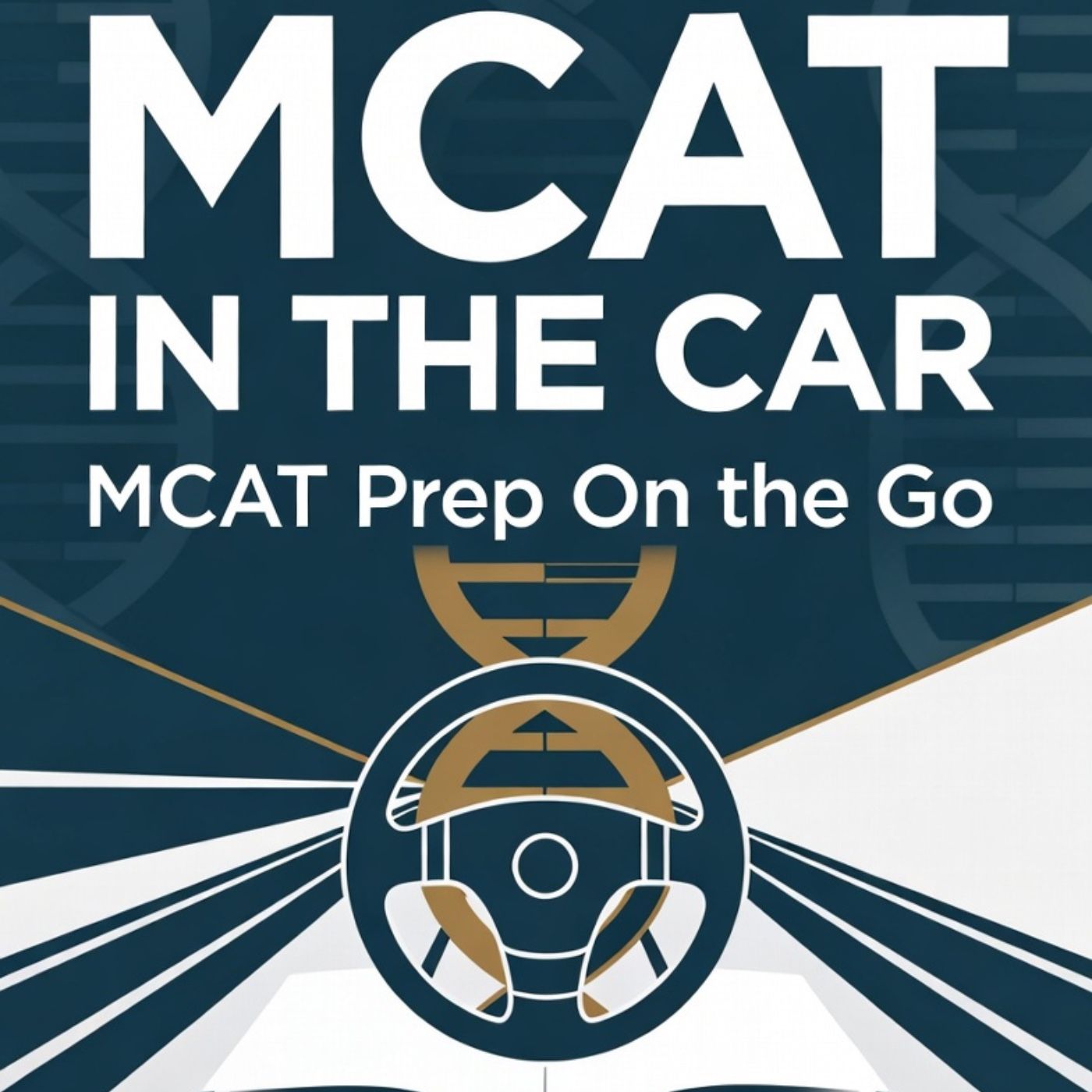
MCAT In The Car
MCAT in the Car is your high-yield mobile prep companion for the MCAT. Turn your commute, workouts, errands, or downtime into focused study sessions with clear, digestible breakdowns of all sections: Biological and Biochemical Foundations of Living Systems, Chemical and Physical Foundations of Biological Systems, Psychological, Social, and Biological Foundations of Behavior, and Critical Analysis and Reasoning Skills (CARS). Get science concept reviews, passage strategies, CARS techniques, practice question walkthroughs, mnemonics, test-taking tips, and mindset advice from 99th-percentile scor...
Vizitează neapărat site-ul podcastului și susține-i creatorul: www.spreaker.com
Autor
Circle Of Insight Productions
Categorie
Site-ul podcastului
Cel mai nou episod
16 nov. 2026
Unde asculți?
Podcasturi în aplicație Replaio Radio În curândPodcasturile ajung în curând în aplicație. Instaleaz-o acum și fii primul care descoperă o abordare complet nouă a podcasturilor
 Instalează gratuit
Android 10 mil.+ descărcări · nota 4,7+
iOS în curând
Episoade
SN1 vs. SN2 Reactions Made Simple for the MCAT: Mechanisms, Stereochemistry, and Common Exam Traps 16.11.2026 3:04
Understanding SN1 and SN2 reactions is essential for the MCAT, particularly when predicting organic chemistry reaction mechanisms, products, and stereochemistry. This episode explains how nucleophiles, leaving groups, solvents, and molecular structure determine whether a reaction follows an SN1 or SN2 pathway. Through practical examples and common exam traps, you’ll learn how to distinguish these...
DNA Replication Made Simple for the MCAT: Leading Strands, Lagging Strands, and Okazaki Fragments Explained 15.11.2026 3:22
DNA replication is a fundamental concept tested on MCAT, particularly in questions involving molecular biology, enzyme function, and genetic inheritance. This episode explains how DNA is copied, why leading and lagging strands are synthesized differently, and the roles of helicase, primase, DNA polymerase, and ligase. You’ll also learn how Okazaki fragments are formed, why DNA synthesis proceeds i...
The Pentose Phosphate Pathway Made Simple for the MCAT: NADPH, Ribose-5-Phosphate, and Oxidative Stress 10.11.2026 3:12
The pentose phosphate pathway is an important metabolic pathway tested on the MCAT, particularly in questions involving glucose metabolism, nucleotide synthesis, and cellular protection against oxidative damage. This episode explains how the pathway produces NADPH and ribose-5-phosphate, why glucose-6-phosphate dehydrogenase deficiency can damage red blood cells, and how the pathway differs from g...
Thermodynamics Made Simple for the MCAT: Gibbs Free Energy, Enthalpy, Entropy, and Spontaneous Reactions 08.11.2026 4:14
Thermodynamics is one of the most important chemistry concepts tested on the MCAT, particularly when evaluating chemical reactions, metabolic pathways, and energy transfer. This episode explains Gibbs free energy, enthalpy, entropy, and the relationship between spontaneity and equilibrium using practical examples and straightforward calculations. You’ll also learn how ATP hydrolysis drives unfavor...
Michaelis-Menten Kinetics for the MCAT: Competitive, Noncompetitive, and Uncompetitive Inhibition Explained 03.11.2026 2:43
Understanding enzyme inhibition is essential for the MCAT, especially when interpreting changes in Km and Vmax. This episode explains Michaelis-Menten kinetics, the four major patterns of enzyme inhibition, and how each affects enzyme activity. You’ll also learn how to recognize common exam traps, interpret enzyme kinetics graphs, and apply these principles to MCAT-style questions.
Gluconeogenesis for the MCAT: How the Body Makes Glucose During Fasting 02.11.2026 4:07
Gluconeogenesis is an essential metabolic pathway that allows the body to produce glucose when dietary carbohydrates are unavailable. This episode explains how the liver and kidneys synthesize glucose from lactate, glycerol, and certain amino acids, while examining the three major bypass reactions that distinguish gluconeogenesis from glycolysis. You'll also learn how insulin, glucagon, and cellul...
Acids, Bases, and Buffers for the MCAT: pH, pKa, and the Henderson-Hasselbalch Equation Made Simple 01.11.2026 3:39
Understanding acids, bases, and buffers is essential for the MCAT, particularly when interpreting biochemical reactions and physiological systems. This episode explains pH, pKa, the Henderson-Hasselbalch equation, and how buffers resist changes in acidity. You’ll also learn how to solve common MCAT calculations, recognize acid-base relationships, and apply these concepts to blood chemistry, amino...
Newton’s Laws for the MCAT: Forces, Motion, and Acceleration Made Simple 19.10.2026 2:37
Newton’s three laws of motion are essential concepts for the Chemical and Physical Foundations section of the MCAT. In this episode of MCAT in the Car, we explain how forces affect movement, why mass and acceleration are connected, and how Newton’s laws apply to everyday situations and human physiology. You’ll learn the difference between balanced and unbalanced forces, understand the equation F e...
Enzyme Kinetics for the MCAT: Km, Vmax, and Competitive Inhibition Explained 18.10.2026 3:19
Enzyme kinetics is one of the most important biochemistry concepts tested on the MCAT. In this episode of MCAT in the Car, we explain how enzymes accelerate chemical reactions, what Km and Vmax tell us about enzyme activity, and how competitive and noncompetitive inhibitors change reaction rates. You’ll also learn how to recognize common MCAT questions about enzyme inhibition without getting lost...
Glycolysis for the MCAT: ATP, NADH, and the Three Enzymes You Must Know 13.10.2026 3:53
Glycolysis is one of the most important metabolic pathways tested on the MCAT, and understanding it is essential for mastering cellular energy production. In this episode, we break down how glucose is converted into pyruvate, why ATP is both consumed and produced, and how NADH contributes to cellular metabolism. You’ll learn the three key regulatory enzymes, the net ATP yield, and the differences...
Stoichiometry Made Simple: Moles, Limiting Reactants, and Chemical Reactions 11.10.2026 4:44
One of the most intimidating aspects of MCAT chemistry is stoichiometry. Students see chemical equations, unfamiliar numbers, and multiple conversion steps, and suddenly a relatively simple problem feels overwhelming. But stoichiometry is really about understanding proportions. Once you understand the relationships between substances in a chemical reaction, the calculations become much more manage...
Lipid Digestion Explained: Enzymes, Micelles, and Chylomicrons 08.10.2026 4:39
Understanding lipid digestion requires connecting biochemistry with gastrointestinal physiology. This episode examines triglyceride hydrolysis, bile salt emulsification, micelle formation, and intestinal lipid transport. Discover how enterocytes reassemble triglycerides and package them into chylomicrons for transport through the lymphatic system. Review essential biochemical mechanisms and their...
Atomic Structure and Periodic Trends: Why the Periodic Table Predicts Chemistry 04.10.2026 4:50
The periodic table is more than a collection of elements—it is a map that allows you to predict how atoms behave. In this episode of MCAT in the Car, we review atomic structure, electron configuration, valence electrons, and effective nuclear charge. You’ll learn the major periodic trends involving atomic radius, ionization energy, electron affinity, and electronegativity. More importantly, we’ll...
The Optics & Waves Matrix: Mastering Lenses, Mirrors, Sound, and the Doppler Effect for the MCAT 27.09.2026 5:11
Optics and waves can become relatively easy MCAT points once you stop memorizing isolated equations and start recognizing predictable patterns. This study guide walks through converging and diverging lenses, mirrors, the thin-lens equation, sound waves, and the Doppler effect. Special attention is given to common MCAT traps and how Doppler ultrasound uses changes in frequency to determine blood ve...
CRISPR Turns Down the Bradykinin Dial 20.09.2026 6:33
On September 8, 2026, the FDA accepted Intellia’s biologics application for lonvo-z, a one-time in vivo CRISPR therapy for hereditary angioedema, and gave it Priority Review. That matters because a single gene edit in the liver could replace lifelong attack-prevention drugs for a rare swelling disease driven by excess bradykinin. The core MCAT hook is how loss-of-function CRISPR editing of *KLKB1*...
MCAT Psych/Soc High-Yield: Sensation vs. Perception, Conditioning Schedules, and Three Sociological Lenses 13.09.2026 3:59
Bottom-up and top-down processing are the fastest way to sort sensation from perception on AAMC-style passages. Variable-ratio and fixed-interval schedules produce opposite response patterns and extinction rates that the exam loves to test. Knowing how Conflict Theory, Symbolic Interactionism, and Structural Functionalism actually sound in a vignette lets you eliminate two wrong frameworks in seco...
Starling’s Bargain: The Physics of Capillary Fluid Exchange and Edema 10.09.2026 6:18
This episode examines how microvascular fluid balance is governed by the equilibrium between hydrostatic and oncotic pressures across semipermeable capillary membranes. It explores the physiological variables—transcapillary pressure gradients (\Delta P), oncotic gradients (\Delta \pi), and the endothelial reflection coefficient (\sigma)—that dictate fluid filtration into tissue spaces. Finally, it...
The Lipid Ledger: β-Oxidation vs Fatty-Acid Synthesis, Ketone Bodies, and Membrane Fluidity we use a Lego analogy to help understand 06.09.2026 12:00
This study guide deconstructs lipid biochemistry by examining the reciprocal regulation of catabolic (kat-uh-BAH-lik: breakdown) and anabolic (an-uh-BAH-lik: building) acyl (AY-sil) pathways, centering on the carnitine (KAR-nih-teen) shuttle and allosteric (al-oh-STEER-ik: enzyme-regulating) control via malonyl-CoA (MAL-uh-nil koh-AY). We clarify the compartmental and enzymatic divide governing he...
MCAT Biology Core: From Gene to Protein—Replication, Transcription, and the Genetic Code 01.09.2026 5:58
Following our discussion of enzyme kinetics, this MCAT study guide traces the path from DNA replication to a functioning protein. It reviews replication-fork mechanics, proofreading and DNA repair, promoter and enhancer regulation, and wobble in the genetic code. Most importantly, it explains how a single nucleotide change can alter a protein’s structure—and potentially change its K_m, V_{\max}, o...
MCAT Practice Questions (Action Potentials & Acid-Base Balance) 27.05.2026 6:45
MCAT Practice Questions (Action Potentials & Acid-Base Balance)
The Bio-Electric Engine: Integrating Nervous System Action Potentials with Henderson-Hasselbalch Blood Buffering 25.05.2026 8:38
This episode explores the intricate connection between the nervous system’s electrical signaling via action potentials and the body’s chemical buffering system governed by the Henderson-Hasselbalch equation, essential for maintaining physiological homeostasis. Designed for post-MCAT learners, it breaks down these concepts in accessible terms while highlighting their clinical and exam relevance. Li...
Glycolysis vs Gluconeogenesis: Key Regulation & Rate-Limiting Steps 21.05.2026 6:14
Master the critical metabolic crossroads of glycolysis and gluconeogenesis with a clear, exam-focused analysis of their reciprocal regulation, rate-limiting enzymes, and the pivotal role of fructose 2,6-bisphosphate. This episode explains how insulin and glucagon control these opposing pathways to maintain blood glucose, prevent futile cycling, and support energy demands in fed and fasting states....
The Amino Acid Ledger: Charge, Hydrophobicity, and Enzyme Kinetics (V_{max} and K_m) 17.05.2026 10:39
This episode integrates organic chemistry, biology, and biochemistry by treating amino acids as physical molecules defined by their charge and hydrophobicity, demonstrating how substitutions alter protein tertiary structure and function. It provides a precise breakdown of enzyme kinetics, focusing on V_{max} and K_m, and illustrates the effects of competitive, uncompetitive, and noncompetitive inh...
How to Pass the MCAT on Your First Try: Complete 2026 AAMC Blueprint + 3-Phase Strategy to Hit 528 (Chem/Phys, CARS & Bio/Biochem) 17.05.2026 5:54
The MCAT is a 7.5-hour endurance marathon testing foundational pre-med sciences and critical reasoning across four AAMC sections: Chemical & Physical Foundations (59 questions), Critical Analysis & Reasoning Skills (CARS – 53 questions), Biological & Biochemical Foundations (59 questions), and Psychological, Social & Biological Foundations of Behavior (59 questions). This complete...
Podcasturi asemănătoare







Ascultă podcastul MCAT In The Car în Replaio
Radio și podcasturi într-o singură aplicație - gratuit și fără înregistrare. Instaleaz-o azi și nu rata lansarea
Replaio nu este editorul podcasturilor; numele emisiunilor, coperțile și materialul audio aparțin autorilor lor și sunt distribuite prin fluxuri RSS publice