Al Zambone
Historically Thinking
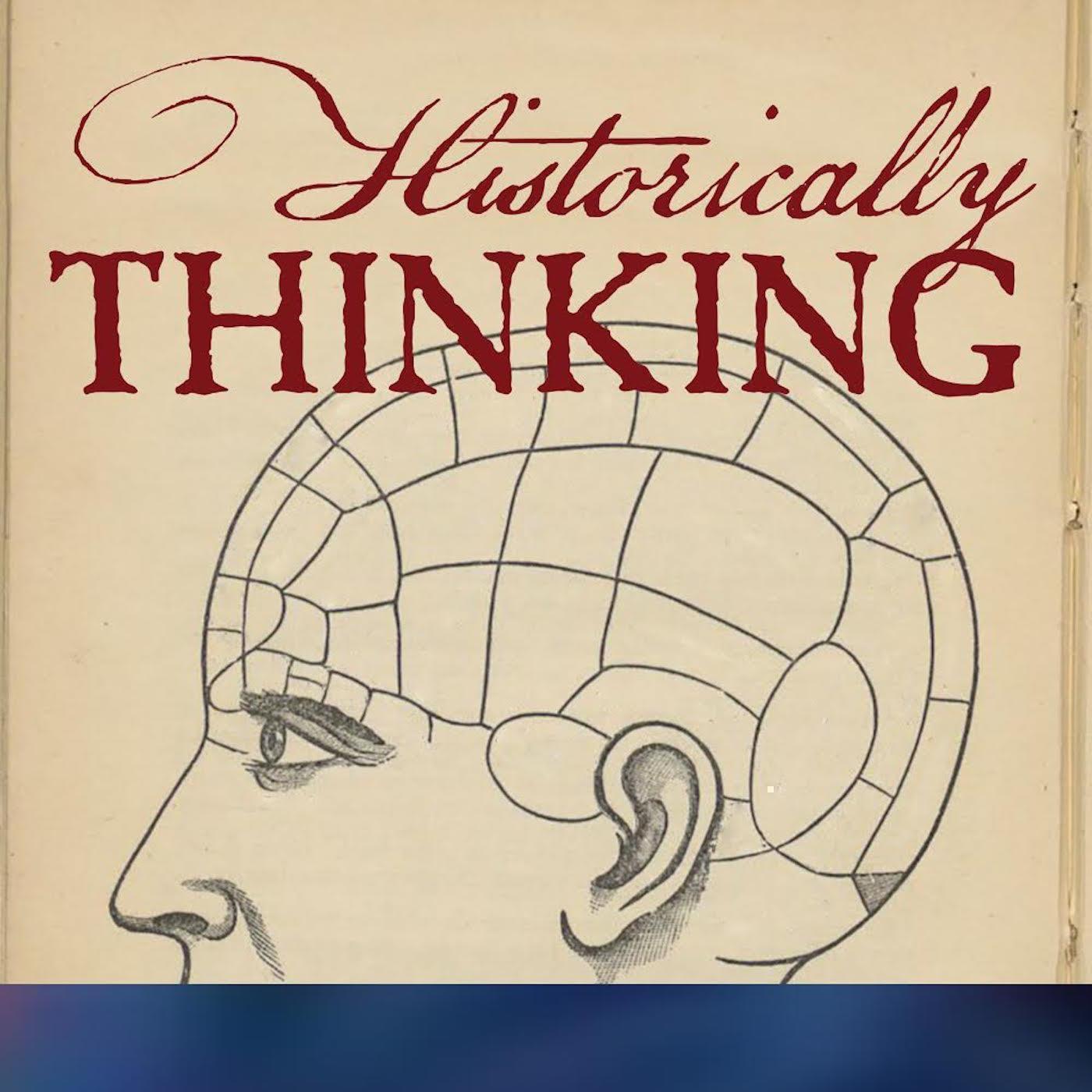
We believe that when people think historically, they are engaging in a disciplined way of thinking about the world and its past. We believe it gives thinkers a knack for recognizing nonsense; and that it cultivates not only intellectual curiosity and rigor, but also intellectual humility. Join Al Zambone, author of Daniel Morgan: A Revolutionary Life, as he talks with historians and other professionals who cultivate the craft of historical thinking.
Vizitează neapărat site-ul podcastului și susține-i creatorul: blubrry.com
Unde asculți?
Podcasturi în aplicație Replaio Radio În curândPodcasturile ajung în curând în aplicație. Instaleaz-o acum și fii primul care descoperă o abordare complet nouă a podcasturilor
 Instalează gratuit
Android aproape 10 mil. descărcări · nota 4,8
iOS în curând
Instalează gratuit
Android aproape 10 mil. descărcări · nota 4,8
iOS în curând
Episoade
Episode 305: Degrading Equality 27.02.2023 1:18:55
In 1835, Oberlin College in Ohio determined that it would admit black students. A very few other colleges did at the time, but Oberlin was unique in that it chose to do so as an explicit matter of college policy. At Oberlin, and a few other places both before and after the Civil War, black and white students were allied first in the cause of emancipation, and then for civil rights. Yet following...
Episode 304: Mass Expulsion 20.02.2023 1:03:56
“At the start of the twelfth century,” writes Rowan Dorin, “western European rulers almost never resorted to the collective expulsions of wrongdoers from their domains; ecclesiastical authorities evinced little concern about the Jewish communities living under Christian rule; and the church’s efforts to repress usury focused largely on clerics who engaged in money lending. By the late thirteenth...
Episode 303: Victorian Jacobites 13.02.2023 53:39
On a January night in 1897, a crowded Episcopal church in Philadelphia was the stage for a curious ceremony. In the Church of the Evangelists, located in south Society Hill just ten or so blocks from Independence Hall, a gaggle of clerics unveiled a life-size painting of Charles I, King of England and–so far as the clerics were concerned–saint and martyr. Then Williams Stevens Perry, the Episcopal...
Episode 302: Tudor England 06.02.2023 1:02:37
On 11 October 1537, Henry VIII finally received the son for which he had been waiting for decades. The day before the future Edward VI was born, friars, priests, livery companies, and the mayor and aldermen of London all processed through the city streets, praying for the Queen’s safe delivery. With his birth te deums were sung in London’s churches, bells were rung, fires were lit in every street,...
Episode 301: Wandering Army 23.01.2023 1:08:43
On May 11th, 1745, the British Army went into battle against the army of France near the village of Fontenoy, in what is now Belgium. 15,000 British soldiers marched forward bearing not only their muskets, but the reputation that they had gained in the continental campaigns of John Churchill, the first Duke of Marlborough. But Marlborough had by then been dead for nearly 25 years, and the British...
Episode 300: Wild Problems 09.01.2023 1:08:42
Welcome to Episode 300 of Historically Thinking! Design theorists popularized the idea of “tame problems” and “wicked problems.” “Tame problems” are answers to questions like how to get to Chicago, or how to increase the battery life of a cell phone. As in mathematics and chess have clarity in their aims and their solutions. “Wicked problems” have neither clarity in their aims or in their solut...
Episode 299: The Good Country 05.01.2023 1:07:42
What lover of American literature doesn’t remember these haunting lines: “Tell about the Midwest. What's it like there. What do they do there. Why do they live there. Why do they live at all.” Of course that was, as some of you quickly recognized, a deliberate mangling of a famous passage from William Faulkner’s Absalom Absalom. It’s more than a little disconcerting, as I hope you noticed, to subs...
Episode 298: How the Victorians Took Us to the Moon 19.12.2022 1:03:14
The Victorians didn’t actually travel to the moon. But they were the first people, observes my guest Iwan Morus, to think that travel to the Moon was not only possible, but that “their science already possessed – or would soon possess – the means of getting there.” This confidence was based on the cascades of “new technologies, new ways of making knowledge and new visions about the future came tog...
Episode 297: Reign of Arrows 12.12.2022 1:17:40
If the Parthian Empire is known at all, it’s by students of Roman history who see it pop up from time to time, before disappearing once again. Marcus Licinius Crassus, a member of the first triumvirate– consisting of himself, Pompey, and Julius Caesar– died in battle against the Parthians. At the moment of his assasination, Caesar was preparing for a campaign against Parthia; and Mark Anthony, o...
Episode 296: Mercy 05.12.2022 57:48
I can't introduce Cathal Nolan's book Mercy: Humanity in War any better than he does himself, with these words: This is not a book about war. It is about mercy and humanity… Mercy happens in a microsecond, wrapped inside a surprise moment of mortal danger; it restrains baser instinct and reminds us about higher things. This book shows that mercy limits cruelty in ways laws and honor codes seldom d...
Episode 295: New England Fashion 28.11.2022 1:27:53
When the Massachusetts Historical Society was founded in 1791, its august members probably did not anticipate that one day its archives would contain not only family papers, but family dresses–as well as waistcoats, wigs, and at least two scarlet cloaks worn by fashionable men in the late eighteenth century. Kimberley Alexander (who is Director of Museum Studies and Lecturer at the University of N...
Episode 294: Black Suffrage 21.11.2022 54:38
On April 11, 1865, Abraham Lincoln addressed a crowd gathered outside the White House. He spoke not of recent victories, or those to come, but to the shape of the peace that would follow. Now that the Thirteenth Amendment had been passed by Congress, he urged that it be ratified. Moreover, it seemed to him, Lincoln said, that it was necessary for “the colored man” to have the right to vote. “I my...
Episode 293: Brilliant Commodity 14.11.2022 57:17
At the end of the 19th century, Amsterdam was home to nearly seventy diamond factories, in which were 7,500 steam-powered polishing mills. The workers who cut and polished the diamonds, brought there from the mines of South Africa, were not all Jewish–but many of them were. Indeed, in the late 1890s Jews were about 10% of the population of Amsterdam, and half of them were economically reliant on w...
Episode 292: Mutiny! 07.11.2022 1:02:57
It is perhaps the greatest scandal and sea-story of the first half of 19th Century America that nearly everyone has forgotten. It led to a court martial, endless headlines, a fistfight in a meeting of the President’s cabinet, and quite possibly to the foundation of the United States Naval Academy. And given that nearly everyone who went to see in the early American republic seemed to know one anot...
Episode 291: True Blue 31.10.2022 1:04:26
In late November, 1864, David R. Snelling visited his uncle, who then lived in Baldwin County near Milledgeville, Georgia. As a boy, he had worked in his uncle’s fields alongside those his uncle enslaved. Now Snelling returned home as a Lieutenant in the Army of the United States, commanding Company I of the First Alabama Cavalry–though detached on temporary duty as commander of the headquarters e...
Episode 290: Oh, Dakota! 27.10.2022 53:14
My guest today is Dr. Ben Jones, Director of the South Dakota State Historical Society and the South Dakota State Historian. Ben Jones served for 23 years in the United States Air Force, attaining the rank of lieutenant colonel. During his service he taught at the Air Force Academy. Subsequently he was dean of the College of Arts and Sciences at South Dakota State University from 2013 to 2019, a...
Episode 289: Peace and Friendship in the American West 24.10.2022 1:02:25
For over a generation the history of the American West has been described by scholars as one of violence, including genocide, ethnic-cleansing, and settler colonialism. While it replaced an older history which spoke of “winning the West” and the triumph of civilization, curiously enough both the old and the now aging histories of the west focused on violence. After all, in the popular imagination,...
Episode 288: The American Revolution in Hapsburg Lands 20.10.2022 1:03:02
In 1780, captured American naval officer Joshua Barney escaped from prison in Plymouth, made his way to London, and with the help of some English sympathizers to the American Revolution was able to take the ferry to Ostend, the principal port of the Austrian Netherlands. During his journey he struck up an acquaintance with an Italian noblewoman after curing her seasickness. Grateful, she insisted...
Episode 287: The Hessians are Coming! 17.10.2022 1:12:49
In 1776 a massive British fleet of more than 400 ships carrying tens of thousands of soldiers arrived outside New York Harbor. Many of these soldiers were German, hired from their princes by the British government. Americans then and now have called them Hessians. For the next seven years, these German soldiers marched, fought, and suffered seemingly everywhere in eastern North America, from the w...
Episode 286: Weavers, Scribes, and Kings 13.10.2022 1:19:13
The history of the ancient Near East can seem like staring down a deep, deep well of time, so deep that it gives one vertigo. It stretches back to 3,500 BC: that is, I’ll do the math for you, 5,522 years ago. In thinking about its 3,000 years of history, one begins to think not in terms of years, but in decades and centuries. Yet there were continuities amidst change, not simply within those three...
Episode 285: Finding Agatha Christie 10.10.2022 1:03:12
At her 80th birthday party Agatha Christie described a conversation she had once overheard about herself. She had been on a train, and there listened to two ladies talking about her, copies of her latest mystery perched on both their knees. “I hear,” said one, “that she drinks like a fish.” Christie’s latest biographer Lucy Worsley begins her new book with that anecdote because for her it so nice...
Episode 284: The Greatest Russian General, in War and Peace 03.10.2022 1:08:00
If we know Mikhail Ilarionovich Golenischev-Kutuzov, we know him as Tolstoy imagined him, as an old man, before Austerlitz, “with his uniform unbuttoned so that his fat neck bulged over his collar if escaping… in a low chair with his podgy old hands resting symmetrically on its arms'' who begins to snore loudly and rhythmically as his generals plan the battle. Why? Because he alone understands the...
Episode 283: Two Houses, Two Kingdoms 29.09.2022 1:10:46
For centuries the Kingdom of England faced northeast, across the northern seas towards Scandinavia. Indeed, under King Canute, England was part of Scandinavia. But with the Norman invasion–even though the Normans were eponymously “North-men”–that changed dramatically. Within a few decades, the French and English royal trees began to intertwine, to graft branches to one another, to make love and wa...
Episode 282: Griffins, Greek Fire, and Ancient Poisons 26.09.2022 50:39
For thousands of years humans have in war and peace attempted to poison one another—or, perhaps for variety, burn each other to death. We might think of poison gas, biological weapons, or the use of unwitting victims to spread epidemics as being modern innovations, but such horrors have been employed since the earliest recorded history. Moreover, for nearly that entire time humans have debated t...
Episode 281: The Great Atlantic Freedom Conspiracy 16.09.2022 1:04:20
In 1815, John Adams wrote to a correspondent of the importance, of all things, of the Boston Committee of Correspondence in the 1760s: …I never belonged to any of these Committees and have never Seen one of their Letters Sent or received... But in my Opinion the History of the United States never can be written, till they are discovered. What an Engine! France imitated it, and produced a Revolutio...
Podcasturi asemănătoare






Ascultă podcastul Historically Thinking în Replaio
Radio și podcasturi într-o singură aplicație - gratuit și fără înregistrare. Instaleaz-o azi și nu rata lansarea
Replaio nu este editorul podcasturilor; numele emisiunilor, coperțile și materialul audio aparțin autorilor lor și sunt distribuite prin fluxuri RSS publice