Med School Audio - Medical Knowledge Reimagined & Learning Made Memorable.
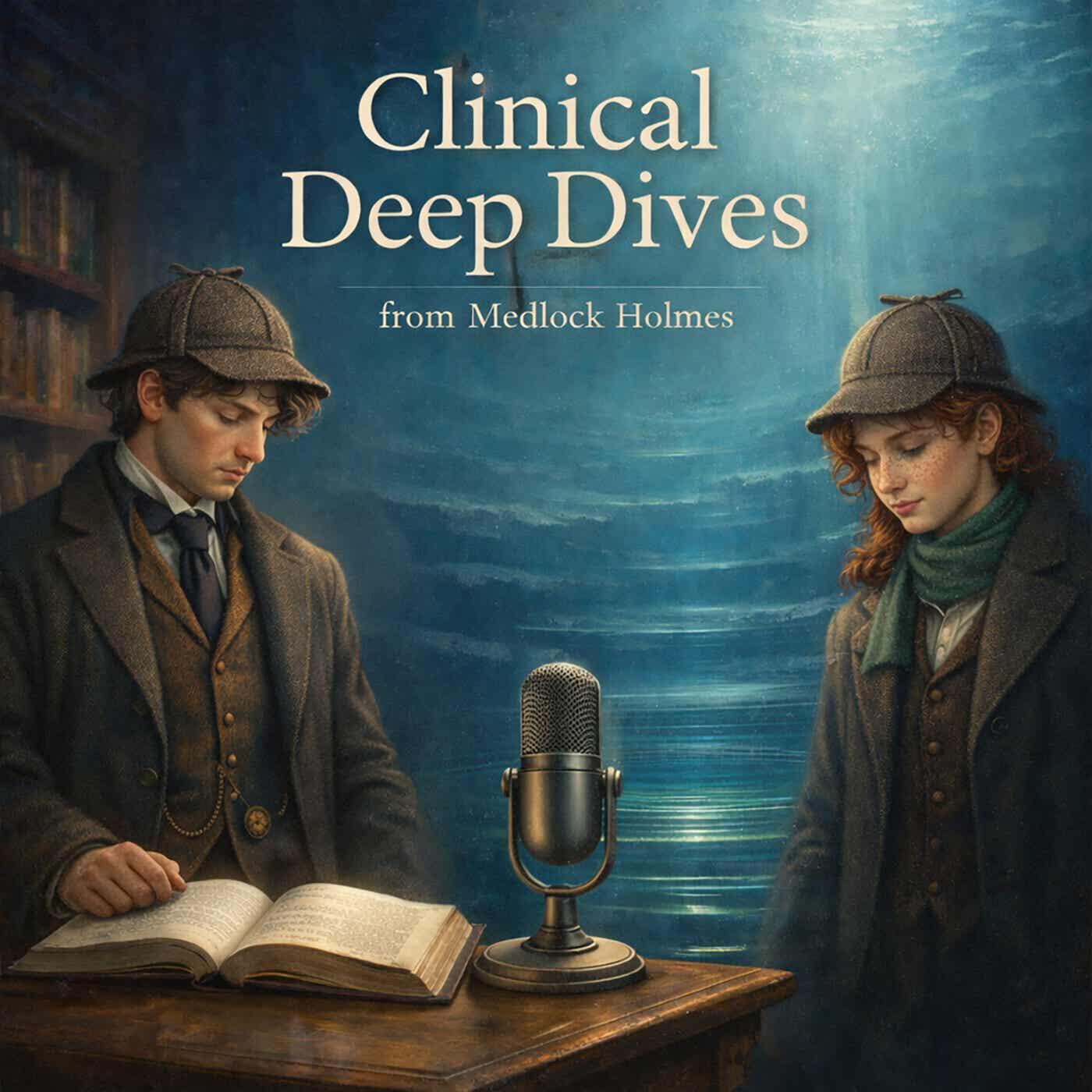
Clinical Deep Dives
Clinical Deep Dives is a Medlock Holmes podcast for clinicians and learners who want understanding, not just information. Using classic medical and surgical texts as a guide and the generative power of AI, each episode explores ideas with curiosity and clarity, designed for learning on the move and knowledge that actually sticks. drmanaankarray.substack.com
Vizitează neapărat site-ul podcastului și susține-i creatorul: drmanaankarray.substack.com
Autor
Med School Audio - Medical Knowledge Reimagined & Learning Made Memorable.
Categorie
Site-ul podcastului
Cel mai nou episod
2 nov. 2026
Unde asculți?
Podcasturi în aplicație Replaio Radio În curândPodcasturile ajung în curând în aplicație. Instaleaz-o acum și fii primul care descoperă o abordare complet nouă a podcasturilor
 Instalează gratuit
Android aproape 10 mil. descărcări · nota 4,8
iOS în curând
Episoade
PSYCH 121: Anxiety Disorders - Neuroimaging and Neuroanatomical Circuits 13.09.2026 45:20
Medlock Holmes enters the Grand Neuroanatomical Theatre of Fear . At the centre hangs an enormous transparent brain. The amygdala glows brightly. But Holmes does not stop there. Around it are the hippocampus. The medial and orbital prefrontal cortex. The anterior cingulate cortex. The insula. The thalamus. The hypothalamus. The bed nucleus of the stria terminalis. The periaqueductal grey. The locu...
PSYCH 120: Anxiety Disorders - Neurobiology and Neuroscience 12.09.2026 1:21:15
Medlock Holmes enters the Neurobiological Citadel of Fear . At its centre stands an enormous transparent brain. It is not silent. Signals move constantly between the amygdala, hippocampus, prefrontal cortex, thalamus, hypothalamus, locus coeruleus, and brainstem. Some pathways detect threat. Others generate autonomic responses. Others encode memories. Others decide whether a stimulus is dangerous....
PSYCH 119: Anxiety Disorders - Epidemiology 11.09.2026 54:35
Medlock Holmes enters the Global Atlas of Anxiety . At the centre floats an enormous illuminated globe. Every continent is marked. Every age group is represented. And across the map, the same message appears: Anxiety disorders are everywhere. Epidemiology asks more than how many people are affected. It asks: Who develops anxiety? When does it begin? Which disorders persist? What travels with them?...
PSYCH 118: Anxiety Disorders - Clinical Features 10.09.2026 1:06:10
Medlock Holmes enters the Grand Gallery of Anxious Minds . At the entrance, every patient appears to have the same complaint: “I am anxious.” But Holmes knows that this is only the beginning of the investigation. Anxiety is found across psychiatry. The diagnosis depends not simply on the presence of fear, but on what is feared, when it occurs, what the person predicts will happen, and what they do...
PSYCH 117: Anxiety Disorders - Introduction and Overview 09.09.2026 40:49
Medlock Holmes enters the Grand Observatory of Fear and Anxiety . At the centre stand two enormous warning systems. One is labelled: FEAR The other: ANXIETY At first they appear identical. Both activate the body. Both sharpen attention. Both pull behaviour towards avoidance. Both exist to protect the organism from harm. But Holmes quickly sees the difference. Fear is immediate. A threat is here. A...
PSYCH 116: Mood Disorders - Neurobiology 08.09.2026 25:13
Medlock Holmes enters the Grand Neurobiological Observatory of Mood . At its centre is not one brain map, but an enormous interconnected city of systems. One district controls attention and executive function. Another processes salience and threat. Another turns inward towards memory, self-reflection, and rumination. Another regulates movement. Another tracks reward and motivation. Above them all,...
PSYCH 115: Mood Disorders - Psychotherapy 07.09.2026 38:01
Medlock Holmes enters the House of Therapeutic Conversations . Unlike the pharmacological observatory, there are no bottles, serum levels, or receptor maps here. Instead, there are rooms. Each room represents a different way of understanding and changing mood disorder. One contains memories, conflicts, and unresolved relationships. Another contains automatic thoughts and deeply held beliefs. Anoth...
PSYCH 114: Mood Disorders - Pharmacologic Treatment of Depression and Bipolar Disorders 06.09.2026 40:31
Medlock Holmes enters the Grand Pharmacological Observatory of Mood . At its centre stands an enormous control table. Two major pathways emerge from it. One is labelled: MAJOR DEPRESSIVE DISORDER The other: BIPOLAR DISORDER At first, the pathways appear similar. Both contain depression. Both contain impaired function. Both may involve suicidality, anxiety, sleep disturbance, and psychotic features...
PSYCH 113: Mood Disorders - Suicidal Behaviou 05.09.2026 37:26
Medlock Holmes enters the Observatory of the Suicidal Mind . At first, the room appears to contain a familiar psychiatric chart: Depression → Suicide Risk Holmes immediately rejects it. The relationship is far more complex. Mood disorders are among the strongest contributors to suicidal behaviour, but most people with depression do not die by suicide, and suicidal crises can occur outside formal d...
PSYCH 112: Mood Disorders - Intrapsychic and Interpersonal Aspects 04.09.2026 41:28
Medlock Holmes enters the Hall of Inner Worlds , where three different investigative rooms attempt to explain the same depressed patient. The first is the Psychodynamic Chamber . Here, the focus is on what lies beneath conscious experience: loss, unconscious conflict, guilt, anger turned inward, injured self-esteem, and the enduring influence of early relationships. Freud’s classic account of mela...
PSYCH 111: Mood Disorders - Clinical Features 03.09.2026 34:41
Medlock Holmes enters the Theatre of Mood . At first, the stage appears simple. One side is darkened by depression. The other glows with mania. But as the lights rise, Holmes realises that mood is only one part of the performance. Behind every emotional state lies an entire orchestra of change. Movement slows or accelerates. Sleep contracts or expands. Appetite disappears or increases. Thought bec...
PSYCH 110: Mood Disorders - Epidemiology 02.09.2026 34:54
Medlock Holmes enters the Atlas of Human Mood . It is an extraordinary observatory. Suspended at its centre is an enormous illuminated globe. Across every continent, thousands of small lights pulse between blue and gold. Blue represents depression . Gold represents mania and hypomania . But the lights are not distributed randomly. Holmes notices patterns. They cluster differently according to sex....
PSYCH 109: Mood Disorders - Historical Introduction and Conceptual Overview 01.09.2026 38:08
Medlock Holmes enters the Great Museum of the Emotional Mind . It is unlike any museum he has visited before. Instead of paintings, its galleries contain theories . Instead of fossils, there are abandoned explanations of human suffering. And running through the centre of the building is an enormous pendulum. At one extreme is engraved: MELANCHOLIA At the other: MANIA The pendulum has been swinging...
PSYCH 108: Other Psychotic Disorders 31.08.2026 41:44
Medlock Holmes enters the Grand Railway Terminus of Psychosis . Every platform begins in the same central hall. A patient may arrive with hallucinations. Another with delusions. Another with disorganised speech, bizarre behaviour, perplexity, agitation, or catatonic stillness. At first glance, all appear to be travelling towards the same destination. But the departures board tells a different stor...
PSYCH 107: Psychosis as a Defining Dimension in Schizophrenia 30.08.2026 52:01
Medlock Holmes enters the Grand Archive of Psychiatric Boundaries . The building is divided into rigid rooms. One is labelled Schizophrenia . Another Bipolar Disorder . Another Psychotic Depression . Beyond them lie chambers for substance-induced psychosis, psychosis caused by medical illness, delusional disorder, schizotypal personality disorder, and brief psychotic states. Each room appears sepa...
PSYCH 106: Recovery in Schizophrenia 29.08.2026 58:46
Medlock Holmes enters the Museum of Lost Futures . The walls are lined with portraits of people diagnosed with schizophrenia. Beneath each portrait is the same inscription: Chronic. Disabled. Dependent. The museum presents these outcomes as inevitable. Holmes is immediately suspicious. He opens the historical ledgers and discovers that long-term studies tell a different story. Many people diagnose...
PSYCH 105: Medical Health in Schizophrenia 28.08.2026 47:47
Medlock Holmes is called to investigate a disturbing pattern. The records appear unrelated. A man with schizophrenia dies from a myocardial infarction in his fifties. A woman develops diabetes that remains undetected for years. Another patient is repeatedly treated for anxiety while an underlying respiratory illness worsens. Someone else survives psychosis but dies from a preventable infection. Ho...
PSYCH 104: Psychiatric Rehabilitation in Schizophrenia 27.08.2026 51:56
Medlock Holmes enters a psychiatric hospital expecting to find the next mystery inside the consulting room. Instead, the patient is waiting at the front gate. His hallucinations have improved. His delusions are less intense. His medication is stable. Yet he has nowhere secure to live, no employment, few relationships, and no meaningful reason to wake each morning. The treatment has reduced the ill...
PSYCH 103: Pharmacologic Treatment of Schizophrenia 26.08.2026 1:04:36
Medlock Holmes enters the Great Apothecary of the Divided Mind . The chamber is vast. Along one wall stand the abandoned instruments of psychiatric history: wet-sheet packs, insulin syringes, barbiturate sleep chambers, convulsive machines, and the cold steel apparatus of prefrontal lobotomy. Each represents an era in which clinicians tried to calm psychosis without understanding how to treat it....
PSYCH 102: Phenotypes of Psychosis 25.08.2026 22:28
Medlock Holmes is summoned to a locked psychiatric ward to meet an extraordinary patient. The man was once a distinguished professor of anatomy: intellectually formidable, artistically gifted, and professionally successful. Long after the age at which schizophrenia usually appears, he developed relentless visual hallucinations and an elaborate belief that the source of psychosis lay within the hum...
PSYCH 101: Neurocognition in Schizophrenia 24.08.2026 51:52
Medlock Holmes arrives at what appears to be the simplest of all investigations. A patient is sitting quietly in an elegant Victorian library. No voices. No delusions. No obvious distress. To every casual observer, the illness seems well controlled. Yet something is wrong. The patient repeatedly loses track of conversations. Simple instructions must be repeated. Bills remain unpaid. Appointments a...
PSYCH 100: Multimodal Neuroimaging and the Future of Schizophrenia Research 23.08.2026 55:31
Medlock Holmes stands before the final chamber of the Neuroimaging Institute. Around him are the tools he has mastered throughout his investigation. MRI reveals the brain’s architecture. Diffusion imaging maps its white matter highways. PET uncovers its chemistry. Magnetic resonance spectroscopy measures its metabolites. Functional MRI watches neural networks come alive. Each technique has solved...
PSYCH 099: Functional Brain Imaging in Schizophrenia 22.08.2026 58:42
Medlock Holmes enters the Hall of Living Minds. Unlike the museum of structural imaging, nothing here is still. Every wall pulses with colour as thoughts ignite across the cortex. Memory glows, emotion flickers, attention surges, and language races through intricate neural pathways. Holmes is no longer examining anatomy-he is watching the brain at work. His first instrument is functional magnetic...
PSYCH 098: Structural Brain Imaging in Schizophrenia 21.08.2026 57:47
Medlock Holmes enters a vast radiological observatory where the human brain can be examined without ever being opened. The earliest instruments are crude. Old computed tomography images reveal enlarged ventricles-dark chambers within the brain that seem wider in people with schizophrenia. The finding is important, but it is not specific enough to solve the case. Then the observatory changes. Magne...
PSYCH 097: Cellular and Molecular Neuropathology of Schizophrenia 20.08.2026 1:02:23
Medlock Holmes enters a laboratory containing a brain that appears, at first glance, entirely normal. There is no tumour. No haemorrhage. No obvious area of destruction. Nothing resembling the unmistakable lesions seen in many neurological diseases. Yet Holmes knows that normal appearance does not mean normal function. He begins his investigation at the microscopic level. Within the prefrontal cor...
Podcasturi asemănătoare







Ascultă podcastul Clinical Deep Dives în Replaio
Radio și podcasturi într-o singură aplicație - gratuit și fără înregistrare. Instaleaz-o azi și nu rata lansarea
Replaio nu este editorul podcasturilor; numele emisiunilor, coperțile și materialul audio aparțin autorilor lor și sunt distribuite prin fluxuri RSS publice